Mushika Meaning: Why Ganesha Rides a Mouse
Ganesha's tiny mouse vehicle is not a comic mismatch. Mushika expresses the reach of desire, the power of disciplined intelligence, and humility before the Divine.
A deity with an elephant head rides one of the smallest creatures in the household world. The contrast is deliberate: why Ganesha rides a mouse is answered through the relationship between vast wisdom and restless desire.
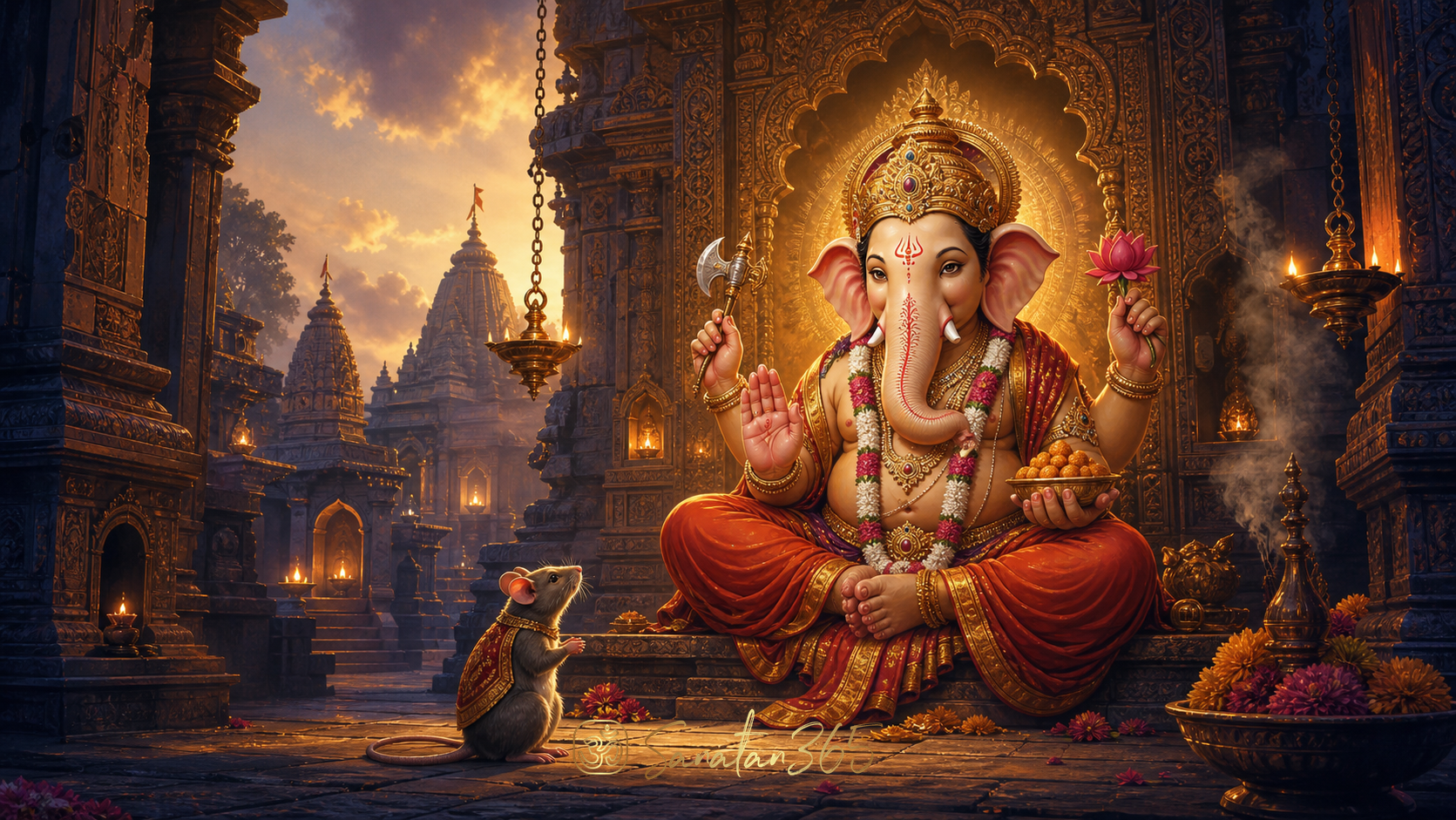
The mouse is Mushika (मूषिक, mūṣika, mouse), Lord Ganesha's vahana (वाहन, vāhana, vehicle or bearer). Hindu tradition does not treat him as a decorative pet. Mushika represents powers that can either disturb life or serve wisdom: appetite, quick movement, hidden reach, persistence, and the mind's ability to slip through the smallest opening. Beneath Ganesha, these energies are not destroyed; they are directed.
Why Ganesha Rides a Mouse Rather Than a Grand Animal
Hindu sacred art often brings unlike forms together so that meaning appears through relationship. Ganesha has the head of an elephant, a form associated with strength, memory, and the ability to clear a path. His vehicle is a mouse, light enough to vanish into a crack and persistent enough to chew through barriers. The pairing joins the immense and the minute.
The Encyclopaedia Britannica overview of Ganesha identifies the mouse as his vehicle and notes Ganesha's place as the remover of obstacles and patron of beginnings. Museum collections likewise show that the mouse has remained a recognizable element of Ganesha's iconography across centuries. In sculptures, paintings, festival images, and household shrines, Mushika may sit near the deity's feet, look upward, or receive an offering.
The visual message is not that greatness humiliates smallness. It is that no scale of life lies outside sacred order. The same intelligence that addresses a vast undertaking must also notice the tiny habit, private impulse, or neglected detail from which an obstacle grows.
An elephant cannot enter a narrow crevice, but a mouse can. A mouse cannot carry the weight of an elephant-bodied deity by ordinary physical logic, but sacred image is not engineering. It expresses the principle that wisdom can travel through the subtlest channels when even restless energy accepts direction.
Key takeaway: Ganesha and Mushika unite expansive wisdom with attention to the smallest hidden cause.
What Does Mushika Symbolize in Ganesha Iconography?
No single interpretation exhausts a sacred symbol. Regional teaching, family tradition, temple discourse, and philosophical commentary may emphasize different meanings. Four interpretations are especially useful when held as complementary rather than exclusive.
Desire that learns its proper place
A mouse continually searches, nibbles, stores, and returns. For that reason, teachers often connect Mushika with kama (काम, kāma, desire) or appetite. Desire itself is part of embodied life; the problem begins when it moves without measure and quietly consumes what should be protected.
Mushika beneath Ganesha suggests mastery, not violent suppression. The appetite remains alive, yet it no longer decides the destination. Wisdom sits above it. This is a subtle ethical image: spiritual discipline does not always require pretending that impulses have vanished. It asks that they be seen, bounded, and placed in service of a worthy purpose.
The restless mind
The ordinary mind can behave like a mouse in a storeroom. It darts between impressions, revisits anxieties, and finds openings into places one meant to keep settled. Ganesha's calm presence above Mushika becomes an image of gathered attention.
This does not mean the mind is an enemy. Quickness can become alertness. Curiosity can become inquiry. Persistence can become practice. Under discernment, the same mental energy that scattered attention can search carefully, learn deeply, and detect an obstacle before it becomes a crisis.
Reach into hidden places
Mice move through spaces unseen by larger creatures. Symbolically, Mushika can enter the concealed corners of thought: embarrassment, envy, avoidance, or a fear that has not yet acquired words. Ganesha is invoked at beginnings partly because a sound beginning requires recognition of what might obstruct it.
Before a project, ceremony, study period, or life transition, the image invites a precise question: what small unseen pattern could undermine this effort? The answer may not be dramatic. It may be a missed conversation, weak preparation, careless speech, or an attachment to being praised.
Humility and sacred inclusion
The divine vehicle is not always the animal humans consider most majestic. By including a mouse in sacred iconography, the tradition refuses to equate spiritual worth with size, status, or conventional beauty. Mushika has a place near Ganesha because the sacred order can employ every capacity.
This insight should not be turned into a hierarchy among living beings or people. It points in the opposite direction: apparent smallness does not mean meaninglessness.
Key takeaway: Mushika's appetite, speed, secrecy, and persistence become spiritual instruction when placed beneath discernment.
How Do Hindu Stories Explain Ganesha's Mouse Vehicle?
Story traditions provide more than one account, and versions can vary. A widely told Puranic account describes Mushika as a powerful being whose uncontrolled force caused destruction before Ganesha subdued him and made him his vehicle. Some retellings name him as a celestial musician transformed by a curse; others emphasize a giant mouse troubling an ashram. The Mudgala Purana tradition is frequently associated with the name Mushika and with Ganesha's mastery over disruptive force.
The variations matter because Hindu narrative often preserves meaning through multiple tellings rather than through one compulsory literal sequence. The stable pattern is clearer than every narrative detail: an energy too unruly for its surroundings encounters Ganesha, yields, and receives a new role.
That pattern is morally richer than simple defeat. Mushika is not erased after being overcome. He becomes the bearer of the very wisdom that mastered him. Transformation creates service.
Readers should also distinguish older textual traditions from later explanatory symbolism. A museum label may establish that the mouse appears in a historical sculpture; it does not necessarily establish every modern psychological interpretation. Similarly, a contemporary teacher's reflection on desire can be insightful without being presented as the only meaning intended by every artist or text.
Key takeaway: The stories consistently turn disruptive power into disciplined service, even when their narrative details differ.
What Can the Ganesha Mouse Symbolism Teach in Daily Life?
Sacred iconography becomes practical when it sharpens conduct without reducing devotion to a productivity trick. Mushika offers a compact framework for beginnings.
- Name the small obstacle. Before starting, identify one overlooked detail that could grow: an unclear responsibility, missing material, unpaid obligation, or unspoken concern.
- Notice the appetite beneath the plan. Ask whether the effort is driven by service, learning, fear, recognition, comfort, or some mixture. Honest naming makes desire governable.
- Give quick energy a worthy task. Restlessness can be directed into a ten-minute preparation, a careful checklist, or the first respectful conversation.
- Enter the narrow place. Address the part of the problem that grand statements cannot reach. This may mean correcting one sentence, apologizing for one remark, or learning one foundational concept.
- Keep wisdom in the seat. Let values determine direction while energy supplies movement. The vehicle has power, but it does not choose the destination.
A simple reflection before work can make the image memorable:
May clear intelligence guide every restless impulse. May no hidden obstacle escape honest attention.
This is a reflection, not a replacement for a traditional mantra or a claim of scriptural wording. Devotees may instead offer their established Ganesha prayer, sit quietly before an image, or begin with Om Gan Ganapataye Namah according to their lineage and comfort. The distinction protects both reverence and accuracy.
For children, the image can open a gentle conversation about self-control. Rather than saying that wanting things is bad, adults can ask: “Who is choosing the direction, Ganesha's wisdom or the mouse's hurry?” The question preserves the symbol's depth without frightening or shaming the child.
Key takeaway: Daily practice begins by directing energy, examining motives, and attending to the smallest real obstacle.
How Is Mushika Seen in Worship and Festival Traditions?
In many Ganesha temples, devotees look for Mushika near the main shrine. Local customs differ. In some places, a devotee may respectfully whisper a wish near the mouse figure, trusting him as the close attendant who carries prayer toward Ganesha. This should be understood as living devotional custom, not a universally required ritual.
During Ganesh Chaturthi, artists often include Mushika in the complete festival image. The mouse may be easy to miss beside an elaborate murti, yet his presence completes the iconographic relationship. Families can use that detail to move beyond spectacle and study what each element teaches.
Representations vary across India. Maharashtrian festival art may place Mushika prominently beside offerings; South Indian stone and bronze traditions may render him compactly near the pedestal; calendar art and diaspora shrines may use different scale and posture. Variation does not weaken the symbol. It shows how a stable sacred relationship can live through many artistic languages.
Devotees should treat temple figures and murtis with the etiquette of that place. Touching, feeding, climbing, or placing items on a figure may be inappropriate unless local practice explicitly permits it. Quiet observation and guidance from temple caretakers are reliable forms of respect.
The mouse also should not be used to justify unsafe handling of wild rodents. Symbolic reverence and household hygiene are compatible. Hindu care for life does not require encouraging infestation, risking disease, or using cruel methods. Prevention, sealed food storage, blocked entry points, and humane professional guidance can reflect both responsibility and compassion.
Key takeaway: Mushika remains a living devotional presence, but customs vary and should be approached with local respect and practical care.
Seeing the Whole Image
Ganesha's iconography works as a whole. His broad elephant head evokes capacious intelligence. His ears suggest attentive listening. His broken tusk is often read through sacrifice, discernment, and the power to preserve wisdom. His rounded form conveys abundance and the capacity to contain experience. Mushika brings these meanings down to ground level.
He waits near the feet, where lofty teaching meets movement. The pairing prevents spirituality from remaining abstract. Vast understanding must eventually guide a particular appetite, enter a particular hidden corner, and carry a particular next action.
The image also protects against spiritual pride. A person may admire wisdom while being undone by a “small” unexamined habit. Ganesha riding Mushika reminds the devotee that mastery is proven not only in grand declarations but in humble governance of the minute.
That is why the apparent mismatch endures. The elephant-headed Lord does not need an equally imposing vehicle. His greatness is shown through the ability to dignify, transform, and direct what appears least grand.
Key takeaway: Mushika completes Ganesha's image by showing how great wisdom becomes precise, humble action.
Conclusion
Why Ganesha rides a mouse is ultimately a teaching about relationship. Mushika is desire, motion, hidden reach, and persistence; Ganesha is the discerning presence that gives those forces direction. The mouse is neither mocked nor allowed to rule. He is transformed into a vehicle.
Key takeaway: Spiritual intelligence does not merely remove restless energy; it places that energy in service of dharma.
FAQ
What is the name of Ganesha's mouse?
Ganesha's mouse is commonly called Mushika or Mushaka, from Sanskrit words associated with a mouse or rat. Spellings vary in English transliteration.
Why does Lord Ganesha have such a small vehicle?
The contrast carries meaning. Ganesha's expansive wisdom is paired with a creature able to enter tiny hidden spaces, suggesting attention to subtle obstacles and mastery of restless desire.
Does Mushika represent evil?
Not simply. Mushika represents capacities such as appetite, speed, persistence, and hidden movement. Under Ganesha's guidance, these capacities become useful rather than disruptive.
Is the story of Mushika the same everywhere?
No. Textual and regional retellings differ, but many share a pattern in which Ganesha subdues an uncontrolled force and transforms it into his vehicle.
Can devotees whisper wishes to Mushika?
This is a living custom at some temples, not a universal requirement. Devotees should follow the etiquette and guidance of the particular temple they visit.
About the author
Sanatan365 Editorial
Bringing Sanatan Dharma to modern seekers through authentic, scripture-grounded content.
Related in Deities
 Deities
Ushas, the Vedic Goddess of Dawn: Light, Renewal, and Time
Ushas, the Vedic goddess of dawn, appears in the Rigveda as radiant light that awakens life, calls beings to activity, and reveals both ren…
 Deities
Chitragupta Meaning: Divine Records and Ethical Accountability
Chitragupta is remembered as the divine keeper of karmic records in Yama's court. His symbolism connects writing, memory, justice, and ethi…
 Deities
Varuna Deva Meaning: Rta, Waters, and Cosmic Order
Discover Varuna Deva's Vedic role as guardian of rta, his bond with waters, and what his hymns teach about truth, accountability, and mercy.