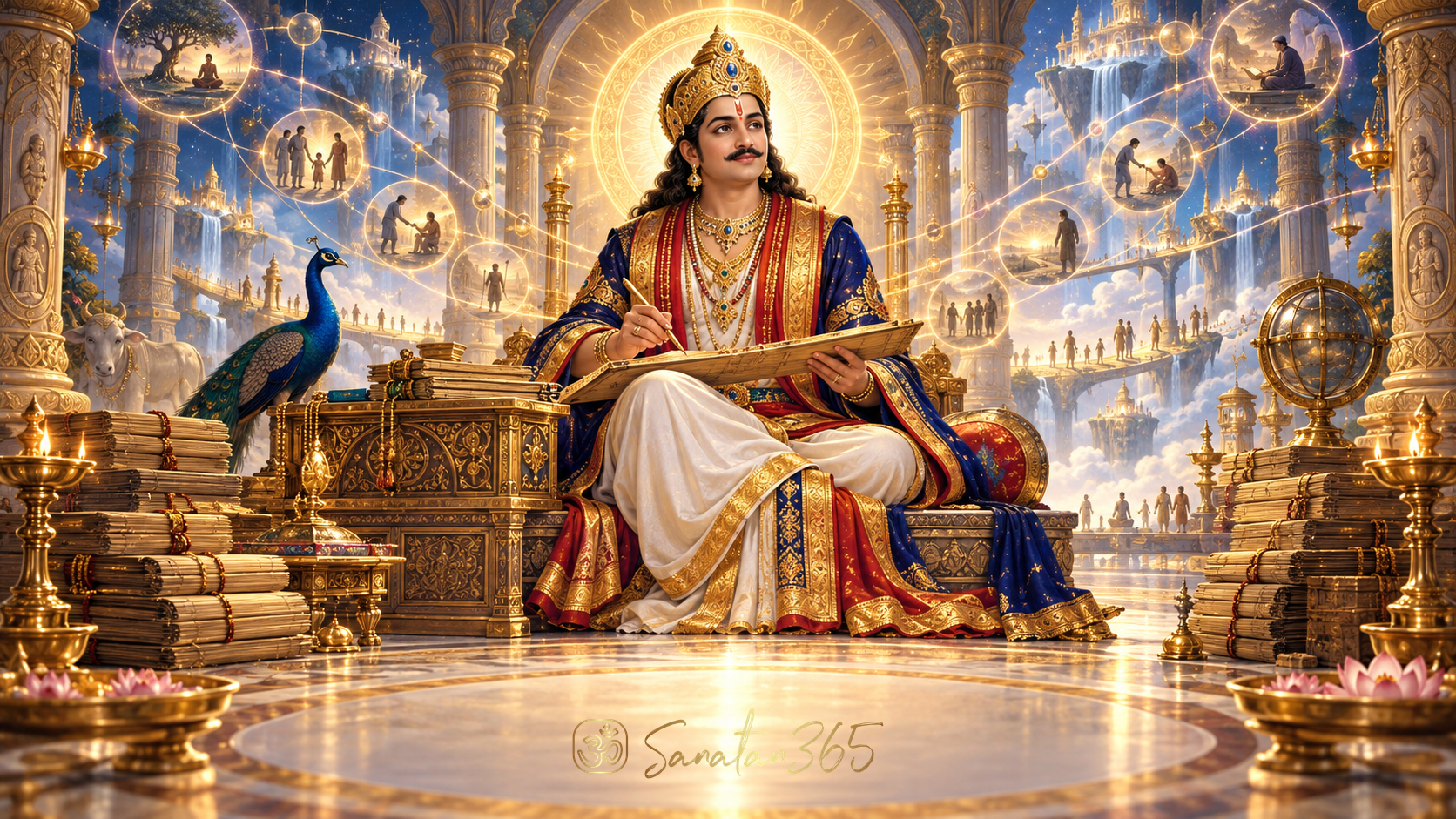
Chitragupta Meaning: Divine Records and Ethical Accountability
Chitragupta is remembered as the divine keeper of karmic records in Yama's court. His symbolism connects writing, memory, justice, and ethical responsibility without reducing karma to fear.
A divine accountant may sound like an image of paperwork in heaven, but Chitragupta represents something far more searching: no action is too small to shape character. Chitragupta meaning begins with citra (चित्र, “varied, vivid, or wonderful”) and gupta (गुप्त, “hidden or protected”), a name often understood through the idea of a hidden or finely detailed record.
In Hindu traditions, Chitragupta is remembered as the divine record-keeper associated with Yama, the guardian of moral order and death. He records the karma (कर्म, karma, “action and its consequence”) of living beings so that judgment reflects the whole pattern of a life. This is devotional symbolism, not a reason for panic: its practical lesson is that choices matter, memory matters, and accountability can serve moral clarity.
Who Is Chitragupta in Hindu Tradition?
Chitragupta appears in multiple textual and regional traditions rather than in one single biography accepted everywhere. Puranic narratives commonly place him in the court of Yama, where he keeps accounts of human conduct. Some traditions describe him as emerging from the body or mind of Brahma and therefore being called kāyastha (कायस्थ, kāyastha, “established in the body”). That sacred etymology is especially meaningful within Kayastha community memory.
The broad picture is consistent: Yama presides over judgment, while Chitragupta preserves the record needed for judgment. This division matters. Chitragupta is not simply “another name for Yama,” nor is he usually portrayed as deciding fate by whim. He embodies accurate remembrance within a moral universe.
Classical Hindu reflection on karma is wider than this image. The Encyclopaedia Britannica overview of karma notes that Indian traditions understand karma as action and its ethical consequences across life. Chitragupta gives that abstract principle a memorable sacred form: a witness who neither forgets the public deed nor overlooks the private intention.
The deity's iconography often includes a manuscript, ledger, pen, or stylus. These are not merely occupational props. Writing makes a fleeting act durable. A thought becomes speech; speech becomes conduct; conduct becomes habit; habit shapes a life. Chitragupta's page gathers that sequence into one image.
Key takeaway: Chitragupta is the divine keeper of moral memory, serving beside Yama so that accountability rests on the complete record of action.
What Do Chitragupta's Divine Records Symbolize?
The image of a celestial ledger can be read at three levels: cosmic, ethical, and inward.
A cosmic record of cause and consequence
At the cosmic level, the record affirms that reality is morally intelligible. Actions do not vanish simply because no human observer notices them. This does not require imagining karma as a crude reward-and-punishment machine. Hindu philosophical schools explain karma differently, but they broadly refuse the idea that intentional conduct is meaningless.
The Bhagavad Gita repeatedly turns attention toward action, motive, duty, and attachment. Its teaching is not that every difficult event can be traced to one identifiable past deed. Such certainty would be both philosophically careless and compassionately harmful. The more responsible lesson is prospective: this action, here and now, participates in shaping what follows.
An ethical record of intention and conduct
A ledger suggests detail. Two outwardly similar acts may arise from different intentions; one generous act may conceal vanity, while another may express quiet care. Conversely, good intention does not erase harmful impact. Chitragupta's symbolism invites attention to both.
This is why the image should not be used to blame people for illness, poverty, grief, or misfortune. No reader can inspect another person's “account,” and Hindu teachings on karma are not a licence to abandon compassion. Ethical accountability begins with one's own conduct.
An inward record carried by character
The record can also be understood psychologically. Repeated choices leave impressions called saṃskāra (संस्कार, saṃskāra, “mental or behavioural imprint”). A person who practises truthfulness strengthens the capacity to tell the truth again; a person who repeatedly avoids responsibility makes avoidance easier.
In that sense, one does not need to wait for a celestial judgment to encounter the ledger. It appears in trust gained or lost, habits strengthened, promises remembered, and the kind of person each choice is helping to form.
The most demanding account is not the one kept against another person. It is the honest record one is willing to read within oneself.
Key takeaway: Chitragupta's ledger symbolizes the continuity between intention, action, consequence, habit, and character.
How Is Chitragupta Connected with Yama and Karma?
Yama is one of the oldest divine figures in Hindu sacred literature. In Vedic hymns he is associated with the path of the ancestors, while later literature develops his role as Dharmaraja, the king who upholds dharma (धर्म, dharma, “right order, responsibility, and sustaining conduct”). Chitragupta's later courtly role complements that responsibility by supplying an exact account.
The relationship can be understood without turning the afterlife into a literal bureaucracy. Sacred traditions frequently use royal images because a court gathers several moral ideas in one scene:
- Witness: deeds are known rather than erased.
- Record: judgment considers a pattern, not a rumour.
- Discernment: conduct is weighed in context.
- Consequence: choices carry effects.
- Order: judgment belongs to dharma, not private revenge.
The Bhagavad Gita's teaching on action without attachment offers a useful companion idea. Freedom from attachment to results does not mean freedom from responsibility. It asks a person to act carefully, offer the result, and avoid making ego the sole owner of action.
Chitragupta therefore stands against two opposite errors. The first is fatalism: “Everything is predetermined, so my choices do not matter.” The second is control: “If I behave perfectly, I can guarantee every outcome.” Karma is subtler. Conduct matters deeply, yet life also includes other persons, inherited conditions, natural events, and consequences beyond anyone's calculation.
This is where humility enters the symbolism. The divine ledger is complete; a human judgment rarely is. A person may assess their own promise, effort, or harm, but should be cautious about announcing the spiritual causes of another person's suffering.
Key takeaway: Beside Yama, Chitragupta represents evidence, memory, and moral precision; karma calls for responsible action without fatalism or false certainty.
Why Do Kayastha Communities Honour Chitragupta?
Chitragupta holds special importance for many Kayastha communities, particularly in North and Central India. Community origin traditions often regard Kayasthas as descendants of Chitragupta and connect their historical association with administration, scholarship, record-keeping, and writing to his sacred office.
Chitragupta Puja is observed in different forms according to region and family tradition, commonly around the period after Diwali and alongside Bhai Dooj in parts of North India. It may include worship of Chitragupta, reverence for pens, ink, paper, account books, or professional tools, and prayers for clarity, integrity, and wise work. Local calendars and customs vary, so one household's sequence should not be presented as universal.
The ritual focus on writing has a wider resonance. The pen can record truth or distort it. An account book can protect fairness or conceal exploitation. A legal file, school register, medical note, database, or line of code can affect lives far beyond its author. Honouring the instrument is therefore also a vow about its use.
For someone participating respectfully, three principles are helpful:
- Follow the practice of the household, temple, or community hosting the puja.
- Treat community narratives with reverence without forcing them into one historical chronology.
- Let worship renew professional ethics: accuracy, confidentiality, fairness, and responsibility.
Those who do not belong to a Kayastha community can still learn from Chitragupta without appropriating a lineage identity. The appropriate response is respect: listen to the tradition, acknowledge its custodians, and apply the universal ethical lesson to one's own work.
Key takeaway: Kayastha traditions honour Chitragupta as an ancestral and professional ideal whose pen joins sacred memory with accuracy, learning, and ethical service.
What Can Chitragupta Teach About Ethical Accountability Today?
Modern life produces records constantly: messages, financial transactions, photographs, location histories, medical files, workplace documents, and algorithmic decisions. Yet more data does not automatically produce more truth. Chitragupta's symbolism can guide how records are created and used.
Keep an account without becoming punitive
A brief evening reflection can ask:
- What promise did I keep today?
- Where did my speech create clarity or confusion?
- Did I benefit from work someone else performed invisibly?
- What harm can I repair while repair is still possible?
- What good action should become a habit?
This is not a spiritual scorecard for self-hatred. It is svādhyāya (स्वाध्याय, svādhyāya, “self-study and study of sacred teaching”) applied to conduct. The purpose is correction, not obsession.
Distinguish confession from repair
Admitting an error is important, but accountability becomes meaningful when it changes what happens next. Depending on the situation, repair may mean apologising without excuses, returning what was taken, correcting a public claim, compensating loss, changing a process, or accepting a fair consequence.
Hindu ethics also leaves room for prāyaścitta (प्रायश्चित्त, prāyaścitta, “atonement or corrective observance”). Its forms differ across texts and communities, but the principle is powerful: wrongdoing need not be denied, and a person need not remain frozen in it. Recognition, restraint, restitution, and transformed conduct can belong together.
Protect records from misuse
Chitragupta's sacred ledger is imagined as truthful and properly held. Human institutions must work to deserve that trust. Anyone responsible for another person's information has duties of accuracy, privacy, proportion, and access control. A record can support justice, but surveillance, careless sharing, and biased interpretation can cause harm.
The contemporary question is therefore not only “What has been recorded about me?” It is also “What am I recording about others, why do I need it, and how am I protecting it?”
Remember what no database can measure
Digital systems count clicks, hours, purchases, and outputs. They cannot fully measure courage, remorse, patience, hidden care, or the moral weight of context. Chitragupta's “complete record” exposes the limits of human metrics. Good administration needs data, but good judgment also needs humility.
This is especially relevant when evaluating workers, students, children, or family members. A number may reveal part of the truth. It should not be confused with the whole person.
Key takeaway: Chitragupta's modern lesson is to practise honest self-review, repair harm, steward information responsibly, and remember that human metrics are always incomplete.
How Can Someone Reflect on Chitragupta Without Fear?
Fear may bring short-term restraint, but mature accountability grows from reverence, clarity, and care. A simple reflection can be practised without claiming to replace any lineage ritual:
- Sit quietly with a notebook.
- Remember Chitragupta as a symbol of truthful memory.
- Write one action that aligned with dharma.
- Write one action that needs repair.
- Name one concrete step and a realistic time to take it.
- Close with gratitude for the chance to choose again.
The practice should remain proportionate. If self-review becomes compulsive, despairing, or tied to a mental-health crisis, seek qualified professional support and speak with trusted loved ones. Spiritual reflection can accompany responsible care; it should not replace it.
The deepest purpose of a moral record is not to prove that a person never failed. It is to prevent forgetfulness from becoming an excuse. Remembering accurately makes learning possible. Repair makes responsibility alive. Better action writes the next line.
Key takeaway: Reflect on Chitragupta as an invitation to truthful memory and practical repair, not as a threat designed to produce shame.
FAQ
What is the meaning of the name Chitragupta?
The name combines citra, meaning varied, vivid, or wonderful, and gupta, meaning hidden, guarded, or protected. Devotional explanations often connect the name with a subtle, complete, or hidden record of actions.
Is Chitragupta the same as Yama?
No. In common Hindu tradition, Yama presides over moral judgment and the realm of the departed, while Chitragupta keeps the detailed record of actions used in that judgment.
What does Chitragupta hold in images?
He is often depicted with a manuscript, ledger, pen, or stylus. These attributes express his role as divine record-keeper and connect writing with truth, memory, and accountability.
Who celebrates Chitragupta Puja?
Chitragupta Puja is especially important among many Kayastha communities, although observances vary by region and family. It is commonly associated with the period after Diwali in parts of North and Central India.
Does Chitragupta mean every misfortune is punishment for past karma?
No responsible conclusion of that kind can be drawn. Hindu teachings on karma are complex, and people should not use them to blame others for illness, grief, poverty, or hardship. Chitragupta's symbolism is best applied to one's own ethical responsibility.
Chitragupta transforms the humble tools of writing into a sacred question: if every choice were remembered clearly, what would one choose next? His ledger is not merely an image of judgment after death. It is a reminder that attention, honesty, and repair can reshape life now.
Key takeaway: Chitragupta teaches that actions deserve truthful remembrance, consequences deserve humble attention, and every new choice can become a line written with greater integrity.
About the author
Sanatan365 Editorial
Bringing Sanatan Dharma to modern seekers through authentic, scripture-grounded content.
Related in Deities
 Deities
Savitr Deva Meaning: Golden Hands and the Rhythm of Life
Meet Savitr, the Vedic divine impeller whose golden hands set life in motion and whose hymns honour rest as well as activity.
 Deities
Indra Deva Meaning: The Vajra, Rain, and Responsible Power
Indra links the thunderbolt and released waters with a demanding question: what is strength for? Read his Vedic imagery and later lessons w…
 Deities
Agni Deva Meaning: Sacred Fire and the Divine Messenger
Meet Agni as the Vedic priest and messenger, read the first Rig Veda hymn, and understand sacred fire without reducing a living deity to a…

