Nandi Meaning: Why Shiva's Sacred Bull Faces the Lingam
Nandi is far more than Shiva's mount. His steady gaze toward the lingam expresses devotion, disciplined strength, joyful service, and the stillness required for sacred attention.
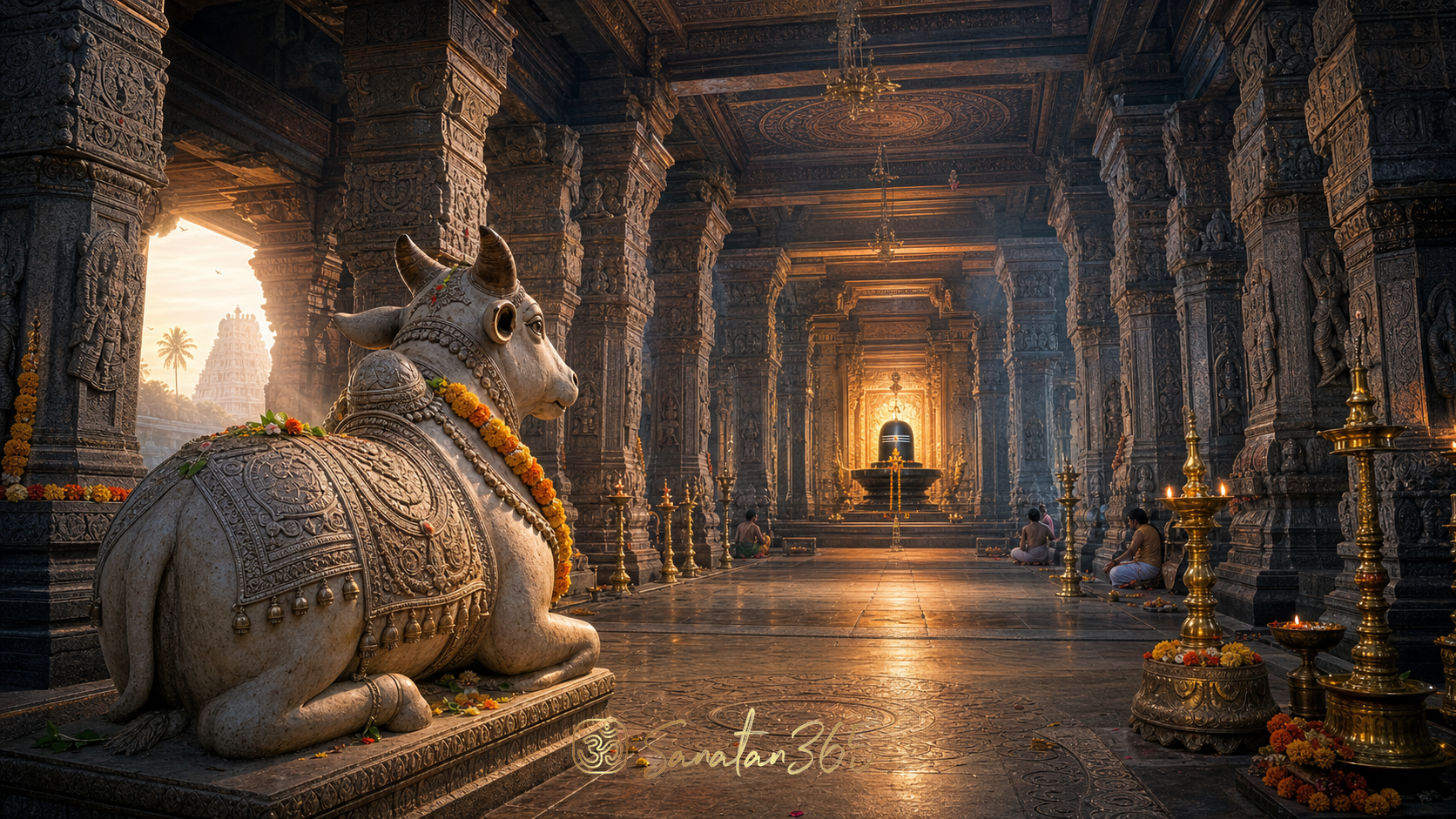
In a Shiva temple, one figure never turns away. Nandi, the sacred bull, sits before the sanctum with his gaze fixed upon the Shiva lingam, even as generations of worshippers arrive and depart.
The Nandi meaning is expressed in that quiet posture. Nandi is Shiva's vāhana (वाहन, sacred vehicle or mount), guardian, attendant, and exemplary devotee. His strength is not restless or aggressive; it has become steady attention. Facing the lingam, Nandi represents devotion aligned with dharma (धर्म, sustaining order and right conduct), reminding worshippers that spiritual life asks for patience, disciplined energy, and a mind turned toward the Divine.
What Is the Nandi Meaning in Hindu Tradition?
The Sanskrit name Nandi (नन्दि) is associated with joy, delight, or satisfaction. This is significant: the imposing bull at Shiva's doorway does not primarily communicate fear. He communicates the settled joy that arises when power serves a sacred purpose.
Nandi is commonly identified as the bull vāhana of Lord Shiva. Encyclopaedia Britannica notes that most Shaiva temples place a reclining, humped bull on a raised platform facing the shrine, so that Nandi perpetually gazes toward Shiva. He is also counted among Shiva's chief attendants, and some artistic traditions portray him in anthropomorphic form.
This makes Nandi more than transportation in a mythological scene. In Hindu iconography, a vāhana frequently reveals something about the deity and the forces brought into sacred order. The bull carries associations of physical strength, fertility, patience, and agricultural life. Beside Shiva, that immense life-force becomes composed, watchful, and devoted.
Nandi therefore holds several roles at once:
- Shiva's sacred bull and vehicle
- guardian of the temple threshold
- chief attendant within Shiva's divine company
- ideal devotee whose attention does not wander
- symbol of strength governed by dharma
- in some Shaiva traditions, a recipient and transmitter of sacred teaching
These roles should not be forced into a single literal explanation. Hindu traditions often preserve several layers together: deity, companion, guardian, teacher, and symbol.
Key takeaway: Nandi represents joyful strength made sacred through service, discipline, and unwavering attention to Shiva.
Why Does Nandi Face the Shiva Lingam?
The alignment between Nandi and the Shiva lingam is one of the most recognizable features of Shaiva temple architecture. Nandi normally sits on the central axis before the garbhagriha (गर्भगृह, the innermost sanctum), facing the lingam inside. His orientation is itself a teaching.
The lingam is an aniconic form of Shiva, directing awareness toward the formless and immeasurable Divine through a consecrated form. Nandi's steady gaze shows how the seeker approaches that mystery: not with distraction, possession, or demand, but with attentive presence.
Three meanings are especially helpful.
Attention becomes worship
Nandi does not need constant movement to express devotion. His stillness suggests that sustained attention can itself become an offering. Hindu practice includes music, mantra, flowers, water, lamps, and circumambulation, yet it also values the silent capacity to remain present before the sacred.
Strength bows without becoming weak
A bull could symbolize uncontrolled force. Nandi's seated posture presents another possibility: power can willingly become receptive. He is not defeated before Shiva. He is fulfilled in relationship with Shiva. The image corrects the modern assumption that surrender must mean helplessness. In bhakti, surrender can be the intelligent direction of one's strongest energies.
The threshold requires readiness
Nandi occupies the space between ordinary movement and the concentrated stillness of the sanctum. Passing him can become an inward transition. The worshipper leaves scattered attention behind and prepares to meet Shiva with greater clarity.
Some devotees look toward the lingam between Nandi's horns, and some respectfully whisper a prayer near Nandi's ear. Such customs vary by temple, region, and family. They should be followed according to the temple's established practice rather than treated as universal requirements. The deeper principle remains constant: Nandi directs attention toward Shiva, not toward himself as an obstacle.
Key takeaway: Nandi faces the lingam because his entire posture embodies focused devotion and prepares the worshipper for the sanctum.
What Does Nandi Symbolize?
Nandi symbolism becomes clearest when the bull's natural qualities are read through the lens of Shaiva devotion.
Disciplined strength
Strength has spiritual value when it protects, supports, and endures. Nandi's power is available without being chaotic. This is bala (बल, strength) governed by discernment. For a modern seeker, the lesson is practical: energy, ambition, speech, and authority become nobler when they serve something larger than the ego.
Patience and stability
Nandi waits. His posture is not passive; it is alert repose. This distinction matters. Patience in Hindu practice is not merely tolerating delay. It is the ability to remain aligned while results are uncertain. A daily mantra, an ethical promise, or care for family may require precisely this durable steadiness.
Devotion without display
Nandi's defining act is looking toward Shiva. There is no performance in that gaze. He does not compete for the center of the sanctum. His prominence comes from faithfulness to his place and purpose.
Dharma and reliability
The bull has long been linked with agrarian abundance, labor, and social sustenance. In wider Hindu symbolism, the bull is also connected with dharma. Nandi turns this association into an ethical image: one becomes trustworthy by carrying responsibility steadily, not by seeking attention for doing so.
Joy rooted in alignment
Because the name Nandi carries the sense of joy or delight, his seriousness should not be mistaken for gloom. Spiritual discipline is not presented as joyless suppression. When desire, strength, and duty point in one sacred direction, inner conflict can lessen. Nandi's contentment is the peace of alignment.
Key takeaway: Nandi symbolizes strength that has become patient, reliable, joyful, and devoted rather than forceful or self-serving.
Is Nandi Only Shiva's Mount?
Calling Nandi merely a mount misses much of his religious importance. Britannica identifies him as both Shiva's vehicle and one of his chief attendants. Temple practice gives him an honored architectural and devotional position, while textual and regional traditions expand his identity further.
In South Indian Shaiva traditions, Nandi can appear as a guardian and teacher. The Tamil Shaiva work Tirumantiram, associated with the siddha Tirumular, places Nandi within a lineage of transmitted wisdom. This teacher dimension fits the image seen in temples: the ideal student receives through disciplined attention before passing knowledge onward.
Stories about Nandi's birth, his father Shilada, and his devotion to Shiva appear in several Puranic and regional retellings. Details differ across sources, so it is wise not to flatten them into a single supposedly universal biography. Their common devotional insight is more stable: Nandi's nearness to Shiva comes through grace, tapas, loyalty, and complete dedication.
Nandi may also be represented anthropomorphically, especially in South Indian art. That variation reminds us that sacred identity in Hindu art is not confined to one visual form. The familiar seated bull is central, but the tradition is broader than a single statue type.
This layered identity explains why devotees treat Nandi with reverence rather than as decorative temple furniture. He participates in the sacred world of Shiva as companion, gatekeeper, witness, disciple, and guide.
Key takeaway: Nandi is Shiva's mount, but also a guardian, attendant, exemplary disciple, and teacher in important Shaiva traditions.
How Should a Devotee Approach Nandi in a Shiva Temple?
Temple customs differ, and local instructions should always come first. A respectful approach does not require elaborate behavior. It begins with awareness.
- Pause rather than rush. Notice Nandi's orientation toward the sanctum and allow the body and breath to settle.
- Offer a simple namaskar. Folded hands can acknowledge Nandi as Shiva's devoted attendant and guardian.
- Keep the sanctum central. Nandi's own posture teaches that worship is directed toward Shiva. If viewing the lingam through or beyond Nandi is customary, do so without blocking others.
- Follow local rules. Do not touch, climb upon, decorate, or whisper into a murti unless the temple explicitly permits that practice.
- Carry the teaching outward. The most meaningful offering is to practice steadiness, responsibility, and focused devotion after leaving the temple.
Whispering wishes into Nandi's ear is popular in some places. Devotees may understand Nandi as conveying their prayer to Shiva. This can be a tender act of faith, but it is not a mechanical guarantee that a desire will be fulfilled. Prayer in Sanatan Dharma is joined to humility, karma, discernment, and willingness to accept a wiser outcome.
Nandi also offers a useful check on temple behavior. If the mind is entirely occupied with obtaining a result, his silent gaze asks a different question: can one remain present before the Divine without turning worship into a transaction?
Key takeaway: Approach Nandi with quiet respect, honor local custom, and let his posture redirect attention from hurried asking to steady presence.
How Can Nandi's Symbolism Guide Daily Life?
Nandi belongs within consecrated temple space, but the virtues he represents can shape ordinary decisions.
Choose one worthy direction
Modern attention is repeatedly divided by alerts, comparison, and unfinished intentions. Nandi's gaze suggests a simple discipline: decide what is sacred and keep returning to it. This might mean ten minutes of japa, honest work, caring for an elder, or maintaining a promise when enthusiasm fades.
Make power dependable
Physical strength, money, influence, expertise, and eloquence are forms of capacity. Nandi asks whether that capacity can be trusted. Before acting, one might ask: does this protect dharma, serve another person, or merely enlarge self-importance?
Practise stillness before response
Nandi is alert but unmoved. In conflict, a short pause can keep force from becoming harm. Three attentive breaths before replying, a moment of mantra, or postponing a charged message can transform reaction into responsible action.
Serve without disappearing
Devotion does not require erasing one's dignity. Nandi remains powerful, visible, and honored while serving Shiva. Healthy seva is neither self-display nor self-neglect. It is capable action offered without possessiveness.
Let discipline mature into joy
At first, a spiritual routine may feel like effort. Over time, regularity can reduce inner friction. Nandi's name points toward this ripening: disciplined alignment is not the opposite of joy; it can become its foundation.
A brief Nandi-inspired reflection can be practised before daily worship:
- Sit steadily and soften the breath.
- Bring to mind Shiva as still, transforming awareness.
- Name one responsibility that deserves unwavering attention today.
- Offer the strength to complete it without agitation or vanity.
- End with a quiet repetition of Om Namaḥ Śivāya (ॐ नमः शिवाय, “reverence to Shiva”).
This is not a substitute for traditional initiation or temple practice. It is a modest way to carry Nandi's ethical symbolism into daily conduct.
Key takeaway: Nandi's daily lesson is to make attention, strength, service, and responsibility point in one dharmic direction.
Nandi, Shiva, and the Sacred Power of Stillness
Nandi's place before Shiva is especially meaningful because Shiva holds together apparent opposites: ascetic stillness and cosmic dance, dissolution and renewal, wildness and perfect yogic composure. Nandi answers those paradoxes with faithful presence.
The bull is fully alive, yet seated. Powerful, yet receptive. Close to the Divine, yet not possessive of the center. Silent, yet capable of teaching everyone who crosses the threshold.
This is why Nandi continues to matter beyond mythological identification. He offers a visual theology of bhakti: the individual does not become empty by turning toward the Divine. Strength finds its purpose. Attention becomes whole. Service becomes joyful. Waiting becomes a form of readiness.
When a worshipper stands behind Nandi and looks along the same axis toward the lingam, temple architecture briefly gathers body, sight, symbol, and prayer into one direction. The sacred bull is not simply in the way. He is showing the way.
Key takeaway: Nandi reveals that stillness is not the absence of power; it is power gathered, purified, and directed toward Shiva.
The single lesson of Nandi is simple: unwavering devotion turns raw strength into dharma and stillness into a living form of worship.
FAQ
Who is Nandi in Hinduism?
Nandi is Lord Shiva's sacred bull, vāhana or mount, chief attendant, and guardian. In temple and Shaiva traditions he also represents ideal devotion, disciplined strength, and, in some lineages, the role of a sacred teacher.
Why does Nandi sit in front of Shiva?
Nandi faces the Shiva lingam to express constant attention and devotion. His position before the sanctum also helps worshippers shift from ordinary distraction toward reverence, stillness, and readiness for darshan.
What does the name Nandi mean?
The Sanskrit name Nandi is associated with joy, delight, or satisfaction. Spiritually, this suggests the contentment that arises when strength and attention are aligned with the Divine.
Can devotees whisper wishes into Nandi's ear?
This is a customary devotional practice at some temples, where Nandi is understood to carry the prayer toward Shiva. It is not universal, so devotees should follow local temple guidance and avoid treating it as a guaranteed wish-fulfilment mechanism.
What can Nandi teach in daily life?
Nandi teaches focused attention, patience, responsible strength, trustworthy service, and devotion without display. His example encourages people to direct their abilities toward dharma rather than impulse or ego.
About the author
Sanatan365 Editorial
Bringing Sanatan Dharma to modern seekers through authentic, scripture-grounded content.
Related in Deities
 Deities
Brahma Deva Meaning: Four Faces, Creation, and Sacred Knowledge
Understand Brahma, the Hindu creator deity, through his four faces, lotus imagery, sacred knowledge, and a careful distinction from Brahman…
 Deities
Ushas, the Vedic Goddess of Dawn: Light, Renewal, and Time
Ushas, the Vedic goddess of dawn, appears in the Rigveda as radiant light that awakens life, calls beings to activity, and reveals both ren…
 Deities
Chitragupta Meaning: Divine Records and Ethical Accountability
Chitragupta is remembered as the divine keeper of karmic records in Yama's court. His symbolism connects writing, memory, justice, and ethi…

