Number 9 Meaning in Hinduism: Nava, Navaratri, and Sacred Completion
A clear guide to number 9 meaning in Hinduism, from nava and Navaratri to Navagraha, nine forms of Devi, mantra counts, and daily spiritual practice.
Nine is rarely just a count in Hindu practice. It often marks a complete circle of effort: nine nights, nine grahas, nine forms, nine steps toward inner steadiness.
Number 9 meaning in Hinduism begins with nava (नव, nine), a word that appears in living traditions such as Navaratri (नवरात्रि, nine nights), Navagraha (नवग्रह, nine grahas or celestial influences), and Navadurga (नवदुर्गा, nine revered forms of Goddess Durga). The number often suggests sacred completion, disciplined practice, and the movement from scattered attention toward wholeness. It should not be treated as a superstition or a guaranteed formula. In Hindu life, nine becomes meaningful when joined with worship, ethical conduct, remembrance, and humility.
What does number 9 meaning in Hinduism really point to?
Number 9 meaning in Hinduism points to completion through sacred order. It gathers many strands of practice into one idea: a full cycle is not only measured by time, but also by attention, intention, and transformation.
The Sanskrit word nava means nine, and it appears in some of the most recognizable Hindu terms. Navaratri literally means nine nights. Navagraha means nine grahas. Navadurga refers to nine forms of Durga worshipped across many Navaratri traditions. In each case, nine is not random decoration. It gives a practice a shape.
This matters because Hindu practice often uses numbers to discipline the mind. A mala (माला, prayer-bead garland) may guide mantra repetition. A vrata (व्रत, sacred observance) may last for a defined number of days. A festival may unfold through repeated worship, fasting, music, and storytelling. The number holds the rhythm so the heart can enter the practice more fully.
At the same time, Hindu sacred numerology is healthiest when it stays humble. Nine does not force the Divine to act. It does not make fate mechanical. It helps the devotee remember that spiritual life matures through ordered effort. A person may light nine lamps, worship for nine nights, or reflect on the nine grahas, but the deeper aim is steadiness, reverence, and wiser conduct.
Key takeaway: Nine in Hinduism often symbolizes a complete devotional cycle, but its value comes from the practice it supports.
Why is Navaratri built around nine nights?
Navaratri is built around nine nights because the festival gives devotees a complete period of worship, discipline, and renewal centered on Devi (देवी, the Goddess or Divine Feminine). The Hindu American Foundation describes Navaratri as a nine-night festival that celebrates the Feminine Divine and brings worship, community, and spiritual reflection together (HAF).
The word Navaratri joins nava (nine) and ratri (रात्रि, night). Night is not only darkness here. It can also be a time of inwardness. Across nine nights, devotees may fast, sing, perform puja (पूजा, worship), read sacred stories, visit temples, dance garba or dandiya in some regions, and honor different forms of Devi. Many families treat the festival as a gradual purification of attention.
The nine-night structure also makes room for regional diversity. In Bengal, Durga Puja becomes a grand public and artistic expression of devotion. In Gujarat, garba and dandiya become forms of communal worship through movement. In Tamil Nadu and parts of South India, Golu displays arrange sacred figures and stories in steps. In Karnataka, Kerala, Tamil Nadu, and other regions, Saraswati and Ayudha Puja honor learning, instruments, tools, and the dignity of work.
These variations show why nine is so powerful in Hindu culture. It is structured, but not narrow. A fixed number can hold many local expressions. The same nine nights can become Devi worship, family teaching, music, discipline, fasting, art, and community memory.
For modern readers, Navaratri also offers a practical lesson. Spiritual change rarely arrives through one emotional moment. It often needs repeated attention. Nine nights say: return again, pray again, refine again, remember again.
Key takeaway: Navaratri uses nine nights as a full sacred rhythm for Devi worship, family memory, discipline, and renewal.
How do the Navagraha show the sacred use of nine?
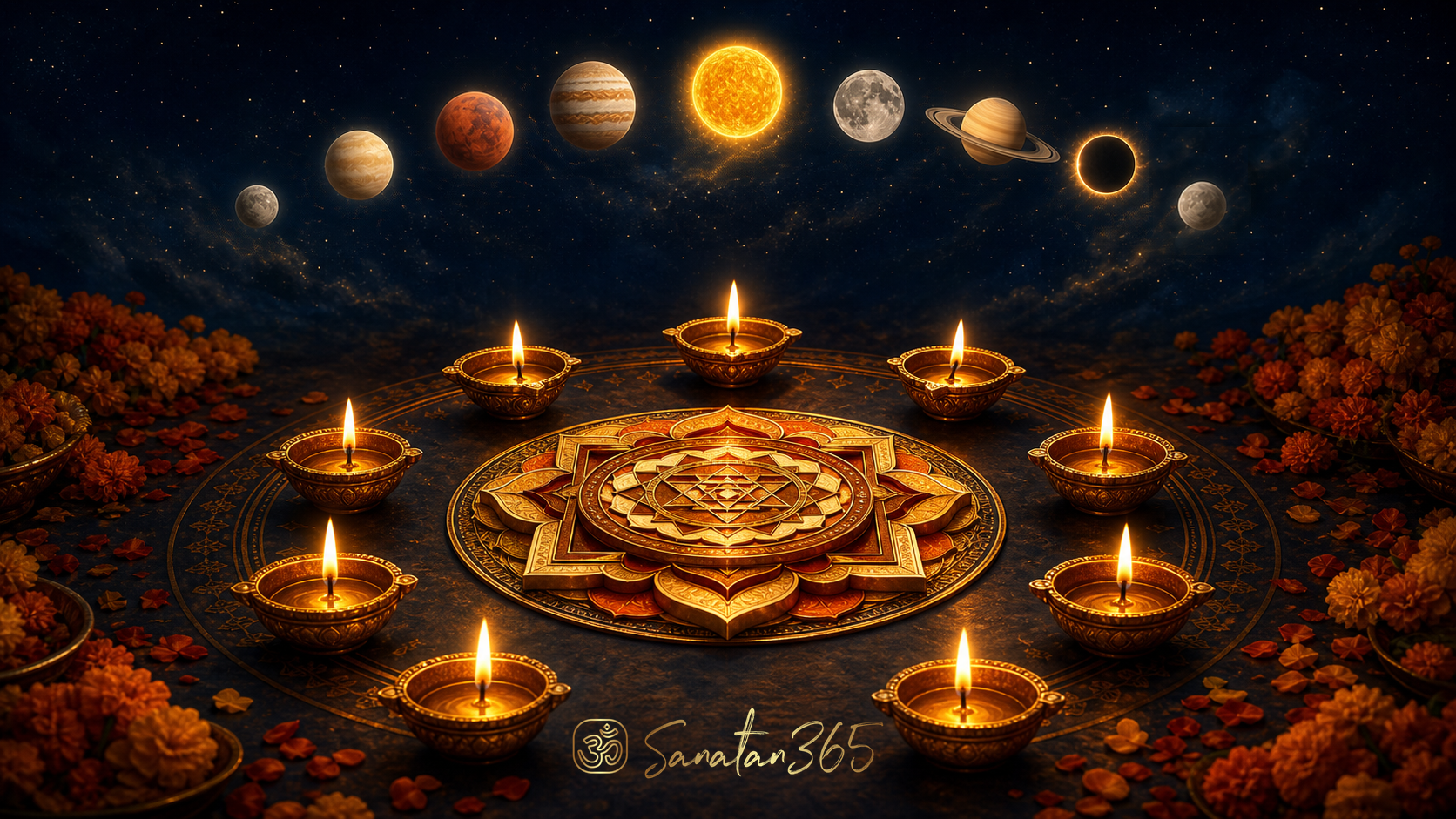
The Navagraha show the sacred use of nine by placing human life within a larger cosmic pattern. Graha (ग्रह) can mean a seizing or influencing force; in Hindu astrology, the Navagraha are nine celestial influences: Surya, Chandra, Mangala, Budha, Brihaspati or Guru, Shukra, Shani, Rahu, and Ketu. HAF notes that Vedic astrology pays attention to these nine grahas, with nava meaning nine (HAF).
The Navagraha are not simply astronomy in the modern scientific sense. They are part of Jyotisha (ज्योतिष, the traditional Hindu science of light and timing), ritual culture, temple practice, and symbolic reflection on karma. In many temples, Navagraha shrines give devotees a way to honor time, responsibility, and the unseen conditions of life.
This is where the number nine becomes philosophical. The grahas remind a person that life is not lived in isolation. Birth, time, family, health, temperament, habit, and consequence all shape experience. Hindu practice does not reduce a person to fate, but it does recognize that human freedom works within conditions.
Worship of the Navagraha is often misunderstood online as fear-based remedy culture. A calmer view is more useful. The grahas can become a language for humility. Surya may suggest vitality and clarity. Chandra may suggest mind and feeling. Shani may suggest discipline, delay, and responsibility. Rahu and Ketu may suggest shadow, desire, release, and karmic complexity. Whether one approaches this devotionally, ritually, or symbolically, the number nine marks a complete field of cosmic influence.
The best use of Navagraha reflection is not panic. It is dharmic response. If Saturn suggests discipline, become disciplined. If the Moon points to the mind, steady the mind. If the Sun points to clarity, live with integrity.
Key takeaway: The Navagraha make nine a symbol of cosmic order, time, responsibility, and humble self-understanding.
Why are nine forms of Devi remembered?
Nine forms of Devi are remembered because Hindu worship often approaches the Divine through many qualities rather than one flat idea. Navadurga, the nine revered forms of Goddess Durga, commonly includes Shailaputri, Brahmacharini, Chandraghanta, Kushmanda, Skandamata, Katyayani, Kalaratri, Mahagauri, and Siddhidatri. The names and emphases may vary across families and regions, but the pattern is clear: the Divine Feminine is honored through a complete spectrum of power, tenderness, discipline, protection, wisdom, and grace.
This is one reason nine feels like completion. A single image cannot exhaust Devi. One day may emphasize courage. Another may emphasize austerity. Another may emphasize motherhood. Another may emphasize fierce protection. Another may emphasize siddhi (सिद्धि, spiritual accomplishment or perfection). Through nine forms, the devotee learns that sacred strength is not one mood.
For families, this makes Navadurga a powerful teaching system. Children can learn that courage and compassion belong together. Elders can pass on stories without reducing the Goddess to a single symbol. Communities can honor the same Devi while allowing regional names, songs, colors, and food traditions to remain alive.
There is also a psychological dimension. Human beings often split life into opposites: gentle or strong, disciplined or loving, inward or active. Devi worship can hold these together. The nine forms remind the devotee that spiritual maturity needs many strengths. A person may need Kalaratri's fearlessness in one season and Mahagauri's serenity in another.
This is not merely mythology as entertainment. It is a devotional map. The nine forms become nine mirrors for human refinement.
Key takeaway: Navadurga makes nine a symbol of complete Divine Feminine power, from discipline and courage to protection and grace.
How is nine related to 108 and mantra practice?
Nine is related to 108 because 108 is divisible by nine and is one of the most familiar sacred counts in Hindu japa practice. A japa mala commonly has 108 beads, and Britannica identifies japa malas as prayer beads used in devotional recitation. In lived Hindu practice, 108 often functions as a complete round of mantra (मन्त्र, sacred sound or formula).
This connection does not mean every sacred number must be forced into one theory. It means Hindu practice often works through layered patterns. Nine can suggest completion; 108 can extend that completion into a full discipline of repetition. A devotee who chants a mantra 108 times may not be thinking about numerology at all. The count simply gives the practice a beginning, middle, and end.
There are also interpretive explanations that connect 108 with 12 zodiac signs and 9 grahas, or 27 nakshatras (नक्षत्र, lunar mansions) and 4 padas (पाद, quarters). Such explanations can be meaningful, but they should be handled as symbolic traditions rather than rigid proof. The safer truth is this: numbers help Hindu practice become repeatable, memorable, and embodied.
In daily life, this can be simple. A person may chant one round of a chosen mantra on a mala. Another may repeat a divine name nine times before leaving home. A family may light nine lamps during a Devi observance. These acts do not need exaggeration. Their strength comes from sincerity and rhythm.
The number nine also protects practice from becoming vague. "I will pray sometime" often dissolves. "I will repeat this name nine times with attention" gives the mind a clear doorway.
Key takeaway: Nine and 108 both show how Hindu practice uses sacred counts to turn devotion into steady, completed attention.
How can a modern Hindu family use the number nine respectfully?
A modern Hindu family can use the number nine respectfully by treating it as a support for devotion, not as a guarantee of outcomes. The number can shape prayer, learning, and family rhythm without becoming superstition.
Here are simple ways to use nine with reverence:
- Light nine diyas during a Devi observance, with a clear prayer for wisdom and protection.
- Teach children one quality from each of the Navadurga across nine days.
- Repeat a simple divine name nine times before study, travel, or an important conversation.
- Reflect on the Navagraha as reminders of time, discipline, emotion, clarity, and responsibility.
- Keep nine minutes for quiet japa, breath, or scripture reading.
- Offer nine acts of seva (सेवा, selfless service) in a month, such as feeding someone, helping elders, or supporting a temple.
- Use nine as a family gratitude practice, naming nine blessings without turning prayer into performance.
The point is not to collect rituals. The point is to create a small container for remembrance. A busy parent, student, or professional may not manage long worship every day. But nine sincere repetitions, nine minutes of silence, or nine lamps during a festival can keep dharma visible inside ordinary life.
Respect also means avoiding fear. Do not tell children that missing a count will bring punishment. Do not make spiritual practice anxious. Hindu devotion is not bookkeeping for the Divine. It is a relationship of reverence, discipline, gratitude, and inner growth.
For diaspora families, nine can become a bridge between culture and practice. Children may notice the pattern in Navaratri, garba, Navadurga, and Navagraha. A parent can explain: "Nine often means a complete sacred cycle. We use it to help the mind remember."
Key takeaway: Use nine as a gentle structure for prayer, teaching, service, and reflection, not as a fear-based rule.
FAQ
What is the simple number 9 meaning in Hinduism?
The simple number 9 meaning in Hinduism is sacred completion. It appears in nava, Navaratri, Navagraha, and Navadurga as a way to give worship, time, and reflection a complete structure.
Is number 9 lucky in Hinduism?
Many Hindus regard nine as auspicious, especially because of Navaratri, Navadurga, and Navagraha traditions. But it is better to call it sacred rather than merely lucky. Its meaning depends on reverent practice, not automatic fortune.
What does nava mean in Sanskrit?
Nava (नव) means nine in Sanskrit. It appears in words such as Navaratri, meaning nine nights, and Navagraha, meaning nine grahas or celestial influences.
Why are there nine nights in Navaratri?
Navaratri has nine nights to create a complete period of Devi worship, discipline, fasting, music, family teaching, and inner renewal. The nine-night rhythm lets devotion deepen gradually.
How can beginners use the number nine in daily practice?
Beginners can repeat a simple mantra nine times, sit quietly for nine minutes, light nine diyas during a Devi observance, or teach one sacred quality across each day of a nine-day practice. The count should support sincerity, not pressure.
The single key takeaway: nine in Hinduism is a sacred rhythm of completion, most meaningful when it turns attention into devotion, discipline, and wiser living.
About the author
Sanatan365 Editorial
Bringing Sanatan Dharma to modern seekers through authentic, scripture-grounded content.
Related in Numerology
 Numerology
Number 12 Meaning in Hinduism: Adityas and the Shape of a Year
Twelve connects the Adityas with the turning year. Learn what scripture says, why lists differ, and how sacred numerical symbolism differs…
 Numerology
Number 6 Meaning in Hinduism: Six Seasons and Six Tastes
Six seasons and six tastes show how Hindu cultural traditions organize change and variety. Learn their meaning without turning a sacred num…
 Numerology
Number 8 Meaning in Hinduism: Ashta, Balance, and Sacred Order
Explore the meaning of number 8 in Hinduism through ashta symbolism, the eight directions, Ashta Lakshmi, and disciplined balance without r…