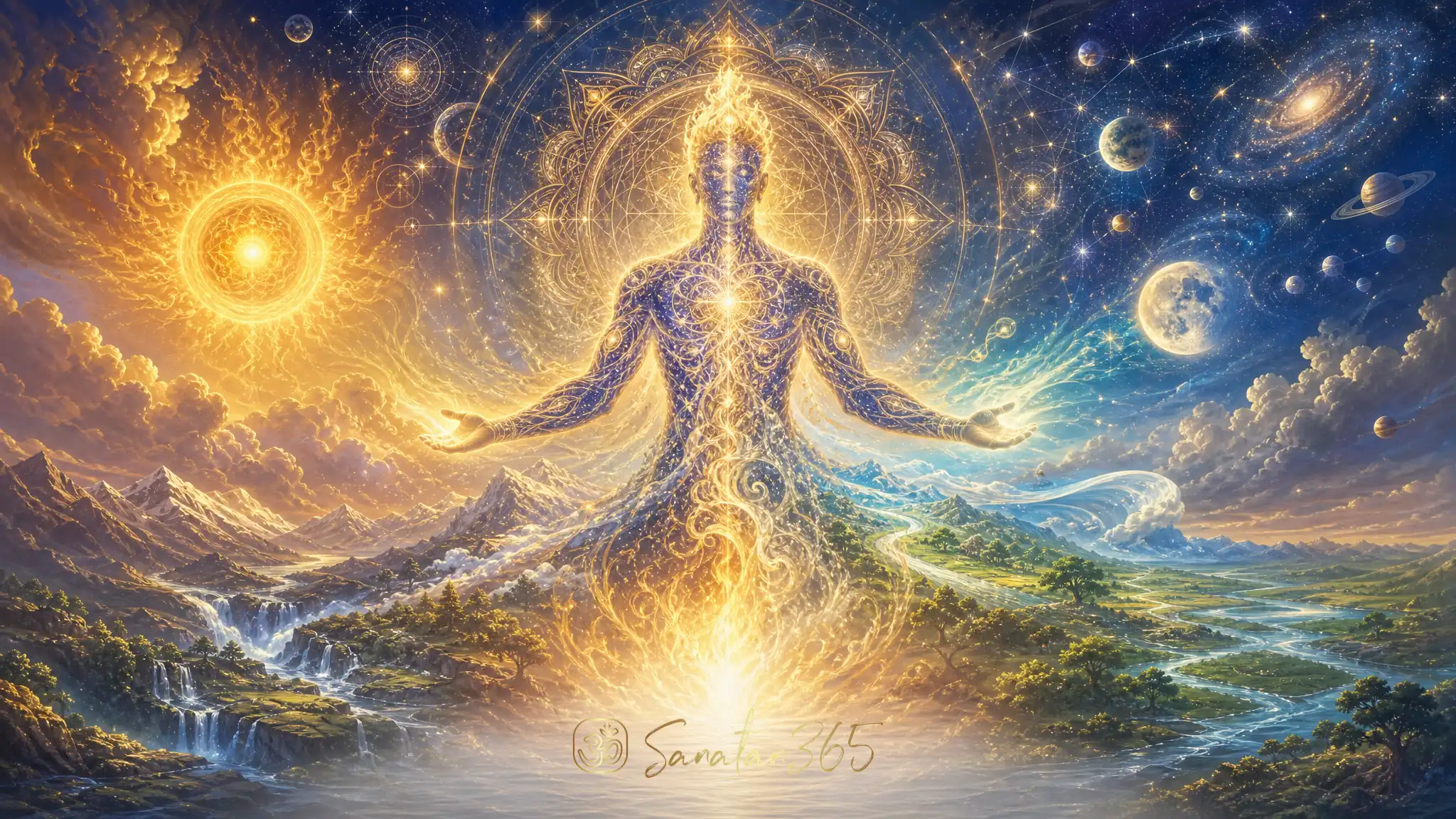
Purusha Sukta Meaning: The Cosmic Person and the Sacred Whole
A careful, devotional guide to the Purusha Sukta, Rig Veda 10.90, and its vision of creation, sacrifice, unity, and inner reverence.
A single hymn can make the universe feel less like scattered matter and more like one living sacred body.
The Purusha Sukta meaning begins with this vision: purusha (पुरुष, cosmic person or conscious being) is not merely one figure inside the universe, but the vast sacred whole from which the universe is understood. In Rig Veda 10.90, the hymn speaks through symbolic language: yajna (यज्ञ, sacred offering) becomes creation, unity becomes multiplicity, and every part of life is invited back into reverence.
For many Hindu families, the Purusha Suktam is heard in temple worship, homa, daily chanting, and major rituals. For seekers reading it today, it offers a powerful question: what changes when we stop seeing life as separate fragments and begin seeing existence as one sacred body?
What is the Purusha Sukta meaning in simple words?
The Purusha Sukta is a Vedic hymn from Rig Veda 10.90 that presents the cosmos as arising from Purusha, the cosmic person. A standard reference identifies Purusha as the primal cosmic being whose body becomes the universe in the Vedic imagination Britannica. The hymn also appears in related Vedic recitation traditions, where it is loved as Purusha Suktam.
The opening image is deliberately vast. Purusha has "a thousand heads, a thousand eyes, a thousand feet." In Vedic poetry, "thousand" often signals immeasurable fullness, not arithmetic counting. The hymn is saying that the Divine whole sees through all eyes, moves through all feet, and exceeds every boundary the mind tries to draw.
This is why the Purusha Sukta is not only a creation hymn. It is also a meditation on relationship. The world is not portrayed as spiritually empty. Sun, moon, wind, fire, directions, beings, and ritual order are all related to one source.
That source is not reduced to an object. Purusha is both immanent, meaning present within the world, and transcendent, meaning beyond the world. The hymn says he pervades the earth and still extends beyond it. A seeker can hold both truths together: the sacred is near, and the sacred is greater than what the senses can grasp.
Key takeaway: the Purusha Sukta meaning is the vision of one sacred reality expressing itself as many forms without ceasing to be whole.
Why does Rig Veda 10.90 describe creation as yajna?
The hymn's central act is yajna (यज्ञ, sacred offering). In ordinary ritual life, yajna may mean a fire offering performed with mantras, discipline, and devotion. In the Purusha Sukta, yajna becomes cosmic language. Creation is imagined as a sacred offering where the one becomes the many.
This does not need to be read as physical violence. Vedic hymns often speak in symbols. The offering of Purusha can be understood as a transformation of fullness into manifest life. The world comes forth not from accident or spiritual emptiness, but from sacred abundance.
The hymn describes the moon arising from the mind, the sun from the eye, Indra and Agni from the mouth, air from the breath, and space from the navel. These are poetic correspondences. They teach that human life, ritual life, and cosmic life mirror one another.
This is also why the hymn remains powerful in puja and homa. When a devotee offers ghee, flowers, mantra, or attention, the act participates in a larger pattern. Hindu ritual is not simply "asking for something." At its best, it is alignment. The small offering reflects the great offering through which life itself is sustained.
The word yajna also helps modern readers avoid a shallow reading of sacrifice. Sacrifice in this context is not loss for its own sake. It is the discipline by which ego loosens and life becomes service. Time given to family, food offered as prasad, study done with humility, and speech used truthfully can all become yajna when performed with sacred intention.
The Purusha Sukta therefore reframes creation as a devotional act. The world is not a random pile of things; it is a ritually ordered emergence from the sacred whole.
Key takeaway: Rig Veda 10.90 uses yajna to show creation as sacred transformation, where giving and becoming are woven together.
How does the Purusha Sukta explain unity and diversity?
One of the hymn's deepest teachings is unity without sameness. Everything arises from Purusha, yet everything has its own role, form, and rhythm. The sun is not the moon. The wind is not the earth. A mantra is not a river. Still, the hymn refuses to treat them as spiritually unrelated.
This matters for Hindu thought because unity in Sanatan Dharma rarely means flattening the world into one color. It means seeing the hidden relation beneath difference. The same spiritual instinct appears in many later teachings: Atman (आत्मन्, the inner Self) is sought within, Brahman (ब्रह्मन्, the ultimate reality) is reflected upon as the ground of all, and dharma (धर्म, sustaining order) guides life in harmony with the whole.
Readers who enjoyed Isha Upanishad Meaning: Wholeness, Action, and Seeing the Divine in Daily Life will recognize a similar mood. The Isha Upanishad begins with the sense that all this is pervaded by the Divine. The Purusha Sukta gives that intuition a grand Vedic image: the world is a sacred organism rather than a spiritually empty machine.
This image can reshape everyday practice. If life is one sacred body, then carelessness toward others is not merely social failure; it is spiritual forgetfulness. Food, work, speech, learning, nature, and worship belong to one field of responsibility.
For diaspora families, this is especially useful. A child may ask why a hymn matters if it was composed in an ancient world. The answer need not be abstract. The hymn trains the imagination to see connection. It teaches that no life is isolated from the larger whole.
Key takeaway: the Purusha Sukta teaches unity in diversity, where many forms arise from one sacred source and remain spiritually connected.
What should readers know about the Purusha Sukta and social symbolism?
The Purusha Sukta includes a famous passage describing different social functions arising from the cosmic person. This section is often discussed because later readers have connected it to varna (वर्ण, class or functional order) and caste. A responsible article cannot ignore the passage, and a reverent article should not use it to justify human superiority or exclusion.
The safest devotional reading is to keep the hymn's larger frame in view. The passage appears inside a cosmic body image. No part of a body exists for hatred of another part. Mouth, arms, thighs, and feet are interdependent. The whole body suffers when one part is despised.
That does not erase the painful history of caste discrimination. Nor should any spiritual writer pretend that social misuse has not happened. But the Purusha Sukta itself can be approached in a way that emphasizes interdependence, duty, humility, and sacred belonging rather than hierarchy.
For modern readers, this distinction matters. Sanatan Dharma at its best calls people toward dharma, compassion, self-discipline, seva (सेवा, service), and spiritual realization. Any reading that turns a sacred hymn into a license for contempt has missed the moral center of Hindu practice.
The hymn's cosmic body symbolism can instead become an ethical mirror. If all beings belong to the same sacred whole, then service to another person is not beneath anyone. Feet carry the body. Hands protect and work. Speech teaches and blesses. Nourishment sustains. Each function matters when joined to dharma.
This is not a political reading. It is a spiritual caution: sacred poetry must be handled with humility, especially where human dignity is involved.
Key takeaway: the Purusha Sukta should be read with sensitivity, emphasizing sacred interdependence and rejecting any use that demeans people.
How is the Purusha Suktam used in worship and daily practice?
The Purusha Suktam is widely recited in Vedic worship, temple rituals, homa, abhishekam, and household devotion. Many listeners may not know every word, yet the sound itself carries solemnity. The meter, repetition, and cosmic imagery create a sense that the ritual space has expanded beyond the room.
In practice, devotees may hear the hymn during Vishnu worship, Narayana worship, consecration rituals, and major pujas. Some traditions especially connect Purusha with Narayana or Vishnu. Other readers approach the hymn as a broader Vedic meditation on the supreme cosmic being. A careful tone allows both without forcing sectarian rivalry.
For home practice, the hymn can be approached in several gentle ways:
- Listen to a traditional recitation before reading a translation.
- Learn the first verse slowly with proper guidance.
- Reflect on one image at a time: thousand heads, cosmic yajna, sun and moon, the sacred whole.
- Offer one daily action as yajna, such as study, cooking, caregiving, or honest work.
- Read the hymn beside another text, such as the Mandukya Upanishad Meaning: Om, Turiya, and the Four States of Consciousness, to see how Vedic and Upanishadic language both point toward the unseen ground of life.
Beginners do not need to force instant philosophical mastery. Vedic hymns are meant to be lived with. A single line can sit in the mind for years and keep opening.
It is also wise to learn pronunciation from a qualified teacher when chanting formally. Vedic recitation has its own discipline, including accents and oral tradition. Listening with respect is already a meaningful first step.
Key takeaway: the Purusha Suktam is not only read for information; it is heard, chanted, contemplated, and slowly absorbed as sacred practice.
Why does the Purusha Sukta matter for modern life?
The modern mind often splits life into compartments: work here, worship there, body here, spirit there, nature outside, self inside. The Purusha Sukta challenges that split. It asks the reader to see existence as one field of sacred relation.
That does not mean abandoning practical life. It means spiritualizing responsibility. If speech arises in the sacred body, speech should become truthful and kind. If food belongs to the sacred body, eating should carry gratitude. If nature is part of the same whole, care for rivers, animals, soil, and air becomes a dharmic instinct, not a lifestyle accessory.
This vision also offers emotional steadiness. A person may feel small before illness, loss, pressure, or uncertainty. The Purusha Sukta does not deny human vulnerability. It places vulnerability within a larger sacred order. The individual is not cut off from the whole.
For families, this can become a simple teaching: "We are parts of one larger life." Children can understand that kindness, respect, and discipline are not only rules. They are ways of honoring the sacred body to which all belong.
For seekers, the hymn can also deepen meditation. Instead of viewing the Divine only as distant, the practitioner can contemplate the sacred presence in breath, sight, thought, sound, and action. The next step is humility: if the sacred is everywhere, then spiritual life begins in how one treats what is near.
The Purusha Sukta meaning therefore remains alive because it does not merely answer where the world came from. It asks how one should live inside a world that is sacred.
Key takeaway: the hymn matters today because it turns spiritual belief into reverence for life, duty, nature, and everyday conduct.
A careful conclusion
The Purusha Sukta is one of Hinduism's great hymns of sacred wholeness. It speaks through cosmic poetry: a vast person, a primordial yajna, the emergence of sun and moon, the ordering of life, and the mystery of the one becoming many.
Its meaning should be held with devotion and responsibility. Read carelessly, the hymn can be flattened into mythology or misused as social hierarchy. Read carefully, it becomes a meditation on unity, interdependence, humility, and sacred offering.
The single key takeaway: the Purusha Sukta teaches that life is not spiritually fragmented; all beings belong to one sacred whole, and the right response is reverence.
FAQ
What is the Purusha Sukta meaning?
The Purusha Sukta meaning is the Vedic vision of Purusha, the cosmic person, as the sacred whole from which the universe emerges. It teaches unity, creation through yajna, and the interconnection of all life.
Where is the Purusha Sukta found?
The Purusha Sukta is found in Rig Veda 10.90. It also appears in related Vedic recitation traditions, which is why many devotees know it as Purusha Suktam.
Is Purusha the same as Vishnu or Narayana?
Many Vaishnava traditions identify Purusha with Narayana or Vishnu. Other readings approach Purusha more broadly as the supreme cosmic being. The hymn can be honored without turning that difference into sectarian conflict.
Does the Purusha Sukta support caste discrimination?
No sacred hymn should be used to demean human beings. The social-symbolic passage is best read within the larger cosmic body image, emphasizing interdependence, duty, and sacred belonging rather than contempt or superiority.
How can beginners study the Purusha Suktam?
Beginners can start by listening to a traditional recitation, reading a reliable translation, learning key terms such as purusha and yajna, and reflecting on one image at a time before attempting formal chanting.
About the author
Sanatan365 Editorial
Bringing Sanatan Dharma to modern seekers through authentic, scripture-grounded content.
Related in Scriptures
 Scriptures
Uddhava Gita Meaning: Krishna's Final Teachings on Devotion and Detachment
Explore the Uddhava Gita in the Bhagavata Purana: Krishna's counsel to Uddhava on devotion, discernment, and living without clinging.
 Scriptures
Hiranyagarbha Sukta Meaning: The Golden Beginning in Rigveda 10.121
Read Rigveda 10.121 with care: the golden embryo image, its recurring question, Prajapati, and the difference between sacred poetry and sci…
 Scriptures
Antaryamin Meaning: The Inner Controller in the Brihadaranyaka Upanishad
The Brihadaranyaka Upanishad describes Antaryamin as the immortal inner presence dwelling within earth, life, mind, and every being while r…

