Purushartha Meaning: The Four Goals of Hindu Life
Purushartha explains the four aims of Hindu life: dharma, artha, kama, and moksha. Learn how this framework balances duty, prosperity, joy, and liberation.
Ancient Hindu thought does not treat human life as a problem to escape or a marketplace to win.
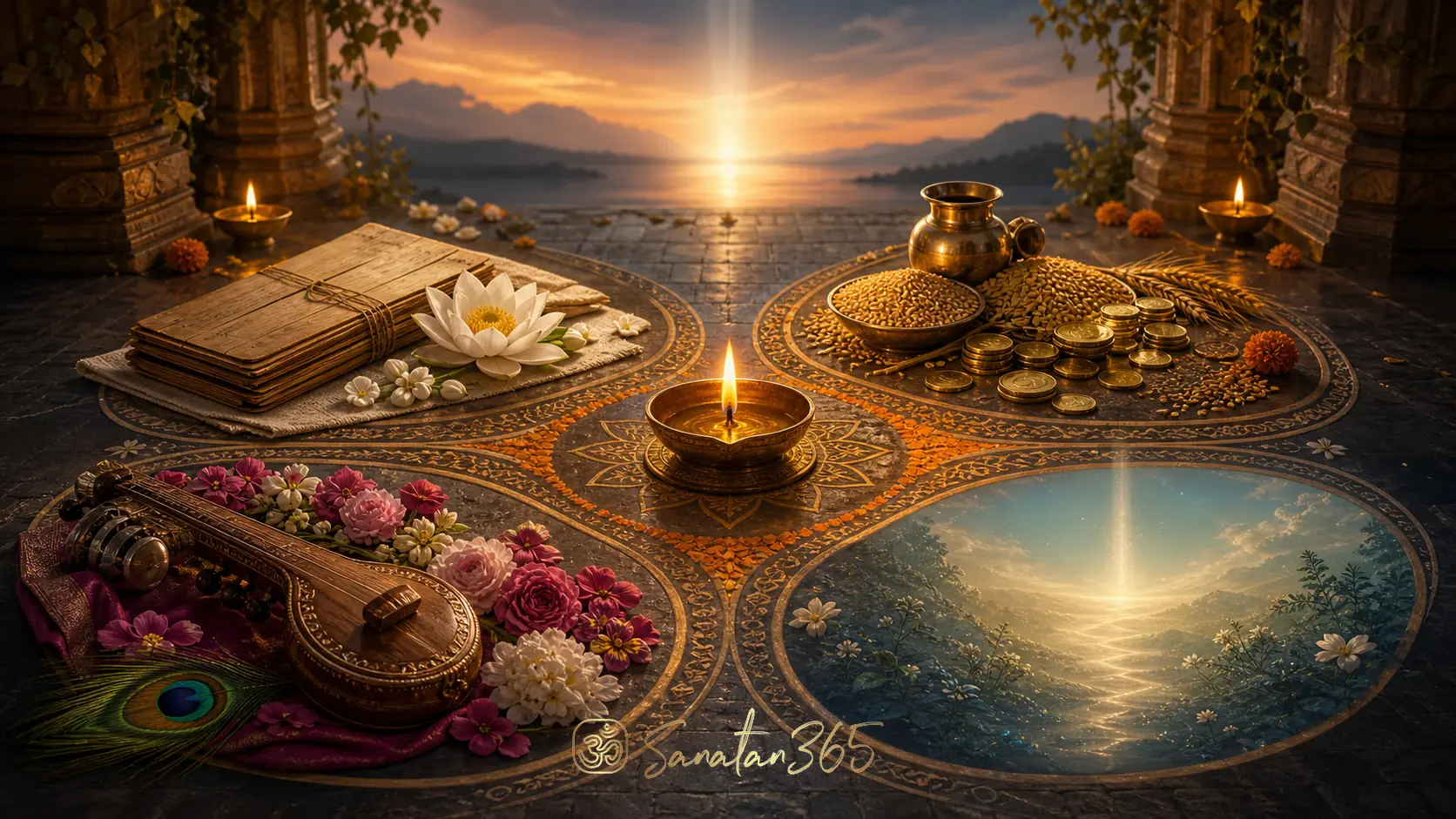
Purushartha meaning begins with a simple idea: life has four worthy aims, and each must be held in the right proportion. The four goals of Hindu life are dharma (धर्म, ethical order and right conduct), artha (अर्थ, material security and meaningful resources), kama (काम, joy, love, and refined desire), and moksha (मोक्ष, liberation or spiritual freedom). Together, they form a Hindu map for living fully without losing the soul's direction.
The word purushartha (पुरुषार्थ) is often translated as "human aim" or "purpose of life." It is not a slogan. It is a disciplined way of asking: What is worth pursuing, what must guide pursuit, and what finally sets the heart free?
What Is Purushartha Meaning in Hindu Wisdom?
Purushartha meaning is the Hindu framework of four life goals: dharma, artha, kama, and moksha. These aims do not ask a person to reject family, work, beauty, or responsibility. They ask a person to place all of them inside a larger moral and spiritual order.
The Hindu American Foundation summarizes these four goals in public educational material as ethical living, material prosperity, pleasure, and liberation; in a wedding context, it describes them as goodness and universal well-being, security, happiness, and spiritual freedom (HAF wedding primer). That matters because the four goals are not abstract philosophy only. They enter marriage, household life, education, work, ritual, and old age.
The order is also meaningful. Dharma gives direction. Artha gives stability. Kama gives sweetness. Moksha gives ultimate freedom.
Key takeaway: Purushartha is not four separate ambitions; it is one integrated Hindu view of a balanced life.
Why are there four goals instead of one?
A one-goal life easily becomes distorted. If only wealth matters, the heart hardens. If only pleasure matters, discipline weakens. If only renunciation is praised without readiness, ordinary duties may be neglected. If only duty is emphasized without joy, life can become dry.
The four goals of Hindu life answer this imbalance. They acknowledge that human beings need meaning, support, affection, beauty, and transcendence. The framework is generous, but not loose. Artha and kama are legitimate only when guided by dharma. Moksha remains the horizon that prevents the other goals from becoming idols.
This is why Purushartha belongs naturally beside other Sanatan teachings already explored on the blog, including Sattva Rajas Tamas Meaning: The Three Gunas in Daily Life and Yama and Niyama Meaning: Yoga's Ethical Foundation for Daily Life. Both help explain how inner qualities and ethical disciplines shape daily choices.
Key takeaway: Hindu wisdom does not deny human needs; it refines them through dharma and points them toward moksha.
How Does Dharma Guide the Four Goals of Hindu Life?
Dharma is the foundation of Purushartha. The word is difficult to compress into one English term because it includes duty, virtue, order, truthfulness, responsibility, and the deeper law that sustains life.
In practical terms, dharma asks: Is this action aligned with truth? Does it protect trust? Does it support family, society, nature, and the inner life? Does it respect the Atman, the sacred self, in oneself and others?
Without dharma, artha becomes greed and kama becomes indulgence. With dharma, wealth can become service, and joy can become gratitude.
The Bhagavad Gita repeatedly places action inside a disciplined moral and spiritual frame. In 2.47, it teaches that a person has a right to action, but not ownership over the fruits of action (Gita Supersite, 2.47). In 3.19, it praises action done without attachment. These teachings are not an escape from work; they are a purification of motive.
Key takeaway: Dharma is the steering principle of Purushartha, keeping ambition and desire aligned with sacred order.
Dharma in everyday decisions
Dharma becomes visible in ordinary moments:
- Earning honestly instead of manipulating.
- Speaking truth without cruelty.
- Caring for parents, children, teachers, and dependents.
- Using knowledge with humility.
- Choosing restraint when pleasure would harm trust.
- Serving without turning every act into self-display.
This is why the Hindu idea of seva (सेवा, selfless service) is so central to daily life. The earlier article Seva Meaning: Hindu Selfless Service in Daily Life explains how service becomes a way to purify action rather than merely perform kindness.
Key takeaway: Dharma is not theory stored in scriptures; it is the quality of choice in daily life.
What Is Artha Without Losing Dharma?
Artha means resources, livelihood, security, and the practical means that allow life to function. It includes money, work, skill, property, health systems, education, and social stability.
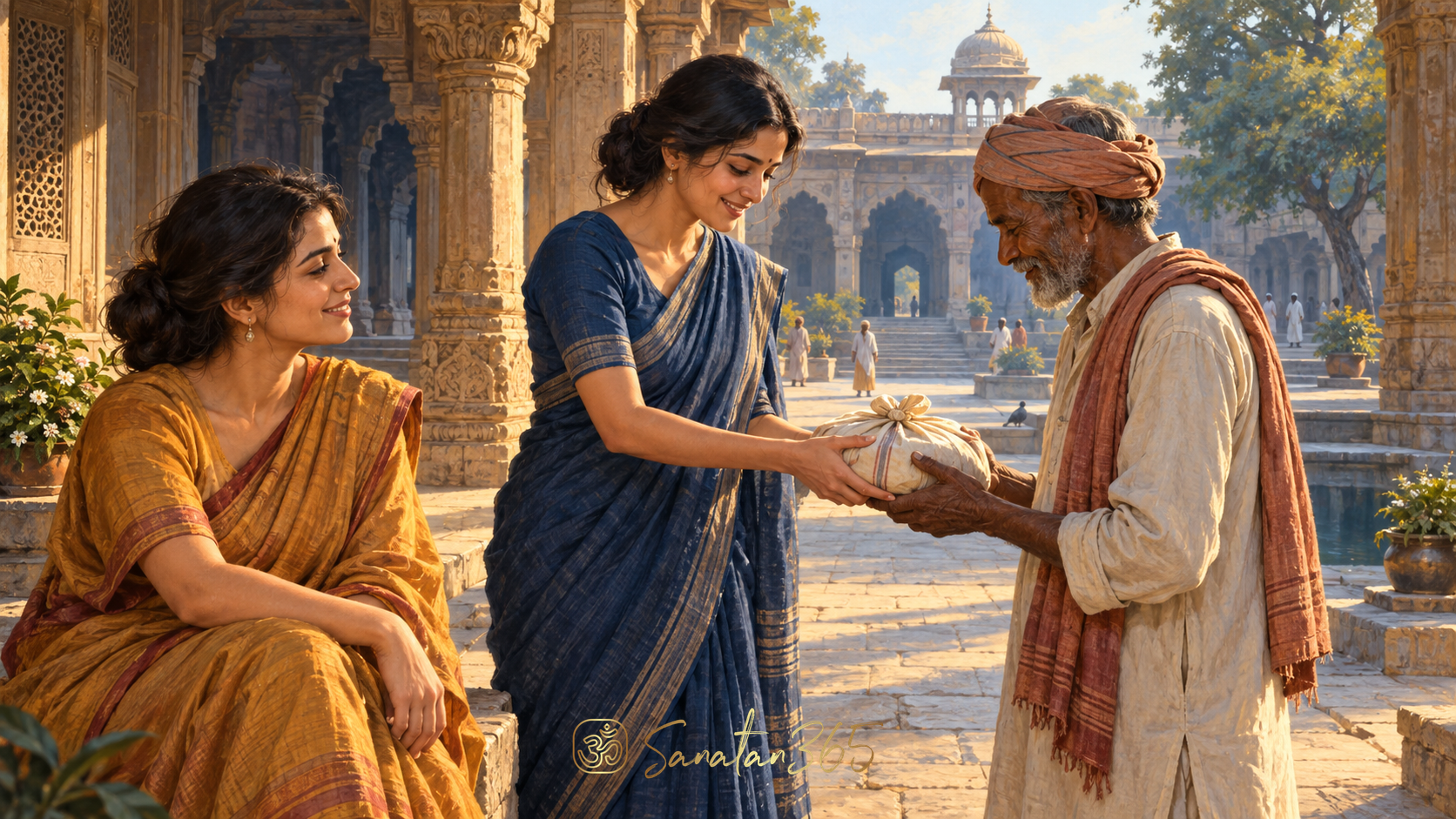
Hindu wisdom does not treat artha as dirty. A family needs food. A student needs books. A temple needs support. Charity requires resources. A society without economic stability cannot easily protect learning, art, ritual, or service.
The danger is not artha itself. The danger is artha without dharma.
When artha is guided by dharma, wealth becomes a responsibility. It supports household life, education, hospitality, donations, temples, community care, and the dignity of dependents. When artha is separated from dharma, it can turn into exploitation, anxiety, comparison, and pride.
Key takeaway: Artha is a valid Hindu goal when it is earned, used, and shared through dharma.
A balanced way to pursue artha
A dharmic pursuit of artha asks several questions before chasing success:
- Is the work honest?
- Does the pursuit damage health, family, or conscience?
- Are employees, partners, and customers treated fairly?
- Does prosperity increase generosity?
- Can the mind remain steady if gain is delayed?
These questions are especially useful for modern readers. A person may live in Mumbai, Bengaluru, New Jersey, London, or Singapore and still face the same inner test: can ambition remain clean?
Purushartha does not ask everyone to become poor. It asks wealth to become accountable to dharma.
Key takeaway: Prosperity is strongest when it supports duty, dignity, learning, and service.
What Is Kama in the Four Goals of Hindu Life?
Kama means desire, affection, pleasure, beauty, art, emotional fulfillment, and love. In a narrow sense, people often associate kama with sensual desire. In the broader Hindu understanding, it includes the refined joys that make life graceful: music, poetry, friendship, marriage, fragrance, food, celebration, and aesthetic delight.
Kama is not automatically opposed to spirituality. The question is whether desire is governed by dharma.
A flower offered in puja, a raga sung with devotion, a family meal, a loving marriage, a festival lamp, a well-made home, a beautiful poem, and the laughter of children can all belong to a dharmic life. Hindu culture has never been merely severe. It has temples, dance, painting, music, ornament, fragrance, rasa (रस, aesthetic flavor), and celebration.
But kama becomes harmful when desire forgets consequence. Pleasure that breaks trust, exploits another person, weakens discipline, or turns the mind restless is no longer healthy kama. It has lost dharma.
Key takeaway: Kama is sacred when desire is refined by love, responsibility, beauty, and restraint.
Kama and the discipline of joy
Modern culture often treats joy as instant consumption. Purushartha treats joy as something to be educated.
That education includes:
- learning what brings lasting peace rather than temporary stimulation
- honoring marriage and family commitments
- enjoying beauty without addiction
- celebrating festivals without excess
- practicing gratitude before taking pleasure
- remembering that every joy is more luminous when it does not injure dharma
This is a gentle but demanding teaching. It allows the sweetness of life while refusing to let sweetness become slavery.
Key takeaway: The Hindu path does not reject joy; it teaches the soul how to enjoy without becoming bound.
Why Is Moksha the Highest Horizon?
Moksha means liberation. Britannica defines moksha as release from samsara, the cycle of death and rebirth, and connects the word with the Sanskrit root meaning "to free" (Britannica). In Hindu practice, moksha also points to freedom from ignorance, ego-bondage, compulsive desire, and the mistaken belief that the body-mind is the whole self.
If dharma is the foundation, moksha is the horizon.
The first three goals belong mainly to life within the world: ethical order, resources, and fulfilled desire. Moksha asks a deeper question: Who is the one seeking all this? What remains when wealth changes, pleasure fades, roles shift, and the body ages?
The Upanishadic vision answers by turning attention toward Atman (आत्मन्, the Self), the innermost reality beyond temporary identity. Moksha is not a gloomy rejection of life. It is freedom from false dependence on what cannot last.
Key takeaway: Moksha keeps the four goals from becoming a closed circle of duty, earning, and desire.
Moksha in household life
Many people assume moksha belongs only to monks, renunciants, or forest sages. Hindu tradition certainly honors renunciation, but Purushartha also lets householders live with moksha in view.
A householder may remember moksha by:
- Offering daily work to the Divine.
- Practicing japa (जप, repeated sacred recitation).
- Studying the Gita, Upanishads, Ramayana, or other trusted texts.
- Seeing family duty as sadhana (साधना, disciplined spiritual practice).
- Giving without possessiveness.
- Enjoying life while remembering impermanence.
This is where Purushartha becomes practical. It does not demand that every person abandon society. It asks each person to live in society without forgetting the eternal.
Key takeaway: Moksha can guide a modern householder through remembrance, detachment, devotion, and disciplined action.
How Can Purushartha Shape Modern Life?
Purushartha is especially useful because modern life often separates what Hindu wisdom holds together. Work is separated from ethics. Pleasure is separated from restraint. Spirituality is separated from economics. Family life is separated from inner growth.
The four goals reunite them.
A student can use Purushartha to choose education that serves both livelihood and character. A founder can use it to build prosperity without sacrificing integrity. Parents can use it to teach children that success, happiness, and spiritual depth are not enemies. A retired person can use it to shift gradually from accumulation toward study, service, and liberation.
The framework also helps diaspora families explain Hindu life without reducing it to festivals alone. Festivals are beautiful, but Sanatan Dharma is also a complete philosophy of human purpose.
Key takeaway: Purushartha gives modern seekers a way to integrate career, family, joy, service, and spiritual freedom.
A simple Purushartha reflection
Once a week, a person can reflect on four questions:
- Dharma: What duty or truth needs more attention?
- Artha: Are resources being earned and used responsibly?
- Kama: Is joy becoming refined or restless?
- Moksha: What attachment can be loosened?
These questions do not require a perfect life. They create direction. Over time, they reveal where imbalance has entered.
If artha dominates, the calendar may be full but the heart anxious. If kama dominates, desire may feel exciting but unstable. If dharma is ignored, success becomes spiritually expensive. If moksha is forgotten, even good things can become chains.
Key takeaway: Purushartha is a weekly mirror for restoring balance before life drifts too far.
FAQ
What is Purushartha meaning in simple words?
Purushartha means the four aims of human life in Hindu wisdom: dharma, artha, kama, and moksha. In simple words, it teaches ethical living, responsible prosperity, refined joy, and spiritual liberation.
What are the four goals of Hindu life?
The four goals of Hindu life are dharma (right conduct), artha (resources and prosperity), kama (joy and desire), and moksha (liberation). Together, they guide a balanced life.
Is artha or kama considered bad in Hinduism?
No. Artha and kama are valid goals when guided by dharma. Hindu wisdom does not reject wealth or joy; it asks that both be pursued ethically and without spiritual forgetfulness.
Why is moksha considered the highest goal?
Moksha is considered the highest horizon because it points to liberation from ignorance, attachment, and the cycle of birth and death. It gives the other goals their final spiritual direction.
Can Purushartha apply to modern professional life?
Yes. Purushartha can guide work, money, family, pleasure, service, and spiritual practice. It helps modern seekers ask whether success is ethical, joy is healthy, and daily life remains connected to liberation.
Purushartha teaches that a complete life is not built by choosing between duty, prosperity, joy, and freedom. It is built by letting dharma guide artha and kama, while moksha keeps the soul turned toward what is eternal.
About the author
Sanatan365 Editorial
Bringing Sanatan Dharma to modern seekers through authentic, scripture-grounded content.
Related in Wisdom
 Wisdom
Mudita Meaning: Joy in Another Person's Goodness
Explore mudita in Yoga Sutra 1.33: appreciative joy in another person's goodness, its limits, and a grounded way to practise it.
 Wisdom
Anugraha Meaning: Divine Grace and Human Effort in Hindu Thought
Anugraha names grace, but not a bargain for a particular result. Explore how Hindu traditions hold divine help and human effort together.
 Wisdom
Vasudhaiva Kutumbakam Meaning: When the World Becomes One Family
Vasudhaiva Kutumbakam means that the whole earth is one family. Rooted in the Maha Upanishad, the teaching asks seekers to move beyond narr…