Sattva Rajas Tamas Meaning: The Three Gunas in Daily Life
Sattva, rajas, and tamas are the three gunas that shape thought, mood, action, and spiritual discipline. Learn their meaning through the Bhagavad Gita and simple daily examples.
A restless day, a clear day, and a dull day may look like three different personalities. Hindu thought sees them as three changing qualities moving through the mind.
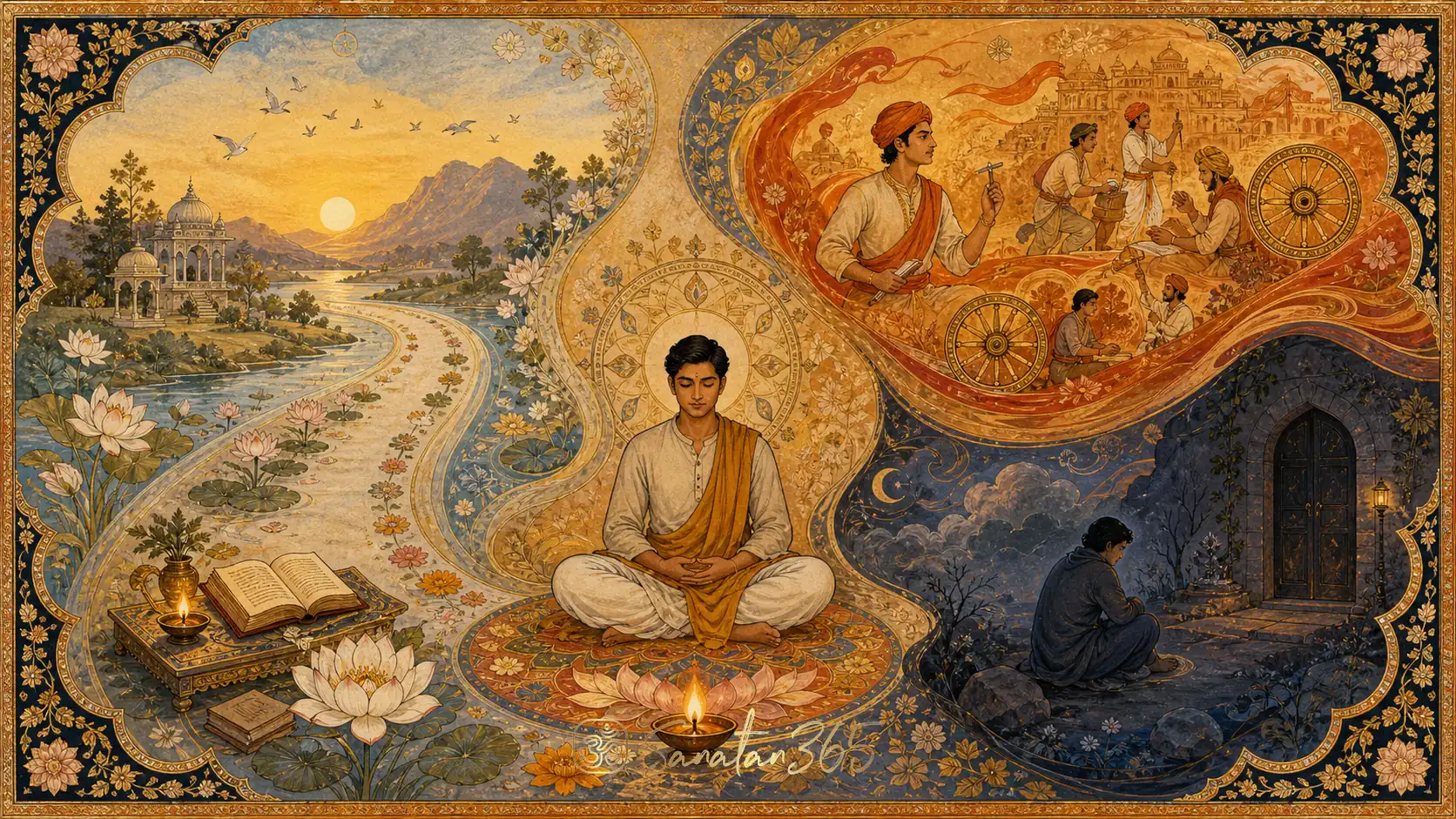
Sattva Rajas Tamas meaning begins with guna (गुण, quality or mode). In the Bhagavad Gita, Krishna explains that prakriti (प्रकृति, material nature) works through three gunas: sattva (सत्त्व, clarity and harmony), rajas (रजस्, activity and craving), and tamas (तमस्, inertia and confusion). These qualities color thought, food, speech, work, sleep, study, and worship. The lesson is not to label people as good or bad. The lesson is to notice which guna is active, cultivate more clarity, and finally remember that the true Self is deeper than all three.
Key takeaway: The three gunas are a practical map for understanding moods, habits, and spiritual growth without reducing a person to one fixed nature.
What is the Sattva Rajas Tamas meaning in the Bhagavad Gita?
The phrase Sattva Rajas Tamas meaning refers to the three gunas, the basic qualities through which nature operates. Bhagavad Gita Chapter 14 is traditionally called Guna Traya Vibhaga Yoga, the yoga of discerning the three gunas. In verse 14.5, Krishna says that sattva, rajas, and tamas arise from prakriti and bind the embodied self to the body Bhagavad Gita 14.5.
This binding does not mean a person is spiritually doomed. It means the mind is often pulled by qualities it has not yet learned to observe. A sattvic mood may feel clear and peaceful. A rajasic mood may feel busy, ambitious, and restless. A tamasic mood may feel heavy, resistant, and clouded. These moods appear in every person in different proportions at different times.
The Gita's genius is that it avoids both shame and self-flattery. Even sattva, the most refined guna, can bind through attachment to happiness and knowledge Bhagavad Gita 14.6. Rajas binds through desire and attachment to action Bhagavad Gita 14.7. Tamas binds through negligence, laziness, and sleep Bhagavad Gita 14.8.
For daily life, this teaching becomes simple: before reacting, ask what is moving through the mind. Is there clarity? Is there agitation? Is there dullness? That question itself creates distance from the impulse.
Key takeaway: The three gunas explain changing inner states, not permanent human worth.
What does sattva mean in daily life?
Sattva means clarity, harmony, balance, luminosity, and truthward movement. A sattvic mind is not sleepy or passive. It is awake without being harsh. It can study, pray, listen, serve, and decide with steadiness.
In daily life, sattva may appear as clean speech, a simple meal, a quiet morning, honest work, a disciplined routine, gratitude before eating, or the ability to pause before answering. It is the quality that makes the mind transparent enough to reflect dharma.
The Gita describes sattva as pure, illuminating, and free from disease-like disturbance, while also warning that it can bind through attachment to happiness and knowledge Bhagavad Gita 14.6. This is subtle. A person may become proud of being calm, learned, vegetarian, spiritual, or disciplined. Then sattva has become a polished ego rather than a doorway to freedom.
Sattva is cultivated through habits that reduce unnecessary friction. Waking at a reasonable time, keeping spaces clean, reading scripture, choosing truthful speech, doing japa (जप, repetition of a sacred name or mantra), honoring elders, serving without display, and eating in moderation can all support sattva. The practice is not cosmetic purity. It is inner order.
For children and families, sattva can be taught through simple examples: tell the truth even when it is inconvenient, keep promises, share food, speak gently, finish duties before entertainment, and sit quietly for one minute before a meal. These are not small things. They train the mind to enjoy clarity.
Key takeaway: Sattva is clear, kind, disciplined awareness, but it must remain humble to become spiritually useful.
What do rajas and tamas mean?
Rajas means movement, passion, drive, restlessness, and desire. Without rajas, ordinary life would not move. People would not build homes, study for exams, start businesses, cook meals, defend families, or repair what is broken. Rajas gives energy.
The problem begins when rajas becomes craving. The Gita describes rajas as born of desire and attachment, binding the person to action Bhagavad Gita 14.7. This is the mood of "more, faster, mine, now." It may appear as constant comparison, impatience, overwork, shopping to fill emptiness, anger when plans fail, or inability to rest without a screen.
Tamas means inertia, heaviness, delusion, resistance, and obscuration. Like rajas, it has a limited role. Sleep is necessary. Stillness is necessary. A seed rests in darkness before it sprouts. But when tamas dominates the mind, rest becomes avoidance. Sleep becomes escape. Confusion becomes an excuse. The Gita links tamas with ignorance, negligence, laziness, and sleep Bhagavad Gita 14.8.
A tamasic state may sound like: "I know this is wrong, but I do not care." "I will do it later." "Nothing matters." "Let me hide from the consequence." In family life, tamas can show up as ignored responsibilities, stale resentment, careless speech, addiction to dulling habits, or refusal to learn from mistakes.
The lesson is not to hate rajas or tamas. It is to purify and redirect them. Rajas can become disciplined effort. Tamas can become healthy rest. Sattva can guide both.
Key takeaway: Rajas gives movement and tamas gives heaviness; both become harmful when they rule the mind without sattvic discernment.
How do the three gunas shape food, work, and speech?
The three gunas become easiest to understand when seen in ordinary behavior.
Food is one example. A sattvic meal is fresh, moderate, nourishing, and taken with gratitude. A rajasic meal may be overstimulating, rushed, excessive, or eaten while chasing taste and excitement. A tamasic meal may be stale, careless, heavy, or consumed in a state of dullness. The point is not to turn food into superiority. It is to notice how food affects attention.
Work is another example. Sattvic work is done as duty, with care and a clean intention. Rajasic work is done mainly for praise, control, status, or anxious results. Tamasic work is careless, delayed, confused, or harmful. The same job can carry different gunas depending on the inner posture.
Speech reveals the gunas quickly. Sattvic speech is truthful, beneficial, timely, and gentle. Rajasic speech seeks victory, attention, or emotional dominance. Tamasic speech may be cruel, false, lazy, vulgar, or deliberately confusing. Bhagavad Gita 17.15 describes disciplined speech as truthful, pleasing, beneficial, and non-agitating Bhagavad Gita 17.15.
Even spiritual practice can be colored by the gunas. Sattvic worship is steady, reverent, and sincere. Rajasic worship seeks reward, recognition, or social image. Tamasic worship may be mechanical, careless, fear-driven, or mixed with harmful intention. This is why Hindu practice places so much value on bhava (भाव, inner feeling).
Key takeaway: The gunas are not abstract philosophy; they can be seen in what we eat, how we work, how we speak, and why we worship.
How can a person move from tamas and rajas toward sattva?
The movement toward sattva is usually gradual. A tamasic mind cannot always jump directly into meditation. It may first need light, movement, cleanliness, and responsibility. A rajasic mind cannot always become peaceful by command. It may need disciplined action, reduced stimulation, and service.
A simple progression can help:
- From tamas to rajas: get up, bathe, clean one area, walk, complete one pending duty, eat something fresh, speak to someone trustworthy, and stop feeding dullness.
- From rajas to sattva: slow the breath, reduce unnecessary noise, do one task with full attention, offer the result to the Divine, and choose enough over excess.
- From sattva to freedom: practice humility, devotion, self-inquiry, and non-attachment even to one's own goodness.
The Gita does not end with sattva as the final goal. Krishna describes the one who transcends the gunas as steady amid light, activity, and delusion, seeing that the gunas alone are acting Bhagavad Gita 14.22-23. This does not make a person indifferent in a cold way. It makes the person less enslaved by inner weather.
For a household devotee, a practical sattva routine may be modest: wake without immediate scrolling, offer one short prayer, keep the first meal simple, do work honestly, avoid gossip, chant a name of the Divine, and close the day with gratitude. Over time, the mind begins to prefer clarity.
Key takeaway: The daily path is to lift tamas into responsible action, refine rajas into disciplined service, and let sattva become a bridge to deeper freedom.
Why are the gunas useful for children and beginners?
The gunas are a gentle way to teach self-observation. Instead of telling a child, "You are lazy," a parent can say, "Tamas is strong right now. Let us bring in light and movement." Instead of telling a student, "You are too restless," a teacher can say, "Rajas has energy. Let us give it direction." Instead of praising a child as permanently superior, elders can say, "That was a sattvic choice. Keep it humble."
This language separates the person from the passing state. That is spiritually protective. A child learns that moods can be worked with. A beginner learns that failure is not identity. A family learns to discuss habits without humiliation.
The lesson also helps adults. A professional can notice rajasic overwork before burnout. A devotee can notice tamasic avoidance before it becomes neglect. A student can notice sattvic clarity after study, prayer, and enough sleep. The gunas make inner life visible.
For Sanatan education, this is one of the most practical teachings. It connects scripture with daily habit. It gives families a vocabulary for emotions, discipline, food, speech, and worship. It also keeps the highest truth in view: every guna changes, but the witness of change is deeper.
Key takeaway: Teaching the gunas helps children and beginners name inner states without shame and choose better habits with awareness.
FAQ
What is the simple Sattva Rajas Tamas meaning?
Sattva means clarity, harmony, and balance. Rajas means activity, desire, and restlessness. Tamas means inertia, dullness, and confusion. These three gunas are qualities of prakriti, or material nature, that influence the mind and behavior.
Are sattva, rajas, and tamas found in every person?
Yes. Hindu philosophy teaches that all three gunas are present in everyone, but their proportions change. A person may be sattvic in prayer, rajasic at work, and tamasic when avoiding responsibility. The goal is awareness and refinement, not labeling.
Is rajas always bad?
No. Rajas gives movement, effort, ambition, and action. It becomes harmful when driven by craving, ego, anger, or endless comparison. When guided by sattva, rajasic energy can become disciplined service and purposeful work.
How can I reduce tamas in daily life?
Begin with physical and practical steps: wake at a steady time, clean your space, get sunlight, move the body, eat fresh food, complete one small duty, and avoid habits that increase dullness. Then add prayer, study, and honest company.
Is sattva the final spiritual goal?
Sattva is the clearest guna and a necessary support for spiritual life, but the Gita points beyond all three gunas. A seeker cultivates sattva, then uses clarity, devotion, and wisdom to stop identifying with any passing quality.
The single key takeaway: Sattva, rajas, and tamas are not labels for people; they are changing forces in the mind, and dharma begins when we learn to observe and guide them.
About the author
Sanatan365 Editorial
Bringing Sanatan Dharma to modern seekers through authentic, scripture-grounded content.
Related in Lessons
 Lessons
Ashtavakra and Bandin: Wisdom Beyond Appearance
The Ashtavakra and Bandin story in the Mahabharata follows a young scholar who enters King Janaka's court, answers prejudice with learning,…
 Lessons
Gargi Vachaknavi: The Upanishadic Voice of Fearless Inquiry
Gargi Vachaknavi stands in the Brihadaranyaka Upanishad as a formidable questioner whose disciplined dialogue with Yajnavalkya reveals cour…
 Lessons
Andal: The Poet-Saint Who Made Longing a Path of Devotion
Discover Andal, the Tamil poet-saint whose Tiruppavai transformed sacred longing, shared song, and wholehearted surrender into a living pat…