Ram Mandir Ayodhya Live Darshan: Bringing Ram Lalla Into Daily Practice
A warm, practical guide to Ram Mandir Ayodhya live darshan, Ram Lalla devotion, and how daily online darshan can support remembrance, family practice, and steady dharma.
A temple can be far away in distance and still become near in daily attention.
Ram Mandir Ayodhya live darshan is the practice of seeing Ram Lalla, the child form of Lord Rama, through a live or official temple-linked viewing experience when a devotee cannot physically stand in Ayodhya. Darshan (दर्शन, sacred seeing) is not only watching; it is a reverent exchange of attention. For families, elders, students, and diaspora devotees, live darshan can turn an ordinary morning or evening into a small act of remembrance, gratitude, and dharma.
Key takeaway: Live darshan is most meaningful when treated as a devotional pause, not passive screen time.
What is Ram Mandir Ayodhya live darshan?
Ram Mandir Ayodhya live darshan means receiving a real-time or current visual connection with Shri Ram Mandir in Ayodhya, especially the darshan of Ram Lalla. The Sanskrit word darshan comes from a root meaning "to see," but in Hindu practice it also means being seen by the sacred. This is why devotees do not treat temple viewing as ordinary video. They sit, fold hands, become quiet, and bring the mind toward Bhagavan.
Ayodhya holds a unique place in Hindu memory. UP Tourism describes Ayodhya as one of ancient India's sacred Saptpuris and locates it on the bank of the Sarayu River, with deep association to Maryada Purushottam Shri Ram. The Ramayana tradition remembers Rama as the embodiment of dharma, restraint, courage, tenderness, and righteous conduct. Britannica's overview of the Ramayana identifies Rama as an avatar of Vishnu and the epic's central figure of exemplary character.
In temple practice, the form seen matters. At Ayodhya, devotees commonly speak of Ram Lalla, the beloved child form of Shri Ram. This is not merely an architectural landmark. The emotional centre is the deity, the sanctum, the aarti, the rhythm of seva (सेवा, sacred service), and the devotee's own inner response.
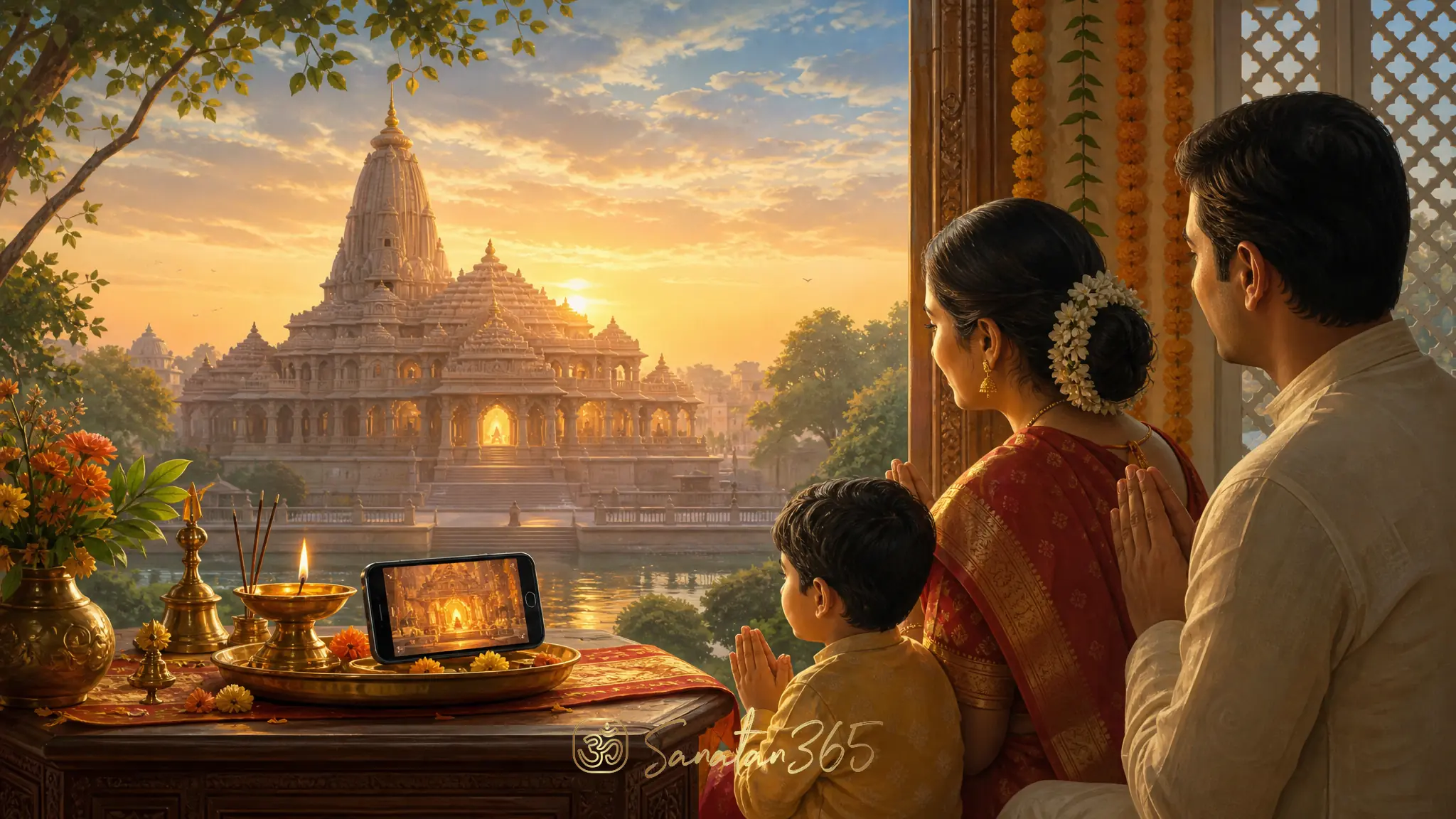
Live darshan, therefore, asks for a different posture than ordinary media. A devotee may be in Mumbai, New Jersey, London, Singapore, or a small hostel room in Pune. The phone or laptop is only the doorway. The practice begins when the heart becomes attentive.
Key takeaway: The screen is not the sacred object; attention, reverence, and remembrance make the viewing devotional.
Why does Ram Lalla darshan feel so personal?
Ram Lalla darshan carries a special tenderness because the devotee is not only approaching Rama as king, warrior, or teacher. The child form brings the bhava (भाव, devotional mood) of care, affection, innocence, and nearness. Many devotees naturally lower their voice, smile, or pray with a softer heart when they behold Ram Lalla.
This child-form devotion is not sentimental weakness. In Sanatan practice, love can be a serious spiritual discipline. A mother offering food, a father teaching a child to say "Jai Shri Ram," a grandparent watching morning darshan with folded hands, or a student whispering a prayer before an exam can all enter the same stream of remembrance.
The Ramayana's Rama is often remembered as Maryada Purushottam, the ideal person of noble restraint. That phrase can feel large, almost unreachable. Ram Lalla brings the same presence into a more intimate devotional register. The devotee can ask: How do I protect innocence? How do I speak truth gently? How do I act with dignity when life is difficult? How do I hold family duty without losing inner softness?
This is why a few minutes of darshan can become more than visual contact. It can become a daily ethical reminder. A devotee sees Ram Lalla and remembers maryada (मर्यादा, sacred boundary or disciplined conduct). The mind turns from complaint toward steadiness.
For children, the practice can be especially powerful. Instead of beginning dharma only through rules, they first meet beauty: the glow of the mandir, the sound of aarti, the image of folded hands, the family's quiet tone. Later, stories and lessons have somewhere to land.
Key takeaway: Ram Lalla darshan joins affection with discipline, making dharma feel close, tender, and livable.
How can Ram Mandir Ayodhya live darshan become a daily home practice?
The best way to approach Ram Mandir Ayodhya live darshan is to make it small, steady, and respectful. A devotional habit does not need to be dramatic. It needs to be sincere enough to repeat.
One simple home rhythm:
- Choose a regular time, preferably morning or evening.
- Clean the space where the phone or laptop will be placed.
- Light a diya only if it is safe and appropriate.
- Sit for one minute before opening the stream.
- Fold hands and mentally offer pranam (प्रणाम, respectful bowing).
- Watch quietly for a few minutes.
- End with one simple sankalpa (संकल्प, sacred intention) for the day.
The intention can be practical: "May my speech be truthful today," "May I act with patience," or "May this home remember Shri Ram." This keeps darshan connected to conduct.
Families can add a short Ram naam japa (जप, repeated sacred recitation), such as "Shri Ram Jai Ram Jai Jai Ram," after the viewing. Children can be invited to name one quality of Rama: courage, kindness, promise-keeping, respect for parents, loyalty to friends, or protection of the vulnerable. This avoids turning live darshan into a lecture. It becomes a shared family moment.
Diaspora devotees may find live darshan especially grounding. Physical temple visits may be weekly, monthly, or rare. A daily viewing from Ayodhya can connect the home calendar to Bharatiya sacred geography without making anyone feel cut off from local life. The practice says: Ayodhya is not only a destination. It is also a direction of attention.
Sanatan365 includes Daily Live Temple Darshan from Home among its daily devotional features, including Ram Mandir Ayodhya in its live temple darshan inventory. Used gently, this can help devotees build a repeatable rhythm without searching across scattered links each day.
Key takeaway: A five-minute darshan habit can carry more spiritual value than irregular long sessions done without attention.
What should devotees know about official timings and etiquette?
For physical visits, official information matters. The Shri Ram Janmbhoomi Teerth Kshetra website publishes temple free darshan time windows and aarti-related information, and its official online portal handles official services such as donations, donation receipt, and aarti access. The Trust also states that darshan and aarti passes are not charged through unofficial agents. Devotees should therefore verify current timings and pass rules directly through official temple sources before planning travel or relying on third-party claims.
For online darshan, the etiquette is simpler but still important:
- Do not watch casually while scrolling other apps.
- Do not treat the deity image as content to consume.
- Do not argue in comments or forward unverified claims.
- Do not use temple imagery for mockery, memes, or political messaging.
- Do not promise guaranteed worldly results from darshan.
Darshan is not a transaction. The devotee does not "watch and receive a reward." The deeper fruit is refinement of attention. When a person sees Ram Lalla with humility, the mind may become less scattered, speech may become kinder, and the day may begin with a better centre.
It is also wise to distinguish between temple darshan and travel planning. Live darshan is a blessing for those who cannot go now. It does not replace the full embodied experience of yatra (यात्रा, sacred pilgrimage), where the devotee walks, waits, listens, offers, receives prasad, and shares space with other pilgrims. Both have value. One is immediate access; the other is embodied pilgrimage.
Key takeaway: Official sources protect devotees from confusion, while etiquette protects the sacred mood of darshan.
How does live darshan support modern Hindu families?
Modern families often struggle less with belief and more with rhythm. People may respect Sanatan Dharma deeply, yet find it hard to maintain daily practice amid school schedules, work calls, elder care, commute pressure, and global time zones. Live darshan helps because it lowers the friction of beginning.
The practice can serve different people differently:
- For elders, it offers temple connection when travel is difficult.
- For children, it gives a visual anchor for Rama bhakti.
- For working adults, it creates a short pause before decisions and duties.
- For diaspora families, it keeps Ayodhya present in the home.
- For new seekers, it offers a gentle entry before deeper study.
This is where technology should remain humble. The tool should not become louder than the temple. A good devotional product helps the user arrive, become quiet, and remember. It should not turn sacred practice into endless notifications or spiritual performance.
Sanatan365's role is strongest when it supports this daily rhythm: live temple darshan, bell ringing, meditation, mantras, aarti, stories, and AI spiritual guidance can each become small doors into remembrance. In the case of Ram Mandir Ayodhya live darshan, the most important door is simple: open the app, behold Ram Lalla with attention, and carry one quality of Rama into the day.
The feature should never be mistaken for a substitute for temple communities, family elders, gurus, acharyas, or living tradition. It is a support. It helps the modern devotee begin again, especially on days when distance or schedule would otherwise make practice disappear.
Key takeaway: Live darshan is useful when technology becomes a quiet support for devotion, not the centre of devotion.
What is a balanced way to use Ram Mandir Ayodhya live darshan?
A balanced practice has three parts: seeing, remembering, and living.
Seeing is the darshan itself. The devotee sits before Ram Lalla with folded hands, even if only for a few minutes.
Remembering is the inner turn. The devotee recalls one name, one line from the Ramayana, one value of Shri Ram, or one family teaching.
Living is the test. After darshan, does speech become more truthful? Does anger soften? Does duty feel less like burden and more like seva? Does the home feel a little more aligned?
This three-part pattern prevents live darshan from becoming either mechanical or overly emotional. It also avoids making impossible claims. Darshan does not guarantee a problem-free life. It gives the heart a sacred reference point from which to meet life.
A practical weekly pattern can help:
- Monday: pray for steadiness in work.
- Tuesday: remember courage and service through Hanuman's devotion to Rama.
- Wednesday: read a short Ramayana passage with children.
- Thursday: offer gratitude to teachers and elders.
- Friday: reflect on truthfulness in speech.
- Saturday: clean the home altar and simplify one habit.
- Sunday: plan an in-person temple visit or family satsang when possible.
This pattern makes darshan relational. Ram Mandir Ayodhya is not only an image seen on a screen. It becomes a weekly mirror for conduct.
Key takeaway: The fruit of live darshan is visible in how a devotee speaks, serves, decides, and remembers after the screen is closed.
FAQ
What is Ram Mandir Ayodhya live darshan?
Ram Mandir Ayodhya live darshan is a way for devotees to see Ram Lalla and the temple's devotional atmosphere through live or current visual access when they cannot physically visit Ayodhya. In Hindu practice, darshan means sacred seeing and being seen by the divine.
Is online darshan the same as visiting Ayodhya in person?
No. Online darshan supports remembrance when travel is not possible, but an in-person yatra includes the full embodied experience of pilgrimage, temple space, prasad, local sacred geography, and shared devotion. Both can support bhakti when approached reverently.
How long should a daily live darshan practice be?
Even five focused minutes can be meaningful. A simple rhythm of sitting quietly, folding hands, watching with attention, repeating Ram naam, and carrying one quality of Shri Ram into the day is better than a long distracted viewing.
Where should devotees check official Ram Mandir timings?
Devotees planning physical darshan or aarti should check the official Shri Ram Janmbhoomi Teerth Kshetra website and official booking portal for current timings, passes, and instructions. Timings can change for festivals, crowd management, or temple decisions.
Can families use live darshan with children?
Yes. Families can use live darshan as a gentle daily practice by keeping it short, reverent, and story-linked. Children can be invited to notice one quality of Shri Ram, such as truthfulness, courage, kindness, or respect for duty.
Ram Mandir Ayodhya live darshan is most powerful when it begins with seeing Ram Lalla and ends in changed conduct. The single key takeaway: let the darshan become a daily reminder to live with maryada, tenderness, and steady remembrance of Shri Ram.
About the author
Sanatan365 Editorial
Bringing Sanatan Dharma to modern seekers through authentic, scripture-grounded content.
Related in Features
 Features
AI Adi Shankaracharya Guide: Viveka and the Practice of Clear Judgment
Explore viveka, the Vedantic discipline of discernment, and learn how the AI Adi Shankaracharya guide can support thoughtful reflection wit…
 Features
AI Venkateswara Guide: Patience, Stewardship, and Responsible Hope
Explore Sri Venkateswara's devotional lessons on patience, stewardship, and responsible hope, with practical reflection through Sanatan365'…
 Features
AI Vaishno Devi Guide: Faith, Courage, and the Divine Mother's Grace
Explore Vaishno Devi's living symbolism of faith, courage, and maternal grace, with practical ways to bring these teachings into daily deci…