Satyakama Jabala Story: Why Truth Made Him a Worthy Student
The Chandogya Upanishad's story of Satyakama Jabala shows that truthfulness, humility, service, and readiness to learn—not inherited status—prepare a seeker for sacred knowledge.
A boy asks his mother a question that could decide whether a respected teacher will accept him: “What is my lineage?” Her answer gives him no prestigious name to carry, only the courage to tell the truth.
The Satyakama Jabala story in the Chandogya Upanishad teaches that a seeker becomes worthy of sacred knowledge through satya (सत्य, truthfulness), humility, disciplined service, and the ability to learn from life. When Satyakama honestly admits that he does not know his paternal lineage, the sage Gautama recognizes the truthfulness of his speech and accepts him as a student. The episode does not make ancestry the measure of spiritual fitness. It makes integrity visible.
What Is the Satyakama Jabala Story in the Chandogya Upanishad?
The narrative appears in Chandogya Upanishad 4.4–9. Satyakama wishes to live as a brahmacharin (ब्रह्मचारिन्, a student committed to disciplined sacred learning). He approaches his mother, Jabala, and asks which lineage he belongs to, because a prospective teacher may ask him.
Jabala answers without concealment. In her youth, she says, she served in many places and had him; she does not know his paternal lineage. She tells him to identify himself simply as “Satyakama, son of Jabala.” Her reply is neither embellished nor defensive. It gives her son the one inheritance she can establish beyond doubt: an honest name.
Satyakama then goes to the sage Haridrumata Gautama and asks to become his student. Gautama asks about his lineage. Satyakama repeats his mother's words faithfully, including the uncertainty. Gautama responds that only one committed to truth could speak so plainly, and he accepts the boy for initiation and study Chandogya Upanishad 4.4, translation resources at the Ramakrishna Math's Vedanta literature archive.
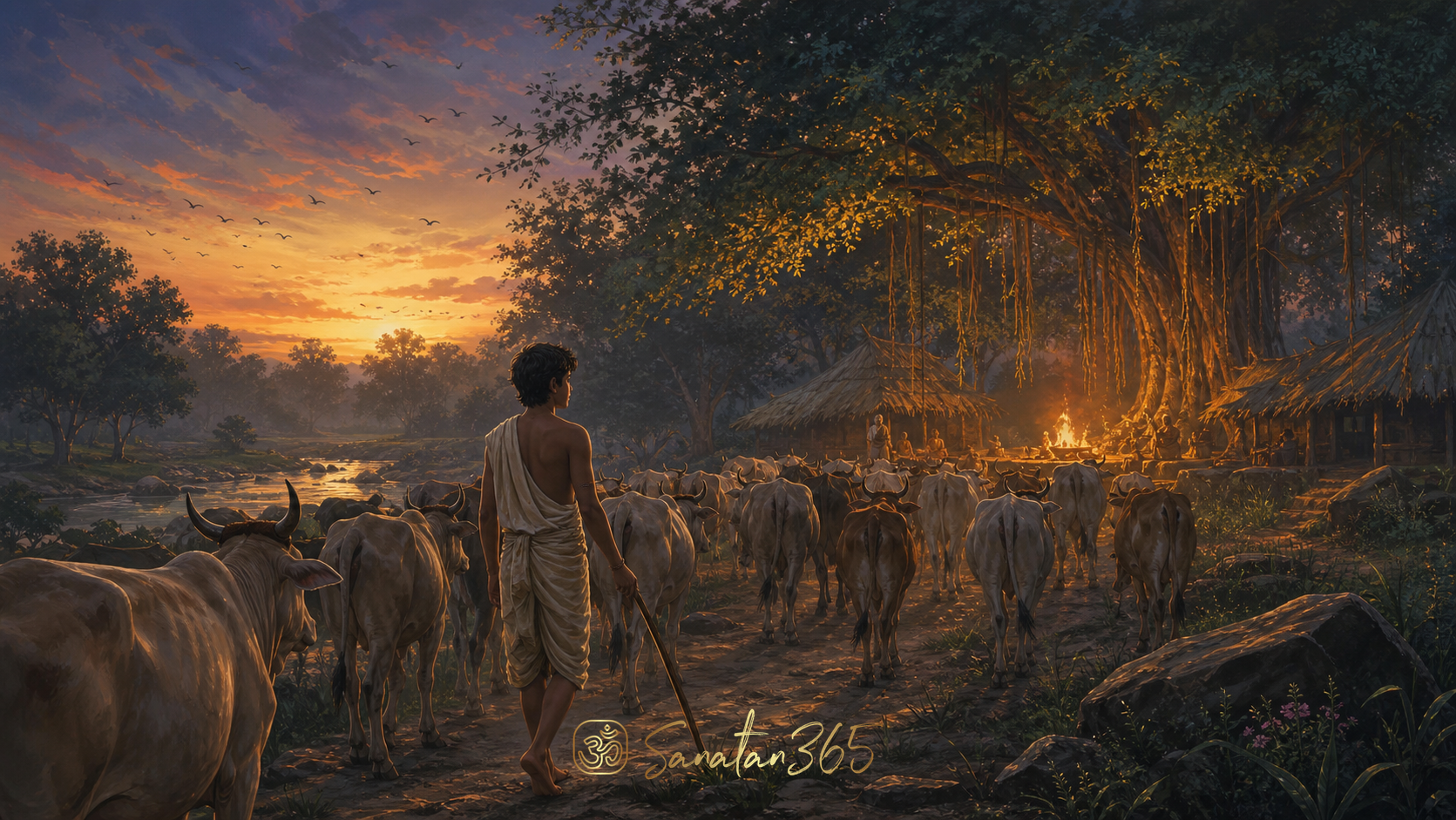
The teacher later gives Satyakama four hundred lean cows and instructs him to tend them. Satyakama resolves not to return until they have become one thousand. This is not a quick examination of memory. It is education through responsibility, patience, solitude, and care.
When the herd reaches one thousand, the Upanishad describes a series of teachings delivered through a bull, fire, a swan, and a water bird. Each reveals one “quarter” of Brahman (ब्रह्मन्, the limitless ground of reality) through dimensions such as the directions, worlds, lights, and faculties of embodied life. On his return, Gautama sees that Satyakama's face shines with understanding. Yet Satyakama still asks his human teacher to complete the instruction, because knowledge received within the guru-shishya (गुरु-शिष्य, teacher-student) relationship carries disciplined integration.
Key takeaway: The story moves from honest self-identification to service, contemplative learning, and finally instruction confirmed by a teacher.
Why Does Gautama Accept Satyakama as a Worthy Student?
Gautama does not accept Satyakama because the boy supplies the expected social credential. He accepts him because Satyakama refuses to invent one. Faced with possible rejection, the student tells the exact truth he has received from his mother.
This is satya as spiritual discipline. Truthfulness in the Upanishadic setting is more demanding than merely avoiding an obvious lie. It means allowing reality to stand without manipulating it for advantage. The Taittiriya Upanishad later gives the graduate the injunction “satyam vada” (सत्यं वद, speak truth) alongside “dharmam chara” (धर्मं चर, live dharma) Taittiriya Upanishad 1.11. Speech and conduct are joined.
Gautama's discernment is equally important. A good teacher looks beneath a socially convenient answer and notices the student's character. Satyakama demonstrates three qualities at once:
- Courage: He risks being turned away rather than manufacturing certainty.
- Fidelity: He repeats Jabala's account without altering it to protect his image.
- Readiness: He asks for disciplined study, not admiration or entitlement.
The passage has generated varied historical interpretations, and readers should avoid forcing a later social theory onto a concise ancient narrative. Its immediate literary emphasis, however, is unmistakable: Gautama treats truthful speech as decisive evidence of fitness for learning. The teacher's response turns uncertainty of birth into certainty of character.
This lesson remains sharp today. Applications, interviews, classrooms, and spiritual communities often tempt people to polish their histories. The story does not ask a seeker to disclose every private detail to everyone. It asks that what one does claim be truthful, and that spiritual identity not be built on fabrication.
Key takeaway: Gautama recognizes that the capacity to face an inconvenient truth is itself evidence that a student can receive deeper truth.
What Do the Four Teachers of Satyakama Represent?
The bull, the sacred fire, the swan, and the water bird should not be reduced to a charming folktale. Within the Upanishad's contemplative language, the world becomes pedagogical. Directions, earth, sky, ocean, sun, moon, lightning, breath, sight, hearing, and mind are gathered into meditations on the wholeness of Brahman.
The bull teaches vastness through direction
The bull teaches a quarter of Brahman through east, west, south, and north. The lesson turns orientation into contemplation: wherever the student faces, reality is not outside the sacred whole. Space is not merely empty distance; it becomes a reminder of boundlessness.
Fire teaches rootedness in the worlds
Agni (अग्नि, sacred fire) teaches through earth, atmosphere, heaven, and ocean. Satyakama has tended an actual fire during his years of service. The ordinary discipline of keeping it alive prepares him to hear fire as more than an object. Attention changes the world from scenery into instruction.
The swan teaches luminosity
The swan's teaching gathers fire, sun, moon, and lightning. These are forms of illumination, but the passage invites more than admiration of physical brightness. Knowledge itself illumines: it allows what was confused to become perceptible.
The water bird teaches inward support
The final teaching turns toward breath, sight, hearing, and mind. The search that began across the four directions returns to the living person. The limitless is contemplated not only across the cosmos but through the faculties by which experience becomes known.
These teachings do not license a seeker to treat every impulse as divine instruction. Satyakama's learning occurs after sustained discipline and is later completed by Gautama. The Upanishadic pattern joins openness to the world with the correcting structure of a trustworthy teacher and tradition.
The story therefore avoids two extremes. Sacred knowledge is not confined to abstract words alone, but neither is private intuition made infallible. Text, teacher, service, contemplation, and lived reality work together.
Key takeaway: Nature becomes a teacher for the prepared mind, while the guru helps turn insight into coherent knowledge.
How Does Service Prepare Satyakama for Knowledge?
The herd is central to the Satyakama Jabala story. Four hundred weak cows become one thousand under his care. The text compresses years into a few lines, but the implied discipline is substantial: finding pasture and water, protecting vulnerable animals, watching seasons change, maintaining fire, and remaining faithful without constant supervision.
Seva (सेवा, selfless service) here is not decorative volunteering. It trains capacities needed for wisdom:
- Patience: Growth cannot be forced on a preferred timetable.
- Attention: Living beings require observation rather than abstraction.
- Reliability: Duty continues when no audience is present.
- Restraint: Solitude exposes distraction, complaint, and self-importance.
- Care: Knowledge matures when responsibility extends beyond oneself.
This helps explain why the teacher does not begin with a lecture. Satyakama first becomes capable of remaining with a task. The Bhagavad Gita similarly links learning with humility, sincere inquiry, and service: one approaches those who see truth through pranipata (प्रणिपात, respectful humility), pariprashna (परिप्रश्न, sincere questioning), and seva Bhagavad Gita 4.34.
Service is not payment for secret information. It is a way of reorganizing the student. A restless mind asks for profound answers but may not yet be able to hold them. Repeated care steadies attention. Duty reveals where the ego resists. Silence makes observation more exact.
Modern learners can apply the principle without imitating the ancient setting literally. Completing a research task carefully, caring for family without seeking applause, maintaining a daily recitation, serving a community kitchen, or tending a shared space can all become disciplines when performed responsibly. The test is not hardship for its own sake. The test is whether service makes one more truthful, attentive, and compassionate.
Key takeaway: Satyakama's long stewardship of the herd converts aspiration into dependable character.
What Can Students and Seekers Learn from Satyakama Today?
The narrative offers a practical framework for education and spiritual life.
Begin with what is actually known
Satyakama does not confuse uncertainty with shame. He distinguishes what is known from what is not known, then speaks accordingly. This is foundational to scholarship, science, and spiritual inquiry. “I do not know” can be more fertile than a confident fiction.
Let identity rest on integrity
Many identities matter: family, region, language, tradition, profession, and community. The story does not erase them. It warns against using identity as a substitute for character. No inherited label can perform one's truthfulness, attention, or service.
Accept formation before recognition
Satyakama asks to learn and receives cows to tend. He does not protest that the work looks unrelated to philosophy. Mature education often begins with foundations that appear ordinary: learning a vocabulary, keeping time, listening carefully, caring for tools, or repeating a practice until it becomes stable.
Learn from more than one mode
The story includes a mother, a guru, animals, fire, landscape, bodily faculties, and contemplative insight. A modern learner also needs multiple modes: primary texts, qualified teachers, careful observation, discussion, silence, and ethical action. Variety is useful when anchored in discernment.
Return for completion
Even after receiving luminous teachings, Satyakama returns to Gautama. His humility survives insight. This is a safeguard against spiritual pride. A powerful experience may be meaningful, but it still benefits from examination, context, and ethical integration.
A simple seven-day practice can bring these lessons into daily life:
- Each morning, name one thing you know and one thing you do not know.
- Keep one small promise exactly.
- Perform one useful task without announcing it.
- Spend ten minutes observing nature without a phone.
- Record one assumption that proved incomplete.
- Ask a sincere question of a trustworthy teacher or text.
- Review whether your speech became clearer and kinder.
Truth must also be expressed with care. Bhagavad Gita 17.15 describes disciplined speech as truthful, non-agitating, beneficial, and grounded in sacred study. Honesty is not permission for cruelty. Satyakama's speech is plain, relevant, and free of performance; that is why it carries force.
Key takeaway: The modern practice of Satyakama's lesson is accurate speech, quiet responsibility, attentive learning, and humility after insight.
Why Does Jabala's Honesty Matter as Much as Satyakama's?
The story is often named for Satyakama, but its moral clarity begins with Jabala. She could have supplied a respectable fiction, evaded the question, or transferred her anxiety to her son. Instead, she gives him a truthful account and her own name.
Her honesty does not close his future. It equips him for it. Because Jabala refuses false certainty, Satyakama can approach Gautama without living inside a deception. The teacher's recognition is therefore built upon a truth first protected at home.
This is a profound lesson for parents and mentors. Adults may feel pressure to present a flawless family story to children. Age-appropriate honesty can be more stabilizing than image management. It teaches that dignity does not depend on pretending one's circumstances are different.
The episode also preserves Jabala as a person rather than treating her merely as missing genealogical information. Satyakama identifies himself through her: Jabala is his mother, and Jabala's truth becomes part of his name. The passage's restraint should guide interpretation; it offers no warrant for shaming her. Gautama does the opposite—he receives the truthful son she has raised.
Key takeaway: Jabala's refusal to invent a story makes Satyakama's spiritual education possible.
Conclusion
The Satyakama Jabala story is memorable because its decisive moment is so simple. A student tells the truth when a lie might have seemed useful. A teacher notices. Years of service then deepen that honesty into attention, and attention opens the world as a field of learning.
Key takeaway: Sacred learning begins when the desire to appear worthy gives way to the discipline of becoming truthful, responsible, and ready to learn.
FAQ
Who was Satyakama Jabala?
Satyakama Jabala was a student in the Chandogya Upanishad who sought instruction from the sage Haridrumata Gautama. He is remembered for honestly stating that he did not know his paternal lineage and for completing years of disciplined service before receiving and integrating teachings about Brahman.
Why did Gautama accept Satyakama?
Gautama accepted him because his candid answer demonstrated truthfulness. The narrative presents truthful speech as evidence of the character and readiness needed for sacred study.
What did Satyakama learn from the bull, fire, swan, and water bird?
They taught contemplative “quarters” of Brahman through the directions, cosmic worlds, forms of light, and human faculties such as breath, sight, hearing, and mind. Gautama later completed the instruction.
What is the main moral of the Satyakama Jabala story?
Its central lesson is that integrity, humility, responsible service, and readiness to learn matter more than a manufactured credential. Truthfulness prepares the seeker for deeper truth.
Where is the Satyakama Jabala story found?
The main episode appears in Chandogya Upanishad 4.4–9, with his request for studentship in 4.4 and the herd and fourfold teachings continuing through the subsequent sections.
About the author
Sanatan365 Editorial
Bringing Sanatan Dharma to modern seekers through authentic, scripture-grounded content.
Related in Lessons
 Lessons
Monkey and Crocodile Story: Presence of Mind in the Panchatantra
A close reading of the Panchatantra fable about a generous monkey, a divided crocodile, and the clear thinking that protects a life.
 Lessons
Panchatantra Pigeons Story: Unity and Responsible Leadership
The pigeons escape a hunter together, but their freedom also depends on friendship, practical help, and a leader who puts others first.
 Lessons
Aruni Lessons: Responsibility and Care in the Mahabharata
Read Aruni’s field-breach episode closely: a student’s resolve, a teacher’s search and practical lessons in responsibility that never requi…