Aruni Lessons: Responsibility and Care in the Mahabharata
Read Aruni’s field-breach episode closely: a student’s resolve, a teacher’s search and practical lessons in responsibility that never require unsafe imitation.
A broken watercourse, not a battlefield, becomes the setting for an unforgettable lesson in the Mahabharata.
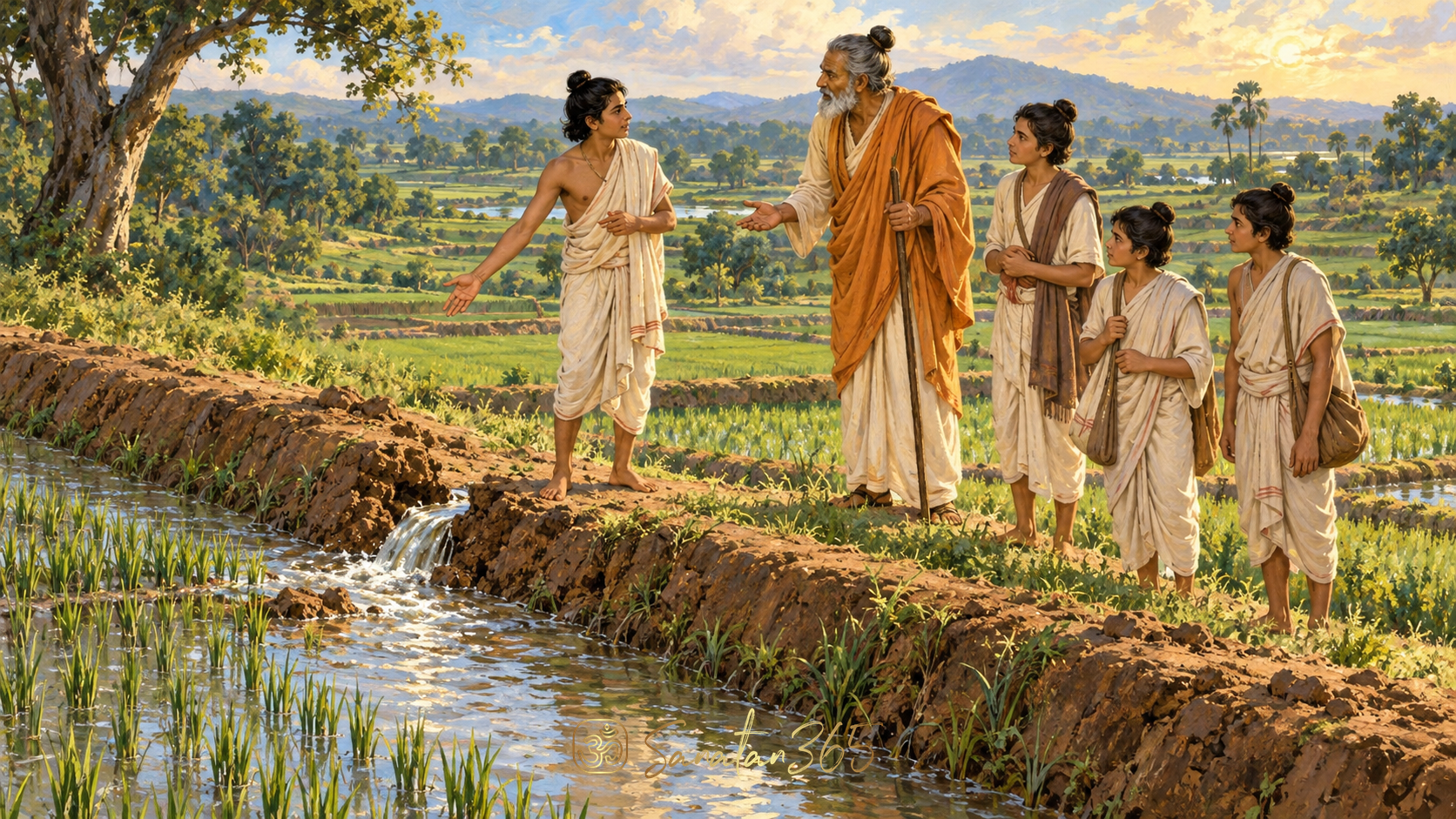
Aruni lessons concern responsibility, persistence and the relationship between a student and a teacher. In the epic’s opening book, Aruni tries to stop a breach in his teacher’s field, uses his own body when other means fail, and rises when his teacher comes looking for him. A careful reading honours his resolve while recognising that modern responsibility requires communication, help and safety, not self-endangerment.
The short episode can seem simple when reduced to “obey the teacher.” Read more closely, however, and its sequence becomes richer. A task is assigned. Ordinary efforts fail. A student makes an extraordinary choice. His absence is noticed. A teacher and other students go to find him. The story ends in conversation and blessing, not in the student remaining unseen.
The account below follows the Mahabharata’s Adi Parva, section III, in Kisari Mohan Ganguli’s translation. The narrative details belong to that text; the suggestions for families and classrooms are contemporary applications, not instructions quoted from the epic.
What does the Aruni lessons episode actually say?
The Mahabharata, a Sanskrit epic concerned with human action and its consequences, introduces the teacher Ayodha-Dhaumya and three disciples: Aruni, Upamanyu and Veda. Aruni is described as being from Panchala. His teacher sends him to stop a breach in a field’s watercourse. The translation describes his difficulty as being unable to stop it “by ordinary means.” It does not give a detailed engineering account of what he tried.
Aruni becomes distressed because he cannot accomplish the assignment. He then enters the breach and lies down in it, confining the water with his body. Later, Dhaumya asks the other students where Aruni is. They remind him of the task he assigned. The teacher responds by taking the students to the field.
When Dhaumya calls to him, Aruni gets up and comes before him. He explains that he could find no other means of stopping the flow, and that rising to answer the teacher has allowed the water to escape again. He then asks what he should do next. Dhaumya gives him the name Uddalaka in connection with his rising from the ditch and blesses his learning. The passage then says Aruni went to the country after his heart. These are the events presented in the cited section.
Two distinctions prevent careless retelling. First, the teacher asks him to repair the breach; the text does not say that Dhaumya explicitly orders him to use his body. Second, the teacher comes looking for him and calls him out. Those details matter when the story is discussed with young readers.
This article stays with the field episode rather than combining different passages into a single invented biography. Its purpose is to read one short narrative accurately and consider what it can responsibly teach today.
Key takeaway: Accurate storytelling begins with the actual sequence, including the failed ordinary efforts and the teacher’s search.
Why is a breach in a field an ethical test?
A watercourse directs a resource on which cultivation depends. A gap in its bank is therefore not merely a small imperfection. It can interrupt the intended movement of water and affect the field. Aruni recognises that the assignment has a purpose beyond satisfying a teacher’s words.
That is the first useful lesson: responsibility involves noticing what a task is for. A person who is asked to put away a book is helping preserve it and make it available again. A person who is asked to close a tap is preventing waste. The visible action is small; the care behind it is larger.
The epic expresses Aruni’s commitment through an extreme narrative act. Modern readers need not copy that act to understand the seriousness it conveys. Indeed, using a body to block water is dangerous and must never become a practical activity for children, students or untrained adults. The meaningful transfer is attentiveness to consequences, not imitation of the physical method.
A useful distinction is between effort and completion. Effort says, “I tried.” Completion asks, “Is the intended problem actually resolved?” Aruni does not walk away merely because the first approach is unsuccessful. He continues thinking about the result. In ordinary life, that habit can be valuable when paired with good judgement and timely assistance.
For example, a student who cannot repair a torn library-book cover should not hide the damage or improvise a harmful repair. The responsible next step is to inform the librarian. A family member who notices a leaking pipe should alert someone able to handle it safely. Taking ownership includes knowing when another person’s skill is required.
The story can also illuminate dharma (धर्म, ethical responsibility and sustaining order). Here that idea need not be turned into a rigid rule. It invites attention to the people, resources and relationships affected by an action. The moral question becomes more precise: what would preserve the purpose of the task while caring for everyone involved?
Key takeaway: Taking a task seriously means understanding its purpose, checking the result and seeking help when the available method is unsafe or inadequate.
What does the teacher’s search add to the lesson?
The teacher’s search is sometimes left out of condensed retellings, yet it changes the emotional shape of the episode. Aruni’s absence does not remain an unnoticed detail. Dhaumya asks where he is, hears the answer and goes with the other disciples to find him.
It would overstate the text to claim that this scene provides a complete modern theory of pastoral care. It does, however, give readers a concrete action to consider: the teacher checks on the person carrying out the assignment. The field matters, but so does the student.
The group’s arrival also breaks the student’s isolation. Aruni no longer faces the difficulty alone. When called, he rises, reports what happened and asks for the next instruction. The narrative contains a movement from solitary resolve toward relationship and explanation. That is a more useful educational emphasis than praising silent endurance without limits.
For a contemporary teacher, parent or team leader, the application is straightforward. Assignments should be matched to ability. Instructions should identify boundaries. A child should know whom to contact when confused, and an adult should notice when a task takes unexpectedly long. Care is not the opposite of high standards; it makes responsible standards possible.
Consider a child asked to organise materials after a community event. Clear guidance might include which objects can be lifted, where they belong and which heavy items must be left for adults. A check-in turns a vague demand to “help” into a supported responsibility. It also makes it easier for the child to say that a problem has arisen.
The importance of truthful reporting connects naturally with Satyakama Jabala’s lesson in honest learning. The two episodes are different, but both can prompt a discussion about what a good learning relationship requires. Respect and truthful speech belong together.
Key takeaway: A task is not responsibly assigned unless the person doing it has guidance, a safe way to ask for help and someone attentive to their welfare.
How can responsibility be taught without unsafe obedience?
Reverence for teachers is deeply valued in Hindu learning traditions. Guru (गुरु, teacher or spiritual guide) names a relationship whose purpose is learning, not the disappearance of judgement. When a sacred story contains an extraordinary act, readers should distinguish its narrative force from an everyday rule.
Aruni’s bodily response demonstrates how completely he identifies with the task. It does not make self-endangerment a condition of being a worthy student. No child should be told that risking injury proves devotion, or that questioning an unsafe instruction is disrespectful. These are essential limits in a modern educational application.
A practical framework preserves the story’s seriousness without copying its danger:
- Understand the purpose. Ask what the task is meant to protect, improve or complete.
- Check the conditions. Notice whether the task is within ability and whether tools or supervision are needed.
- Try safe, appropriate means. Effort matters, but improvisation must stay within safe boundaries.
- Report obstacles early. Explain what has been tried and what remains unresolved.
- Request help or a revised plan. Asking for support can be the most responsible action available.
- Confirm the outcome. Let the person who assigned the task know what was completed and what still needs attention.
This framework is a contemporary teaching aid. It is not a six-step procedure found in the Mahabharata. Labelling that distinction protects both the text and the reader from confusion.
Respectful disagreement can also be taught through specific sentences: “I understand why this needs doing, but I cannot do it safely”; “Could someone show me the right method?”; or “This is taking longer than expected, and I need help.” Such language keeps commitment visible while making limitations clear.
The related Dharmavyadha lessons on learning and daily duty offer another reminder that spiritual seriousness is tested in conduct. Responsibility is not an impressive display; it is care made reliable in the situation at hand.
Key takeaway: Honour the student’s commitment while making clear that good judgement, truthful communication and safety are part of responsibility.
How can families turn the story into a thoughtful conversation?
Families in India and the diaspora may encounter Aruni through oral storytelling, school lessons or translated editions. A short account can be read aloud, but the discussion should remain open enough for children to ask difficult questions. There is no need to present every decision in the narrative as an action to repeat.
Begin by inviting the child to reconstruct the sequence. What was Aruni asked to do? What problem did he face? What did the teacher do when Aruni did not return? Separating events from interpretations helps children learn careful reading before they are asked to extract a moral.
Then ask about alternatives. “If a task is too difficult, who could help?” “What would be a safe way to tell the teacher that the first method did not work?” “How could the teacher make the assignment clearer?” These questions do not diminish the story. They make its relevance thoughtful rather than automatic.
A paper-based activity is enough. Draw a field and a channel on a sheet, then mark a gap in the bank. Ask the child to write three possible next steps, including reporting the problem to an adult. Do not reenact the episode in water, ditches or irrigation channels. The learning goal is to practise decision-making, not to test physical endurance.
Older children can compare two statements: “A responsible person never asks for help” and “A responsible person makes sure a problem is handled well.” Which statement better protects the purpose of a task? Which makes truthful reporting easier? The contrast exposes a common misunderstanding: needing support is not the same as refusing responsibility.
The discussion can end with one modest household example. Returning borrowed materials, checking that a shared room is tidy or telling an adult about a broken item are suitable tasks. The chosen activity should fit the child’s age and ability, and completion should include a brief report. There is no spiritual benefit to making the task needlessly difficult.
Key takeaway: Good storytelling invites accurate recall, thoughtful questions and safe examples rather than a test of unquestioning obedience.
What can Aruni teach about finishing a task well?
Finishing well has two sides: the task’s outcome and the relationship around it. Aruni’s explanation identifies both. He tells the teacher what he did, why he did it and what changed when he rose. He does not pretend that the water remains confined after he has left the breach.
That honest description is especially useful today. An incomplete task becomes harder to resolve when its condition is concealed. Clear reporting allows another person to decide what to do next. Even a sincere effort should not be described as a completed result if the underlying problem remains.
The teacher’s blessing gives the episode its traditional conclusion. In family discussion, the lasting emphasis can be a quieter one: commitment should grow more intelligent as it grows stronger. Care for a field, a book, a shared space or a community undertaking should include care for the people involved.
Key takeaway: Aruni’s resolve is best carried forward as attentive, truthful and supported responsibility, never as an obligation to suffer or take unsafe risks.
FAQ
Where is Aruni’s field story found?
It appears in the Mahabharata’s Adi Parva, within the Paushya Parva. In Kisari Mohan Ganguli’s English translation, it is in section III, alongside accounts of Ayodha-Dhaumya’s other disciples. Section numbering may differ between editions.
Why does Aruni lie in the breach?
In the narrative, he cannot stop the water by ordinary means and chooses to use his body. The action conveys extraordinary resolve. It is not a safe method to imitate, nor a requirement that modern students should follow.
Why is Aruni called Uddalaka?
The cited passage connects the name to his rising from the ditch when the teacher calls. Dhaumya gives the name as a mark of favour. This is the narrative’s explanation, not a claim about independently established historical etymology.
What is the main lesson for children?
A useful lesson is to understand a task, make a sincere effort, report obstacles and seek appropriate help. Adults should explicitly add that responsibility never requires dangerous behaviour or silence about a problem.
Does respecting a teacher mean never asking questions?
No. In a healthy learning relationship, respectful questions and honest reports help learning. A student can value a teacher while saying that an instruction is unclear, beyond their ability or unsafe. The story can begin that conversation without becoming a rule of blind obedience.
About the author
Sanatan365 Editorial
Bringing Sanatan Dharma to modern seekers through authentic, scripture-grounded content.
Related in Lessons
 Lessons
Dharmavyadha Lessons: When Daily Duty Teaches a Scholar
The Mahabharata’s Dharmavyadha episode asks how anger, learning, and ordinary responsibilities reveal the quality of spiritual practice.
 Lessons
Ashtavakra and Bandin: Wisdom Beyond Appearance
The Ashtavakra and Bandin story in the Mahabharata follows a young scholar who enters King Janaka's court, answers prejudice with learning,…
 Lessons
Gargi Vachaknavi: The Upanishadic Voice of Fearless Inquiry
Gargi Vachaknavi stands in the Brihadaranyaka Upanishad as a formidable questioner whose disciplined dialogue with Yajnavalkya reveals cour…

