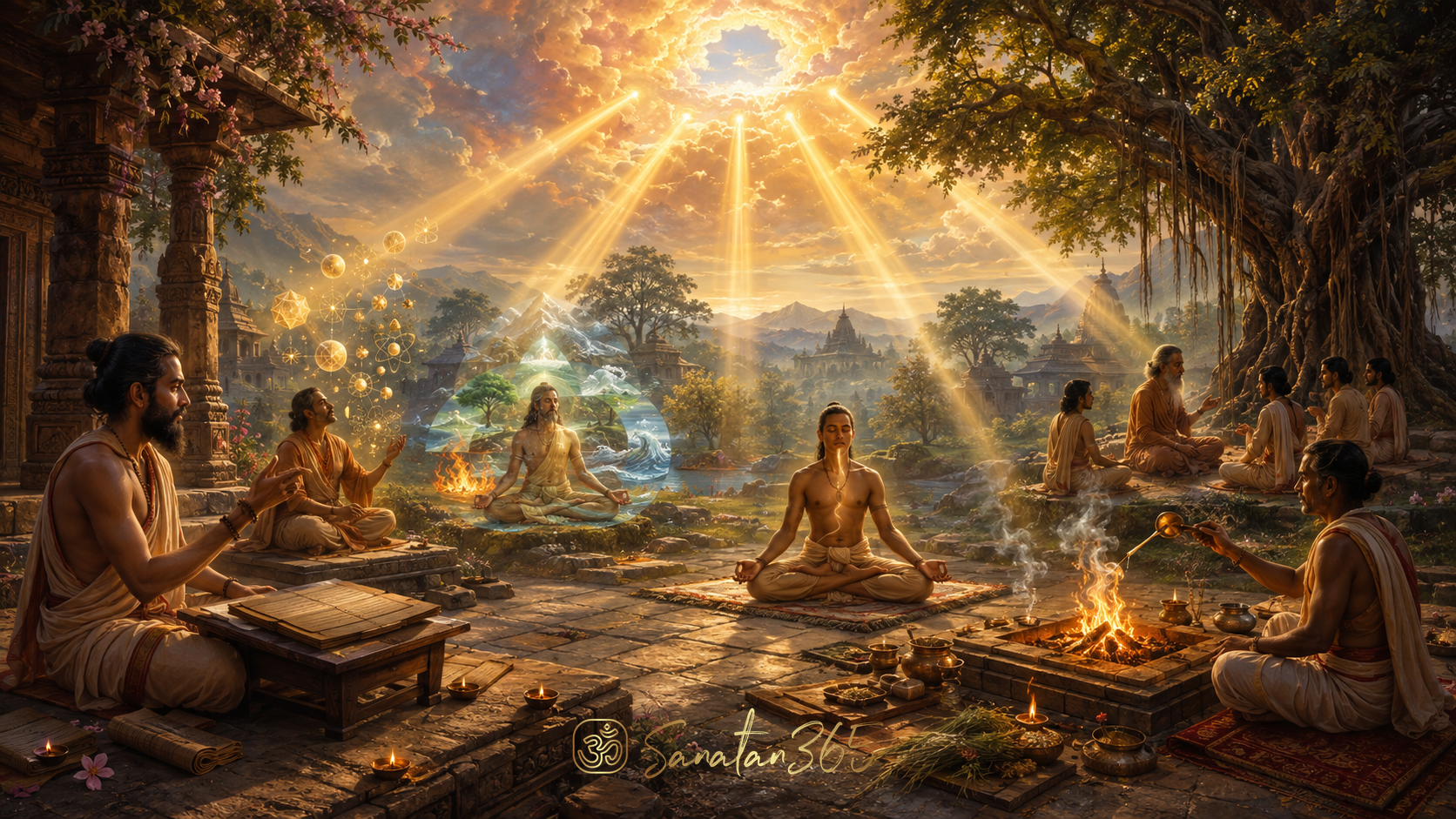
Shad Darshana Meaning: Six Ways Hindu Philosophy Sees Truth
The Shad Darshanas are six classical Hindu systems of inquiry: Nyaya, Vaisheshika, Samkhya, Yoga, Mimamsa, and Vedanta. Their disagreements reveal a disciplined tradition in which logic, action, meditation, and liberation can be examined through distinct yet connected lenses.
Hindu philosophy did not preserve wisdom by requiring every thinker to say the same thing. It preserved a disciplined conversation about what can be known, what is real, how action bears fruit, why suffering persists, and what freedom means.
The Shad Darshanas are the six classical Veda-affirming systems of Hindu philosophy: Nyaya, Vaisheshika, Samkhya, Yoga, Mimamsa, and Vedanta. Shad (षट्, ṣaṭ) means “six,” while darshana (दर्शन, darśana) means “seeing,” “viewpoint,” or a disciplined vision of reality. Each school develops its own methods and conclusions, yet all participate in the wider search for right knowledge, right action, and liberation.
What Does Shad Darshana Mean in Hindu Philosophy?
The Shad Darshana meaning becomes clearer when darshana is understood as more than a modern “philosophy” in the abstract. The Sanskrit root dṛś means “to see.” A darshana is therefore a way of seeing that trains both understanding and life. It asks not only, “What ideas are correct?” but also, “What kind of knowing loosens confusion?”
The six are often called astika (आस्तिक, āstika) systems. In this classification, astika does not simply mean “theist.” It indicates acceptance of Vedic authority in some meaningful sense. A school may still debate the nature of Ishvara, the status of the world, the self, ritual duty, or the means of liberation. The category marks a relationship to the Vedas, not agreement on every doctrine.
This prevents two common mistakes. First, the six schools are not six denominations competing for a single institutional throne. They are rigorous intellectual and spiritual traditions, each with foundational texts, arguments, teachers, and internal debates. Second, they should not be reduced to six slogans. “Yoga means meditation” or “Vedanta means oneness” cannot carry the precision of centuries of commentary.
The Internet Encyclopedia of Philosophy’s overview of Hindu philosophy situates these systems within a much wider field of Hindu reflection. That breadth matters: Shad Darshana is a useful classical map, but it is not a claim that every Hindu tradition fits neatly into only six boxes.
Key takeaway: Shad Darshana names six disciplined ways of seeing, not six interchangeable summaries of one doctrine.
Why Are These Six Schools Grouped Together?
Later histories often present the six schools in three pairs: Nyaya with Vaisheshika, Samkhya with Yoga, and Mimamsa with Vedanta. The pairing is useful because the traditions influenced one another and sometimes shared conceptual tools. Yet it should not erase their differences.
They are grouped together because each became a sustained classical system concerned with reliable knowledge, reality, human action, and the possibility of moksha (मोक्ष, mokṣa), liberation from bondage. They also argued across boundaries. A Vedantin could borrow Nyaya reasoning while rejecting a Nyaya conclusion. Yoga could use Samkhya categories while giving Ishvara a distinctive place. Philosophical disagreement was often carried through objections, replies, and careful definitions rather than through the assumption that questions were unwelcome.
The six schools can be approached through four shared questions:
- How do we know? Which pramanas (प्रमाण, pramāṇas), or valid means of knowledge, can be trusted?
- What exists? Is reality composed of enduring substances, changing nature, consciousness, Brahman, or other categories?
- What binds a person? Is bondage rooted in false knowledge, misidentification, karma, desire, or failure to understand sacred duty?
- What liberates? Does freedom arise through knowledge, discriminative insight, disciplined practice, Vedic action, divine grace, or a relationship among these?
These questions connect naturally with the Hindu understanding of life’s aims described in the four Purusharthas. Philosophy is not separated from dharma, meaningful worldly life, or liberation. It helps clarify how these aims relate.
Key takeaway: The six darshanas belong together because they sustain a shared field of inquiry, even where their answers remain genuinely different.
What Do Nyaya and Vaisheshika Teach About Knowledge and Reality?
Nyaya: disciplined reasoning and reliable knowledge
Nyaya (न्याय, Nyāya) is frequently introduced as the school of logic, but its purpose is larger than winning arguments. It examines how reliable knowledge arises and how error can be identified. Classical Nyaya discusses perception, inference, comparison, and verbal testimony as means of knowledge. Its analysis of debate, fallacy, doubt, and inference helped shape reasoning across Indian intellectual traditions.
The practical insight is demanding: confusion is not cured by confidence alone. A claim needs grounds. Perception can mislead under poor conditions; inference needs a dependable relation; testimony depends on a trustworthy source and proper understanding. Nyaya turns intellectual care into a spiritual responsibility because false knowledge helps sustain suffering.
Vaisheshika: categories of what exists
Vaisheshika (वैशेषिक, Vaiśeṣika) asks how reality can be classified. It became known for a detailed account of padarthas (पदार्थ, padārthas), fundamental categories of knowable reality, including substance, quality, motion, universality, particularity, and inherence; later presentations commonly include absence as well.
Its discussions of atoms should not be casually equated with modern physics. Vaisheshika atomism belongs to its own metaphysical system and historical vocabulary. Its lasting intellectual gesture is classification: before explaining change, causation, or identity, one must ask what kinds of things are being discussed and how qualities relate to their bearers.
Nyaya and Vaisheshika gradually interacted so closely that later scholarship often treats them as a combined tradition. Still, their starting emphases differ: Nyaya foregrounds knowing and reasoning, while Vaisheshika foregrounds the structure and categories of reality. Encyclopaedia Britannica’s account of Indian philosophy provides a concise historical orientation to these classical developments.
Key takeaway: Nyaya sharpens the instruments of knowledge; Vaisheshika sharpens the categories through which reality is described.
How Do Samkhya and Yoga Explain Consciousness and Freedom?
Samkhya: distinguishing consciousness from nature
Samkhya (सांख्य, Sāṃkhya) offers an influential analysis of experience through the distinction between purusha (पुरुष, puruṣa), conscious witness, and prakriti (प्रकृति, prakṛti), primordial nature. Prakriti unfolds through principles that include intellect, ego-sense, mind, sensory capacities, subtle elements, and material elements. Purusha is not another material component within that unfolding.
Bondage arises when consciousness identifies with nature’s changing processes: “I am this fear,” “I am this role,” “I am this restless mind.” Samkhya’s liberating insight is viveka (विवेक, viveka), discriminative discernment between the seer and the seen. This is not indifference to life. It is clarity about what changes and what illumines change.
Yoga: making discernment lived and stable
Classical Yoga shares much of Samkhya’s analytic framework but emphasizes disciplined practice. Patanjali’s Yoga Sutra describes yoga as the stilling of the movements of mind and presents an eight-limbed discipline involving ethical restraints, observances, posture, breath regulation, sensory withdrawal, concentration, meditation, and absorption.
Yoga also gives Ishvara (ईश्वर, Īśvara), a special purusha untouched by affliction and karma, a meaningful place in practice. Commentarial interpretations differ, and the system should not be collapsed into posture practice alone. Its central concern is how habits of mind become transparent enough for discriminative knowledge to remain steady.
The pairing teaches a simple distinction. A map of consciousness is not identical with the training required to embody its insight. Samkhya supplies a powerful analysis; Yoga organizes sustained transformation. The relationship resembles the difference between understanding vairagya, or non-attachment and patiently cultivating it.
Key takeaway: Samkhya explains the distinction between consciousness and nature; Yoga disciplines attention so that distinction becomes experiential freedom.
Why Do Mimamsa and Vedanta Read the Vedas Differently?
Mimamsa: dharma, language, and the authority of action
Mimamsa (मीमांसा, Mīmāṃsā) means disciplined inquiry or reflection. Purva Mimamsa focuses especially on the earlier, ritual portions of the Vedas and on dharma (धर्म, dharma) as known through Vedic injunction. It developed sophisticated accounts of language, interpretation, duty, and the relation between action and result.
To call Mimamsa “only ritualism” misses its depth. The school asks how sacred sentences convey obligation, how apparently conflicting passages should be interpreted, and why the Veda can function as an authoritative source for matters not available to ordinary perception. Its tools influenced law, grammar, theology, and scriptural interpretation far beyond formal ritual discussion.
Vedanta: inquiry into Brahman, Atman, and liberation
Vedanta (वेदान्त, Vedānta) literally means the “end of the Veda,” referring both to the Upanishads and to their culminating concern. Its foundational triad is commonly described as the Upanishads, Bhagavad Gita, and Brahma Sutras. Vedanta asks about Brahman, Atman, the world, bondage, knowledge, devotion, and liberation.
There is no single undifferentiated Vedanta position. Advaita, Vishishtadvaita, Dvaita, and other lineages interpret the relationships among Brahman, individual selves, and the world differently. Some emphasize non-dual identity; others qualified unity, eternal distinction, devotion, and grace. Treating “Vedanta” as a synonym for only one school erases a living family of arguments.
Mimamsa and Vedanta both take Vedic interpretation with utmost seriousness, but they often foreground different portions and aims. Mimamsa gives sustained attention to injunction, sacred action, and dharma. Vedanta foregrounds Upanishadic knowledge and liberation while developing diverse accounts of devotion and disciplined action. Their disagreement shows how a shared scripture can generate precise, responsible, and plural interpretation.
Key takeaway: Mimamsa clarifies Vedic duty and interpretive method; Vedanta explores the ultimate teaching of Brahman, self, world, and freedom through several distinct lineages.
How Can a Beginner Compare the Six Darshanas Without Flattening Them?
A beginner does not need to choose a school after reading six paragraphs. A better first step is to learn what question each tradition asks especially well.
- Nyaya: What makes a belief reliable rather than merely persuasive?
- Vaisheshika: What categories are needed to describe reality carefully?
- Samkhya: What changes in experience, and what is conscious of that change?
- Yoga: What disciplines make clarity stable in body, conduct, and mind?
- Mimamsa: How should sacred language, duty, and action be interpreted?
- Vedanta: What is the deepest relation among self, ultimate reality, world, devotion, and liberation?
Three habits protect against oversimplification:
- Read a trustworthy overview, then a primary text in translation. Sutra literature is compressed, so commentary is not optional decoration; it carries the argument.
- Distinguish a school from one later lineage within it. “Vedanta says” may hide major differences. “Yoga says” may confuse Patanjali’s system with every practice called yoga today.
- Let disagreement remain informative. Traditions need not be forced into artificial sameness to belong within a shared sacred civilization.
This last habit is especially valuable. Sanatan Dharma holds many paths of knowledge, action, meditation, and devotion without requiring contempt for another path. Respect does not mean pretending distinctions are unreal. It means representing each view honestly, learning its reasons, and refusing to turn philosophical difference into hostility.
The six schools also invite self-examination. A person drawn to logic may need contemplative discipline. A dedicated practitioner may benefit from clearer reasoning. A student of non-duality may still need attention to ethics and action. A ritual participant may discover profound philosophy within the structure of sacred duty. The darshanas become fruitful when they refine character as well as vocabulary.
Key takeaway: Compare each school through its own central questions, texts, and methods before searching for a quick synthesis.
The Shad Darshanas show that Hindu thought is not weakened by serious questions. It is strengthened by methods capable of carrying them. Nyaya tests knowledge, Vaisheshika classifies reality, Samkhya distinguishes consciousness from nature, Yoga trains the mind, Mimamsa interprets duty, and Vedanta investigates ultimate reality and liberation.
Their enduring gift is not a neat chart. It is a culture of inquiry in which reason, practice, scripture, and spiritual realization remain answerable to one another.
Key takeaway: The six darshanas offer different disciplines of seeing, and their conversation teaches seekers to pursue truth with both conviction and humility.
FAQ
What is the simple meaning of Shad Darshana?
Shad Darshana means the six classical Veda-affirming systems of Hindu philosophy: Nyaya, Vaisheshika, Samkhya, Yoga, Mimamsa, and Vedanta. Each offers a disciplined way to investigate knowledge, reality, action, suffering, and liberation.
Are the six schools of Hindu philosophy all the same?
No. They share a broad Vedic intellectual world, but they differ on valid knowledge, metaphysics, Ishvara, ritual authority, the self, and liberation. Their differences should be studied accurately rather than erased.
Does astika mean that every school believes in God in the same way?
No. In this philosophical classification, astika primarily indicates acceptance of Vedic authority. The schools differ substantially in how they discuss Ishvara and whether a creator is required within their explanations.
Is Yoga separate from Samkhya?
Classical Yoga draws heavily on Samkhya categories, especially the distinction between purusha and prakriti, but it is a distinct system with its own foundational text, disciplined method, and treatment of Ishvara.
Which darshana should a beginner study first?
There is no universal first choice. A broad scholarly overview followed by a reliable translation of a foundational text is a sound beginning. The best entry point depends on whether the reader is drawn toward logic, metaphysics, meditation, sacred action, or Upanishadic inquiry.
About the author
Sanatan365 Editorial
Bringing Sanatan Dharma to modern seekers through authentic, scripture-grounded content.
Related in Wisdom
 Wisdom
Pramana Meaning: How Hindu Philosophy Examines Knowledge
Explore pramana, the means of valid knowledge, through perception, inference and testimony, with clear distinctions among Hindu philosophic…
 Wisdom
Shadripu Meaning: Six Inner Adversaries and Responsible Choice
Understand desire, anger, greed, delusion, pride and envy as six inner adversaries, with practical distinctions that keep self-discipline h…
 Wisdom
Mudita Meaning: Joy in Another Person's Goodness
Explore mudita in Yoga Sutra 1.33: appreciative joy in another person's goodness, its limits, and a grounded way to practise it.

