Shaligram Stone Meaning: Vishnu in the Living Landscape of Gandaki
A Shaligram is both an ancient ammonite fossil and, in Vaishnava devotion, a naturally manifest sacred form of Lord Vishnu. Its meaning joins geology, pilgrimage, Tulsi, and simple daily worship.
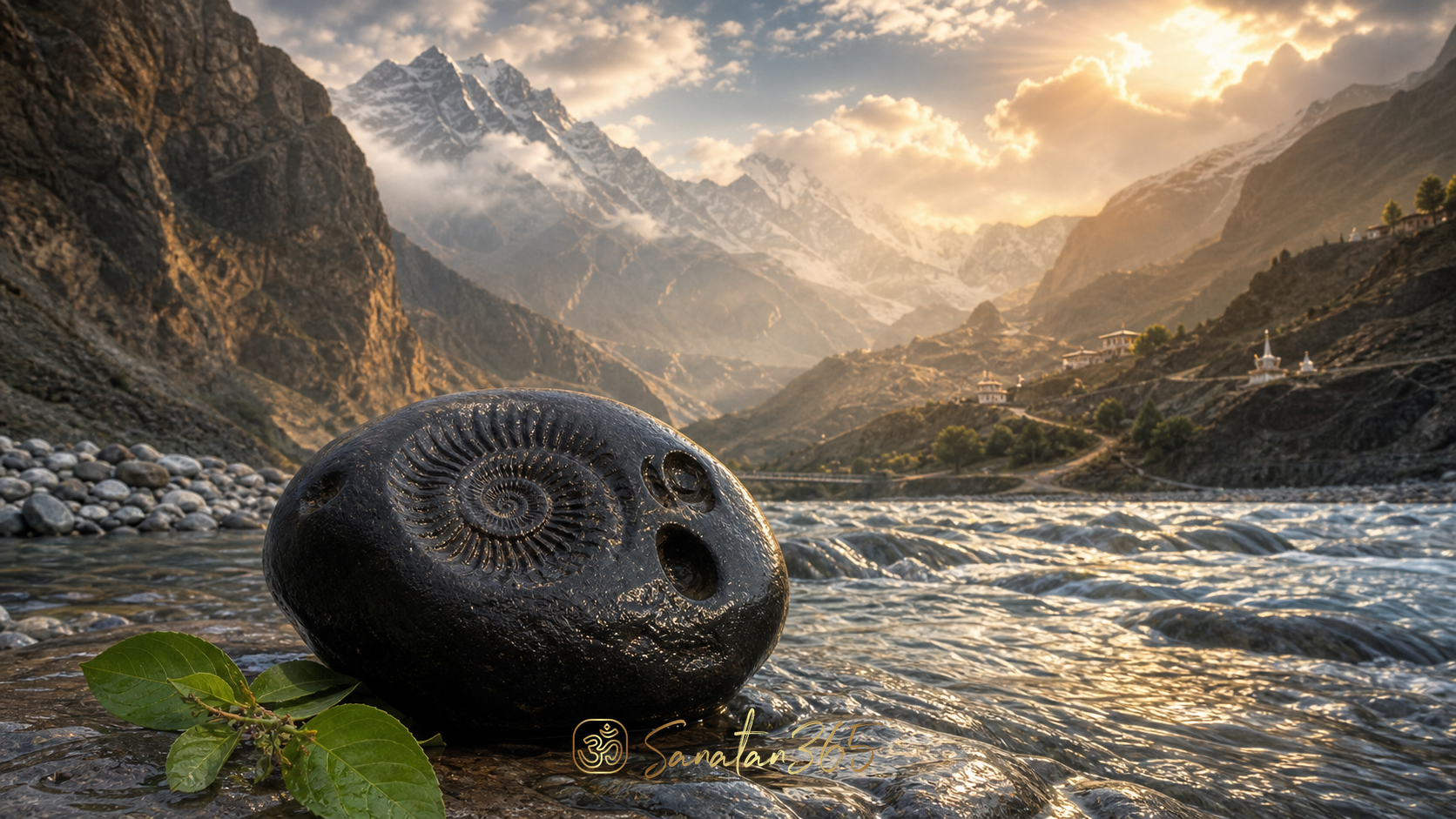
A Shaligram can fit in the palm, yet its meaning reaches from an ancient Himalayan seabed to the daily altar of a Vaishnava home. Shaligram stone meaning begins with this union: a naturally formed ammonite fossil from Nepal's Kali Gandaki River is revered as a self-manifest sacred form of Lord Vishnu, not merely as a stone decorated to resemble him.
Known more fully as Shaligrama Shila (शालिग्राम शिला, Śāligrāma-śilā, the sacred Shaligram stone), it brings landscape, scripture, pilgrimage, and household devotion into one relationship. Its spirals can be understood geologically as traces of ancient marine life and devotionally as chakra (चक्र, discus or sacred wheel) markings associated with Vishnu. These readings do not need to compete. For many devotees, nature's deep history is precisely what makes the form so wondrous.
What Is a Shaligram Stone and Why Is It Sacred?
A Shaligram is generally a dark, rounded fossil stone traditionally gathered from the Kali Gandaki River and its tributary landscape in Nepal. Scientific study identifies such forms as ammonites, extinct marine creatures whose coiled shells were preserved in rock over immense spans of time. Sacred tradition recognizes particular stones from this geography as manifestations of Vishnu.
This makes the Shaligram an example of aniconic worship: the Divine is encountered without a sculpted human-like image. The stone is not carved into Vishnu's body. Its form, openings, ridges, and spiral impressions arise through natural processes. In Vaishnava understanding, that unmade quality matters. The Shaligram is often described as svayambhu (स्वयम्भू, self-manifest), a sacred presence not dependent upon an artisan's hand.
Lord Vishnu is revered as the sustaining and preserving dimension of the Divine. Encyclopaedia Britannica's overview of Vishnu describes his central place in Hindu tradition and his association with preserving cosmic order. A Shaligram therefore becomes more than a symbol of permanence. Its patient geological formation, river-worn surface, and enduring presence can invite reflection on dharma (धर्म, the order and responsibility that sustains life).
The Shaligram also challenges a common modern assumption: sacred art must be manufactured before it can become meaningful. Here, recognition comes before alteration. Devotion learns to see form in what the river has already revealed.
Key takeaway: A Shaligram is revered as a naturally manifest form of Vishnu whose sacredness is inseparable from its uncarved origin and Gandaki landscape.
Why Does the Kali Gandaki River Matter to Shaligram Stone Meaning?
The Kali Gandaki flows through the Himalayan region of Mustang and past pilgrimage landscapes linked with Muktinath. Shaligrams are not simply a category of black stones found anywhere. Place is part of their identity. The river carries fossils out of mountain strata, moves them through water and sediment, and reveals them along its banks.
Anthropological research published by The Conversation on Shaligrams and the Kali Gandaki emphasizes that devotees understand these stones through the sacred geography of the valley. The landscape is not a warehouse holding religious objects. River, mountain, pilgrimage route, story, and stone form one living sacred world.
This place-based meaning also explains why ecological disruption matters spiritually. River engineering, extraction, road construction, climate change, and altered water flow can affect where Shaligrams appear and how pilgrims reach them. Respect for a sacred object cannot be separated from respect for the habitat and communities that hold its tradition.
For diaspora families, a Shaligram kept thousands of kilometres away can retain this geographical memory. Daily worship recalls the Gandaki even when the devotee cannot make the pilgrimage. Water poured gently over the stone evokes the river without pretending that a home ritual replaces the actual landscape.
There is an ethical lesson here. Pilgrimage is not ownership. Receiving a sacred form should deepen care, restraint, and gratitude rather than encourage indiscriminate collection or commercial exploitation.
Key takeaway: The Kali Gandaki is not incidental provenance; it is an active part of the Shaligram's sacred identity and calls devotees toward ecological responsibility.
How Do Geology and Devotion Meet in the Shaligram Fossil?
At first glance, “fossil” and “divine form” may sound like rival descriptions. They answer different questions. Geology asks how a material form developed: an ammonite shell was buried, mineralized, lifted through tectonic processes, exposed, and carried by a Himalayan river. Devotion asks how that form is received, related to, and understood within a sacred life.
Neither account needs to erase the other. The fossil's antiquity can enlarge devotional wonder. Long before a household placed Tulsi beside it, the form passed through ocean, stone, uplift, and river. The worshipper encounters not a mass-produced emblem but a record of profound time.
Traditional classification pays close attention to the stone's markings. Spiral impressions are often read as the Sudarshana Chakra, Vishnu's discus, while shapes, openings, colour, and lines may be associated with particular forms or names of Vishnu. Classification systems vary between texts, regions, and lineages. Responsible explanation therefore avoids declaring that every unusual marking has one universally accepted identity.
The important distinction is between recognition and fabrication. A naturally occurring mark may be interpreted within tradition; a newly carved or artificially drilled stone is not the same thing. Buyers should be cautious of certainty claims, miracle marketing, and aggressive sales language. Sacred trust is weakened when commercial confidence replaces provenance and humility.
This is also why a Shaligram should not be marketed as a lucky charm or a device guaranteed to produce wealth, health, marriage, or protection. Hindu devotion is not a vending transaction. Vishnu worship can cultivate steadiness, gratitude, truthfulness, service, and remembrance, but it does not cancel human responsibility or guarantee material outcomes.
Key takeaway: Geology explains the Shaligram's formation, while devotion explains its sacred relationship; together they invite wonder without superstition or denial of nature.
What Is the Relationship Between Shaligram, Vishnu, and Tulsi?
Tulsi (तुलसी, sacred basil) holds an especially intimate place in Vaishnava devotion. Traditional narratives connect Tulsi, also called Vrinda, with Vishnu and the Gandaki landscape. Versions differ across Puranic and regional tellings, so the story is best approached as sacred narrative rather than flattened into a single historical report.
In household worship, clean Tulsi leaves may be offered to Vishnu and placed respectfully near a Shaligram. The pairing expresses more than ritual correctness. Tulsi represents devoted relationship, fragrance, care, and living renewal; the Shaligram represents enduring presence shaped through deep time. Leaf and stone bring the growing world and the ancient world together.
Tulsi Vivah, the ceremonial wedding of Tulsi with Vishnu or a Vishnu form, gives this relationship a festival setting in many communities. Practices differ across North India, western India, Nepal, and diaspora homes. Some families include a Shaligram; others worship Vishnu through another established form. No household needs to imitate a custom outside its own lineage merely to make devotion “complete.”
The ethical centre of the pairing is reciprocity. Tulsi must be tended as a living plant, not treated only as ritual inventory. Leaves should be taken carefully according to family custom, without stripping or damaging the plant. The Shaligram should likewise be handled as sacred presence, not displayed as a collectible specimen.
Key takeaway: Tulsi and Shaligram express a relationship between living devotion and enduring divine presence, shaped by lineage and careful daily attention.
How Is Shaligram Worship Practised Respectfully at Home?
Shaligram worship can be simple, but simple does not mean casual. Different Vaishnava sampradayas (सम्प्रदाय, teaching lineages) and family traditions give different instructions. Anyone who inherits or receives a Shaligram should first ask a knowledgeable elder, temple priest, or trusted teacher from the relevant lineage.
A modest daily practice may include:
- Bathe and approach the altar with clean hands and a settled mind.
- Place the Shaligram on a clean, dedicated altar surface.
- Offer clean water gently, where family practice permits, and dry the area responsibly.
- Offer Tulsi leaves, flowers, incense, or a lamp according to custom and household safety.
- Recite a Vishnu name or mantra already received or used in the family, such as a simple repetition of “Om Namo Narayanaya.”
- Conclude with gratitude, pranama (प्रणाम, reverent salutation), and a practical act of dharma.
Water and offerings should never become wasteful. Large quantities are not more devotional than careful quantities. If milk or other substances are used in a lineage-specific abhisheka (अभिषेक, ritual bathing), they should be handled hygienically and without creating food waste or drainage problems. Many homes can keep the practice to clean water.
Daily consistency also matters. Some traditions hold that a Shaligram is already sacred and does not require prana pratishtha (प्राण प्रतिष्ठा, a formal rite of establishing sacred presence) in the way a newly made murti may. That does not mean it requires no care. The absence of an installation ceremony increases, rather than reduces, the emphasis on sustained relationship.
If a family cannot maintain an inherited Shaligram, it should not discard, sell, or casually transfer it. A respected Vaishnava temple, priest, or lineage elder can advise an appropriate next step. The goal is continuity with dignity, not fear.
Key takeaway: Respectful Shaligram worship is clean, simple, lineage-aware, ecologically careful, and expressed through daily ethical conduct as much as offerings.
What Can the Shaligram Teach Beyond the Altar?
The Shaligram gathers several teachings into one small form.
First, sacred presence may be recognized rather than manufactured. The stone trains attention. Its value does not depend on polish, size, price, or spectacle.
Second, preservation is active. Vishnu's sustaining principle is not passive resistance to change. The Shaligram itself carries evidence of enormous change: sea became mountain, shell became fossil, rock entered river, and pilgrimage brought the form into relationship. What endures is not sameness but continuity through responsible transformation.
Third, devotion includes place. To honour a Gandaki Shaligram while ignoring the river's health would divide worship from dharma. Sacred geography asks for restraint in collecting, honesty in trade, respect for Nepal's communities, and attention to environmental change.
Fourth, a home altar should shape life outside the altar. Water offered to Vishnu should sharpen concern for water conservation. Tulsi offered with love should deepen care for plants. Repeated divine names should make speech more truthful. A sacred stone held gently should make other beings less disposable.
The Shaligram therefore resists two reductions. It is not “only a fossil,” because human communities have met it through centuries of sacred relationship. It is not a magical commodity, because devotion cannot be bought by acquiring a rare object. Its deepest meaning emerges through reverence, responsibility, and sustained practice.
Key takeaway: The Shaligram makes preservation tangible: honour deep time, sacred place, living tradition, and the responsibilities that keep them connected.
Conclusion
Shaligram stone meaning cannot be contained in a label. It is an ammonite fossil, a gift of the Kali Gandaki, a self-manifest form of Lord Vishnu in Vaishnava tradition, a companion to Tulsi, and a discipline of careful seeing. Its uncarved form reminds the devotee that the sacred may already be present before human hands intervene.
Key takeaway: To honour a Shaligram is to honour Vishnu through reverence for natural form, sacred geography, faithful practice, and the dharma of preservation.
FAQ
What is a Shaligram stone?
A Shaligram, or Shaligrama Shila, is a naturally formed fossil stone traditionally found in Nepal's Kali Gandaki River region and revered in Vaishnava Hindu tradition as a sacred form of Lord Vishnu.
Is a Shaligram an ammonite fossil or Lord Vishnu?
Geologically, Shaligrams are associated with ammonite fossils. Devotionally, particular naturally marked stones from the Gandaki landscape are received as manifestations of Vishnu. The descriptions address material formation and sacred meaning, so many devotees hold both together.
Does a Shaligram need prana pratishtha?
Many Vaishnava traditions regard the Shaligram as self-manifest and therefore not dependent on a formal prana pratishtha ceremony. Customs vary, so a family should follow its lineage or seek guidance from a trusted Vaishnava teacher.
Why are Tulsi leaves offered to a Shaligram?
Tulsi is deeply associated with Vishnu worship and with sacred narratives connecting Vrinda, Vishnu, and the Gandaki. Offering clean Tulsi leaves expresses devotion, relationship, and living care.
Can anyone keep a Shaligram at home?
Traditions differ on preparation and daily obligations. A sincere person should not treat a Shaligram as décor or a collectible. Before bringing one home, it is wise to learn the expected care from a trusted elder, temple, or lineage teacher and to verify ethical provenance.
About the author
Sanatan365 Editorial
Bringing Sanatan Dharma to modern seekers through authentic, scripture-grounded content.
Related in Deities
 Deities
Ushas, the Vedic Goddess of Dawn: Light, Renewal, and Time
Ushas, the Vedic goddess of dawn, appears in the Rigveda as radiant light that awakens life, calls beings to activity, and reveals both ren…
 Deities
Chitragupta Meaning: Divine Records and Ethical Accountability
Chitragupta is remembered as the divine keeper of karmic records in Yama's court. His symbolism connects writing, memory, justice, and ethi…
 Deities
Varuna Deva Meaning: Rta, Waters, and Cosmic Order
Discover Varuna Deva's Vedic role as guardian of rta, his bond with waters, and what his hymns teach about truth, accountability, and mercy.