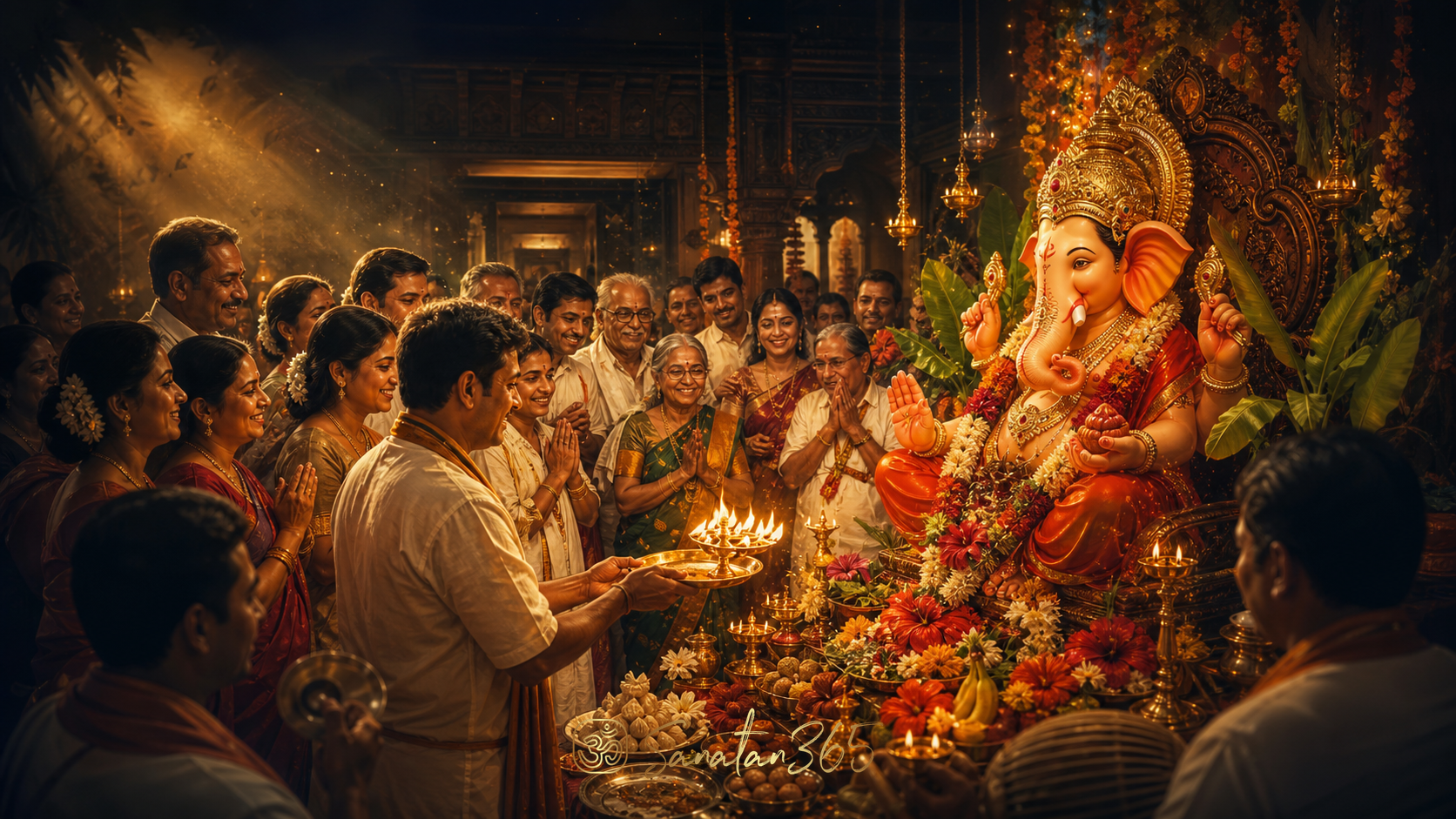
Sukhkarta Dukhharta Meaning: The Ganesh Aarti of Joy and Refuge
Explore the meaning of Sukhkarta Dukhharta, its Marathi imagery, connection with Samarth Ramdas, and a reverent way to sing this beloved Ganesh aarti.
The first two words of Maharashtra's best-loved Ganesh aarti contain an entire theology of hope: the Divine makes well-being possible and helps carry sorrow away. Sukhkarta Dukhharta meaning is therefore deeper than a promise that every difficulty will vanish. The Marathi hymn praises Lord Ganesha as the giver of auspicious joy, remover of obstacles, radiant presence, and compassionate refuge, then asks the devotee to meet grace with attention and trust.
Traditionally attributed to the seventeenth-century saint Samarth Ramdas, Sukhkarta Dukhharta is sung in homes, temples, and public Ganesh festivals across Maharashtra. It is an ārati (आरती, a devotional offering of light accompanied by song): worshippers circle a flame before the murti (मूर्ति, a consecrated sacred form), sing together, and receive the light as blessing. Understanding its words turns a familiar melody into an act of thoughtful devotion.
What Is the Sukhkarta Dukhharta Meaning?
The title comes from two compact Marathi descriptions. Sukhakarta means “one who brings or creates sukha,” a word that can include happiness, ease, welfare, and a well-directed life. Dukhaharta means “one who removes duhkha,” or sorrow and distress. Together, they address Ganesha not as a machine for granting wishes, but as the sacred intelligence through which confusion becomes clarity and fear can become steadiness.
The opening verse praises Ganesha as one who removes obstacles and spreads love and grace. It also says that his presence pervades everything. This is a striking progression: the hymn begins with a personal need, then widens the devotee's vision beyond the immediate problem. Ganesha is sought not merely because something has gone wrong, but because wisdom is needed to see and act rightly.
That emphasis fits Ganesha's broad place in Hindu tradition. He is commonly honored at beginnings and before important undertakings, while his iconography associates him with wisdom, learning, and the overcoming of impediments. The Metropolitan Museum of Art's overview of Ganesha and Encyclopaedia Britannica's account offer accessible background on these enduring associations.
Key takeaway: The title is a prayer for auspicious clarity and compassionate support, not a guarantee of a life without hardship.
How Do the Sukhkarta Dukhharta Lyrics Describe Ganesha?
The aarti does not explain Ganesha through abstract argument. It lets the devotee behold him through color, fragrance, ornament, and form. The familiar Marathi lines describe a body adorned with red vermilion, a pearl necklace, a crown set with jewels, and anklets that sound at the feet. These are not decorative details added at random. They make reverence tangible.
Vermilion, flowers, and sacred presence
The word shendur refers to the red-orange vermilion traditionally offered to Ganesha in many Maharashtrian settings. Red suggests energy, auspiciousness, and living presence. The hymn also mentions sandalwood paste and saffron-colored adornment. Fragrance, color, touch, sight, and sound all participate in worship; the whole person is invited to become attentive.
This sensory fullness helps explain why aarti works so powerfully in community. A child may first remember the lamp and melody. An elder may know every word. Someone returning after years away may recognize the rhythm before understanding the verse. The practice holds many levels of participation without making one superior to another.
The curved trunk and compassionate face
Ganesha is addressed as Vakratunda (वक्रतुण्ड, “one with the curved trunk”). The name honors his recognizable form, but it can also prompt reflection: intelligence does not always move in a straight line. A wise response may go around an obstruction rather than collide with it. Adaptability, patience, and discernment can remove obstacles that force cannot.
The hymn repeatedly seeks darshan (दर्शन, sacred seeing and being seen by the Divine). Darshan is more than looking at an image. In devotional understanding, the encounter asks the worshipper to become inwardly present. The radiant face described in the song is therefore both beauty and invitation.
Modak and the sweetness of disciplined wisdom
Ganesha's beloved modak (मोदक, a sweet dumpling offered in worship) appears across his devotional world. Its sweetness is often read as the joy of spiritual insight. Yet a modak must be prepared, offered, and received; sweetness comes within a practice of care. The symbolism points toward effort joined with grace.
Readers interested in the wider ritual form can also explore why Hindus offer light in worship and why camphor becomes a sacred flame. Both destinations are part of the living context in which this Marathi Ganpati aarti is sung.
Key takeaway: The hymn's visual language gathers the senses so that devotion becomes embodied attention rather than hurried recitation.
Who Composed Sukhkarta Dukhharta?
The aarti is traditionally attributed to Samarth Ramdas (1608–1681/82), the Marathi saint, poet, and spiritual teacher associated especially with devotion to Rama and Hanuman. The final verse contains the signature “Dasa Ramacha,” identifying the speaker as a servant of Rama. Traditional accounts connect the composition with Ganesha devotion in Maharashtra, including the sacred geography of Morgaon, one of the Ashtavinayak temples.
Historical details surrounding widely transmitted devotional songs can accumulate through oral memory, manuscripts, performance, and later retelling. It is therefore more careful to say “traditionally attributed” than to present every popular anecdote as independently proven. What is beyond dispute is the aarti's deep place in Marathi religious life and its association with the Ramdas devotional tradition.
The attribution also reveals a generous feature of Sanatan Dharma: a saint known for Rama-bhakti could compose praise of Ganesha without treating devotion as a competition. The hymn begins worship by honoring the one traditionally invoked at beginnings. Distinct forms of the Divine can be approached with full reverence while remaining part of a larger sacred order.
Key takeaway: The Ramdas tradition places the aarti within Maharashtra's devotional history while reminding readers to distinguish living tradition from overconfident historical claims.
Why Is This Marathi Ganpati Aarti So Central in Maharashtra?
In Maharashtra, Sukhkarta Dukhharta is heard throughout the year, but Ganesh Chaturthi gives it exceptional public force. Household murtis, neighborhood mandals, temples, schools, and diaspora gatherings bring people together around the same melody. The song can open or anchor a sequence of aartis, allowing a room full of different voices to breathe and respond together.
Its strength lies partly in language. Marathi makes the praise intimate and immediate. Sanskrit mantras retain their own sacred roles, but vernacular devotional poetry lets meaning travel through ordinary speech, family memory, and regional music. A grandmother's pronunciation, a child's first chorus, and a community's drum rhythm become part of the hymn's transmission.
The aarti also joins private and public devotion. In a home, one small lamp may circle before a clay murti. At a large festival, hundreds may sing beneath elaborate decorations. The scale changes, but the ethical center should not: reverence, hospitality, responsible celebration, and care for the surrounding community.
That includes ecological care. Natural clay murtis, modest decoration, safe lamps, restrained sound, and responsible immersion practices allow celebration to honor both devotion and the shared environment. Such choices are not departures from bhakti; they are ways devotion becomes accountable action.
For a broader look at the folded-hands gesture often seen before and after aarti, read Anjali Mudra meaning. The gesture and the flame share a purpose: gathering scattered attention into offering.
Key takeaway: The aarti endures because regional language, family memory, public celebration, and personal prayer meet within one compact form.
How Can Someone Sing Sukhkarta Dukhharta With Understanding?
Perfect musical performance is not the central requirement. A respectful practice can be simple, especially for beginners or families learning outside Maharashtra.
- Prepare a safe, clean space. Place the Ganesha murti or image securely. Use a stable lamp, keep flame safety in mind, and supervise children.
- Learn the sense before every syllable. Read a reliable Marathi text and translation. Notice the movement from praise, to visual contemplation, to the request for protection.
- Begin at a comfortable pace. Clear pronunciation matters more than speed. A recording can support learning, but should not replace attention.
- Offer what is available with care. A lamp, flower, or quiet folded hands may be enough. Devotion is not measured by expense.
- Let the refrain become reflection. When singing “Jai Deva,” bring to mind gratitude, a needed act of courage, or an obstacle requiring wise effort.
- Close responsibly. Receive the aarti flame with reverence, share prasad (प्रसाद, blessed food offered and then received), and ensure the lamp is safely extinguished when appropriate.
Those who do not speak Marathi can still participate respectfully. Listen, learn the meaning, and avoid treating the hymn as background entertainment. Regional pronunciation varies naturally; sincerity and continued learning matter more than anxious imitation.
The prayer should also be held without magical or harmful claims. Asking Ganesha to remove obstacles does not mean ignoring medical care, professional counsel, safety duties, or practical preparation. Devotion can steady action; it does not excuse inaction.
Key takeaway: Sing slowly enough for praise to become attention, and let prayer strengthen wise, responsible effort.
What Does “Remove Obstacles” Ask of the Devotee?
The easiest reading makes Ganesha responsible for changing everything outside the worshipper. The more demanding reading asks what must change within. Is the obstacle confusion, haste, pride, poor preparation, fear of beginning, or refusal to seek help? The aarti places distress before Ganesha, but it also places the singer under the light.
This is why offering a flame is such a fitting action. Light reveals. It does not complete the devotee's duties, but it makes the next step visible. When the chorus fills a room, individual anxiety is also held by a community. One voice may falter while another continues; shared devotion becomes a form of support.
The line between hope and denial matters. Hindu prayer can make room for grief without declaring grief a spiritual failure. Duhkha is named directly in the title. The hymn does not pretend sorrow is unreal; it turns toward sacred companionship and asks that sorrow not have the final word.
This makes Sukhkarta Dukhharta especially resonant at beginnings. A new home, a study session, a family ceremony, or Ganesh Chaturthi itself carries uncertainty. Invoking Ganesha is a way of saying: may this beginning be guided by clear intelligence, humility, and benevolent purpose.
Key takeaway: The remover of obstacles is invoked most fruitfully when prayer is joined with honest self-examination and the next right action.
Conclusion
Sukhkarta Dukhharta gives Marathi devotion a luminous, memorable language: Ganesha brings auspicious joy, receives sensory offerings, protects the distressed, and helps devotees meet obstacles with wisdom. Its deepest meaning appears when singing, seeing, and responsible action support one another.
Key takeaway: Offer the flame, understand the words, and carry Ganesha's clarity into whatever must be begun.
FAQ
What does Sukhkarta Dukhharta mean in English?
It means “the giver or maker of happiness and the remover of sorrow.” In the aarti, these words praise Lord Ganesha as the source of auspicious support, wisdom, and refuge amid difficulty.
Who wrote Sukhkarta Dukhharta?
The Marathi Ganesh aarti is traditionally attributed to the seventeenth-century saint and poet Samarth Ramdas. Its closing reference to the servant of Rama aligns it with the Ramdas devotional tradition.
When is Sukhkarta Dukhharta sung?
It is sung during Ganesh worship throughout the year and is especially prominent during Ganesh Chaturthi in Maharashtra and Marathi communities worldwide. Families and temples may include it in morning, evening, or concluding aarti sequences.
Do worshippers need to know Marathi to sing it?
No. A learner can participate respectfully by studying a reliable transliteration and translation, listening carefully, and singing at a manageable pace. Understanding the praise and prayer is more valuable than rushing through unfamiliar words.
Is Sukhkarta Dukhharta a mantra?
It is generally described as a Marathi aarti or devotional hymn rather than a Vedic mantra. It accompanies the offering of light and uses vernacular poetic praise directed to Lord Ganesha.
About the author
Sanatan365 Editorial
Bringing Sanatan Dharma to modern seekers through authentic, scripture-grounded content.
Related in Aarti
 Aarti
Om Jai Lakshmi Mata Aarti Meaning: Grace, Prosperity, and Gratitude
Om Jai Lakshmi Mata praises Goddess Lakshmi as the source of auspicious abundance, ethical prosperity, nourishment, virtue, and household w…
 Aarti
Aarti Kije Hanuman Lala Ki Meaning: Hanuman’s Strength in Rama’s Service
Understand Aarti Kije Hanuman Lala Ki through its refrain, Ramayana memories, devotional themes, textual variants, and a simple home practi…
 Aarti
Om Jai Shiv Omkara Aarti Meaning: Shiva, Omkara, and Sacred Unity
Om Jai Shiv Omkara is a beloved Shiva aarti whose images of Brahma, Vishnu, and Sadashiva invite devotees to see creation, preservation, an…

