Yaksha Prashna: Yudhishthira, the Greatest Wonder, and the Test of Dharma
A thoughtful guide to the Yaksha Prashna in the Mahabharata: the forest-lake crisis, Yudhishthira's famous answers, his choice of Nakula, and lessons for daily life.
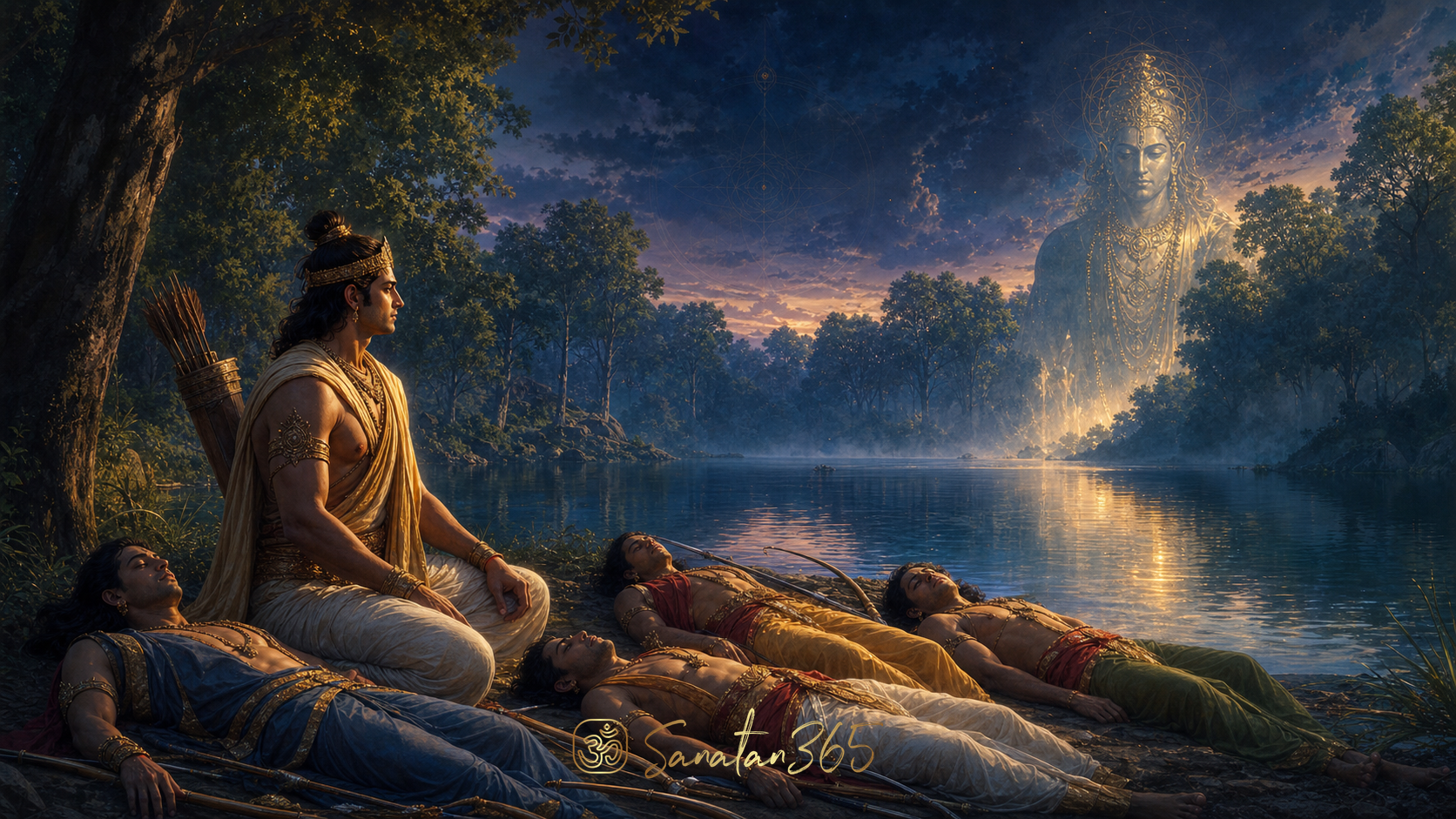
Four mighty warriors lie motionless beside a clear forest lake. Their eldest brother arrives thirsty, but the first thing he does is listen.
The Yaksha Prashna (यक्षप्रश्न, “questions of the Yaksha”) is a celebrated dialogue in the Mahabharata’s Vana Parva (वनपर्व, Book of the Forest). A mysterious guardian tests Yudhishthira with questions about life, death, happiness, knowledge, and dharma (धर्म, right order and responsible conduct). The episode is remembered not merely because Yudhishthira gives wise answers, but because he remains attentive, truthful, and fair while grief and danger press upon him.
That is the direct meaning of the story: wisdom is proven when knowledge becomes conduct under pressure.
What Is the Yaksha Prashna Story in the Mahabharata?
The episode occurs near the end of the Pandavas’ forest exile. A distressed Brahmin asks them to recover the wooden sticks needed for his sacred fire after a deer carries them away. During the search, the brothers become exhausted and thirsty. Yudhishthira sends Nakula to find water. Nakula reaches a beautiful lake, but an unseen voice warns him not to drink before answering its questions. Overcome by thirst, he ignores the warning, drinks, and falls motionless.
Sahadeva, Arjuna, and Bhima follow one after another. Each encounters the same warning. Each drinks before answering. Each falls beside the lake.
When Yudhishthira arrives, he finds his brothers apparently dead. He grieves, examines the scene, and hears the guardian’s command. Unlike the others, he does not treat the voice as an obstacle to be overcome by force. He accepts the condition and asks the unseen questioner to begin.
The questioner is a yaksha (यक्ष, a powerful nature or guardian being in Indian sacred traditions). Yakshas are associated in Hindu, Buddhist, and Jain sources with places such as forests, trees, lakes, and hidden treasure; Encyclopaedia Britannica notes their longstanding role as guardians of local places and natural wealth. In this Mahabharata episode, the Yaksha is eventually revealed as Dharma, also identified with Yama, and as Yudhishthira’s divine father.
The scene matters because it reverses ordinary heroic expectations. Bhima’s strength cannot solve it. Arjuna’s weapons cannot solve it. The decisive power is disciplined attention.
Key takeaway: The first victory in the Yaksha Prashna is not a clever reply; it is Yudhishthira’s willingness to stop, listen, and respect a boundary.
What Do the Yaksha Prashna Questions and Answers Teach?
The dialogue contains many questions in traditional recensions and translations. Counts and wording can differ, so it is safer to focus on the ethical patterns rather than insist on one universal numbering. The Kisari Mohan Ganguli translation of the Vana Parva preserves the episode in English, while Sanskrit editions and later retellings sometimes organize its questions differently.
The questions move rapidly across cosmology, family duty, character, learning, friendship, happiness, and mortality. Their form is concise, but they are not a trivia contest. They test whether Yudhishthira can distinguish appearance from essence.
Several recurring lessons stand out:
- Character is greater than status. Birth, rank, and reputation do not by themselves establish virtue. Conduct gives identity its moral weight.
- Self-command is a form of strength. Anger, greed, pride, and uncontrolled desire can defeat a person who appears powerful.
- Relationships carry duty. Parents, teachers, companions, guests, and dependants are not abstractions; gratitude and care must appear in action.
- Truth needs discernment. Dharma is subtle. A slogan cannot replace careful attention to context, consequence, and responsibility.
- Mortality should clarify life. Remembering death is not presented as despair, but as a reason to live without carelessness.
Yudhishthira’s answers are admired because they repeatedly turn attention inward. The easiest response to a crisis is to blame the world, the enemy, or fate. The harder response is to ask which inner tendency is clouding judgment.
This is one reason the episode remains useful in family teaching. A child can understand the surface story of a magical lake, but an adult can return to it as a study of leadership, grief, restraint, and moral reasoning.
Key takeaway: The Yaksha’s questions convert philosophy into self-examination: what rules the mind when comfort, certainty, and power disappear?
Why Is Yudhishthira’s “Greatest Wonder” Answer So Famous?
The most quoted exchange asks, in essence, “What is the greatest wonder?” Yudhishthira answers that living beings see others going to the realm of death every day, yet those who remain behave as though they will live forever. What could be more astonishing?
This answer is often reduced to “everyone dies,” but its force is more precise. Death is visible, repeated, and undeniable, yet the mind quietly grants itself an exemption. Human beings postpone reconciliation, meaningful work, spiritual practice, gratitude, and service as though time were guaranteed.
The Sanskrit idea behind wonder here is often rendered as āścarya (आश्चर्य, astonishment or marvel). The wonder is not mortality itself. It is the mind’s ability to observe mortality and still live in forgetfulness.
The teaching can be practiced without becoming gloomy. Remembering impermanence may lead to healthier questions:
- Is this conflict worth carrying for another year?
- Has gratitude been spoken while the other person can still hear it?
- Is daily work aligned with what one claims to value?
- Has prayer become something always postponed until life becomes convenient?
- If time is limited, what deserves patient attention today?
The Mahabharata does not ask the reader to abandon worldly duties. Yudhishthira is a householder, brother, ruler in exile, and future king. Awareness of death should refine responsibility, not erase it.
This is close to the disciplined non-attachment explored in Nishkama Karma: one acts wholeheartedly while releasing the fantasy of total control over time and results.
Key takeaway: The greatest-wonder answer is a call to remember death so that life becomes more truthful, timely, and compassionate.
Why Does Yudhishthira Choose Nakula to Be Revived?
After the questions are answered, the Yaksha offers to restore one brother. A purely strategic choice might be Bhima, whose strength is unmatched, or Arjuna, whose skill is crucial for the conflicts ahead. Yudhishthira chooses Nakula.
His reasoning reveals the deepest test in the episode. King Pandu had two wives: Kunti and Madri. Yudhishthira, a son of Kunti, remains alive. By asking for Nakula, a son of Madri, he seeks to ensure that each mother has one surviving son. He refuses to let his immediate attachment to his full brothers erase his responsibility toward Madri.
This is samatā (समता, evenness or impartial regard) expressed through a painful decision. It does not mean Yudhishthira loves Bhima or Arjuna less. It means love is governed by fairness when preference could easily disguise itself as necessity.
The Yaksha is pleased by this commitment to balance and restores all the brothers. The story therefore gives a demanding definition of dharma: not choosing the person who appears most useful to oneself, but protecting a principle even when the cost feels personal.
Modern leadership often faces a gentler version of the same problem. A manager may favor the most visible performer. A parent may unconsciously excuse one child more readily. A family may distribute care according to convenience rather than need. A community may defend fairness in public while making private exceptions for its own circle.
Yudhishthira’s choice asks whether a principle remains a principle when it limits personal advantage.
Key takeaway: Nakula’s revival shows that dharma is not merely correct speech; it is impartiality maintained when attachment has every reason to interfere.
How Can the Yaksha Prashna Guide Modern Decisions?
The story offers a practical sequence for moments when emotion is high and facts are incomplete.
1. Pause before acting
The brothers’ thirst is real, but urgency narrows their attention. Yudhishthira creates a pause. In modern life, this may mean delaying an angry message, reading a document twice, or asking one clarifying question before making a public accusation.
2. Respect the boundary
The lake has a condition. Whether or not the brothers understand it, ignoring it has consequences. Ethical life includes limits: consent, safety, law, duty, confidentiality, and the dignity of others.
3. Name the inner opponent
Many Yaksha Prashna answers direct attention toward anger, greed, pride, and delusion. Before blaming circumstances, one can ask: is fear making the decision, is vanity defending an image, or is impatience pretending to be efficiency?
4. Separate what is useful from what is right
Bhima or Arjuna may appear strategically useful. Nakula represents fairness. The right decision may still consider outcomes, but it does not reduce people to tools.
5. Remember the long horizon
The greatest-wonder answer restores proportion. Many urgent matters are not important, and many important duties never feel urgent. Mortality helps reorder them.
This approach complements sakshi bhava (साक्षी भाव, the attitude of the witness), explored in Sakshi Bhava meditation. Witnessing creates enough inner space to notice a reaction before obeying it.
Key takeaway: A Yaksha Prashna decision practice is simple: pause, listen, examine motive, protect fairness, and remember what matters beyond the present emotion.
What Should Readers Avoid When Interpreting the Story?
Sacred stories lose depth when turned into rigid formulas. The Yaksha Prashna should not be used to claim that every problem has one short answer, that grief can be solved by cleverness, or that Yudhishthira never makes mistakes elsewhere in the Mahabharata.
His wider life is morally complex. That complexity makes this episode more valuable, not less. Dharma is not a permanent badge awarded to a flawless person. It must be chosen again in changing circumstances.
Readers should also avoid lifting isolated lines from uncertain online lists without checking the text or translation. The core episode is ancient, but exact question counts, sequence, and English phrasing can vary by recension and translator. Responsible study distinguishes the Mahabharata’s teaching from a modern paraphrase.
Finally, the story should not encourage passivity in the face of danger. Yudhishthira listens because the situation demands discernment. Elsewhere, dharma may require protection, refusal, or decisive action. The lesson is not “never act quickly”; it is “do not let urgency destroy awareness.”
Key takeaway: The Yaksha Prashna teaches living discernment, not mechanical obedience or context-free quotations.
The lake becomes a mirror. Yudhishthira enters the scene seeking water and leaves having demonstrated what sustains life more deeply: attention, truthfulness, restraint, fairness, and remembrance of mortality. The single lesson is this: dharma becomes visible when pressure removes every easy choice.
FAQ
What does Yaksha Prashna mean?
Yaksha Prashna means “questions of the Yaksha.” It refers to the Mahabharata dialogue in which a mysterious guardian at a forest lake questions Yudhishthira about life, ethics, knowledge, happiness, death, and dharma.
Where does the Yaksha Prashna appear?
The episode appears in the Vana Parva, the Book of the Forest, during the Pandavas’ exile. Chapter numbering differs across editions and translations, so readers should look for the Yaksha Prashna or Dharma Baka episode within the Vana Parva.
What did Yudhishthira call the greatest wonder?
He observed that countless beings die every day, yet those who remain live as though they themselves will continue forever. The wonder is the human tendency to witness mortality while forgetting its relevance to one’s own life.
Why did Yudhishthira choose Nakula?
Yudhishthira chose Nakula so that both of Pandu’s wives would have one surviving son: Yudhishthira for Kunti and Nakula for Madri. The choice demonstrates impartiality over personal preference or strategic advantage.
Who was the Yaksha really?
The Yaksha reveals himself as Dharma, also associated with Yama, and as Yudhishthira’s divine father. The encounter is therefore both a rescue story and a test of whether Yudhishthira embodies the principles he speaks.
About the author
Sanatan365 Editorial
Bringing Sanatan Dharma to modern seekers through authentic, scripture-grounded content.
Related in Lessons
 Lessons
Panchatantra Pigeons Story: Unity and Responsible Leadership
The pigeons escape a hunter together, but their freedom also depends on friendship, practical help, and a leader who puts others first.
 Lessons
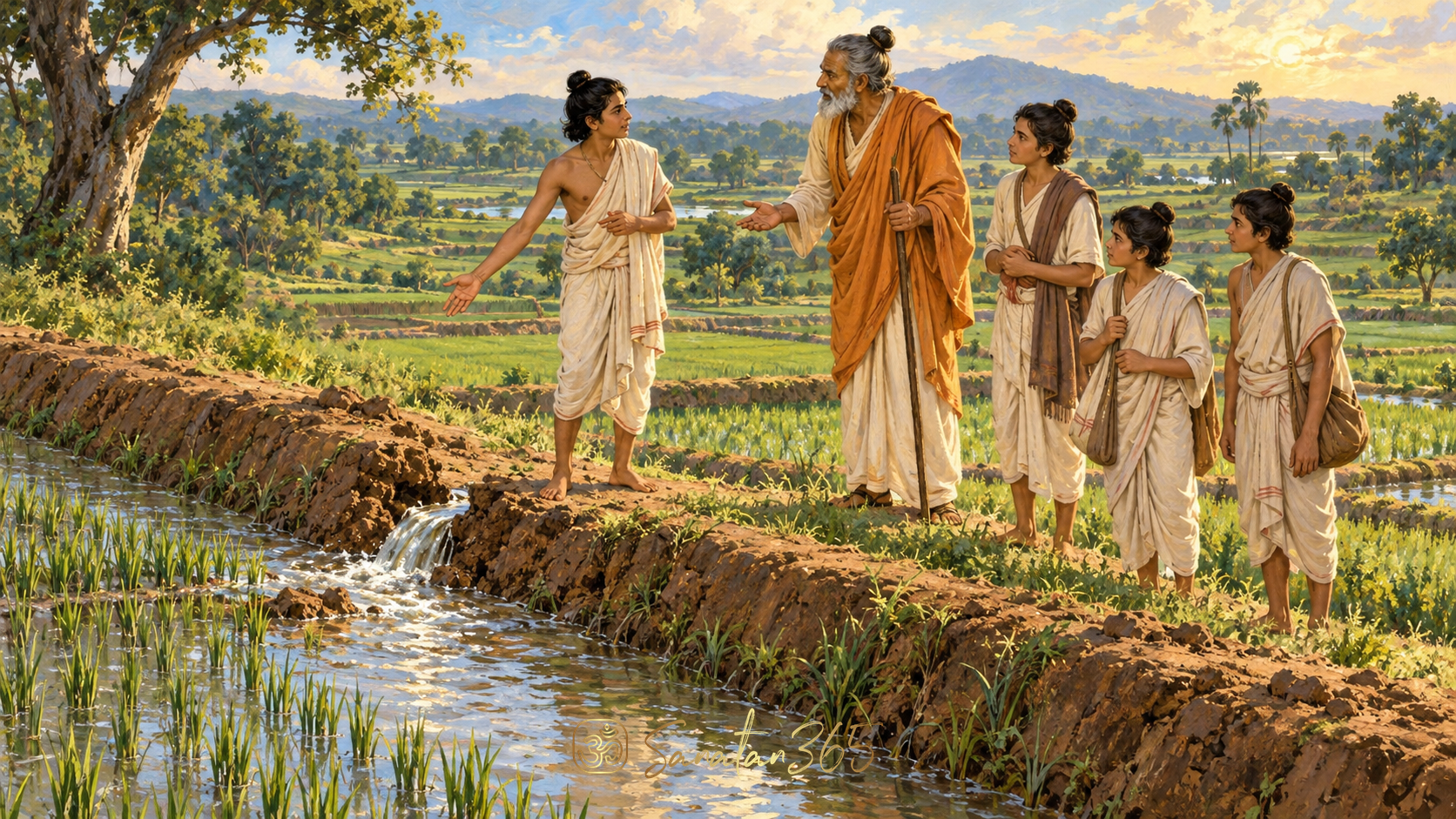
Aruni Lessons: Responsibility and Care in the Mahabharata
Read Aruni’s field-breach episode closely: a student’s resolve, a teacher’s search and practical lessons in responsibility that never requi…
 Lessons
Dharmavyadha Lessons: When Daily Duty Teaches a Scholar
The Mahabharata’s Dharmavyadha episode asks how anger, learning, and ordinary responsibilities reveal the quality of spiritual practice.