
Yoga Sutra 1.36 Meaning: Reading the Sorrowless Light
Patanjali gives just three words. Vyasa and Bhoja show why their light belongs to a discussion of steady attention.
Patanjali needs just three words for a teaching that commentators explain with the light of the moon, the centre of a lotus and the stillness of an ocean.
The Yoga Sutra 1.36 meaning is that a sorrowless, luminous condition can steady the mind. The brief line names that quality of experience and offers it as another possibility within a sequence of teachings about steadiness. Vyasa and Bhoja give readers ways to understand the image of light. Reading their explanations beside the original words shows where the images begin and what work they do.
What is the Yoga Sutra 1.36 meaning?
विशोका वा ज्योतिष्मती ॥
viśokā vā jyotiṣmatī
In Rama Prasada’s edition of the sutra with Vyasa’s commentary, viśokā (विशोका, free from sorrow or distress) and jyotiṣmatī (ज्योतिष्मती, luminous or lucid) describe the condition. Between them is vā (वा, or). That small middle word points outside the sentence. It indicates another possibility in a series, so the line can be read as an invitation within a larger discussion of how the mind becomes steady.
The explanation about steadiness completes the sense of the line. The Sanskrit printed above has no separate verb meaning “see” and names no lamp, colour or place in the body. An English rendering needs words such as “condition” to make the sentence readable. A commentary can go further and explain what a condition like that might involve. That is how a very short text can have longer translations without all of those words being present on the page.
The translation choice matters. “Lucid” directs attention toward a quality of knowing. “Luminous” lets the text keep its imagery and invites the reader to ask what kind of light is meant. A reader can understand both by keeping brightness and clarity in view together. A window that has just been cleaned is a simple analogy. The view becomes clearer even though the window adds no new light of its own. The analogy is a way to consider lucidity in English, while the traditional images belong to the commentators.
Key takeaway: The line describes sorrowlessness and luminosity together and draws its sense of steadiness from the surrounding teaching.
Why does Vyasa describe a lotus and several kinds of light?
Vyasa’s commentary gives the reader two ways to approach the luminosity. The first begins with attention to the lotus of the heart. In Rama Prasada’s translation, the resulting awareness may take forms comparable to lights such as the sun, moon, planets or precious stones. Those examples differ in brightness, scale and appearance. Together they convey that the luminous quality admits more than one shape. A reader who picks out the moon and builds the whole interpretation on moonlight misses the range of examples.
The second approach turns to the bare sense of “I am.” Vyasa compares its stillness to an ocean without waves. The comparison is good to read slowly. A rough sea and a still sea are both vast. What changes is the movement on the surface. The image makes room for depth while directing attention to the absence of disturbance. In the commentary, both forms belong to the discussion of luminosity and its relation to a steady mind.
The same edition includes a separate explanation by Vachaspati Mishra. It goes into more detail about the heart lotus. A reader comparing quotations can use the headings in the edition to keep the layers straight. Patanjali gives the compact line, Vyasa gives an account with the lotus and different sorts of light, and Vachaspati expands that account. Each layer can be studied for what it contributes. Attributing every detail to the three words of 1.36 removes much of what is interesting about reading these pages together.
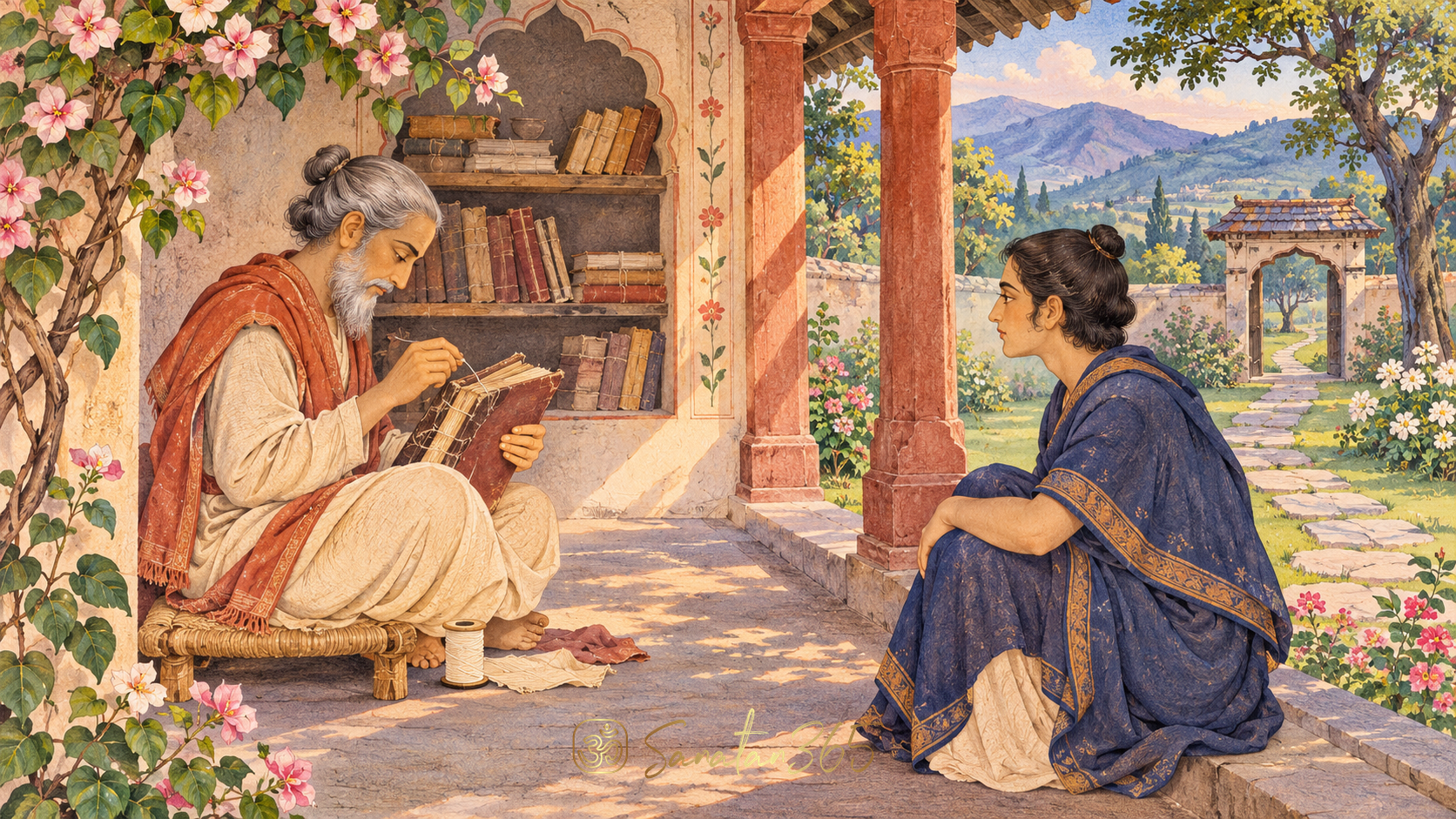
There is an artistic distinction here, too. An illustration can put a lotus in actual water and place the moon above it so both ideas are visible at once. In the explanation each image has its own purpose. The heart lotus gives a place in contemplative imagery, the moon is one example of luminosity, and the still ocean helps convey the quality of the “I am” reflection. The landscape is a way to hold those ideas together on one page.
Key takeaway: Vyasa uses changing forms of light and an unruffled ocean to explain two aspects of the luminosity described in the sutra.
How does Bhoja describe the luminous condition?
In Rajendralala Mitra’s translation of Bhoja’s commentary, the first step is again to supply what the short sentence leaves implicit. When the described condition arises, the thinking principle becomes steady. Bhoja explains luminosity through the fullness of the quality conventionally called goodness or lucidity, sattva (सत्त्व, clarity or goodness). This places the emphasis on the disposition itself. The brightness belongs to how the condition is understood.
Bhoja also brings in a lotus of the heart and an ocean without waves. Having familiar images in both explanations makes it tempting to treat them as identical. Read a paragraph from each and their accents become audible. Vyasa distinguishes two forms and gives a range of possible appearances. Bhoja explains how the quality of lucidity fills a condition and how such a condition steadies thought. The reader can follow both lines of explanation while noticing that each spends time answering a different question.
Older English translations can make this comparison harder than it needs to be. Prasada and Mitra sometimes choose English terms that carry a different everyday sense now. Reading just one translated expression and treating it as an exact modern equivalent can make the teaching sound more complicated. It helps to write down the few agreed features first. The condition is luminous, the condition is described as sorrowless, and both explanations associate it with steadiness. The separate vocabulary then becomes easier to read as an attempt to explain the relation among those features.
This is also a useful point for readers who come to the verse through a quotation. A quotation may present a complete English sentence about light and leave the reader unaware that the Sanskrit is much shorter. Setting the quoted line alongside the edition ordinary readers can consult gives credit to the translator’s choices and leaves space to notice another rendering.
Key takeaway: Bhoja relates brightness to the quality of lucidity and uses it to explain why the thinking principle becomes steady.
How can readers distinguish contemplation from looking at a flame?
A phrase such as “inner light” can recall a candle on a shelf. The association is easy to understand. Both images give the imagination a bright point, and a familiar object can help a reader enter an unfamiliar passage. They still belong to different textual descriptions. A guide to trāṭaka (त्राटक, steady gazing) can discuss the object at which the gaze is directed. The commentaries on 1.36 are explaining the luminosity and steadiness of a contemplative condition.
Keeping the descriptions distinct makes the verse less demanding for a first reading. A reader can follow the point about luminosity without checking for a flash or an inner picture. The words describe a quality. Vyasa’s variety of comparisons, followed by the language of a waveless ocean, provides a good reason to allow the imagery more than one function. Some of it evokes a possible appearance. Some of it tells the reader how the condition differs from an ordinary succession of impressions.
The “or” also matters here. It leaves space alongside neighboring possibilities. For comparison, Yoga Sutra 1.39 on a chosen focus takes up the place of something one finds fitting to contemplate. Reading the verses in sequence helps explain why no single image has to stand for the entire teaching. It also helps a reader distinguish what this particular line contributes. Its distinctive subject is the pairing of luminosity with freedom from sorrow.
Key takeaway: A candle is a familiar comparison for brightness. The textual focus of 1.36 is the luminous condition and its steadiness.
What can a reader bring to the next reading of the passage?
The sutra rewards an unhurried rereading. One can start with the three words, mark the “or,” and write a one-sentence paraphrase. Then read Vyasa and note the point at which the heart lotus first appears on the page. Finally read Bhoja and underline the place where he connects light to a quality of the disposition. A reader can do this with a simple pencil and a few minutes. The small amount of marking makes it easier to find each statement again.
On a second reading it is worth asking which images speak most clearly. Someone who immediately pictures a bright disc may find Vyasa’s waveless water unexpectedly helpful. Another reader may respond to the movement between inward quiet and the several kinds of light in his account. The aim of the exercise is to notice what the images express and how they relate, leaving the text and interpretation visible beside each other.
The three words can then be read aloud again. Their brevity is part of their character. Patanjali leaves room for the explanation that follows and gives the reader just enough to return to the particular quality under discussion. By the time a reader has looked at both commentaries, “luminous” has acquired depth. It can evoke light and also suggest the lucidity of an experience that has become steady.
One final comparison helps where two translations seem to disagree. Put their nouns side by side and mark which words refer to the state, which describe its quality, and which say what it does. One edition may describe a luminous disposition, another a lucid state, and a third may supply language about the attention given to it. The reader can then ask where the difference actually lies. Perhaps the translations disagree about an expression, or perhaps one spells out something the other relies on the commentary to explain. This simple distinction lets a reader take translation seriously without deciding too quickly that one Sanskrit word can carry only one acceptable English rendering.
Key takeaway: Read the verse first, follow each commentator’s explanation in turn, and return to the same three words with a clearer sense of what they describe.
FAQ
What does viśokā vā jyotiṣmatī mean?
It describes another possibility for steadiness, a luminous condition that is free from sorrow. The English sentence supplies the relation to steadiness from the surrounding discussion, as the classical explanations do.
Is the lotus of the heart named in Yoga Sutra 1.36?
The three Sanskrit words of the sutra do not name the lotus. Vyasa and Bhoja use a heart lotus in their explanations. The distinction is visible by comparing the original line with the commentary printed underneath.
Do Vyasa and Bhoja use the same explanation?
Both explain the verse in relation to steadiness, and both draw on similar imagery. Vyasa distinguishes different forms of luminosity, while Bhoja emphasises the fullness of lucidity in the condition being described.
What does the word vā contribute?
It means “or.” It links this short verse to the surrounding possibilities for steadiness and helps readers understand why the line can describe a condition without spelling out its effect in full.
About the author
Sanatan365 Editorial
Bringing Sanatan Dharma to modern seekers through authentic, scripture-grounded content.
Related in Meditation
 Meditation
Yoga Sutra 1.37 Meaning: A Mind Worth Contemplating
Read Yoga Sutra 1.37 with Bhoja’s commentary and see how a quality of mind, rather than a person’s reputation, becomes a meditation support.
 Meditation
Bhagavad Gita 6.26 Meaning: Returning the Wandering Mind
Follow Krishna’s instruction for a wandering mind, from the repeated phrases of the verse to the act of returning during meditation.
 Meditation
Dahara Vidya Meaning: The Small Space Within the Heart
Explore the small lotus-like heart-space of the Chandogya Upanishad, its unexpected vastness, and a careful approach to contemplative study.

