Trataka Meaning: Candle Gazing, Steady Attention, and Inner Stillness
A careful guide to Trataka meaning, its roots in Hatha Yoga, how candle gazing supports concentration, and how to practice with safety and reverence.
A small flame can reveal how restless the mind has become.
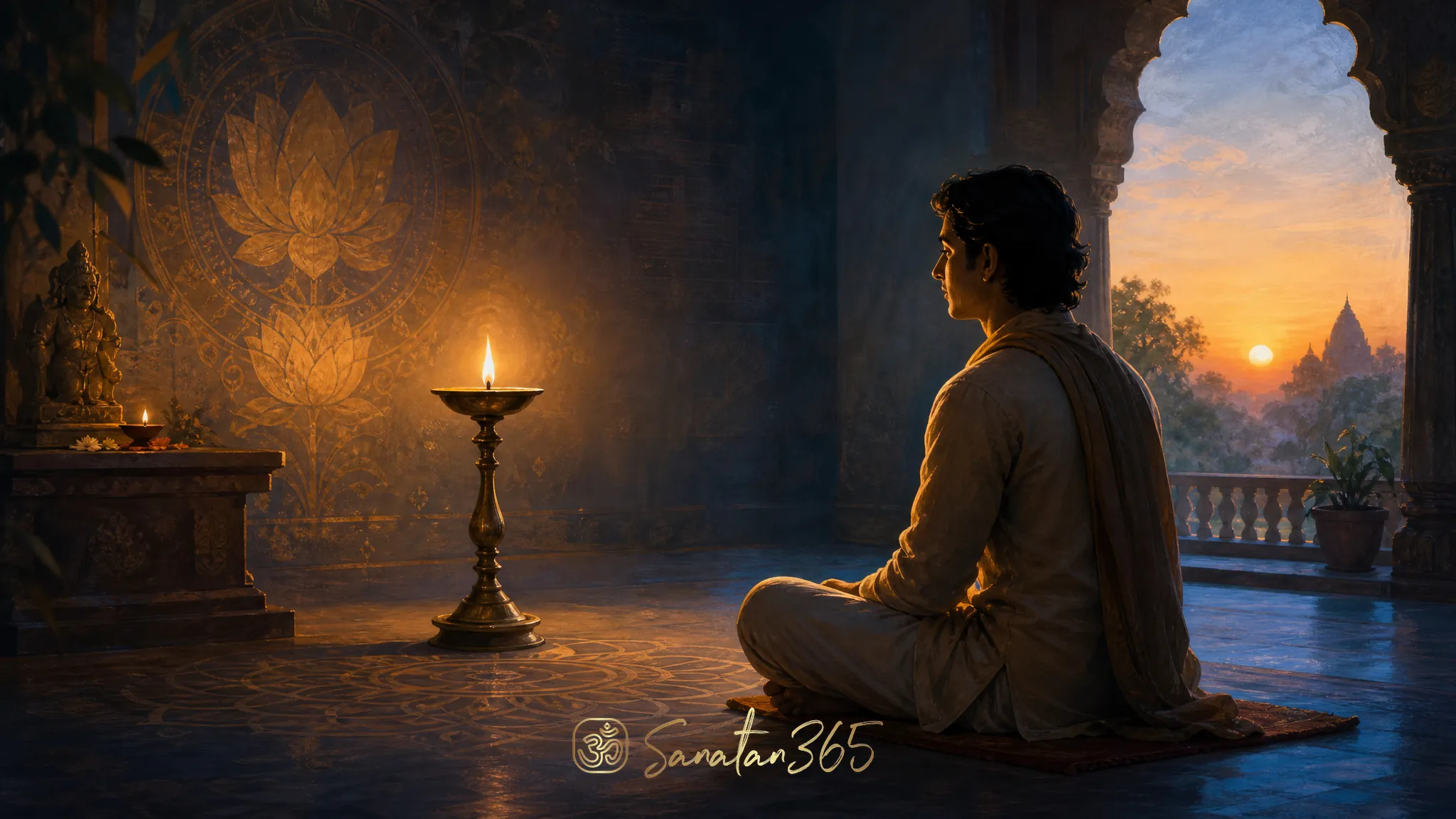
Trataka meaning is simple at the surface: Trāṭaka (त्राटक, steady gazing) is a yogic practice of fixing the gaze on one point, often a candle or diya flame, until attention becomes steady. In Hatha Yoga, it is counted among the shatkarma (षटकर्म, six cleansing disciplines), but its deeper value is meditative: the outer gaze trains inner steadiness. For modern seekers, Trataka is best approached as a gentle concentration practice, not as a spectacle or a cure.
What Is Trataka Meaning in Yoga?
The Sanskrit word Trāṭaka is commonly explained as gazing, looking steadily, or fixing the eyes on a chosen point. In practical terms, it is the discipline of letting the eyes rest on one object so the mind stops scattering itself across many objects.
Traditional Hatha Yoga places Trataka beside other shatkarma practices, the disciplines used to prepare the body and senses for deeper yoga. One accessible translation of the Hatha Yoga Pradipika's Trataka instruction says that the practitioner gazes steadily at a small mark until tears arise, and the tradition remembers this as an eye-cleansing discipline (Yoga Vidya Hatha Yoga Pradipika 2.31-40).
That classical description should be read with care. It does not mean a beginner should strain the eyes, force tears, stare through pain, or turn a contemplative practice into endurance training. A mature reading is more balanced: Trataka asks for steadiness without aggression.
The practice usually has two layers:
- Bahir Trataka (बाहिर त्राटक, external gazing): the eyes rest on an outer object such as a flame, black dot, yantra, or sacred symbol.
- Antar Trataka (अंतर त्राटक, internal gazing): after closing the eyes, attention rests on the inner afterimage or subtle point of awareness.
This movement from outer to inner is why Trataka sits close to dharana (धारणा, concentration), the yogic discipline of holding the mind to one place. Many modern explanations of Yoga Sutra 3.1 describe dharana as fixing attention on a chosen point (Yogapedia on dharana).
Key takeaway: Trataka is not merely staring at a flame; it is a bridge from visual focus to inner concentration.
Why Does Candle Gazing Meditation Matter?
The mind often follows the senses. When the eyes jump from screen to face to object to memory, attention becomes fragmented. Trataka reverses that habit by giving the eyes one clear resting place.
This is why candle gazing meditation remains useful even for people who are not living in an ashram or studying Hatha Yoga in a formal setting. A small flame creates a simple field of attention. It is alive enough to hold interest, yet quiet enough to discourage mental noise. The practitioner is not asked to believe something dramatic. The task is humbler: sit, look, breathe, soften, return.
In Indian homes, the flame also carries devotional resonance. A diya is not only a visual object; it is associated with light, auspiciousness, and the movement from confusion toward clarity. When Trataka is practiced with a diya, the flame can become a symbol of inner steadiness rather than a performance of willpower.
This symbolism matters. If the practice is reduced to a concentration hack, it loses its cultural depth. If it is inflated into a guaranteed mystical method, it loses humility. The middle path is better: Trataka can train attention, prepare the mind for meditation, and bring reverence into a quiet daily practice.
For readers already exploring meditation, Trataka pairs naturally with Dhyana Meaning: Hindu Meditation as Steady Awareness, Not Empty Escape. Dhyana (ध्यान, meditative absorption) is subtler than visual focus, but Trataka can help a distracted beginner understand what steady attention feels like.
Key takeaway: Candle gazing matters because it gives the senses a sacred simplicity: one flame, one posture, one returning mind.
How Is Trataka Practiced Safely?
Trataka should be practiced gently. The eye is not a battlefield, and meditation is not improved by forcing discomfort.
A simple beginner-friendly form looks like this:
- Choose a quiet, ventilated space where the flame is stable.
- Place a diya or candle at eye level, roughly an arm's length away.
- Sit with the spine comfortable and upright.
- Let the body settle before beginning; do not rush into staring.
- Rest the gaze on the flame for a short period, such as 30 seconds to 2 minutes.
- Blink naturally if the eyes need relief.
- Close the eyes and observe the afterimage or the space between the eyebrows without strain.
- End with a few calm breaths and a moment of gratitude.
Beginners can repeat this for two or three short rounds. Longer practice should be learned from a qualified teacher, especially for anyone with eye conditions, recent eye surgery, migraine sensitivity, photosensitive epilepsy, or strong discomfort around light. This article is spiritual education, not medical advice.
The safest attitude is patience. The aim is not to win against blinking. The aim is to notice how attention behaves when given a single point.
A few details improve the quality of practice:
- Keep the flame steady rather than flickering in a strong breeze.
- Avoid practicing when sleepy enough to slump toward the candle.
- Do not use scented candles if fragrance distracts or irritates.
- Do not stare at the sun; that is a different and risky matter.
- Stop if there is pain, burning, dizziness, or distress.
Some traditional descriptions mention tears. For contemporary home practice, tears should not be the goal. If they arise naturally after gentle gazing, one may pause, blink, and rest. Forcing the eyes until tears come can turn Trataka into strain.
Key takeaway: Trataka works best when practiced with steadiness, not severity.
What Should the Mind Do During Trataka?
In Trataka meditation, the eyes rest on the chosen point, but the mind still needs guidance. Otherwise the practitioner may stare outward while thinking about everything else.
A helpful method is to keep three layers together:
- Gaze: stay with the flame or chosen point.
- Breath: let breathing remain natural and quiet.
- Awareness: notice distraction without irritation and return.
This is where Trataka becomes more than a visual exercise. The flame begins as an object outside the body, but the practice reveals the inner movements of attention. Thoughts arise. Impulses appear. The mind wants to compare, plan, remember, and judge. Each return to the flame becomes a small act of dharana.
For a devotional practitioner, the flame may also be held as jyoti (ज्योति, sacred light). This does not require dramatic visualization. It can be as simple as remembering that the same light honored in puja can also illumine speech, action, and thought.
For a more philosophical practitioner, Trataka can become an inquiry into perception. What is seeing? What is attention? When the eyes become still, does the mind become still? When the eyes close, what remains of the object?
Both approaches are valid when held with respect. Sanatan practice has room for bhakti (भक्ति, devotion), yoga, reflection, and disciplined self-observation.
The inner phase is especially important. After gazing, close the eyes gently. If an afterimage appears, observe it without chasing it. If no image appears, rest in the darkness behind closed eyes. The practice is not a contest to produce visions. It is a training in non-reactive attention.
This connects naturally with Mauna Meaning: The Hindu Practice of Sacred Silence. Mauna (मौन, sacred silence) is not only the absence of speech; it is the quieting of unnecessary movement. Trataka brings that lesson through the eyes.
Key takeaway: The mind should stay alert, relaxed, and returning; Trataka is concentration with humility.
How Does Trataka Relate to Daily Hindu Practice?
Trataka is a yogic practice, but it can sit naturally inside a broader Hindu home rhythm. Many homes already light a diya during morning or evening worship. That same flame can become a short moment of meditative steadiness after puja, before japa, or before study.
A gentle daily rhythm might look like this:
- Light the diya with reverence.
- Offer a short prayer or sit in silence.
- Practice one or two minutes of Trataka.
- Close the eyes and rest attention inward.
- Continue with mantra, scripture reading, or quiet reflection.
This kind of practice is especially helpful because it does not require complexity. The seeker is not adding a large new burden. A familiar sacred action becomes slightly more conscious.
For families, Trataka should be adapted with care. Adults may practice quietly, while children can simply observe the diya reverently for a few breaths rather than being asked to stare. The goal is to cultivate respect and calm, not pressure.
For diaspora readers, Trataka can also become a way of preserving a small devotional anchor in a busy household. A clean corner, a lamp, and a few minutes of attention can carry a deep sense of continuity.
Sanatan365's Daily Meditation with Maharshi Patanjali: A Hindu Practice for Steady Awareness feature can support seekers who want a guided daily rhythm, but a non-feature article like this does not need to turn every practice into product use. The deeper point is that steady attention grows through repetition.
Key takeaway: Trataka becomes most useful when it is woven into a sustainable daily rhythm rather than treated as an occasional intensity.
What Are Common Mistakes in Trataka Meditation?
The first mistake is forcing the eyes. If the face tightens, breath becomes harsh, or the eyes begin to hurt, the practice has moved away from yoga. A calm gaze is more valuable than a long gaze.
The second mistake is chasing visions. Some practitioners may see colors, afterimages, or shifting patterns after closing the eyes. These can be natural visual effects. They do not need to be feared, worshipped, or turned into spiritual achievement.
The third mistake is practicing without context. Trataka is not a magic trick for instant enlightenment. It belongs within a larger discipline of ethical life, balanced living, breath awareness, devotion, study, and meditation.
The fourth mistake is using unsafe objects. A stable candle or diya is common, but anything too bright, unstable, smoky, or visually harsh can create discomfort. The practice should feel clean, quiet, and respectful.
The fifth mistake is making claims the tradition itself does not require for a beginner. Trataka may support concentration and meditative preparation. It should not be marketed as a guaranteed cure for eye problems, anxiety, insomnia, or any medical condition. Spiritual practices can complement a healthy life, but they do not replace professional care.
The most mature Trataka practice is simple:
- no force
- no fantasy
- no hurry
- no superiority
- no medical promises
In that simplicity, the flame becomes a teacher. It does not argue. It does not flatter. It only asks the seeker to keep returning.
Key takeaway: The strongest Trataka practice is gentle, grounded, and free from exaggeration.
FAQ
What is Trataka meaning in simple words?
Trataka meaning is steady gazing. In yoga, it usually refers to fixing the eyes on one point, such as a candle or diya flame, so the mind can become more concentrated and inwardly steady.
Is Trataka the same as candle gazing meditation?
Candle gazing meditation is the most common modern form of Trataka, but Trataka can also be practiced with other points of focus, such as a black dot, yantra, or sacred symbol. The essential principle is steady, respectful attention.
How long should a beginner practice Trataka?
A beginner can start with 30 seconds to 2 minutes of gentle gazing, followed by closed-eye rest. Longer practice should be learned gradually, preferably with guidance, and should stop immediately if the eyes feel strained or painful.
Can Trataka be practiced during daily puja?
Yes, it can be practiced after lighting a diya during puja, as long as the practice remains safe and gentle. The flame can serve as both a devotional symbol and a point of meditative attention.
Does Trataka have guaranteed health benefits?
No guaranteed health claims should be made. Trataka is a spiritual and yogic concentration practice. Anyone with eye conditions, light sensitivity, neurological concerns, or medical questions should consult a qualified professional before attempting it.
The heart of Trataka is not the flame alone. It is the discipline of returning to one clear point without aggression, fantasy, or haste. A few quiet minutes with a lamp can remind the seeker that attention itself is sacred when it becomes steady.
Key takeaway: Trataka teaches the eyes to become calm so the mind can remember how to rest in one place.
About the author
Sanatan365 Editorial
Bringing Sanatan Dharma to modern seekers through authentic, scripture-grounded content.
Related in Meditation
 Meditation
Kaya Sthairyam Meaning: Finding Steadiness Before Meditation
Kaya Sthairyam is the yogic practice of body steadiness. Learn how relaxed awareness, a supported seat and patient stillness prepare for me…
 Meditation
Chidakasha Dharana Meaning: Awareness of the Inner Space
Understand the space experienced with closed eyes, how observation differs from visualization, and a gentle introduction to this yogic conc…
 Meditation
Antar Mouna Meaning: Inner Silence Without Fighting Thought
Understand inner silence in Satyananda Yoga, its sensory and thought-awareness stages, and a responsible beginning that does not demand a b…

