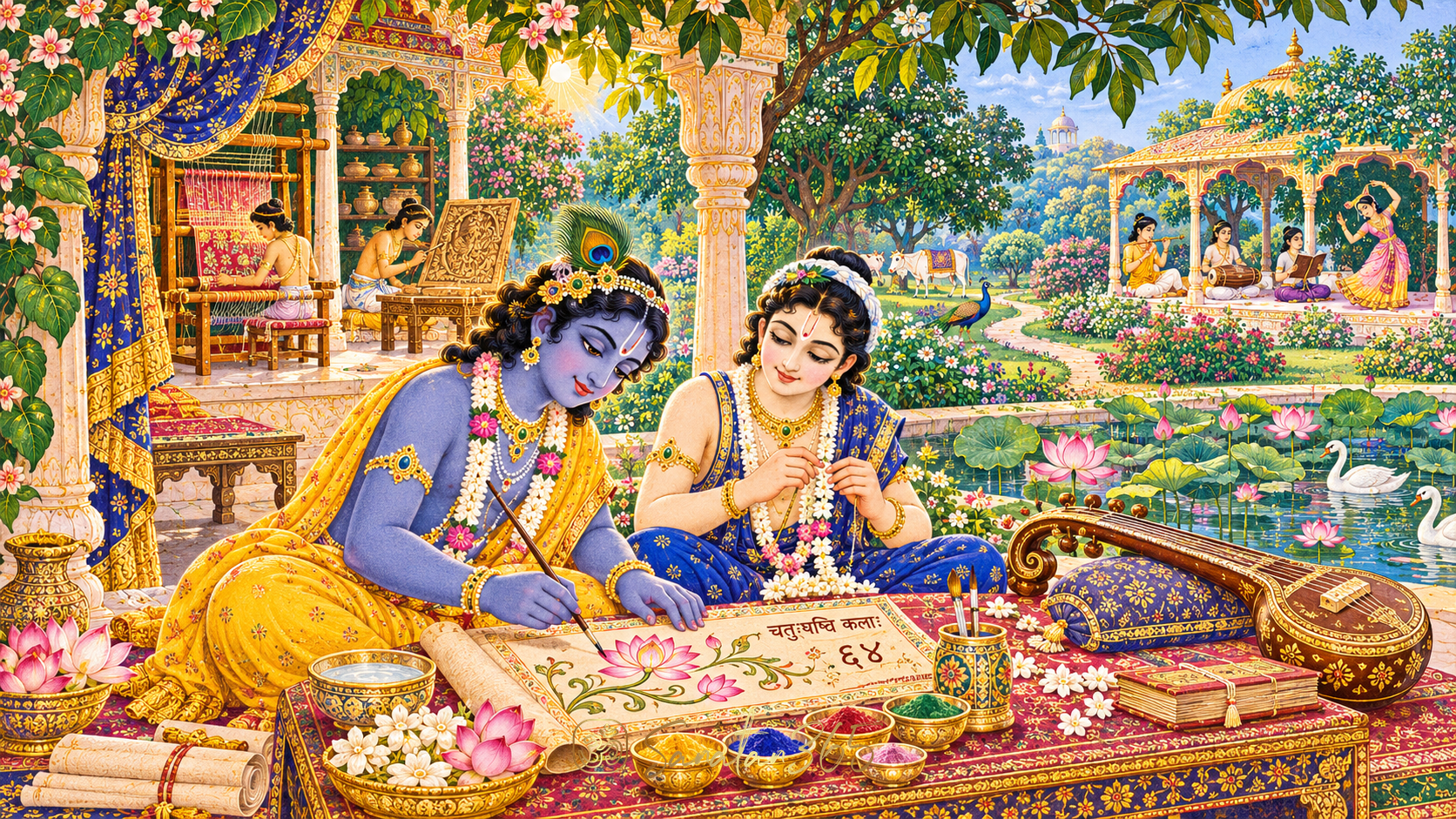
64 Kalas Meaning: What Sixty-Four Arts Invite Us to Learn
The traditional count of sixty-four kalas opens a wide view of skilled learning. Understand its scriptural setting, the difference between a verse and an explanatory list, and a thoughtful way to learn from selected arts.
A number can invite attention to the things being counted. With the sixty-four arts, those things include forms of knowledge that hands, voice and imagination can cultivate.
The 64 kalas meaning is a traditional count of arts and skills, not a code that predicts a person’s future. Kalā (कला) means an art or skill in this context. The Bhagavata’s account associates sixty-four arts with Krishna and Balarama’s learning. The count becomes more useful when read with its source, rather than detached into a promise of exceptional ability.
It offers a reason to look closely at what skilled learning involves.
What is the 64 kalas meaning in this tradition?
The familiar expression “Chatushashti Kala” refers to sixty-four arts: catuḥṣaṣṭi (चतुःषष्टि) means sixty-four. A reader may encounter the same expression as “64 kalas,” “sixty-four arts” or “chausath kala.” The central question is what that number counts in the passage or list being consulted.
“Art” can be a narrower word in ordinary modern conversation. Someone may immediately think of a painting hung on a wall. “Skill” can help widen the question: what can a person learn to do with care, judgment and repeated attention?
The traditional framework invites that broader reading. Yet breadth should not be confused with a license to attach every imaginable discipline to the list. If a source names a particular art, its wording matters. If a modern writer arranges selected examples into convenient groups, that arrangement should be identified as a reading aid.
Sixty-four is also eight multiplied by eight. That arithmetic alone does not explain why a particular text uses the count. A pattern noticed by a modern reader is not automatically a documented ancient explanation. The cited Bhagavata verses give a count; they do not provide a general theory of why every occurrence of sixty-four must have the same meaning.
The responsible starting point is therefore concrete: find the counted arts, the source presenting them and the purpose of the passage. A meaningful number does not need an invented universal explanation.
Key takeaway: Begin with what sixty-four counts, rather than treating the number as a complete explanation by itself.
What does the Bhagavata actually say about sixty-four?
The Bhāgavata Purāṇa (भागवतपुराण), a devotional Sanskrit scripture, presents Krishna and Balarama as learners. In 10.45.35–36, their concentrated learning is described through the count of sixty-four arts in as many days and nights, followed by their offering to the teacher.
That is a devotional narrative about the divine brothers. It should not become a deadline against which an ordinary child’s progress is measured. A family does not need to expect miraculous speed to honour the story’s reverence for learning.
There is also a distinction between the verse and the explanatory material surrounding it. The short passage gives the count and narrative setting. The long catalogue familiar to many readers appears in the explanatory purport on the linked page. Reading a verse and reading an extended list are related activities, but they are not identical.
This distinction helps when someone asks, “Does this verse itself name every art?” The reader can check the boundaries of the page: the original text, its translation and the explanatory discussion. A long webpage can contain all three, and a copied screenshot can easily remove the labels separating them.
The practical lesson is about careful attribution. “The verse gives the count” is a different statement from “this explanatory list describes the arts.” Both can be valuable without making the second statement look like a direct quotation from the first.
Respect for a sacred text includes allowing its actual words and its interpreters’ explanations to remain visible.
Key takeaway: Preserve the difference between the scriptural count, the translated narrative and a longer explanatory catalogue.
Why can lists of the 64 arts look different?
An English list is already an interpretation of names, activities and cultural settings. Readers should check where it comes from before deciding that every difference is a contradiction.
G. V. Tagare’s Bhagavata appendix on the sixty-four arts gives a commentarial list and attributes its transmission to the tradition of Shridhara Svami’s commentary. Its English explanations are not identical to the Vedabase purport’s. For example, a book-related art is described through recitation in one presentation and the reading of manuscripts in the other.
The point is not to declare that two English phrases mean exactly the same thing. It is to notice that the original term, translator’s explanation and numbering need to be compared together.
A useful comparison has three columns on a reader’s own page:
- the original or transliterated name;
- the explanation supplied by that particular edition;
- a question that remains about the activity.
The third column matters. It permits uncertainty to remain a question instead of turning into a confident but unsupported definition. If the activity is unfamiliar, a short English gloss may not explain how it was understood or practised in its setting.
Lists circulating without an author, edition or textual reference are harder to assess. A polished graphic does not provide the information that a source note would. Before repeating an item as “the exact ancient meaning,” look for the source from which it was taken.
This is especially helpful across languages. A familiar regional name and a formal transliteration can look very different on the page. Context and careful comparison are more reliable than guessing from spelling alone.
Key takeaway: Keep the edition and explanation attached to a list; do not silently merge different presentations into one unquestionable catalogue.
What do selected skills reveal about the breadth of learning?
Selected examples in the Vedabase purport include singing, instrumental music, painting, preparing wreaths, needlework and reciting books. These examples suggest several ways to think about learning without pretending that six examples reproduce the entire catalogue.
The following groupings are an editorial aid, not a claim that the traditional list is officially divided this way.
Voice and listening. Singing invites attention to what can be heard. A learner can begin to distinguish a phrase remembered accurately from one reconstructed carelessly. That observation can be valuable even before a polished performance is possible.
Eye and hand. Painting makes choices visible. A line can be uneven, a colour mixture can differ from what was intended, and a second attempt can reveal what changed. The learning is partly in noticing those differences rather than merely producing a finished object.
Arrangement and making. Wreaths and needlework direct attention to relationships among small parts. The maker must consider sequence, tension, spacing or repetition. A viewer may see an attractive result while overlooking the decisions that made it possible.
Language and memory. Reading or recitation can draw attention to accuracy, meaning and the limits of memory. Knowing that a passage sounds familiar is not the same as checking what it actually says.
These are contemporary reflections prompted by selected examples. They are not a translation of an additional hidden verse or a promise that every art produces the same result.
The breadth is useful because learning is not confined to one kind of achievement. A person who finds drawing difficult may still appreciate careful reading. Someone comfortable with words may discover how demanding a small handmade object can be. The comparison can encourage respect for work outside one’s strongest area.
Key takeaway: Selected arts can broaden respect for different kinds of skill without becoming an exhaustive or universal curriculum.
How can this traditional number inspire practice today?
A modern household need not build a sixty-four-item checklist. A smaller, honest encounter with one suitable skill can be more useful than announcing mastery of an entire tradition.
The first step is to choose an activity for a clear reason. It might be a song already meaningful to the family, a simple drawing exercise or a safe handcraft appropriate to the learner’s age. The choice should fit the person and setting rather than a desire to accumulate impressive labels.
A modest practice sequence can help:
- Observe one example carefully. Notice what the teacher, text or demonstration actually asks.
- Try a limited part. Work on a phrase, a line or a small section instead of rushing to complete everything.
- Compare the attempt with the example. Name one difference that can be checked.
- Accept a specific correction. Make the next attempt respond to it.
- Record what remains uncertain. A useful question is evidence of attention, not a failure to learn.
This sequence is a contemporary suggestion offered by the article. It is not being presented as the original method used to teach all sixty-four arts.
The familiar discipline of self-study in yoga offers a related opportunity to examine how a person approaches learning. The connection here is reflective: keeping an honest account of effort and understanding. It does not make every craft exercise a complete spiritual practice by itself.
A family can also protect the dignity of beginners. Avoid comparing a child with the divine brothers’ narrated mastery or with an accomplished performer’s finished work. A small correction, understood and applied, gives a clearer picture of progress than a flattering certificate with no defined standard.
Historical catalogues should not be copied uncritically into a present-day lesson plan. Choose suitable, ethical activities and competent instruction where needed. The value of a tradition can be considered thoughtfully without turning every listed item into something a household ought to attempt.
Key takeaway: Choose one suitable skill, practise a checkable part and remain honest about what has actually been learned.
How should the number be kept in its proper context?
A sacred or culturally important number becomes easier to understand when its companions remain visible. In this case, the companions are arts, learners, teachers, texts and explanations.
Taking sixty-four out of that setting can create claims the cited passage does not make. It does not tell a reader that seeing the number on a clock guarantees success. It does not supply a birth-number interpretation or determine someone’s profession. It does not establish that sixty-four days is a universal learning period.
The broader habit applies to other traditional counts as well. The discussion of sixteen in Hindu contexts similarly begins by asking what is being counted. Different enumerations deserve their own source and purpose; a shared number does not erase those distinctions.
This is not an argument for stripping numbers of meaning. It is a way to let their meaning become more precise. “Sixty-four arts in this devotional account” says something concrete. “Sixty-four controls every part of life” makes a much larger claim that requires evidence of its own.
A reader can leave the subject with a useful question rather than an inflated promise: which kind of skilled attention has been overlooked? Perhaps it is the patience of a maker, the accuracy of a reader or the willingness to receive correction. That question can lead back to an actual person, text or practice.
The single lesson is to let the traditional count deepen respect for learning. Sixty-four names a wide field in the account; honest attention begins with the particular skill in front of the learner.
Key takeaway: Keep the number connected to its source and counted arts, then let learning remain specific, patient and accountable.
FAQ
What does 64 kalas mean?
It refers to a traditional count of sixty-four arts or skills. The meaning should be read in the context of the text and explanatory list being consulted.
Did Krishna learn sixty-four arts in sixty-four days?
Bhagavata 10.45.35–36 presents Krishna and Balarama’s learning in that devotional narrative. It should not be turned into an ordinary child’s learning deadline.
Does the short Bhagavata verse list every art?
The cited verses give the count and narrative setting. The extended catalogue on the linked Vedabase page is explanatory material and should be identified as such.
Can learning one art still be worthwhile?
A person can choose a suitable skill and practise it carefully without claiming mastery of the complete catalogue. The modern exercise suggested here is a reflection inspired by the topic, not a scriptural requirement.
About the author
Sanatan365 Editorial
Bringing Sanatan Dharma to modern seekers through authentic, scripture-grounded content.
Related in Numerology
 Numerology
Number 11 Meaning in Hinduism: Counting the Rudras
Why does one Upanishadic dialogue count ten powers and then name an eleventh? Read the eleven Rudras in the setting of the question that ca…
 Numerology
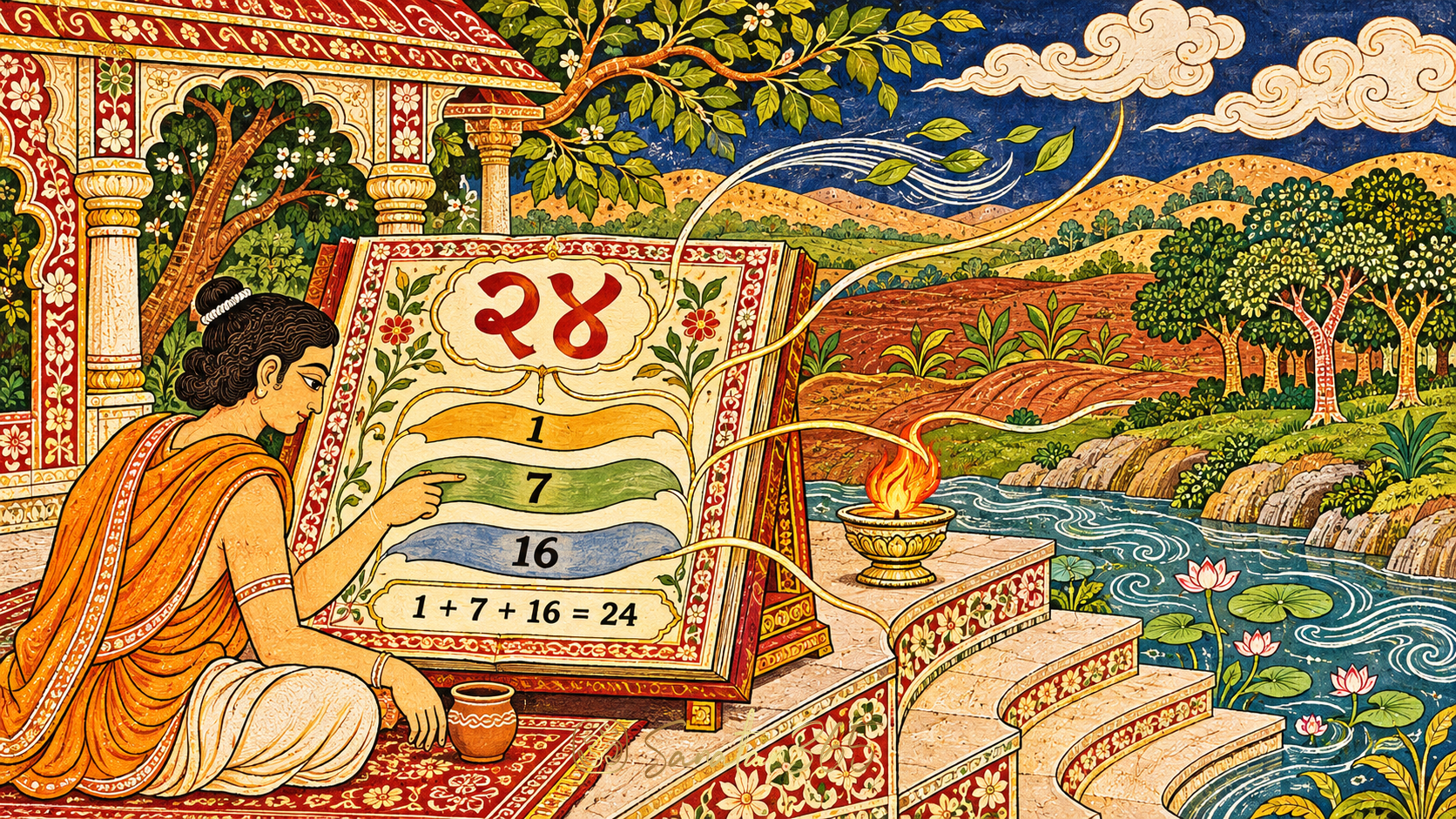
24 Tattvas Meaning: What Sankhya Counts and Why
The 24 tattvas are a defined count in Sankhya. Follow the groups of one, seven and sixteen, then see why purusha is discussed separately.
 Numerology
Number 16 Meaning in Hinduism: Reading Shodasha in Context
Explore sixteen as a sacred count through lunar imagery, life-stage rites and offerings, while keeping each tradition’s meaning distinct fr…

