24 Tattvas Meaning: What Sankhya Counts and Why
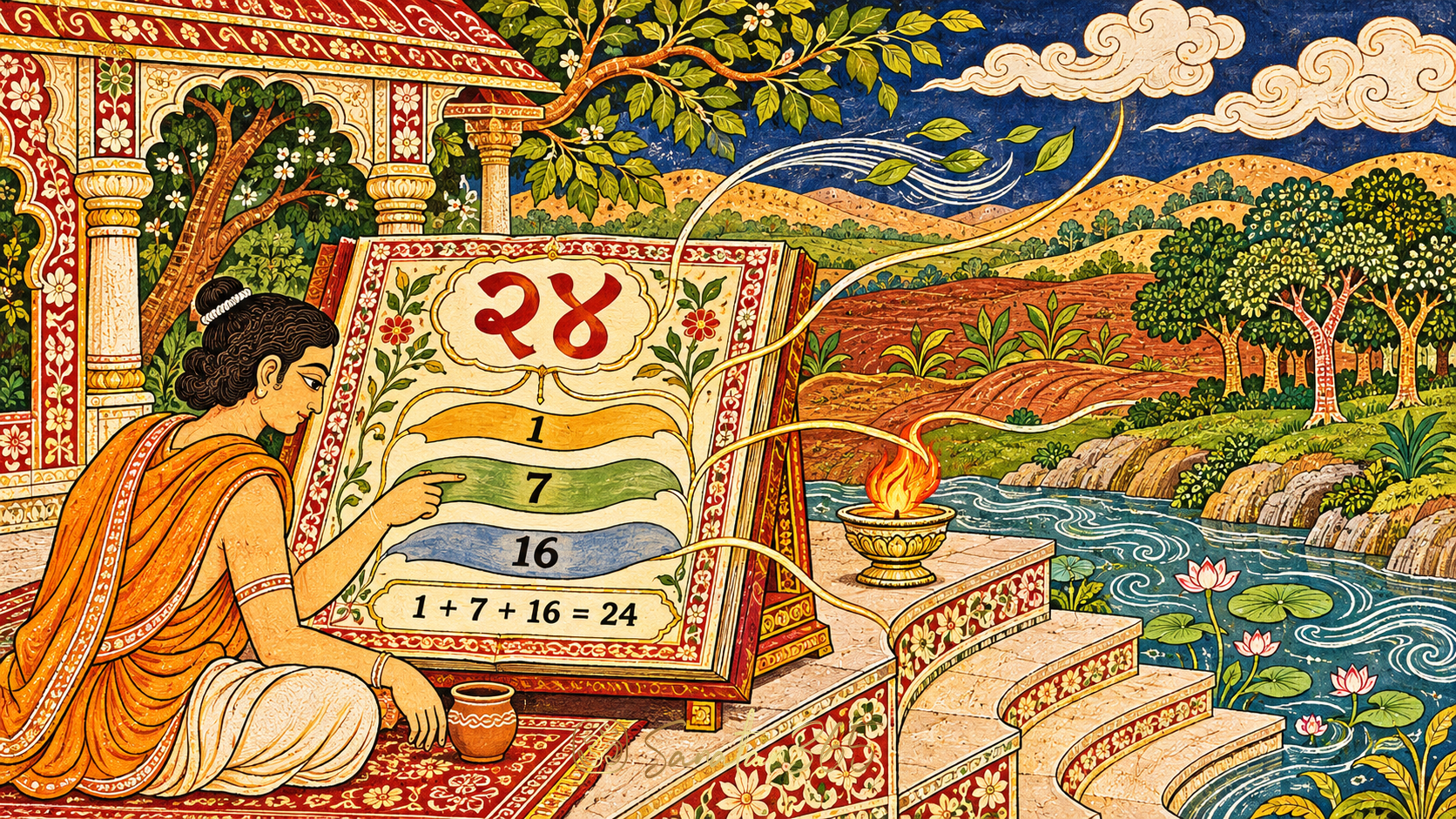
The 24 tattvas are a defined count in Sankhya. Follow the groups of one, seven and sixteen, then see why purusha is discussed separately.
A list can end at twenty-four while the philosophy that uses it speaks of twenty-five principles. The difference lies in what has been included in the count.
24 tattvas meaning concerns the principles belonging to prakṛti (प्रकृति, primordial nature) and its unfolding in classical Sāṃkhya (सांख्य, the philosophical system commonly written Sankhya). A tattva (तत्त्व, principle or fundamental category) is an item in that account. The number twenty-four becomes clearer when its groups are followed carefully. The knowing self, called puruṣa (पुरुष), is discussed separately, giving the familiar total of twenty-five.
What is the 24 tattvas meaning in Sankhya?
The count belongs to a particular philosophical framework. It asks a reader to distinguish what nature produces, what can in turn produce further developments, and what is to be understood separately from that process. The number has meaning because these distinctions have been made. Learning the total is the beginning of learning the relationships.
The Sankhya Karika attributed to Ishvarakrishna gives a compact classification in its third verse. A kārikā (कारिका, a concise verse presenting a teaching) can carry a great deal in very few words. This one groups the principles according to their role as source and product. Its wording is a useful place to begin before moving to a longer list.
मूलप्रकृतिरविकृतिर्महदाद्याः प्रकृतिविकृतयः सप्त । षोडशकस्तु विकारो न प्रकृतिर्न विकृतिः पुरुषः ॥
In a plain reading, root nature is not itself a product. Seven principles beginning with the great principle are both sources and products. A group of sixteen consists of products. Purusha is placed outside both of those categories. The first three groups supply the arithmetic of twenty-four.
The reader therefore has two tasks. One is to learn which principles belong in each group. The other is to remember the rule used to make the groups. A memorised total without that rule can make the list seem arbitrary. Returning to the verse helps show why one principle stands at the beginning, why seven occupy an intermediate role and why sixteen form another group.
The wider guide to the six schools of Hindu philosophy places Sankhya among other ways of inquiry. Here the focus is one count within its own account. Other philosophical texts can arrange their categories differently, so naming the framework is part of naming the meaning.
Key takeaway: Twenty-four is a structured tally. Its meaning comes from the relationship between root nature, intermediate principles and products.
How does the Sankhya Karika count one, seven and sixteen?
The simplest outline is 1 + 7 + 16 = 24. The one is mūlaprakṛti (मूलप्रकृति, root nature). It is the starting principle in this classification. Verse three distinguishes it from a product, while giving it the role of source. The word root helps a learner remember where the account begins.
The seven have a double role. They arise within the unfolding of nature and also serve as sources for further development. They include buddhi (बुद्धि, the determining intellect), also called mahat (महत्, the great principle), and ahaṃkāra (अहंकार, the principle of I-making). The remaining five are the tanmātras (तन्मात्राः, subtle rudiments associated with sound, touch, form, taste and smell).
Counting buddhi and mahat as two separate entries would add an item that this list does not intend. The two names refer here to the same place in the account. This is one reason an unfamiliar list is easier to learn with its grouping beside it. Alternate names can otherwise look like additional members.
The seven can be written as two named principles followed by a group of five. Root nature plus those seven gives eight source principles in the broad outline, though the one and the seven have different roles. Adding the sixteen products brings the count to twenty-four. The arithmetic is simple once the category boundaries stay visible.
A useful study exercise is to write three headings on a page: root source, source-and-product, and product. Place the entries under the relevant heading before drawing any connections between them. This preserves the rule of verse three. A diagram can then help the eye follow the relations that the words have already established.
The later verses supply more of the sequence. Verse twenty-two moves from nature to the great principle and I-making, then describes further development. Verses twenty-four to twenty-seven identify groups of faculties and mind. Verse thirty-eight connects the subtle rudiments with the five gross elements. Reading these passages together gives the short classification room to unfold.
Key takeaway: Keep the one, seven and sixteen visible as separate groups. Within the seven, buddhi and mahat name one principle.
What belongs in the sixteen evolutes?
The sixteen products can be learned in four groups. Five concern knowing, five concern action, one is mind, and five are the gross elements. In this context, evolute means something that has emerged in the philosophical account. Keeping that meaning beside the English word helps a learner follow the text’s own classification.
The groups can be listed as follows.
- Five faculties of knowing, associated with hearing, touch, sight, taste and smell.
- Five faculties of action, associated with speech, grasping, movement, excretion and reproduction.
- Manas (मनस्, mind), which the text discusses in relation to the faculties.
- Five gross elements, conventionally named space, air, fire, water and earth.
The first two groups require a little care in English. A verse may name an ear, a hand or a foot while discussing the capacity associated with it. Hearing and walking help a reader recognise the distinction between knowing something and doing something. The list is arranging functions within a philosophical analysis of experience.
Mind adds one to the ten faculties. The five gross elements add five more, giving sixteen. A learner can check the sum without yet memorising every Sanskrit term. Returning later to the original names becomes easier when each already has a place in a familiar outline.
The two sets of five connected with sensory experience should also remain distinct. The subtle rudiments belong among the seven intermediate principles. The gross elements belong among the sixteen products. A reader who places both sets under one loose English heading such as “elements” can lose the structure that makes the count work.
Consider looking at a clay cup. There is a visible form, the capacity to see and the possibility of reaching out to take hold of it. These are different aspects that a reader can distinguish in an everyday example. The cup is an illustration for study, rather than a substitute for the whole system. It gives the learner somewhere concrete to begin noticing differences in function.
Key takeaway: The sixteen are five faculties of knowing, five of action, mind and five gross elements. Keep the subtle rudiments in their earlier group.
Why is purusha counted separately from the twenty-four?
Verse three gives purusha a distinct position. It is neither a source nor a product in the classification just described. The count of twenty-four therefore concerns nature and its developments. Adding the knowing self gives the wider count of twenty-five principles commonly associated with classical Sankhya.
Swami Abhedananda’s lecture on the Sankhya philosophy of Kapila explains the twenty-four as changeable principles and discusses purusha as the knowing self separately. That distinction helps a reader understand why the two totals can appear in accounts of the same system. The words beside the number tell the reader what is being counted.
This also changes the purpose of learning the list. If intellect, I-making and mind belong to the twenty-four, the question of the knower reaches beyond a simple inventory of visible objects. The list includes aspects of experience that may ordinarily be gathered together under the word “I.” Sankhya asks for closer discrimination within that familiar usage.
A reader can begin by observing that a thought and the object of that thought can both be described. A judgement can change after new information, and attention can move from one thing to another. Such observations can make the text’s questions more approachable. They are starting points for inquiry, while the philosophical claims require continued study and explanation.
The distinction should be allowed to retain its depth. A quick diagram may show purusha beside twenty-four boxes, but the position of a box on a page does not explain the teaching by itself. The diagram is a memory aid for a conceptual distinction. A teacher or careful commentary can help a learner understand what the system claims about knowledge and experience.
Key takeaway: The total of twenty-five includes purusha. The twenty-four count belongs to nature and its developments, so the two numbers answer different counting questions.
How can a reader study the tattva list without losing its purpose?
Begin with the short verse and the three groups. Read it once for the classification, then return to the terms. A learner who tries to remember every name at the first sitting can spend all their attention on vocabulary. A group outline gives each new term somewhere to belong.
A first study page might contain only four lines: root nature, the seven source-products, the sixteen products and purusha separately. On another reading, expand the seven into two plus five. On a later pass, expand the sixteen into five plus five plus one plus five. Each pass makes the same structure more detailed.
It helps to record a question beside an unfamiliar word. Does this term name a knowing capacity, an action, a subtle rudiment or a gross element? Is an alternate name being used for a principle already listed? The questions slow down the impulse to count every unfamiliar word as a new item. They also make a conversation with a teacher more precise.
The guide to how Hindu philosophy examines knowledge introduces another part of philosophical inquiry: how a claim is known. A learner can bring that habit of asking for grounds to the study of the tattvas. Which verse supplies the grouping, and which passage explains an individual role? The answer can be written next to the entry.
Finally, return to the reason the count is being learned. The list gives a language for making distinctions within nature and experience. If the learner can explain why buddhi is counted once, why the two sets of five differ and why purusha is separate, the number twenty-four has begun to carry meaning. The names can then be revisited with greater understanding.
Key takeaway: Learn the grouping before expanding the vocabulary. The count becomes meaningful when the reader can explain the distinctions that produce it.
FAQ
What is the 24 tattvas meaning in simple terms?
They are the principles of nature and its developments in the classical Sankhya count discussed here. The groups of one, seven and sixteen total twenty-four.
Why do some explanations say Sankhya has twenty-five principles?
They include purusha, the knowing self, separately from the twenty-four principles of nature.
Are buddhi and mahat two different entries in this list?
No. In this account they name the same principle, so counting both separately would distort the total.
How can a beginner remember the sixteen products?
Use the groups five, five, one and five: faculties of knowing, faculties of action, mind and gross elements.
About the author
Sanatan365 Editorial
Bringing Sanatan Dharma to modern seekers through authentic, scripture-grounded content.
Related in Numerology
 Numerology
Number 16 Meaning in Hinduism: Reading Shodasha in Context
Explore sixteen as a sacred count through lunar imagery, life-stage rites and offerings, while keeping each tradition’s meaning distinct fr…
 Numerology
Number 18 Meaning in Hinduism: Reading the Mahabharata’s Pattern
Eighteen connects books, dialogue, war days and army units in the Mahabharata. Learn what the texts count and what those patterns do not pr…
 Numerology
Number 10 Meaning in Hinduism: From Sensing to Responsible Action
Ten can gather the capacities for knowing and acting into one framework, without turning a sacred number into a prediction.

