Number 16 Meaning in Hinduism: Reading Shodasha in Context
Explore sixteen as a sacred count through lunar imagery, life-stage rites and offerings, while keeping each tradition’s meaning distinct from luck claims.
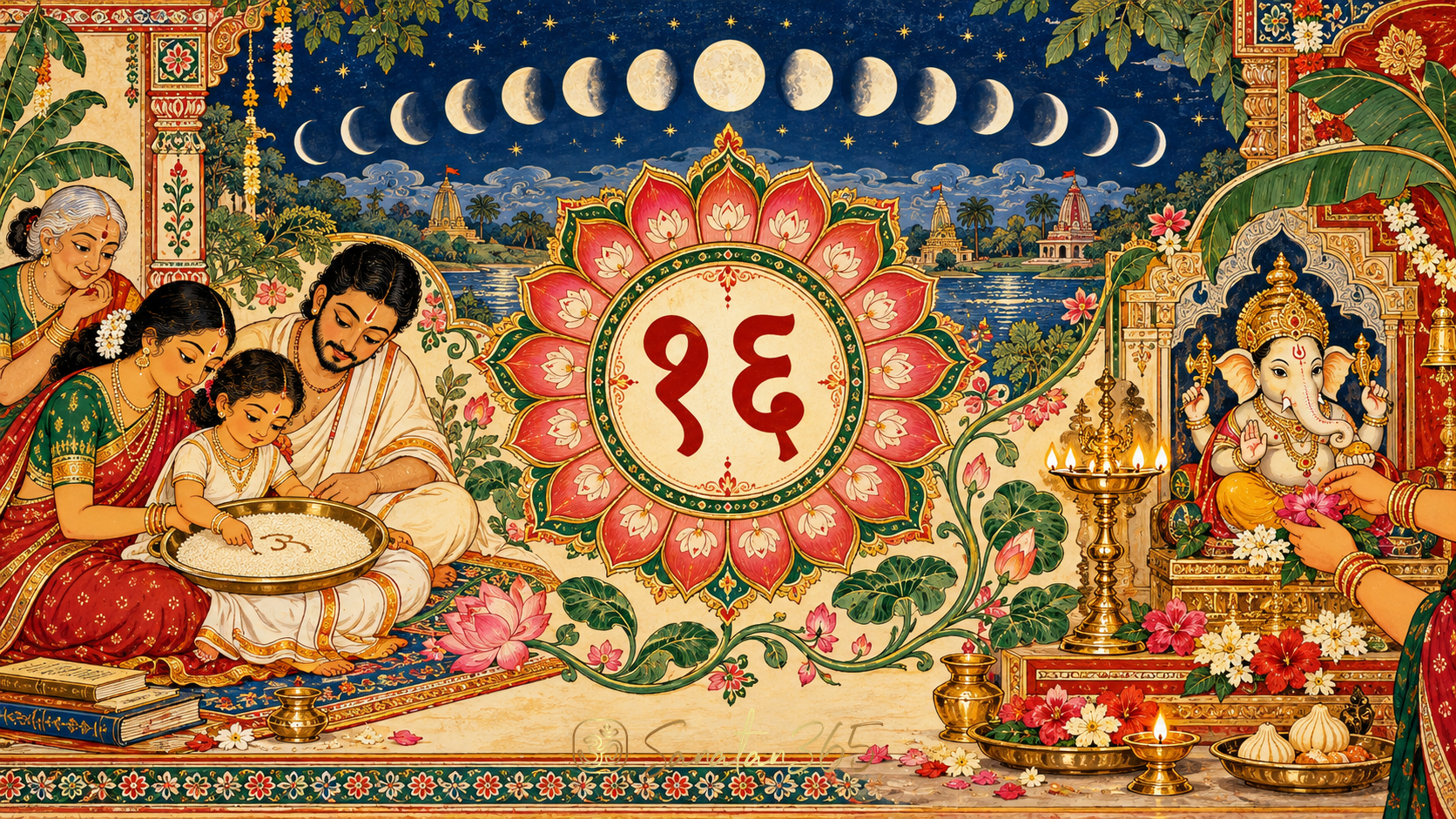
The same number can count a changing moon, a life marked by sacred ceremonies, or the services offered in worship. It does not mean the same thing each time.
Number 16 meaning in Hinduism begins with shodasha (षोडश, ṣoḍaśa), the Sanskrit word for sixteen. Its significance depends on what is being counted: parts in a particular teaching, life-stage rites, or services of devotion. Sixteen can suggest a richly completed whole within those settings, but it is not a universal code for a person's character, luck or future. The most useful first question is simple: sixteen of what?
That question makes the symbolism more interesting, not less sacred. A number becomes meaningful through the relationships it gathers. Reading those relationships carefully lets a familiar word open into a particular practice rather than dissolve into a vague promise.
Number 16 meaning in Hinduism: what does shodasha actually name?
Shodasha is a number-word, not the name of one doctrine. In an expression containing it, the accompanying word usually tells the reader where to look. The whole phrase matters more than the isolated digit.
Three combinations help make the distinction clear:
- Shodasha kala: sixteen parts or portions in a specified symbolic or textual setting. Kala (कला, kalā) means a part or portion in the examples discussed here.
- Shodasha samskara: a grouping of sixteen life-stage rites. Samskara (संस्कार, saṃskāra) refers here to a ceremony of refinement or a rite of passage.
- Shodashopachara: sixteen services or honours in worship. Upachara (उपचार, upacāra) means a service or act of homage in this ritual context.
The count is shared; the counted things are different. A life-stage ceremony is not a lunar portion, and a flower offering is not a stage in a person's biography. Similarity of number invites comparison, but it does not establish identity of meaning.
Imagine finding three folders labelled “sixteen.” One contains a diagram, another family ceremony notes, and the third a worship sequence. The label helps organise them, yet it cannot replace opening each folder. This is an illustration of how to read, not a traditional story about the number.
Readers beginning with our guide to sacred numbers in Hindu practice can bring the same discipline here. Rather than immediately reducing sixteen to another digit or attaching a personality description to it, start with the named teaching or observance. That keeps attention on the material actually being explained.
Key takeaway: Shodasha tells the reader the count; the rest of the expression reveals the subject.
How do lunar parts make sixteen a picture of fullness?
The moon offers a vivid image of increase and decrease. In Brihadaranyaka Upanishad 1.5.14, Prajapati, the lord of creatures in this passage, is identified with the year and described through sixteen parts. Fifteen are associated with the nights and their change, while the sixteenth is presented as constant. Verse 1.5.15 turns the image towards a person, distinguishing changing possessions from the person who remains alive. The text and commentary translated by Swami Madhavananda provide the setting for both comparisons.
This is a specific contemplative use of sixteen. It should not be repackaged as a claim that astronomy recognises sixteen standard named moon phases, or that a person can calculate spiritual worth from a birthday. The passage invites a distinction between what varies and what is treated as its enduring ground.
A reader need not convert that distinction into a personal forecast. It can remain a question for reflection: when circumstances change, what has actually changed, and what has been too quickly identified with those circumstances? The question is offered here as a reading exercise, not as a replacement translation of the verse.
Consider an ordinary example. A person may be introduced by an occupation, a possession or a recent success. If that description changes, it does not follow that the whole person has been adequately described or erased. The example helps illustrate a distinction; it does not prove a philosophical conclusion by itself.
The restraint matters. Sacred imagery can carry an inquiry without becoming a scientific measurement or a guarantee. Its value is not increased by asking it to certify claims outside its purpose. Sometimes the strongest response to a symbol is to stay with the question it raises.
Key takeaway: In this passage, sixteen supports a particular comparison between change and constancy; it is not an all-purpose prediction formula.
Why do sixteen samskaras describe stages of life?
A second setting concerns the significant transitions of a human life. BAPS presents a sixteenfold grouping that includes naming, the beginning of learning, marriage and final rites, while acknowledging that scriptural enumerations differ. Its account of the sixteen samskaras treats them as occasions for consciously honouring life rather than merely passing through it.
The important numerical point is that this sixteen is a sequence of ceremonies. It does not count the same things as the lunar image. The number gathers transitions into an intelligible pattern; it does not make those transitions interchangeable.
Variation also needs to remain visible. The explanation published by Sri Deva Sthanam notes differences in enumeration and in the ceremonies regularly observed by families and regions. A sixteenfold presentation therefore should not become a claim that every Hindu household follows one identical list or performs every ceremony in exactly the same way.
For a family in India or the diaspora, that distinction can make an inquiry more respectful. Instead of asking why a relative has “missed” a numbered requirement, ask what the family's tradition calls the ceremony, who teaches its meaning, and how its form is understood. Those questions begin with learning rather than accusation.
Our explanation of the naming ceremony considers one example in its own right. Here it is enough to notice the larger reading principle: a numbered framework can provide orientation without being turned into a ranking of families.
A useful family conversation might begin with one remembered detail: who gathered, what was offered, what was spoken, and why that transition mattered. Recording the meaning can be more illuminating than checking off a label without understanding it. This is a suggested way to learn about an observance, not a newly prescribed rite.
No reader's dignity or spiritual sincerity should be judged by the length of a ceremony list. Learning about a tradition can be careful and reverent while recognising that people meet it through different households, places and circumstances.
Key takeaway: Sixteen samskaras organise life-stage observances; their meaning is learned through the particular rites and their living traditions.
What changes when sixteen counts the services of puja?
A third setting moves from a whole lifetime to an act of worship. Puja (पूजा, pūjā) means reverential worship. In shodashopachara, sixteen counts services offered to the deity. The dictionary's collected descriptions identify sixteen acts of homage and note that enumerations vary. Familiar services include welcoming, offering a seat, water, fragrance, flowers, light and food.
The sense of a whole here comes through attentive service. It would be a mistake to assume that the sixteen services must correspond one for one with sixteen life-stage ceremonies. The shared number does not provide such a map.
For a newcomer, a useful way to understand the sequence is to notice its verbs. Welcome. Offer. Attend. Honour. These words direct attention towards a relationship rather than towards collecting an impressive display of objects. The verbs are an explanatory aid, not a replacement for a tradition's instructions.
A lamp and a flower are therefore more than numbered entries in a shopping list. Their place is in an act of devotion. Asking what a particular service expresses can keep the observance from becoming an exercise in counting alone.
At the same time, understanding a sequence is different from being authorised or prepared to conduct it. For actual observance, a family's established practice or a qualified teacher is the appropriate guide. This article explains the number's setting; it does not prescribe a universal sixteen-step ceremony.
The distinction is easier to see alongside five simple offerings in panchopachara puja. Pancha (पञ्च, pañca) means five. Different frameworks need to be understood on their own terms. Arithmetic by itself cannot establish that a larger count is more sincere, or that a smaller one is spiritually inferior.
An attentive reader can appreciate the richness of sixteen services without turning worship into a competition over quantity. The question remains what is being offered, to whom, and with what understanding.
Key takeaway: In shodashopachara, sixteen names a framework of devotional service, not a score for measuring devotion.
How can readers honour a sacred number without turning it into a prediction?
A careful reading can follow four modest steps:
- Find the complete phrase. “Sixteen” alone is too broad. Identify whether the source is discussing parts, rites or services.
- Locate the source. A verse reference, a named ritual tradition or a clearly identified institutional explanation is more useful than an unattributed claim that “the scriptures say.”
- Ask what the number does. Does it organise a sequence, bring together a group, or support a comparison? Describe that work before proposing a larger meaning.
- Keep the conclusion proportional. A meaningful count in worship does not, by itself, establish a person's destiny or justify a guaranteed promise.
Suppose someone hears that sixteen represents fullness and then asks whether choosing that number will ensure a desired result. A responsible explanation can acknowledge the sacred association while declining the leap. A symbol may guide reflection without controlling events.
The same care applies to informal claims that one number is always fortunate or always harmful. The examples examined here do not establish either conclusion. They show particular uses of sixteen, each with a subject and a setting.
For study, try a simple three-column note: the phrase, what it counts, and the source. Leave room for a fourth column headed “what remains unclear.” Not knowing an answer yet is preferable to joining unrelated claims into a confident but unsupported explanation.
If a child asks why the same number appears in different places, the answer can stay accessible: the number is the same, but the things being counted are different. The next question is an invitation to look more closely. There is no need to make the explanation mysterious before it becomes meaningful.
This approach does not drain devotional life of wonder. It allows wonder to attach to something specific: a verse's comparison, a ceremony's significance, or the care expressed through an offering. The number becomes a doorway into understanding, rather than a substitute for it.
Key takeaway: Honour the symbol by explaining its actual setting and refusing claims that go beyond the evidence.
FAQ
What does shodasha mean in English?
Shodasha means sixteen. In a longer Sanskrit expression, the accompanying word identifies what is being counted, such as parts, life-stage rites or services of worship. It does not supply one identical meaning for every occurrence.
Does the number 16 always mean completeness in Hinduism?
It can participate in an image or framework of fullness, but the meaning depends on the source and practice. Start with the particular passage or observance rather than treating completeness as a universal definition imposed on every use.
Are sixteen kalas the same as sixteen samskaras?
No. Kala means a part or portion in the textual example discussed here, while samskara refers here to a life-stage rite. Their shared count does not make them the same list or establish a direct correspondence between them.
Must every Hindu family follow the same sixteen ceremonies?
The sources acknowledge differences in enumeration and observance. A family can ask its own teacher or priest about its practice. This article does not use a numbered list to judge a household's sincerity or spiritual standing.
Is 16 a guaranteed lucky or unlucky number?
The sources examined here do not establish such a guarantee. Their symbolic and ritual uses should not be turned into promises about someone's personality, fortune or future. A sacred association and a verified prediction are different kinds of claim.
About the author
Sanatan365 Editorial
Bringing Sanatan Dharma to modern seekers through authentic, scripture-grounded content.
Related in Numerology
 Numerology
24 Tattvas Meaning: What Sankhya Counts and Why
The 24 tattvas are a defined count in Sankhya. Follow the groups of one, seven and sixteen, then see why purusha is discussed separately.
 Numerology
Number 18 Meaning in Hinduism: Reading the Mahabharata’s Pattern
Eighteen connects books, dialogue, war days and army units in the Mahabharata. Learn what the texts count and what those patterns do not pr…
 Numerology
Number 10 Meaning in Hinduism: From Sensing to Responsible Action
Ten can gather the capacities for knowing and acting into one framework, without turning a sacred number into a prediction.

