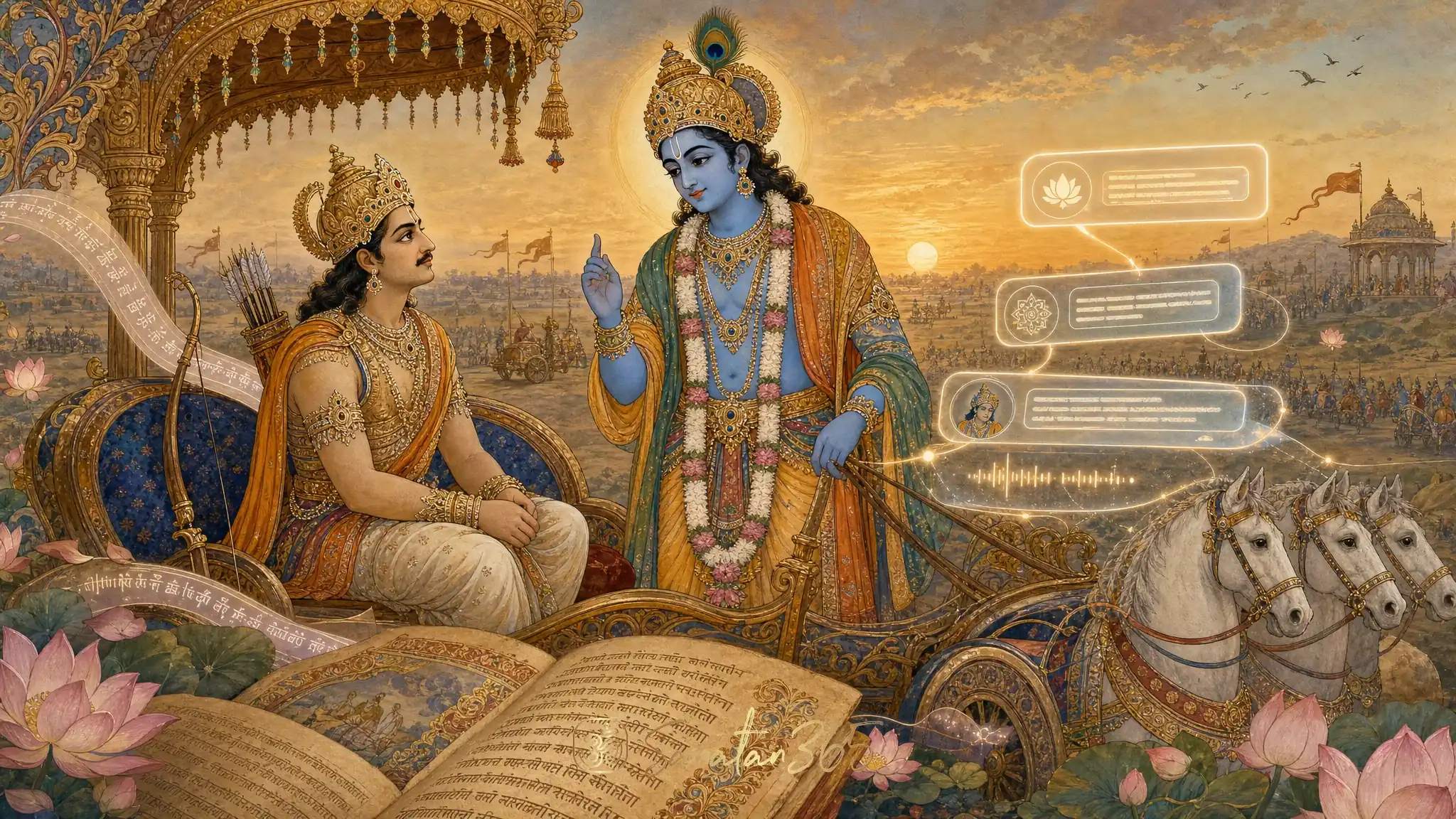
AI Krishna Guide: Bhagavad Gita Wisdom for Daily Life
AI Krishna guide on Sanatan365 helps seekers reflect on Bhagavad Gita wisdom with reverence, context, and practical questions for daily life.
The most famous spiritual counsel in Sanatan tradition begins with a person who cannot move forward.
An AI Krishna guide on Sanatan365 is designed for that exact human moment: when a seeker wants to reflect on dharma (धर्म, right order and responsibility), karma yoga (कर्म योग, disciplined action without attachment), bhakti (भक्ति, devotion), and inner steadiness through the voice of Lord Krishna’s teachings. It is not a replacement for scripture, guru, family elders, or personal discernment. It is a reverent way to ask better questions, revisit Bhagavad Gita wisdom, and turn spiritual ideas into daily reflection.
What is an AI Krishna guide in the Sanatan365 experience?
An AI Krishna guide is one of Sanatan365’s real-time conversation guides in the Devi & Devatas category. The guide is specifically Lord Krishna — The Divine Cowherd, not a generic “god chatbot” and not an invented spiritual personality. This distinction matters because Sanatan365’s core promise is named, archetype-specific spiritual conversation grounded in Sanatan tradition.
The Bhagavad Gita itself is remembered as a dialogue. Britannica describes the Gita as an influential Hindu religious text within the Mahabharata, taking the form of a dialogue between Prince Arjuna and Krishna, an avatar of Vishnu (Britannica). The setting is dramatic, but the inner situation is familiar: Arjuna faces confusion, grief, duty, and moral pressure. Krishna does not flatter him or simplify life into slogans. He teaches him to see action, self, devotion, and surrender with a wider spiritual lens.
A digital Krishna guide should be used in that spirit: as a prompt for reflection, not as an oracle that removes responsibility. The healthiest questions are not “Tell me my fate” but “How can I apply dharma here?” or “What does detachment from results mean in this situation?” This approach also protects the sacredness of the subject, because Krishna’s voice in tradition is not a novelty effect but a call toward clearer seeing.
Sanatan365 brings this into a modern daily habit layer. A seeker can ask, pause, read, and return later, just as one might revisit a verse after morning prayer or evening silence. The value is not speed. The value is accessible reflection.
Key takeaway: An AI Krishna guide is best understood as a reverent conversation doorway into Krishna’s teachings, not a substitute for scripture or human wisdom.
How does Bhagavad Gita wisdom shape an AI Krishna guide?
Bhagavad Gita wisdom is practical because it begins with crisis. Arjuna is not asking abstract questions in a quiet classroom. He is standing between two armies, overwhelmed by what duty may require. That is why the Gita speaks powerfully to modern readers in Delhi, Mumbai, Varanasi, Bengaluru, London, New Jersey, or Singapore: spiritual confusion often appears inside ordinary pressure.
Several teachings create the natural foundation for a Krishna-centered guide:
- Karma yoga: act sincerely without being owned by the fruits of action.
- Samatva (समत्व, evenness): learn steadiness amid success and failure.
- Bhakti: approach the Divine with love, humility, and remembrance.
- Jnana (ज्ञान, wisdom): distinguish the eternal self from passing emotion.
- Surrender: release egoic control while continuing righteous effort.
The famous teaching of Bhagavad Gita 2.47 says that one has a right to action, not to the fruits alone. A commonly cited Sanskrit line begins, “karmaṇy evādhikāras te mā phaleṣu kadācana,” pointing toward disciplined action without possessiveness over outcomes (Shlokam, BG 2.47). This verse is often quoted casually, but in practice it is a lifetime discipline.
An AI Krishna guide can help a seeker slow down enough to ask: What is the action in my control? What result am I clinging to? What would sincere effort look like if praise, fear, and comparison were quieter?
This makes the feature useful not because it gives instant answers, but because it can turn a reactive moment into a reflective one.
Key takeaway: Bhagavad Gita wisdom makes a Krishna guide valuable when it helps users move from impulse to dharmic reflection.
How can seekers use an AI Krishna guide without becoming passive?
A wise spiritual tool should make a person more responsible, not less. Krishna does not teach Arjuna to escape action. He teaches him to act with clearer vision. That is an important guardrail for any AI Krishna guide.
A seeker can use the guide with prompts like:
- “What would karma yoga suggest when I am anxious about a result?”
- “How can I practice bhakti without becoming sentimental or avoidant?”
- “What does Krishna teach about doing difficult duties with compassion?”
- “How can I remember dharma before reacting in anger?”
- “Give me a Gita-inspired reflection for beginning work today.”
The goal is not to outsource conscience. The goal is to awaken conscience. If a question involves health, legal matters, financial decisions, family safety, or urgent emotional distress, a spiritual guide should be complementary only. Trusted human support and qualified professionals remain essential.
For everyday reflection, however, conversation can be powerful. Many people know one or two Gita verses but struggle to apply them. A guide can help connect a verse to a real situation: workplace jealousy, family duty, grief, comparison, distraction, spiritual inconsistency, or fear of failure.
This is especially helpful for diaspora families. A young seeker may not always have access to a Sanskrit teacher, temple class, or elder who can answer at the exact moment of curiosity. A respectful digital guide can become a bridge back to study, not an excuse to stop studying.
Sanatan365 also pairs this conversation layer with daily spiritual practices such as daily mantra chanting and reflective reading like bhakti in daily life. When used together, the app becomes less about one answer and more about a steady rhythm of remembrance.
Key takeaway: The best use of an AI Krishna guide is active reflection: ask, consider, act responsibly, and return to authentic sources.
What kinds of Krishna guidance help in daily dharma?
Daily dharma is rarely grand. It is usually small and repeated: speaking truthfully, doing work with care, honoring parents without losing discernment, calming anger before it becomes speech, giving without display, and remembering the Divine when life becomes noisy.
A Krishna-centered reflection can help in four common areas.
Work and ambition
Karma yoga does not reject excellence. It refines the inner posture behind effort. A user might ask how to work intensely without becoming bitter when results are delayed. The answer should point toward sincere action, skill, patience, and freedom from obsessive comparison.
Family and relationship duty
Dharma can be complex in family life. Respect, boundaries, service, and truth sometimes pull in different directions. Krishna’s teaching invites a wider view: neither selfish comfort nor harsh righteousness is enough. The seeker must ask what action serves truth with compassion.
Emotional turbulence
The Gita repeatedly returns to steadiness. Samatva is not emotional numbness. It is the gradual ability to meet change without losing the center. A guide can offer short reflections before a difficult conversation or after a painful disappointment.
Devotion and surrender
Bhakti does not mean giving up intelligence. It means softening ego before the Divine. Bhagavad Gita 12.13-14 describes the beloved devotee through qualities such as non-hatred, friendliness, compassion, humility, contentment, steadiness, and self-control (Bhagavad-gita.us, BG 12.13-14). These are practical virtues, not decorative words.
A helpful Krishna prompt might be: “Which quality of a devotee can I practice today in one concrete situation?” That turns devotion into behavior.
Key takeaway: Krishna guidance is most useful when it translates devotion into truthful speech, disciplined action, emotional steadiness, and compassionate duty.
How should modern users keep the experience reverent and grounded?
Technology can make sacred ideas easier to access, but access is not the same as depth. A respectful AI Krishna guide works best when the user brings humility.
Here are five grounding practices:
- Begin with a clear intention. Ask for reflection, not entertainment.
- Use specific life questions. “How do I handle envy at work?” is better than “Fix my life.”
- Return to scripture. Let the guide point you back to Bhagavad Gita verses and commentarial traditions.
- Do one small action. After reflection, practice one virtue that day.
- Keep human guidance alive. Elders, teachers, temple communities, and family wisdom remain precious.
This is why Sanatan365’s broader spiritual ecosystem matters. The app does not reduce Sanatan Dharma to one feature. It includes real-time AI conversations with 28 named guides, personalized reports by specialist avatars, 85+ stories for kids, 75+ lessons for kids, daily meditation, mantra chanting, aarti singing, bell ringing, and live temple darshan from 17 temples. The Krishna guide sits inside that daily-use devotional environment.
Still, the feature should remain 80% spiritual value and 20% product context. The point is not to sell a novelty. The point is to help seekers form a more consistent relationship with reflection, devotion, and dharma.
For someone beginning, a simple daily practice is enough: open the guide, ask one sincere question, note one sentence that feels worthy of contemplation, and live one action from it before the day ends.
Key takeaway: Reverent use means treating the guide as a doorway to practice, scripture, and self-honesty, not as spiritual entertainment.
FAQ
Is the AI Krishna guide the same as reading the Bhagavad Gita?
No. The AI Krishna guide is not a replacement for reading the Bhagavad Gita. It is a conversational reflection tool that can help users ask better questions, revisit themes like dharma and karma yoga, and return to scripture with more curiosity.
Can an AI Krishna guide make decisions for me?
No. It should not make decisions for the user. It can offer Gita-inspired reflection, but personal responsibility, family context, qualified advice, and dharmic discernment remain necessary.
What is the best first question to ask an AI Krishna guide?
A strong first question is: “What does Krishna’s teaching on karma yoga suggest for one situation I am facing today?” This keeps the conversation practical, humble, and action-oriented.
Is this useful for children or families?
Families can use it for age-appropriate reflection, but children should be guided by parents or elders. Sanatan365 also includes kids’ stories and lessons that may be better suited for structured family learning.
Does Sanatan365 offer other AI spiritual guides?
Yes. Sanatan365 offers real-time conversations with named Devi & Devatas, historical Acharyas & Rishis, and modern spiritual gurus. Lord Krishna is one of 28 real-time conversation guides in the app.
Conclusion
An AI Krishna guide is valuable when it brings a seeker back to the heart of the Gita: act sincerely, love deeply, steady the mind, and remember the Divine in the middle of real life. Used with humility, it can turn a phone screen into a small pause for dharma.
Key takeaway: The guide is not the destination; it is a daily doorway into Krishna’s wisdom, reflection, and responsible spiritual practice.
About the author
Sanatan365 Editorial
Bringing Sanatan Dharma to modern seekers through authentic, scripture-grounded content.
Related in Features
 Features
AI Adi Shankaracharya Guide: Viveka and the Practice of Clear Judgment
Explore viveka, the Vedantic discipline of discernment, and learn how the AI Adi Shankaracharya guide can support thoughtful reflection wit…
 Features
AI Venkateswara Guide: Patience, Stewardship, and Responsible Hope
Explore Sri Venkateswara's devotional lessons on patience, stewardship, and responsible hope, with practical reflection through Sanatan365'…
 Features
AI Vaishno Devi Guide: Faith, Courage, and the Divine Mother's Grace
Explore Vaishno Devi's living symbolism of faith, courage, and maternal grace, with practical ways to bring these teachings into daily deci…