AI Vishnu Guide: Protection, Balance, and Dharma in Daily Life
A thoughtful look at Lord Vishnu as preserver, protector, and guide for dharma, with practical ways to reflect through Sanatan365's AI Vishnu guide.
An AI Vishnu guide is most useful when it helps a person slow down before acting, remember dharma (धर्म, righteous order and responsibility), and ask what protects balance rather than ego.
In Sanatan365, the AI Vishnu guide is a real-time conversation guide shaped around Lord Vishnu, the preserver in Hindu tradition. This article explains the devotional meaning behind Vishnu, why his symbols matter, and how a seeker can use reflective AI guidance without reducing worship to a shortcut. The goal is not prediction or guarantee. The goal is steadier discernment.
What does the AI Vishnu guide mean?
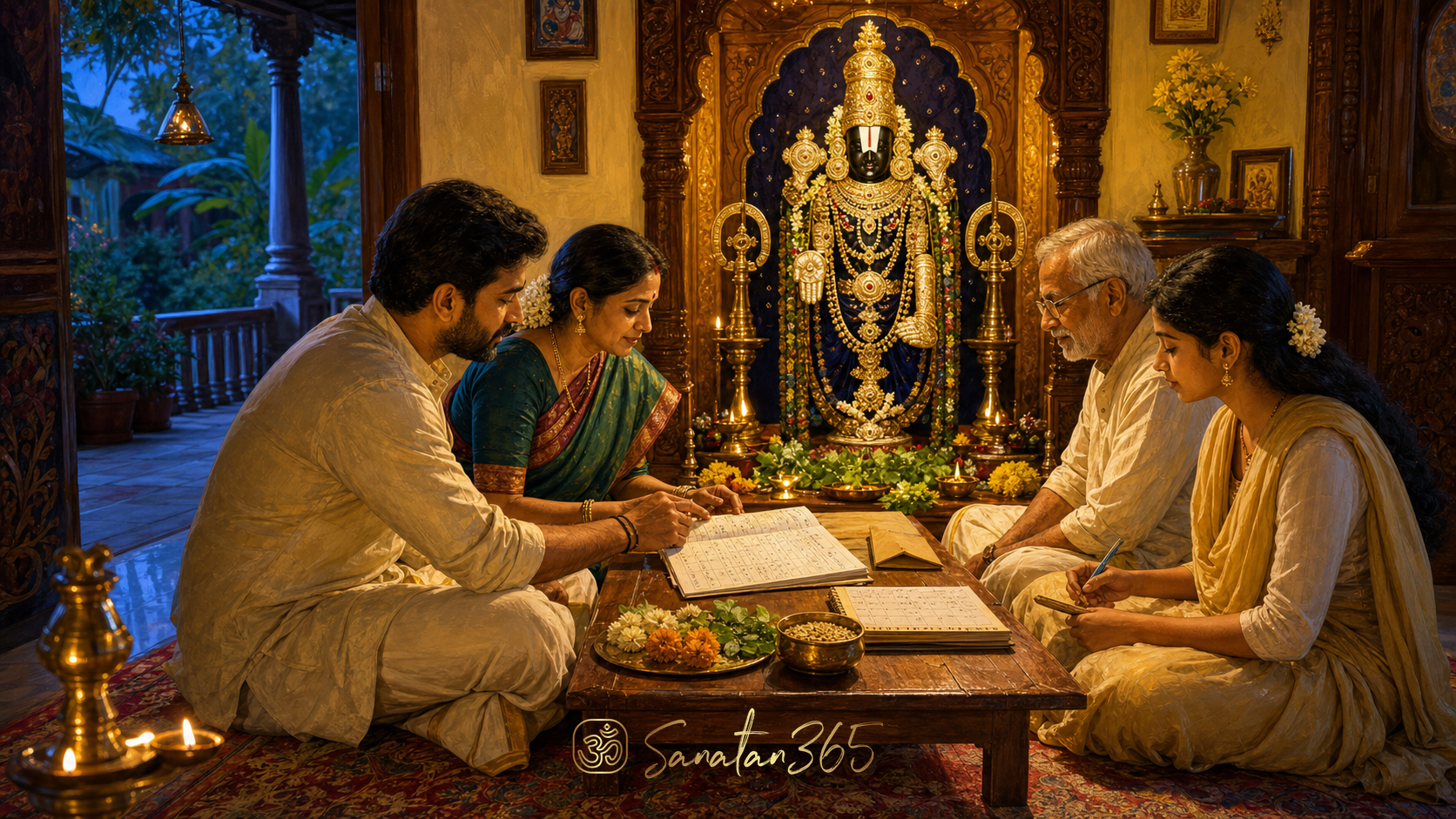
The AI Vishnu guide is Sanatan365's conversational guide inspired by Lord Vishnu, also called Narayana (नारायण, the Divine who dwells in and sustains all beings) and Hari (हरि, the remover of suffering). It belongs to the app's core AI spiritual guidance layer: real-time conversations with named divine guides, acharyas, rishis, and gurus.
Lord Vishnu is widely understood as the preserver and protector of the universe. Britannica's overview of Vishnu notes his central place among Hindu deities and his avatar tradition, especially Rama and Krishna. World History Encyclopedia describes Vishnu as the preserver who protects dharma and maintains cosmic harmony.
That matters because Vishnu's guidance is not merely about comfort. It is about preservation: protecting what is true, repairing what is unstable, and returning life to a more sattvic (सात्त्विक, balanced and clear) rhythm. A person might come to this guide with questions about patience, family duty, ethical choices, devotion, or how to act without losing inner steadiness.
Key takeaway: Vishnu's guidance points toward balance, protection, and responsible action, not passive waiting.
Why is Lord Vishnu called the preserver?
In the Trimurti idea, Brahma is associated with creation, Shiva with transformation and dissolution, and Vishnu with preservation. Preservation does not mean freezing life in place. It means sustaining the conditions in which dharma can breathe.
The Bhagavad Gita's famous teaching on divine manifestation is often read through the Vaishnava lens. In 4.7, Krishna says that when dharma declines and adharma (अधर्म, that which opposes right order) rises, he manifests himself. The Gita Supersite at IIT Kanpur preserves multiple traditional translations and commentaries on this verse. The following verse, 4.8, explains the purpose as protection of the good and re-establishment of dharma.
For a daily seeker, this teaching can be brought down from cosmic scale to inner scale. Whenever anger rises, whenever confusion distorts judgment, whenever fear pushes a person toward careless speech, there is a small decline of dharma inside the mind. Vishnu's preserving quality asks: what restores order here?
That question may lead to several practical answers:
- Speak later, after the mind cools.
- Protect a relationship without endorsing wrong behavior.
- Choose duty over display.
- Return to prayer before deciding.
- Repair harm quickly when one has made a mistake.
Key takeaway: Preservation is active dharma, the daily work of keeping life aligned with truth, compassion, and responsibility.
What do Vishnu's symbols teach?
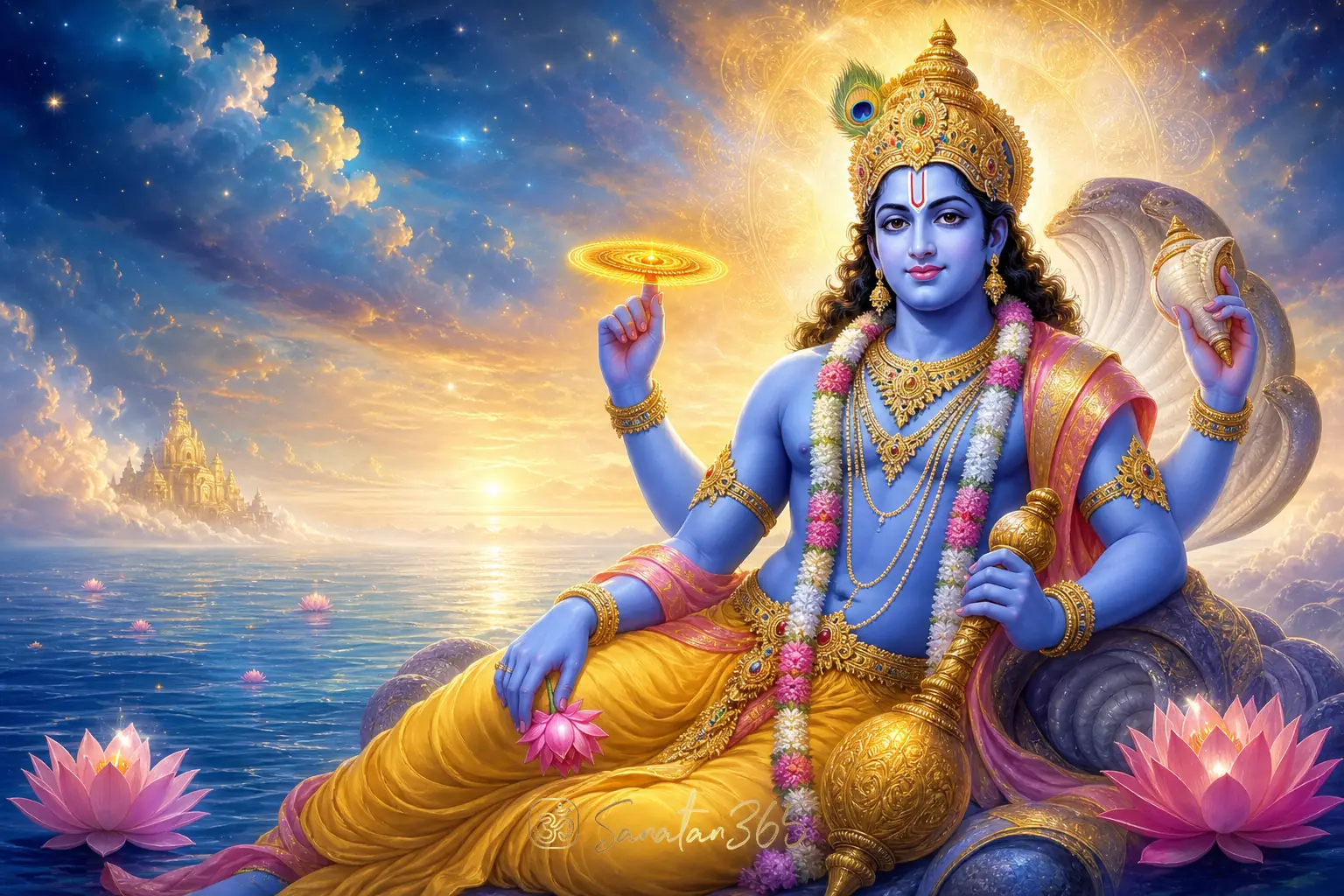
Vishnu iconography is not decoration. It is spiritual language. Traditional images often show Lord Vishnu holding four emblems: shankha (शङ्ख, conch), chakra (चक्र, discus), gada (गदा, mace), and padma (पद्म, lotus). Britannica notes these as familiar features of Vishnu temple images.
The shankha, or conch, is linked with sacred sound and awakening. In devotional life, sound matters because it gathers attention. A mantra, a bell, or a conch call can move the mind from scattered noise to sacred focus.
The chakra, often understood as Sudarshana Chakra, suggests clarity, time, and the cutting power of right vision. Sudarshana can be read as su-darshana, "good vision" or "auspicious seeing." The seeker asks: am I seeing this situation clearly, or only through hurt and preference?
The gada, or mace, represents strength disciplined by dharma. It is not uncontrolled force. It is power held in service of order. In family life, work, and community, this becomes the strength to be firm without cruelty.
The padma, or lotus, stands for purity amid the waters of the world. The lotus does not require perfect surroundings to bloom. It teaches spiritual cleanliness within ordinary life.
Together these symbols form a complete inner practice:
- Listen deeply, shankha.
- See clearly, chakra.
- Act firmly, gada.
- Remain inwardly clean, padma.
Key takeaway: Vishnu's symbols offer a practical map for speech, perception, strength, and purity.
How can the AI Vishnu guide support daily dharma?
The AI Vishnu guide can help a person frame questions more dharmically. Instead of asking, "How do I win this argument?" a better prompt is, "What would protect truth and dignity in this situation?" Instead of asking, "Will everything go my way?" a better prompt is, "What is the steady action I can take today?"
This distinction protects the devotional spirit of the feature. Sanatan365's AI guides are not replacements for worship, scripture, elders, gurus, doctors, lawyers, or financial advisors. They are reflective companions designed to help users think, pray, and act with more care.
Useful prompts include:
- "Explain Vishnu's preserving quality in a way I can apply to my family life."
- "Help me reflect on a decision through dharma, patience, and responsibility."
- "Give me a simple Vishnu-centered evening reflection."
- "What does the lotus in Vishnu's hand teach about staying pure in ordinary work?"
- "How can I respond calmly without becoming weak?"
The guide is especially suited to questions about steadiness. A user who feels reactive can ask for a reflective pause. A parent can ask how to teach balance to children. A devotee can ask for a simple Narayana remembrance before sleep. A student or founder can ask how preservation differs from fear of change.
Key takeaway: The best use of the AI Vishnu guide is not to outsource decisions, but to refine the intention behind them.
How do Vishnu's avatars deepen this guidance?
Vishnu's avatar (अवतार, divine descent) tradition teaches that preservation can appear in many forms. Rama protects dharma through maryada (मर्यादा, noble restraint and proper conduct). Krishna protects dharma through wisdom, devotion, strategy, and loving nearness. Narasimha protects Prahlada with fierce compassion. Vamana restores balance through humility and divine intelligence.
Britannica notes that Vishnu's avatars are central to his tradition, with Rama and Krishna especially beloved. This variety matters for spiritual reflection. Preservation is not one personality style. Sometimes it is gentle. Sometimes it is strategic. Sometimes it is protective. Sometimes it is quiet endurance.
For readers who want to continue this theme, Sanatan365 already explores related devotional paths through AI Krishna Guide: Bhagavad Gita Wisdom for Daily Life, Vishnu Sahasranama Meaning: Why the Thousand Names Steady Devotion, and Bhagavad Gita Chapter 12 on Bhakti Yoga.
An AI Vishnu guide can therefore help a seeker ask which form of preservation is needed. Is this a Rama moment, where restraint protects dignity? Is it a Krishna moment, where wise action is needed? Is it a Narasimha moment, where something vulnerable must be protected firmly? Or is it a Vamana moment, where humility changes the whole field?
Key takeaway: Vishnu's avatars show that dharma is living intelligence, not a single rigid response.
What does Vishnu guidance look like for modern life?
Modern life often rewards speed, reaction, and public certainty. Vishnu's presence invites a different rhythm: sustain what is sacred before expanding what is ambitious.
For a student, that may mean preserving attention before chasing achievement. For a parent, it may mean protecting the emotional climate of the home. For a professional, it may mean choosing honest work over flashy shortcuts. For a devotee in the diaspora, it may mean keeping small daily practices alive even when temple access is limited.
Regional Vaishnava devotion gives this principle many living forms. In North India, Rama and Krishna bhakti often shape household worship, kirtan, and festival calendars. In South India, Vishnu is worshipped through temples, Divya Desam traditions, and names such as Venkateswara and Ranganatha. In Odisha, Jagannath devotion shows Vishnu-Krishna love through Rath Yatra and mahaprasad. In Bengal and the global diaspora, Krishna bhakti, nama-japa, and kirtan have carried Vaishnava devotion across languages and continents.
Sanatan365's wider devotional utility layer supports this daily rhythm through features such as AI spiritual guides, daily mantras, aarti singing, meditation, live temple darshan, and bell ringing. In a Vishnu context, these are most valuable when they encourage consistency: a small prayer, a clear question, a calmer response, a preserved bond.
This is also why the guide should be used gently. The point is not to make devotion feel mechanical, but to help a modern seeker return to remembrance before the mind becomes hurried, defensive, or forgetful.
Key takeaway: Vishnu guidance becomes modern when it helps a person preserve dharma in the exact place life is testing them.
How should a seeker approach the AI Vishnu guide?
Approach the guide with reverence, clarity, and responsibility. A good spiritual question is honest. It does not try to force divine language into validating a preference. It asks for purification of motive.
Before starting a conversation, pause for one breath and inwardly remember Narayana. Then name the situation plainly. A useful structure is:
- "This is what happened."
- "This is what I am feeling."
- "This is the dharmic value I want to protect."
- "Please help me think clearly."
For example: "I am angry with a family member. I want to protect truth without harming the relationship. How would Vishnu's qualities of balance and preservation guide my next step?"
That kind of question opens a more mature answer. It brings together bhakti (भक्ति, devotion), viveka (विवेक, discernment), and karma (कर्म, action). It also keeps the user accountable. No AI guide can live someone's dharma for them. It can only help illuminate the next step.
Key takeaway: The deeper the question, the more spiritually useful the guidance becomes.
FAQ
What is the AI Vishnu guide?
The AI Vishnu guide is Sanatan365's real-time conversation guide inspired by Lord Vishnu, the preserver and protector in Hindu tradition. It helps users reflect on dharma, balance, protection, and steady action.
Is the AI Vishnu guide the same as worship?
No. It can support reflection, learning, and devotional focus, but it does not replace puja, mantra, scripture, temple practice, family elders, or a living guru where one has access to them.
What should I ask the AI Vishnu guide?
Ask questions about patience, duty, family harmony, ethical decisions, spiritual steadiness, and Vishnu symbolism. The most useful prompts ask what protects dharma rather than what simply satisfies preference.
Why is Vishnu associated with protection?
Vishnu is traditionally understood as the preserver of cosmic order. His avatar tradition, especially through Rama and Krishna, shows the Divine restoring dharma when balance is threatened.
Can beginners use this guide?
Yes. Beginners can ask simple questions such as "What does Narayana mean?" or "How can I practice Vishnu remembrance before sleep?" The best approach is humble, clear, and practical.
The single key takeaway: the AI Vishnu guide is most powerful when it helps a seeker preserve dharma in thought, speech, relationship, and action, one steady choice at a time.
About the author
Sanatan365 Editorial
Bringing Sanatan Dharma to modern seekers through authentic, scripture-grounded content.
Related in Features
 Features
AI Adi Shankaracharya Guide: Viveka and the Practice of Clear Judgment
Explore viveka, the Vedantic discipline of discernment, and learn how the AI Adi Shankaracharya guide can support thoughtful reflection wit…
 Features
AI Venkateswara Guide: Patience, Stewardship, and Responsible Hope
Explore Sri Venkateswara's devotional lessons on patience, stewardship, and responsible hope, with practical reflection through Sanatan365'…
 Features
AI Vaishno Devi Guide: Faith, Courage, and the Divine Mother's Grace
Explore Vaishno Devi's living symbolism of faith, courage, and maternal grace, with practical ways to bring these teachings into daily deci…