Akshata Meaning: Why Hindu Puja Uses Unbroken Rice
Akshata is uncooked, unbroken rice offered in Hindu worship as a sign of wholeness, nourishment, and an undivided sacred intention. Learn its meaning, regional forms, preparation, and respectful use.
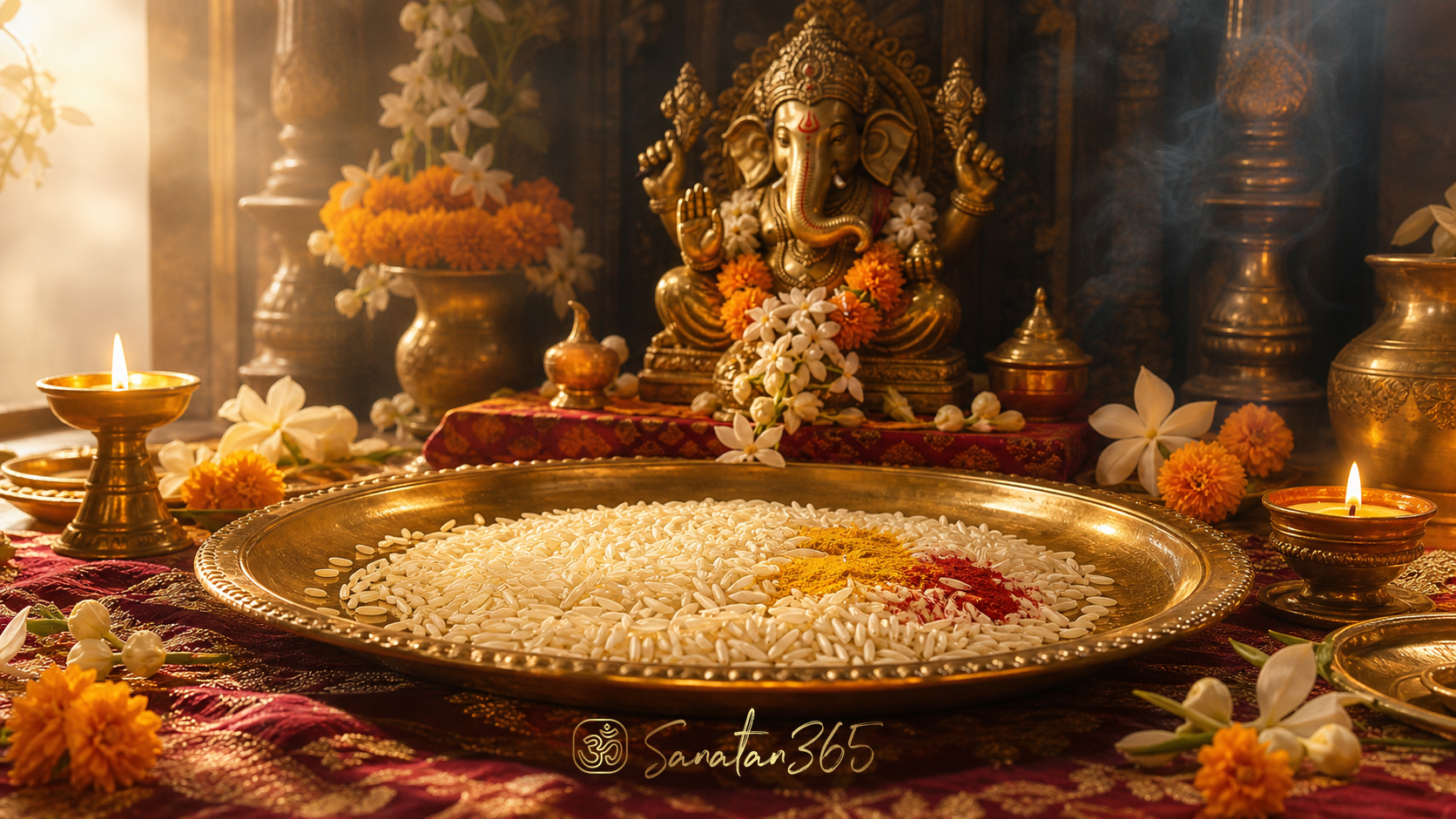
A single grain can look too small to carry a prayer, yet Hindu worship often entrusts an entire intention to a few grains of rice. Akshata meaning begins with its name: akṣata (अक्षत, unbroken or unharmed) refers in puja to uncooked, whole rice offered as a sign of completeness, nourishment, and an intention that should remain undivided. Families use it to honour a deity, bless a person, accompany a mantra, or complete an offering when another ritual item is unavailable.
Akshata is not powerful because rice is expensive or rare. Its eloquence lies in the opposite truth. Rice is familiar food, the fruit of soil, rain, labour, and care. When a household sets aside whole grains for worship, everyday nourishment becomes a language of gratitude.
What is the Akshata meaning in Hindu puja?
The Sanskrit adjective akṣata is built around the sense of something not cut, injured, or broken. In ritual usage, akshata commonly means clean, uncooked rice grains that have been kept whole. Spellings such as akshat, akshata, and akshatham appear across Indian languages and regional traditions.
The physical wholeness of the grain gives the offering its central symbolism. A whole seed still holds possibility. It can nourish; under the right conditions, it can also become new life. For this reason, akshata can suggest:
- completeness rather than fragmentation;
- abundance joined with responsibility;
- fertility, continuity, and auspicious beginnings;
- a blessing that the devotee hopes will remain intact;
- the offering of one's whole attention, not a distracted remainder.
This symbolism should be understood as a devotional interpretation, not a mechanical guarantee. Akshata does not purchase divine favour, erase ethical responsibility, or promise wealth. It helps the worshipper give visible form to saṅkalpa (संकल्प, a solemn intention or resolve).
The rice also carries a larger Hindu reverence for food. The Taittiriya Upanishad teaches that living beings arise from and are sustained by food, and later instructs the householder not to turn away a guest seeking food (Taittiriya Upanishad, 2.2 and 3.10). Akshata therefore brings more than a visual idea of wholeness to the altar. It brings a reminder that life depends on nourishment received, cultivated, and shared.
Key takeaway: Akshata is whole, uncooked rice that turns the ideas of completeness, nourishment, and undivided intention into a simple ritual offering.
Why is unbroken rice used in Hindu worship?
The insistence on whole grains is not a judgment against broken rice as food. Broken rice nourishes millions and should never be treated with contempt or wasted. The distinction belongs to ritual grammar: when a ceremony wishes to express integrity and continuity, an intact grain communicates that meaning more clearly.
A whole grain represents a whole intention
Puja trains attention through form. Water can express welcome and purification. A lamp can express illumination. A flower can express beauty offered without possession. In the same way, an unbroken grain can express a prayer offered without reservation.
This is especially meaningful during beginnings: a wedding, gṛha-praveśa (गृहप्रवेश, entering a new home), initiation of study, a festival vow, or the first worship after establishing a household altar. The devotee is not claiming that life will remain free of difficulty. The gesture says, more humbly, “May our values remain whole as circumstances change.”
Rice represents nourishment and shared prosperity
Rice is a staple across much of India, though the grain central to daily food varies by region. Offering rice acknowledges that prosperity is not merely money. It is the ability to feed, shelter, educate, welcome, and care. In this sense, the Akshata rice significance is ethical as well as auspicious: a blessed storehouse should become a generous one.
The Bhagavad Gita places the inner disposition of offering above display. Krishna says that a leaf, flower, fruit, or water offered with devotion is accepted (Bhagavad Gita 9.26). Rice is not named in that verse, but its teaching clarifies the principle that makes a modest offering meaningful: bhakti (भक्ति, loving devotion), not extravagance.
A seed holds continuity
A whole rice grain is also a seed, even when the polished grain used in a household ritual may no longer be viable for planting. As a symbol, it joins past labour, present nourishment, and future possibility. That is why rice appears naturally in blessings connected with marriage, family continuity, harvest, study, and the welfare of a household.
Regional customs interpret and handle the grains differently. Some families use plain white rice. Others mix it with turmeric, producing yellow grains associated with auspiciousness. In parts of South India, coloured akshatai may be showered during a wedding blessing. In Maharashtra and neighbouring traditions, rice touched with kumkum may accompany welcome and worship. These are living customs, not a single uniform rule for every Hindu.
Key takeaway: Unbroken rice is chosen because its visible integrity expresses whole-hearted prayer, while rice itself recalls nourishment, continuity, and the duty to share abundance.
How is Akshata prepared and offered?
Household tradition should come first. A family priest, elder, temple, or sampradāya (सम्प्रदाय, a living teaching tradition) may prescribe a particular preparation. Where no specific instruction exists, a simple and respectful method is enough.
A simple preparation
- Choose a small quantity of clean, uncooked rice.
- Remove husk, dust, and visibly broken grains without becoming anxious about perfection.
- Keep the rice plain, or add a tiny amount of turmeric according to family custom.
- Some traditions add a trace of kumkum or a drop of clean water so the colour lightly coats the grains. Avoid making the rice wet or sticky unless the ritual specifically calls for it.
- Place it in a clean bowl or section of the puja thali.
The amount can be modest. A handful is not spiritually superior to a pinch. Preparing only what is needed also respects anna (अन्न, food or grain) and reduces waste.
Common ways it is offered
Akshata may be:
- placed gently near a deity's murti or sacred symbol;
- offered with a flower while a name or mantra is recited;
- touched to a kalasha, book, tool, vehicle, or new household object being blessed;
- placed on the forehead after tilak according to local custom;
- showered gently over a couple or family member as an auspicious blessing;
- used as a substitute offering in some puja sequences when a specified flower or item is unavailable.
Not every temple permits visitors to place grains directly on a murti. Temple rules protect the sanctity of worship and the physical safety of sacred images. A devotee should follow the priest's direction and use designated offering places.
Akshata is generally offered with the right hand or with both hands joined in a careful gesture, depending on the ceremony. The deeper discipline is calm attention. One may inwardly name the quality being dedicated: gratitude, steadiness, reconciliation, learning, service, or care for the family.
If the grain has been blessed and returned as prasāda (प्रसाद, grace received through a sacred offering), families may keep a few grains respectfully, place them at the home altar, or use them in the manner taught by their tradition. One should not assume that every prepared batch is edible, especially if it has been mixed with non-food colour, kumkum, oil, or other ritual substances.
Key takeaway: Prepare only a small quantity of clean whole rice, follow the household or temple tradition, and offer it with a clear intention rather than anxiety about elaborate technique.
Where does Akshata appear in ceremonies across India?
Akshata moves easily between temple worship, household puja, and rites of passage because its meaning is both sacred and domestic. It belongs to the altar, but it also remembers the kitchen, field, monsoon, marketplace, and hands that made food possible.
Daily and festival puja
During a simple pañcopacāra pūjā (पञ्चोपचार पूजा, worship with five forms of hospitality) or a more extensive ṣoḍaśopacāra pūjā (षोडशोपचार पूजा, worship with sixteen forms of hospitality), akshata may accompany invocations, names of the deity, or a substitute offering. Exact sequences vary. The grains can also mark a resolved intention before Ganesh, Lakshmi, Shiva, Vishnu, Devi, or another chosen sacred form.
At festivals, colour and context may change. Turmeric-tinted rice can bring a warm auspicious tone to Devi or Lakshmi worship. Plain grains may be preferred in another lineage. The variation is not a contradiction. Sanatan Dharma often preserves shared principles through local forms.
Weddings and family blessings
In many wedding traditions, relatives shower the couple with rice or prepared akshata while prayers are recited. The gesture gathers several hopes into one act: enough food, mutual steadiness, continuity of dharma, and a household capable of generosity.
This should remain a gentle blessing. Throwing hard handfuls at faces, turning the moment into ridicule, or leaving dangerous piles on a slippery floor empties the custom of care. Reverence includes the wellbeing of the people and place involved.
New beginnings
Akshata may appear at the opening of a business, the blessing of study materials, the start of a journey, or worship connected with a new home. Here “unbroken” does not mean that no mistake will occur. It means the purpose is being anchored before action begins.
For diaspora families, ordinary locally available rice can be used when the exact regional variety is unavailable, provided the family tradition does not specify otherwise. Devotion does not require importing wastefully packaged grain across continents. The principle is clean, whole, respectfully offered rice.
Key takeaway: Across regions, Akshata blesses worship, weddings, and beginnings, but the shared principle matters more than enforcing one preparation as universally correct.
What does Akshata teach beyond the ritual?
The smallest offerings often expose the largest questions. Is the worshipper's attention whole? Is the household's prosperity nourishing others? Does the prayer continue as conduct after the lamp is extinguished?
Akshata offers a practical three-part reflection:
- Receive gratefully. Every grain depends on land, water, seed, labour, transport, cooking, and community.
- Act wholeheartedly. An unbroken offering asks for less inner division between stated values and daily choices.
- Share responsibly. Food at the altar should deepen respect for food at the table and concern for those without it.
This reflection prevents symbolism from becoming superstition. Keeping a packet of rice near the altar while wasting meals or ignoring hunger would miss the grain's moral force. The Taittiriya Upanishad's hospitality teaching makes reverence for food inseparable from generosity.
A family can extend the ritual meaning through one concrete act: cook an appropriate quantity, avoid casual food waste, support a community meal, feed a guest, or donate staples through a reliable local organisation. Such acts do not replace puja. They allow the prayer to mature into seva (सेवा, selfless service).
Akshata also corrects the idea that sacred practice must always be spectacular. A quiet offering can be complete when attention is complete. This makes the ritual accessible to a student in a small room, an elder with limited mobility, or a family far from a temple. Simplicity is not spiritual inferiority.
The concluding lesson is not that an unbroken grain guarantees an unbroken life. Human lives include grief, change, illness, migration, conflict, and repair. Akshata instead asks whether a person can return to wholeness of intention within those realities.
Key takeaway: The ritual reaches fulfilment when gratitude for grain becomes wholehearted conduct, hospitality, reduced waste, and care for others.
Conclusion
Akshata is ordinary rice made eloquent by attention. Its unbroken form expresses completeness; its identity as food recalls dependence and gratitude; its use in blessing points toward continuity, generosity, and responsible hope. Regional preparations may differ, yet the heart of the gesture remains recognisable: offer something whole while seeking to live more wholly.
Key takeaway: The deepest Akshata meaning is an undivided offering of gratitude that continues beyond puja as careful, generous action.
FAQ
What is Akshata made of?
Akshata is usually made from clean, uncooked, unbroken rice. Depending on family and regional tradition, it may remain white or be lightly coloured with turmeric, kumkum, or another customary preparation.
Why should Akshata rice be unbroken?
Whole grains visibly symbolize completeness, continuity, and an undivided intention. This is ritual symbolism, not a claim that broken rice is impure as food or should be wasted.
Can any rice be used for Akshata?
Most simple household pujas can use a clean local variety of whole, uncooked rice. Follow a priest, elder, or lineage instruction when a particular ceremony specifies a variety or preparation.
Can blessed Akshata be eaten?
Only if it was prepared entirely with food-safe ingredients and the relevant tradition treats it as edible prasada. Rice mixed with kumkum, synthetic colour, oil, or other ritual substances should not be consumed.
What should be done with Akshata after puja?
Practice varies. A family may keep a few blessed grains at the altar, use them in a customary blessing, place food-safe grains in compost, or follow the temple's disposal guidance. The aim is respectful handling without littering or unnecessary waste.
About the author
Sanatan365 Editorial
Bringing Sanatan Dharma to modern seekers through authentic, scripture-grounded content.
Related in Rituals
 Rituals
Madhuparka Meaning: Sweetness and Sacred Hospitality
Read madhuparka as a ceremonial honey mixture of welcome, exploring textual recipes, guest reception and its distinction from panchamrita.
 Rituals
Samavartana Meaning: Returning Home After Sacred Study
Samavartana marks the completion of traditional study through a ceremonial bath and return. Its lasting question is how learning becomes re…
 Rituals
Vidyarambham Meaning: First Letters, Learning, and Reverence
Explore Kerala’s ceremony of beginning letters, its Vijayadashami setting, rice-writing customs, and the meaning of a gentle first step int…