Madhuparka Meaning: Sweetness and Sacred Hospitality
Read madhuparka as a ceremonial honey mixture of welcome, exploring textual recipes, guest reception and its distinction from panchamrita.
A welcome can be expressed in a bowl small enough to hold in one hand.
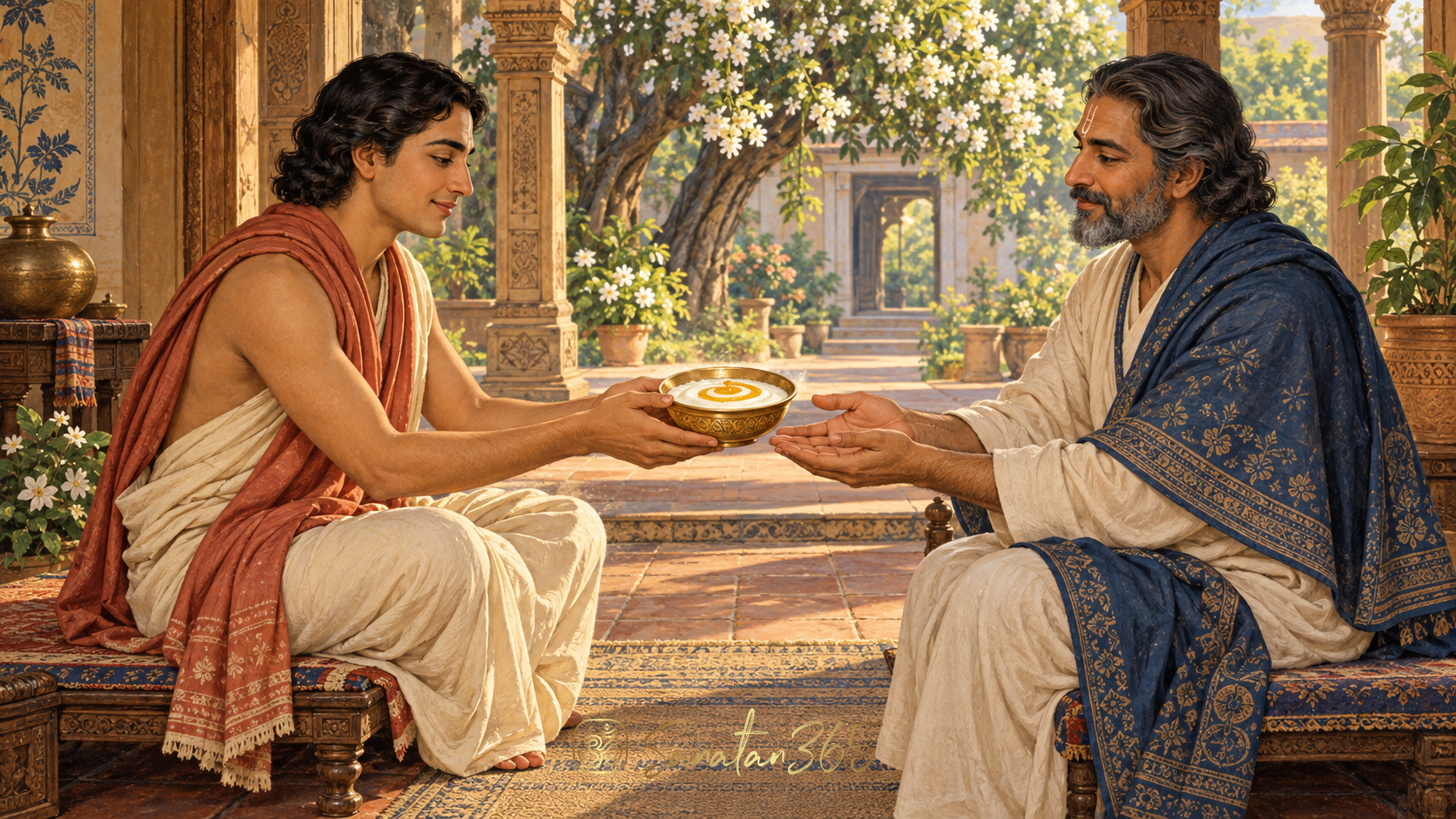
Madhuparka meaning centres on a ceremonial honey mixture offered in the reception of an honoured guest. In the domestic ritual texts known as the Grihya Sutras, it belongs to a sequence of welcome that includes a seat and water. Its ingredients vary: one text describes honey poured into curds, while another names curds, honey and ghee. The significance lies not in an exotic recipe, but in making respect tangible through thoughtful hospitality.
This is a reading of the honey-mixture portion of those texts, not a complete manual for reproducing their historical reception rites. Contemporary ceremonies should follow the family's or officiant's own tradition. Understanding the bowl, however, opens a useful question: what changes when welcoming someone becomes a deliberate act rather than a hurried formality?
Madhuparka meaning: what does the honey mixture signify?
Madhuparka (मधुपर्क, a ceremonial honey mixture) contains the familiar Sanskrit word madhu (मधु, honey or sweetness). The term names both a particular offering and, in discussions of ritual, the special reception associated with it. Context therefore matters. A reference to madhuparka may concern the ingredients in a vessel, or the wider occasion in which that vessel is presented.
Grihya Sutra (गृह्यसूत्र, a concise text of domestic ritual instructions) is the name of a textual genre concerned with household ceremonies. These works give actions in compact succession rather than explaining every step in the expansive style of a modern guide. A bowl may appear in only a few lines, surrounded by instructions about sitting, water, acceptance and recitation. Reading just the recipe loses that setting.
Hermann Oldenberg's translation of the Ashvalayana Grihya Sutra, I.24, calls madhuparka a “honey-mixture.” It first describes recipients and then says to pour honey into curds. Curds here means fermented milk, broadly familiar to Indian readers as plain yoghurt. The text also records an alternative when honey is unavailable. These details can be checked in the published scholarly translation of the Grihya Sutras, Part I, printed pages 197–199.
The offering is thus not simply a dessert with a Sanskrit name. Its role is relational: a host prepares something, presents it with care, and a guest receives it within an ordered welcome. The distinction is comparable to the difference between water left somewhere in a room and water placed attentively before a visitor. The substance may be ordinary; the manner of giving makes the human meaning visible.
Nor does the word itself promise a material result. Sweetness is present as an ingredient and as a helpful interpretive image. It should not be turned into a guarantee of prosperity, a cure, or a way to control another person's feelings. Reverence does not require claims that the sources do not establish.
Key takeaway: Madhuparka is best understood as a ceremonial offering within a relationship of welcome, not as a special food detached from its purpose.
How do the Grihya Sutras describe welcoming a guest?
The Ashvalayana passage places the mixture among several things offered to a guest: a seat, water for washing the feet, an offering of water, and water for sipping. Each has its own place. The Paraskara Grihya Sutra, I.3, similarly begins with preparing a seat and announcing the intention to honour the visitor. Its honey mixture arrives inside that larger sequence, rather than replacing every other act of hospitality.
One of the most revealing lines is the host's invitation in Oldenberg's translation: “sit down” is followed by the intention to “do honour” to the guest. The welcome first makes space. Before any elaborate recitation, someone has thought about where another person will sit. The act is concrete, bodily and practical.
The same Paraskara passage names recipients such as a teacher, an officiating priest, a friend and someone who has completed a course of sacred study. The Ashvalayana list is not identical. These are descriptions of particular textual reception customs, not a modern rule that only people holding certain positions deserve warmth or consideration. A reader can study the historical form without carrying its entire social arrangement into ordinary life.
To see how ceremonial actions express respect, it helps to separate their functions:
- A place to sit acknowledges the visitor's arrival and need for rest.
- Water used in the reception belongs to distinct acts, not one interchangeable gesture.
- An offered mixture gives the welcome a particular ceremonial focus.
- Words and acceptance make the exchange more than an item silently passed across a table.
These observations are interpretations of the sequence, not claims that each object has only one fixed symbolic meaning. A tradition may explain the same action in several ways. A careful account keeps the source's instruction and the reader's reflection distinguishable.
The related meaning of arghya as an offering of water provides useful background. Yet madhuparka is not merely arghya made sweet. The source places several offerings side by side, which is precisely why their individual purposes should remain clear.
Key takeaway: The honey mixture matters because it belongs to a complete welcome: space, attention, practical care and a respectful exchange.
Why do madhuparka ingredients vary between texts?
A frequently repeated online answer gives one ingredient list as though it were the single recipe for every Hindu ceremony. The two passages considered here already show why that approach is too simple.
In Ashvalayana I.24.5–6, the instruction is to pour honey into curds, with butter mentioned as an alternative if honey cannot be obtained. In Paraskara I.3.5, the honey mixture is explicitly described as curds, honey and ghee. Ghee means clarified butter. Paraskara also names a brass vessel with a brass cover in that reception sequence. These statements come from the same translated volume, printed pages 197 and 273 respectively.
Three distinctions prevent confusion:
- A textual ingredient list is not automatically a universal recipe. It belongs to the work and passage being read.
- A substitution is not the same as an additional required ingredient. Ashvalayana's alternative should not be silently added to its main instruction.
- A vessel detail is part of a described ceremonial form. It does not prove that every modern household must acquire an identical vessel.
The English words also need patient reading. “Curds” in this context is not a direction to use any product marketed elsewhere under that name. “Butter” and “ghee” should not be casually collapsed when comparing translations. Accurate explanation begins by preserving what the source actually says.
A household may receive a different preparation instruction from its officiant. That need not be treated as evidence of a mistake. It may reflect another ritual text, a received family practice, or the requirements of that ceremony. The right question is not “Which internet list defeats the others?” but “Which tradition is guiding this particular observance?”
This article therefore gives no compulsory quantities, mixing ratio or modern serving formula. It explains the recorded variation. Anyone taking part in an actual rite can ask the officiant what is being prepared, for whom, and how it is to be offered. That conversation is more useful than assembling fragments from unrelated manuals.
Key takeaway: Madhuparka ingredients are tradition-specific; quoting the exact source is more reliable than declaring one list universal.
What does sweetness express in sacred hospitality?
Honey gives madhuparka its most immediately recognisable quality. But a thoughtful reading need not reduce sweetness to a vague promise that everything will become easy. Hospitality can be sweet in the more demanding sense of being generous, considerate and free from unnecessary harshness.
The Ashvalayana passage associates the acceptance of the mixture with verses containing the language of honey. This article does not prescribe those verses for personal recitation; their presence simply shows that taste and spoken reverence meet within the reception. The mixture is not presented as a silent culinary accessory.
There is a useful ethical reflection here. A host can offer something costly while leaving a guest uncomfortable. Equally, a modest welcome can communicate real care when the host listens, makes room and notices practical needs. The value of hospitality is not exhausted by the price of its materials.
Consider a visitor arriving after a long trip. A thoughtful host asks whether they would like to sit, gives them time to settle and checks what they can comfortably receive. A hurried host begins with expectations: eat immediately, praise the preparation, join the conversation at once. Both may offer food. Only one has made receiving it easy.
This example is a contemporary reflection, not a claim that the ancient texts spell out modern hosting etiquette. It draws attention to something their ordered actions make visible: welcome requires preparation on the host's side. The guest should not have to discover a place to sit or negotiate every small need unaided.
Consent belongs naturally in that reflection. An offering is a gesture of respect, not a demand that someone consume a substance against their wishes. In a present-day ceremony, dietary constraints and personal comfort should be discussed in advance with the people involved. Such care does not empty the ceremony of meaning; it makes the intended respect easier to recognise.
The bowl also invites an examination of speech. It would be inconsistent to offer sweetness ceremonially while greeting someone with ridicule or indifference. The durable lesson is not that one mixture changes character by itself, but that the visible act can call the host back to the quality of the whole encounter.
Key takeaway: Read sweetness as an invitation to considerate conduct, not as a guaranteed supernatural outcome or a substitute for genuine care.
How is madhuparka different from panchamrita?
Madhuparka and panchamrita (पञ्चामृत, “five nectars,” a five-ingredient sacred mixture) can share ingredients such as honey, curds and ghee. That overlap makes them easy to confuse. Ingredient resemblance, however, does not erase a difference in ritual role.
In the Grihya Sutra passages examined here, madhuparka is part of the reception of an honoured guest. Panchamrita is commonly associated with devotional worship and sacred bathing. Its familiar five ingredients include milk, curds, ghee, honey and sugar, though an actual observance should follow its own guidance. The explanation of panchamrita in Hindu puja explores that mixture separately.
A useful comparison asks three questions:
- Who or what receives the preparation? An honoured guest in the cited madhuparka reception is not the same ritual setting as a deity's sacred bathing.
- Where does it occur in the sequence? A welcome has its own order; devotional bathing has another.
- What does the guiding text or officiant call it? A name should not be replaced merely because the bowl looks familiar.
Similarly, prasad (प्रसाद, grace and an offering received as sacred blessing) is not a generic label for every food present near a ceremony. Its devotional context matters. The meaning of prasad in Hindu worship helps clarify the relation between offering and receiving.
These distinctions do not rank one preparation above another. They honour the fact that Hindu ritual language is precise enough to describe different relationships. Two mixtures may resemble each other without being interchangeable, just as two lamps may serve different purposes in different observances.
Key takeaway: Distinguish sacred preparations by their recipient, sequence and purpose, not by ingredients alone.
How should modern readers approach an old ritual?
Domestic ritual texts reward careful reading because they combine recognisable acts with forms shaped by their own textual and historical settings. A modern reader need not either copy every instruction or dismiss the entire account. Understanding begins with knowing the scope of the passage under discussion.
For madhuparka, that means reading beyond a recipe while remembering that this article isolates the honey-mixture and welcome portions. It is not an account of every element in the larger historical reception. Nor does it establish that all present-day Hindu communities follow one identical ceremony.
A useful reading method has four steps:
- Identify the source. Note the text, chapter and translation instead of relying on an unattributed quotation.
- Read the nearby instructions. A bowl offered after a seat and water tells a different story from an isolated ingredient list.
- Name the interpretation honestly. An ethical reflection on thoughtful welcome is not a literal translation of a ritual rule.
- Ask about living practice. A knowledgeable family member or officiant can explain what the specific ceremony requires today.
Hermann Oldenberg's nineteenth-century translation is useful because the relevant passages and notes can be inspected. Its age also makes attention to vocabulary important. The publisher's listing of the two-volume Grihya Sutras translation identifies the work for readers seeking the complete edition rather than an isolated excerpt.
For families in India or the diaspora, the most fruitful question may be simple: why is this offering being made in this ceremony? A clear answer can turn unfamiliar handling of a vessel into an intelligible act of regard. It also allows younger participants to learn without pretending that a short explanation qualifies them to lead an entire rite.
Key takeaway: Madhuparka joins an ordinary sweetness to an extraordinary degree of attention: a welcome becomes sacred when respect is made concrete.
FAQ
What does madhuparka mean in English?
Madhuparka is commonly translated as a ceremonial “honey-mixture.” In the domestic ritual passages discussed here, it is offered during the reception of an honoured guest. The term should be understood through that setting, not only as the name of a food.
What are the ingredients of madhuparka?
They vary by source and tradition. Ashvalayana I.24 describes honey poured into curds and records an alternative when honey is unavailable. Paraskara I.3 names curds, honey and ghee. Follow the relevant officiant's instructions for an actual ceremony rather than treating one list as universal.
Are madhuparka and panchamrita the same?
No. They may share ingredients, but their ritual roles differ. The cited madhuparka passages concern guest reception, while panchamrita is commonly associated with devotional worship and sacred bathing. Similar appearance does not make two preparations interchangeable.
Must every visitor be offered madhuparka?
The cited texts describe particular ceremonial receptions, not a compulsory rule for every ordinary visit today. Thoughtful everyday hospitality can express respect without reproducing a historical ritual. For a formal observance, follow the tradition guiding it.
Does madhuparka have guaranteed health or prosperity benefits?
This article makes no such claim. It explains a ceremonial offering, its textual forms and the meaning of respectful welcome. Ritual significance should not be converted into a medical promise or a guaranteed material result.
About the author
Sanatan365 Editorial
Bringing Sanatan Dharma to modern seekers through authentic, scripture-grounded content.
Related in Rituals
 Rituals
Samavartana Meaning: Returning Home After Sacred Study
Samavartana marks the completion of traditional study through a ceremonial bath and return. Its lasting question is how learning becomes re…
 Rituals
Vidyarambham Meaning: First Letters, Learning, and Reverence
Explore Kerala’s ceremony of beginning letters, its Vijayadashami setting, rice-writing customs, and the meaning of a gentle first step int…
 Rituals
Ganga Aarti Meaning: Why Lamps Are Offered to the River
Why devotees offer light to the Ganga, what the public ceremony in Varanasi expresses, and how visitors can participate with care.

