Vidyarambham Meaning: First Letters, Learning, and Reverence
Explore Kerala’s ceremony of beginning letters, its Vijayadashami setting, rice-writing customs, and the meaning of a gentle first step into learning.
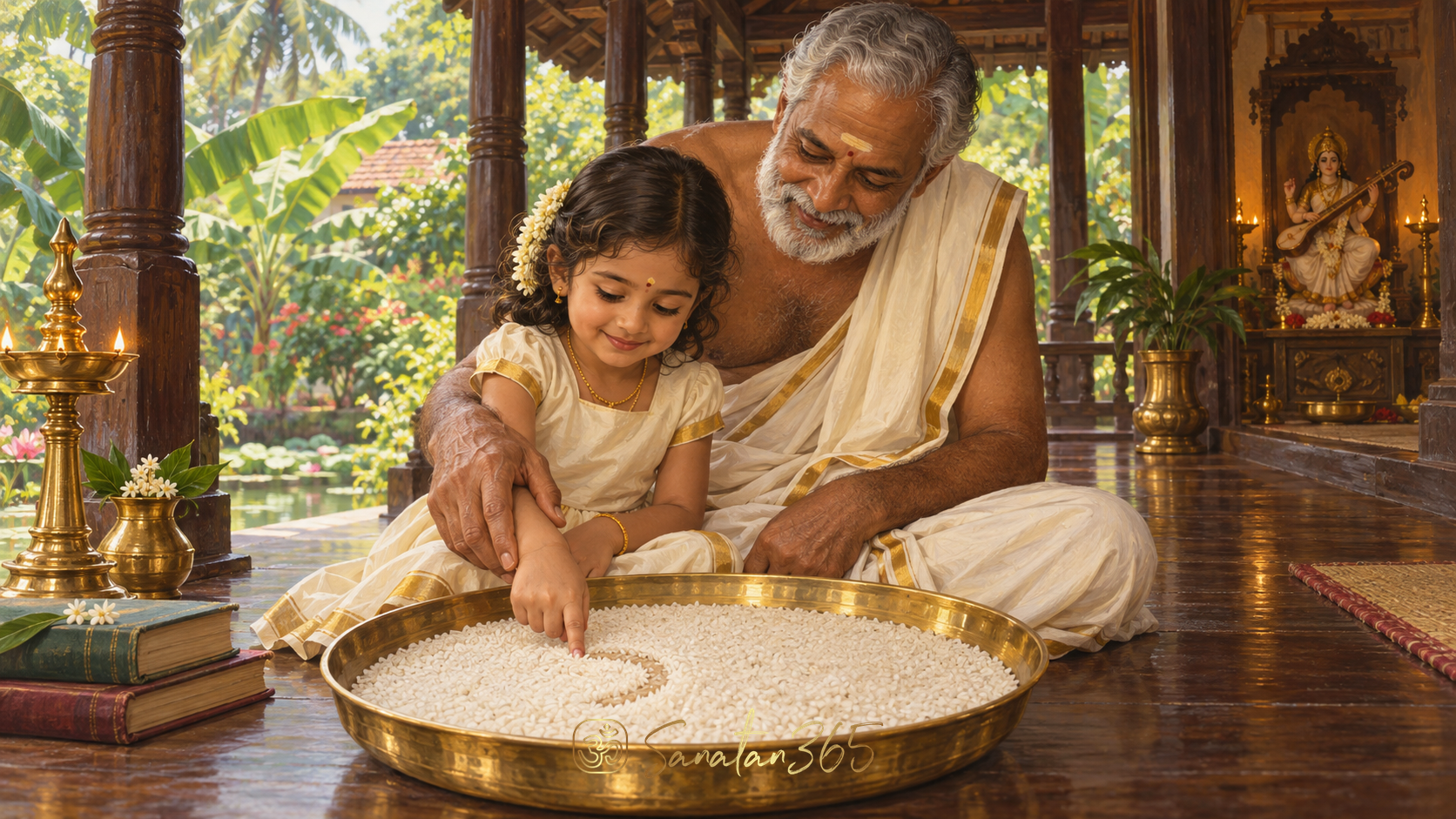
A child’s first written mark can be a curve in rice rather than a line in a notebook. The grain shifts under a small finger, and an adult steadies the hand without demanding a perfect letter.
Vidyarambham meaning is “the beginning of learning”: vidyā (विद्या, knowledge or learning) joined with ārambha (आरम्भ, a beginning). In Kerala, the ceremony commonly introduces a child to letters under a teacher’s or elder’s guidance, especially on Vijayadashami (Vijayadaśamī, विजयदशमी, the tenth day associated with victory). Its best-known image is writing in a tray of rice. The ritual honours knowledge, but its lasting value depends on what follows: patient teaching, curiosity, and a home in which questions are welcome.
What is the Vidyarambham meaning?
Vidyarambham gives an ordinary human beginning a sacred frame. Learning is not treated solely as a route to marks, employment, or social recognition. It is something worthy of reverence before those outcomes exist. The child does not need to understand this entire philosophy. Adults express it through the atmosphere they create: attention, warmth, and respect for the person who teaches.
In Malayalam, the ceremony is also called Ezhuthiniruthu, commonly understood as initiating a child into writing. English spellings vary because Malayalam sounds are represented in different ways. Families may say Vidyarambham, Vidyarambam, or Vidyarambha without referring to entirely different ceremonies. The name matters less than the actual tradition being followed and the care with which a child is welcomed into it.
Kerala Tourism’s description of Vidyarambham associates the occasion with a child’s introduction to the alphabet on Vijayadashami. Contemporary reporting also describes teachers, scholars, writers, priests, and respected elders helping children make their first letters. This is a living regional custom, not a single script followed identically in every home.
The ceremony’s meaning can be considered through three relationships. First is the child’s relationship with knowledge: learning begins as discovery rather than examination. Second is the relationship with a teacher: another person lends skill, attention, and encouragement. Third is the family’s relationship with the child’s future: adults make a commitment to nurture understanding rather than merely celebrate a photograph of the first day.
A tray of rice expresses that beginning unusually well. It offers a surface that can be smoothed and tried again. The mark is visible, but not permanent. Reading this as a metaphor for patient learning is an interpretation, not a claim that every household gives rice the same theological explanation. Its practical tenderness is nevertheless clear: the first attempt can be imperfect without becoming a failure.
Key takeaway: Vidyarambham honours the beginning of learning and the responsibility to help a learner grow.
Why is the ceremony connected with Vijayadashami?
Vijayadaśamī (विजयदशमी, the tenth day associated with victory) concludes the Navratri observance in many Hindu traditions. Navarātri (नवरात्रि) means nine nights. In Kerala’s widely observed learning customs, the closing days have a strong association with Saraswati, the Goddess of knowledge, music, and the arts. Books and instruments may be placed for worship before being taken up again as learning resumes.
These customs turn the festival’s idea of an auspicious new beginning toward study and artistic practice. A child may begin letters; an older learner may return to music, reading, or another discipline. The common thread is not that knowledge arrives automatically on one day, but that effort begins with gratitude and a clear intention.
For the broader devotional context, the symbolism of Goddess Saraswati’s veena and swan helps explain why learning is approached with both sensitivity and discernment. The vīṇā (वीणा, a stringed musical instrument) points toward cultivated skill, not instant achievement. Reverence for knowledge does not remove the need to practise; it gives practice a dignified purpose.
Regional differences should remain visible. Families elsewhere in South India may use names such as Aksharabhyasam for an introduction to letters. Akṣara (अक्षर) can mean a letter or syllable, and abhyāsa (अभ्यास) means repeated practice. Similar intentions do not make every regional rite identical. The words used, the deity invoked, the setting, and the sequence may reflect a particular family or institution.
This article explains the ceremony rather than announcing a festival date. The civil date, local observance, and booking arrangements should be checked for the relevant year with the chosen temple, teacher, or local calendar. A widely circulated date is not enough to establish a particular venue’s session time. Families living abroad should also distinguish the local civil date from schedules copied from India.
A missed public session does not mean a child has missed the possibility of learning. Households can ask their own trusted teacher how to mark the beginning appropriately. The calendar supports a meaningful start; it should not become a source of fear or a reason to postpone ordinary reading, conversation, and play.
Key takeaway: Vijayadashami provides a cherished setting for beginning learning, while local custom determines the details.
How are the first letters introduced?
In a familiar form of Vidyarambham, an elder or teacher helps a child trace an opening invocation or letters in rice spread on a platter. The teacher guides rather than tests the child. A small hand may need help simply to understand how a finger moves across the surface. Participation can be brief, and the gesture need not resemble fluent handwriting.
An opening associated with the ceremony is often written in English as “Hari Sree” or “Hari Shri.” Hari is a sacred name of Vishnu; śrī (श्री) expresses auspiciousness and reverence. Families and institutions may use a longer formula. Those variations should be learned from the officiating teacher rather than reconstructed from a phonetic social-media caption. This article does not prescribe one wording as compulsory for every participant.
A contemporary report on Kerala’s first-letter ceremonies describes writing “HariSree” on rice platters and the customary use of a gold ring to trace letters on a child’s tongue. The latter is a description of a reported tradition, not a recommendation for parents to imitate it. No object needs to be placed in a child’s mouth to make learning meaningful. Families can discuss a rice-writing-only arrangement with the teacher and avoid unwanted contact.
The rice-writing scene also should not be mistaken for the whole ceremony. A family may include prayer, an offering, or a respectful greeting to a teacher. In a public venue there may be an organized queue, an assigned session, and specific instructions about what to bring. At home, the atmosphere may be simpler. Neither setting is inherently more sincere than the other.
A useful way to understand the sequence is:
- Prepare the setting: make room for the child, teacher, and accompanying adult without crowding.
- Acknowledge the purpose: honour learning through the prayer or custom actually followed by the household.
- Introduce a mark: let the teacher demonstrate or gently guide the first letters.
- Receive encouragement: end without comparing the child’s effort with someone else’s.
- Continue later: offer a small, enjoyable encounter with stories, sounds, drawing, or books.
This outline explains the intention, not an authoritative ritual manual. A particular temple may organize the event differently. If the child refuses to touch the rice, the responsible response is to pause, observe, or ask the teacher for an alternative. The ceremony’s dignity lies in welcoming a learner, not securing compliance at any cost.
Key takeaway: The first-letter gesture is an introduction, not a handwriting test or an instruction to copy every reported custom.
How do families prepare without pressuring a child?
Begin with the practical setting rather than a shopping list. Confirm whether the chosen venue requires registration, who guides the child, what materials it supplies, and whether families can choose a non-contact form of participation. These questions prevent confusion on the day and allow parents to explain the experience in ordinary, reassuring language.
The preparation can be modest. A family might show the child a little rice in a tray, make a curved mark together, and then smooth it away. There is no need to rehearse a perfect ceremony or teach the entire alphabet beforehand. Familiarity with the texture and the setting can be enough. Rice should remain supervised, and materials should be kept suitable for a young child’s use.
Clothing should be comfortable for sitting and moving. A hungry, tired, or overwhelmed child is not demonstrating a lack of devotion. Allow time for food, rest, and an unhurried arrival. In a crowded venue, one calm adult accompanying the child may be more helpful than several people giving instructions at once.
Photographs deserve the same care. An image can preserve a family memory, but repeatedly asking a child to recreate a gesture changes the event from a beginning into a performance. Teachers and other participants also have a right not to be recorded without consent. The strongest memory may be the child’s curiosity rather than a perfectly composed frame.
Diaspora households may combine languages. The first letters can connect a child with Malayalam or another family language while daily learning also includes the language used at school. There is no need to treat these as rival loyalties. Families should ask the teacher what the local ceremony supports and then build a continuing relationship with language through speech, song, and reading.
Appreciation for the teacher need not become an expensive display. The discussion of dakshina as gratitude and reciprocity offers a useful related perspective: support should fit the actual setting and the family’s means. A public institution may have a stated policy; a household teacher may prefer a simple expression of thanks. Clarify rather than assume.
Key takeaway: Good preparation protects the child’s comfort and the teacher’s work without turning the ritual into a performance.
What does beginning learning ask of adults?
The ceremony lasts a short time; the adult commitment lasts longer. A child learns from what happens when a question interrupts a busy evening, when a letter is reversed, or when a task takes longer than expected. If the first day honours knowledge but subsequent days punish uncertainty, the family’s practice has lost its centre.
Reverence for learning includes the permission to say, “That is not understood yet.” It also includes looking up an answer rather than pretending to know. These ordinary habits teach that knowledge is something approached honestly. They give the ceremonial respect for the teacher a practical continuation in everyday life.
A small rhythm is often more useful than an ambitious programme. A few minutes with a picture book, naming familiar objects in a family language, listening to a song, or drawing together can keep the first beginning alive. None of these activities needs to be marketed as a guarantee of exceptional intelligence. They are ways of sharing attention and making learning part of a relationship.
Adults can apply the same principle to themselves. Beginning a language, musical instrument, or study discipline involves accepting unfamiliarity. The practice of svadhyaya, or reflective self-study can support that humility, although it is a distinct discipline rather than another name for Vidyarambham.
The single lasting takeaway is simple: the first letter matters most when it begins a continuing culture of patience, curiosity, and reverence for knowledge. Rice can be smoothed and a mark tried again. A good learning environment offers the same generosity to the person making it.
Key takeaway: Honouring a beginning means supporting the many imperfect attempts that come after it.
FAQ
What is Vidyarambham in simple words?
Vidyarambham is a ceremony marking the beginning of learning. In Kerala, a teacher or elder commonly introduces a child to letters by guiding writing in rice. The name joins words for knowledge and beginning. Its spiritual purpose is reverence for learning, not proof that the child can already write.
Is Vidyarambham always held on Vijayadashami?
Vijayadashami is its best-known public setting in Kerala. Individual families and institutions may have their own arrangements. Check the actual venue and local calendar rather than assuming one online schedule applies everywhere. This article does not prescribe a universal date or timing.
Must a child write a perfect letter?
No. The first-letter gesture is an introduction. A young child may make a small mark with assistance, watch the teacher, or need a pause. Comparing children or repeating the gesture until it looks suitable for a photograph works against the ceremony’s welcoming purpose.
Is the gold-ring-on-tongue custom necessary?
It is reported in descriptions of the regional tradition, but this article does not recommend imitating it. Families can discuss a rice-writing-only form with the teacher. Avoid putting objects in a child’s mouth or forcing contact. The meaning of a first learning experience does not depend on that particular gesture.
How can a family continue the spirit of Vidyarambham?
Continue with enjoyable reading, storytelling, language, music, and patient responses to questions. Thank teachers, allow mistakes, and value understanding over comparison. A short, regular practice gives the ceremonial beginning a living place in the home without making promises about grades or future success.
About the author
Sanatan365 Editorial
Bringing Sanatan Dharma to modern seekers through authentic, scripture-grounded content.
Related in Rituals
 Rituals
Ganga Aarti Meaning: Why Lamps Are Offered to the River
Why devotees offer light to the Ganga, what the public ceremony in Varanasi expresses, and how visitors can participate with care.
 Rituals
Chandan Offering in Hindu Puja: The Meaning of Gandha
Why devotees offer sandalwood paste in Hindu worship, what gandha signifies, how the custom varies, and how to practise with care.
 Rituals
Deepa Dana Meaning: Why Devotees Offer Lamps
Deepa Dana is the devotional offering or giving of a lamp. Learn how it differs from aarti, what shared light signifies, and how to observe…

