Andal: The Poet-Saint Who Made Longing a Path of Devotion
Discover Andal, the Tamil poet-saint whose Tiruppavai transformed sacred longing, shared song, and wholehearted surrender into a living path of Vishnu devotion.
Andal did not treat devotion as a distant admiration of the Divine. The Tamil Andal poet-saint made bhakti (भक्ति, loving devotion) immediate: wake before dawn, call the community together, sing the names of Krishna, serve one another, and let every longing become an offering.
She is remembered as the only woman among the twelve Alvars, the poet-saints whose Tamil hymns became foundational to Sri Vaishnava devotion. Her two surviving works, the thirty-verse Tiruppavai and the more intimate Nachiyar Tirumoli, show that spiritual yearning can be disciplined without becoming cold, and deeply personal without becoming self-enclosed. Andal's poetry asks a durable question: what happens when love for the Divine shapes not only emotion, but speech, friendship, ritual, and daily conduct?
Who Was Andal, the Tamil Poet-Saint?
Andal belongs to the Tamil bhakti world of South India and is traditionally associated with Srivilliputhur in present-day Tamil Nadu. Sri Vaishnava tradition remembers that Vishnuchitta, later celebrated as the Alvar Periyalvar, found her as a child beneath a tulasi plant in a temple garden and raised her in an atmosphere of Vishnu devotion. The account belongs to sacred hagiography, a form of remembered life shaped by devotion and theological meaning; it should not be flattened into modern biography.
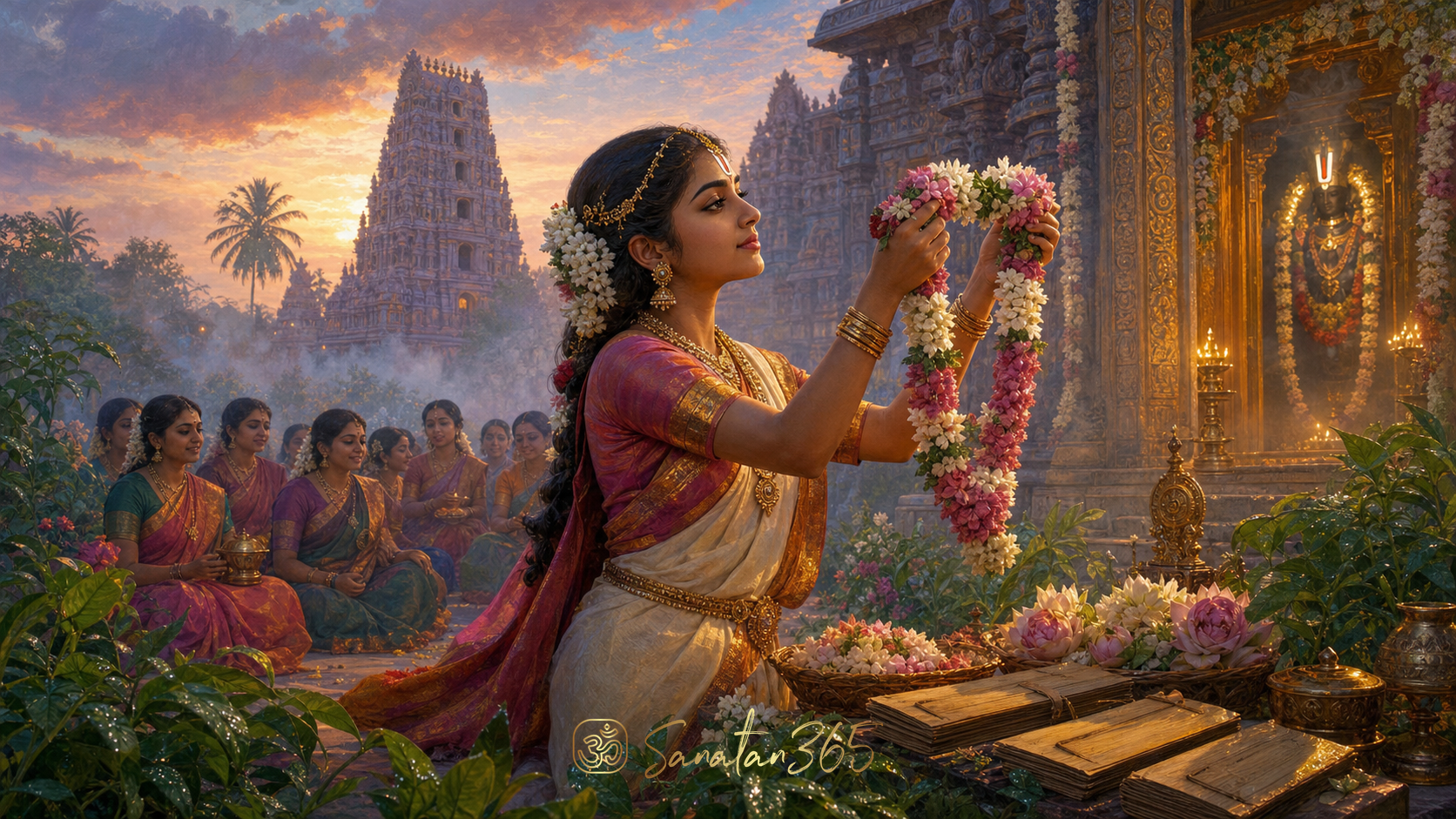
Her Tamil name, Kodhai or Goda, is commonly understood in the sense of a garland or gift of words. Tradition tells that she secretly wore the flower garlands prepared for the temple deity before they were offered. When Periyalvar discovered this, he initially considered the garland ritually unsuitable. Vishnu then revealed, in the sacred story, that the garland worn by Andal was the one he desired. The image is bold: devotion is not merely an object placed before God. The devotee's own life, tested by sincerity, becomes part of the offering.
Andal is therefore honoured as Sudi Kodutha Sudarkodi, often rendered as “the radiant creeper who first wore and then offered the garland.” Her story remains closely woven into worship at Srivilliputhur Andal Temple, while the wider Alvar hymn tradition is preserved in the Nalayira Divya Prabandham, the collection of four thousand Tamil devotional verses. The Encyclopaedia Britannica overview of bhakti helps place this personal, loving mode of devotion within the broader history of Indian religious life.
The traditional narrative culminates in Andal's desire to unite with Lord Ranganatha at Srirangam. Different tellings emphasize different details, but Sri Vaishnava memory understands the culmination not as an ordinary marriage plot, but as the complete surrender of the individual soul to the Divine.
Key takeaway: Andal's sacred biography presents a devotee whose poetry, body, garlands, choices, and destiny become one undivided offering.
What Does the Tiruppavai Teach About Bhakti?
The Tiruppavai is a sequence of thirty Tamil verses traditionally recited during Margazhi, the sacred Tamil month that usually falls across December and January. Its speakers are young cowherd women who undertake a pavai nonbu, a communal observance directed toward Krishna. The setting recalls the gopis (गोपी, cowherd women devotees) of Vrindavan, yet Andal gives their love a disciplined social form.
The poem begins by announcing an auspicious dawn and inviting others to join. Across the verses, companions wake one another, approach Krishna's household, praise his divine deeds, ask for the means to sing and serve, and clarify the true purpose of their observance. The outer language mentions ritual objects and blessings, but the movement of the poem steadily turns toward kainkarya (कैंकर्य, loving service to the Divine).
This matters because the Tiruppavai does not define bhakti as passive feeling. Its devotion has a sequence:
- Remember a sacred purpose.
- Rise from sleep and inertia.
- Invite others without coercion.
- Discipline appetite, speech, and conduct.
- Praise the Divine through remembered stories.
- Ask not merely for reward, but for lasting service.
The poem's dawn is both literal and inward. Sleep can signify forgetfulness; awakening becomes renewed attention. A closed door can be a household door, but also the reluctance that keeps a person from responding to grace. A gathered group becomes more than a chorus: it is a spiritual community that refuses to leave anyone behind.
Readers familiar with the broader practice of sacred company may recognize a related logic in the meaning of satsang: attention is strengthened by the company it keeps. Andal's distinctive contribution is to give that truth the energy of song, friendship, and a village waking together.
Key takeaway: The Tiruppavai teaches that bhakti becomes trustworthy when longing is joined to disciplined action, shared remembrance, and service.
How Does Andal Turn Sacred Longing into Spiritual Practice?
Modern speech often treats longing as a problem to solve quickly. Andal's poetry does something more demanding: it educates longing. Desire is not denied, but redirected toward what can deepen rather than consume the person.
In the Nachiyar Tirumoli, Andal speaks with striking intensity of separation from Vishnu. She addresses clouds, birds, flowers, the monsoon, and the world around her as witnesses or messengers. This literary mode draws on classical Tamil love poetry while placing longing within a devotional horizon. The emotional voice can be intimate and vulnerable, but it is not casual autobiography. It is sacred poetry in which the human soul's desire for the Divine is given imaginative form.
Andal's longing teaches at least three disciplines.
First, it refuses spiritual indifference. The Divine is not an accessory to an otherwise unchanged life. Love asks for response.
Second, it makes truthful speech part of practice. Andal does not pretend that waiting is easy. Her verses can hold absence, impatience, hope, and surrender without reducing devotion to pleasant emotion.
Third, longing becomes creative service. She composes, gathers, praises, dreams, and offers. Emotion is carried into language and ritual rather than allowed to circle endlessly around the self.
This is close to the principle of viraha (विरह, devotional separation): absence intensifies remembrance. Yet viraha should not be romanticized as ordinary suffering that everyone must preserve. In Andal's poetry it is a theological and literary language for radical God-centeredness, not permission to neglect wellbeing, duties, or healthy human boundaries.
The movement resembles the deeper discipline described in vairagya, or non-attachment: freedom does not require numbness. It asks that feeling no longer be ruled solely by possession and immediate satisfaction.
Key takeaway: Andal does not extinguish desire; she trains it to become truthful attention, praise, and self-offering.
Why Is Community Central to Andal's Vision?
One of the most memorable features of the Tiruppavai is its repeated “we.” The speakers do not race toward Krishna as isolated spiritual achievers. They knock on doors. They tease sleepy companions. They praise one another's qualities. They negotiate with gatekeepers. They arrive as a group.
This communal structure protects bhakti from becoming spiritual self-importance. No one can claim private possession of Krishna. Even the most eager devotee must learn patience, conversation, hospitality, and cooperation. The song makes room for different temperaments: the already-awake, the hesitant, the eloquent, the playful, and the one who needs another call.
Community also gives the vow an ethical texture. Traditional commentators note the verses' concern with restraint, generosity, and speech. Waking early has little spiritual value if it produces pride. Singing sacred names cannot be separated from how companions are treated. The devotional group becomes a school for attention.
For readers today, this does not require imitating every detail of a historical or regional observance. A diaspora family, a temple group in Tamil Nadu, or an individual reading a translation may participate differently. The transferable principles are clear:
- Begin practice with a shared purpose.
- Make invitations warm rather than forceful.
- Learn pronunciation and meaning with humility.
- Let singing lead toward service.
- Notice who is absent or excluded.
- Avoid turning regional custom into a universal test of devotion.
Andal's Tamil particularity is not a barrier to wider appreciation. It is the doorway. Respecting the language, Margazhi setting, Sri Vaishnava theology, and temple traditions allows the poem's universal spiritual insights to travel without losing their roots.
Key takeaway: In Andal's vision, devotion matures through companionship; the path to the Divine includes the responsibility to awaken and care for others.
How Can Readers Approach Andal's Poetry Today?
The strongest first step is not to search for a simplified “manifestation meaning” or treat the verses as a formula for receiving material rewards. Read the Tiruppavai as poetry, liturgy, theology, and living tradition together.
A respectful approach can be simple:
- Read one verse at a time. Use a reliable Tamil text with transliteration and a translation from an established Sri Vaishnava or scholarly source.
- Listen before reciting. Hearing a careful rendition helps with Tamil pronunciation and the poem's musical cadence.
- Ask what changes in the verse. Who is speaking? Who is being awakened? What moves from outer request toward inner service?
- Keep the cultural setting visible. Learn why Margazhi, dawn, the cowherd setting, and communal observance matter.
- Choose one embodied response. Rise a little earlier, speak more carefully, join a shared prayer, offer food, or serve someone without seeking recognition.
- Avoid guaranteed claims. Recitation can be a meaningful devotional discipline, but it is not a promise of marriage, wealth, health, or a specific worldly outcome.
Those beginning a daily recitation practice may also benefit from the discipline of abhyasa: steady return matters more than dramatic intensity. Andal's own poems are intense, but their liturgical life is sustained through repetition, season, memory, and community.
The goal is not to imitate Andal's voice artificially. It is to let her poetry sharpen a reader's own capacity for wholeheartedness. What would it mean to bring less calculation into prayer? Can longing become generosity rather than demand? Can a sacred song change the way a person wakes, speaks, and welcomes others?
Key takeaway: Approach Andal through careful reading, listening, cultural respect, and one concrete act of service rather than through reward-seeking shortcuts.
FAQ
Who was Andal?
Andal was a Tamil poet-saint and the only woman traditionally counted among the twelve Alvars. Associated with Srivilliputhur, she composed the Tiruppavai and Nachiyar Tirumoli and is revered in Sri Vaishnava tradition as an exemplary devotee of Vishnu.
What is the Tiruppavai?
The Tiruppavai is a set of thirty Tamil devotional verses by Andal. Framed as a communal Margazhi observance by cowherd women devoted to Krishna, it teaches awakening, disciplined conduct, sacred friendship, praise, surrender, and loving service.
Why is Tiruppavai recited during Margazhi?
Margazhi is traditionally regarded as especially suited to early-morning worship and devotional recitation in Tamil Hindu communities. Each of the thirty verses is commonly associated with a day of the month, though local and family customs vary.
Did Andal really wear the garland before offering it to Vishnu?
Sri Vaishnava sacred tradition tells that Andal wore the temple garland and that Vishnu accepted her worn garland as uniquely dear. This is best understood as hagiographic tradition carrying theological meaning: the sincere devotee's whole being becomes an offering.
What can someone learn from Andal today?
Andal teaches that spiritual longing can be disciplined through song, truthfulness, community, restraint, and service. Her poetry encourages wholehearted devotion without turning faith into a guaranteed transaction for worldly results.
Andal's enduring gift is not merely the beauty of her emotion. It is the form she gives that emotion: wakefulness, poetry, community, cultural rootedness, and service. The girl of the temple garden becomes a teacher because she allows no separation between what she loves and how she lives.
Key takeaway: Sacred longing becomes a path when it awakens the whole person and moves outward as faithful, generous service.
About the author
Sanatan365 Editorial
Bringing Sanatan Dharma to modern seekers through authentic, scripture-grounded content.
Related in Lessons
 Lessons
Sanjaya in the Mahabharata: Divine Sight and the Duty to Tell the Truth
Sanjaya receives divine sight to narrate Kurukshetra to the blind king Dhritarashtra. His story asks what it means to see clearly, speak tr…
 Lessons
Vidura Niti Meaning: Wise Counsel When Power Refuses to Listen
Vidura Niti offers a disciplined vision of leadership, self-mastery, truthful counsel, and dharma in moments when power resists wisdom.
 Lessons
Satyakama Jabala Story: Why Truth Made Him a Worthy Student
The Chandogya Upanishad's story of Satyakama Jabala shows that truthfulness, humility, service, and readiness to learn—not inherited status…