Anusuya Story: Devotion, Hospitality, and Quiet Strength
The story of Anusuya explores devoted partnership, sacred hospitality, discernment, and the quiet spiritual strength that protects dignity without hostility.
Some forms of strength announce themselves. Anusuya’s strength does not. It appears as a clear mind, an open home, disciplined devotion, and the ability to protect dignity without turning another person into an enemy.
The Anusuya story reaches readers through more than one sacred stream. In the Ramayana, Sita meets the elderly ascetic Anusuya in the forest and receives counsel, affection, and gifts. Later Puranic traditions celebrate Anusuya’s spiritual power, her marriage to Atri Rishi, and her connection with Dattatreya. These accounts differ in setting and emphasis, so they should not be compressed into one supposedly uniform episode. Read together, however, they portray a woman whose gentleness rests upon formidable tapas (तपस्, tapas, “disciplined spiritual practice that generates inner clarity”).
Who Was Anusuya?
Anusuya is remembered as the wife and spiritual companion of Atri, one of the revered Vedic rishis. Her name is commonly understood through anasuya—freedom from envy, resentment, or fault-finding. This does not mean passive agreement. It points toward a mind that does not need to diminish another person in order to remain secure.
Hindu tradition honours Anusuya as a pativrata (पतिव्रता, pativratā, “a woman devoted to the sacred responsibilities of marriage”). Modern readers sometimes mistake this word for unquestioning submission. Anusuya’s stories offer a deeper picture. Her devotion includes intelligence, moral agency, hospitality, restraint, and spiritual accomplishment. She is not powerful despite her household commitments; the narratives present faithful relationship, service, and contemplative discipline as part of her power.
The forest ashram shared by Atri and Anusuya is also significant. An ashram (आश्रम, āśrama, “a place or stage of disciplined spiritual life”) is not an escape from responsibility. It is a setting in which food, welcome, study, worship, and care are arranged around a higher purpose. Anusuya’s wisdom grows in this union of the contemplative and the practical.
Key takeaway: Anusuya represents devotion with agency—an inward freedom from envy expressed through disciplined care, wisdom, and courage.
What Happens When Sita Meets Anusuya?
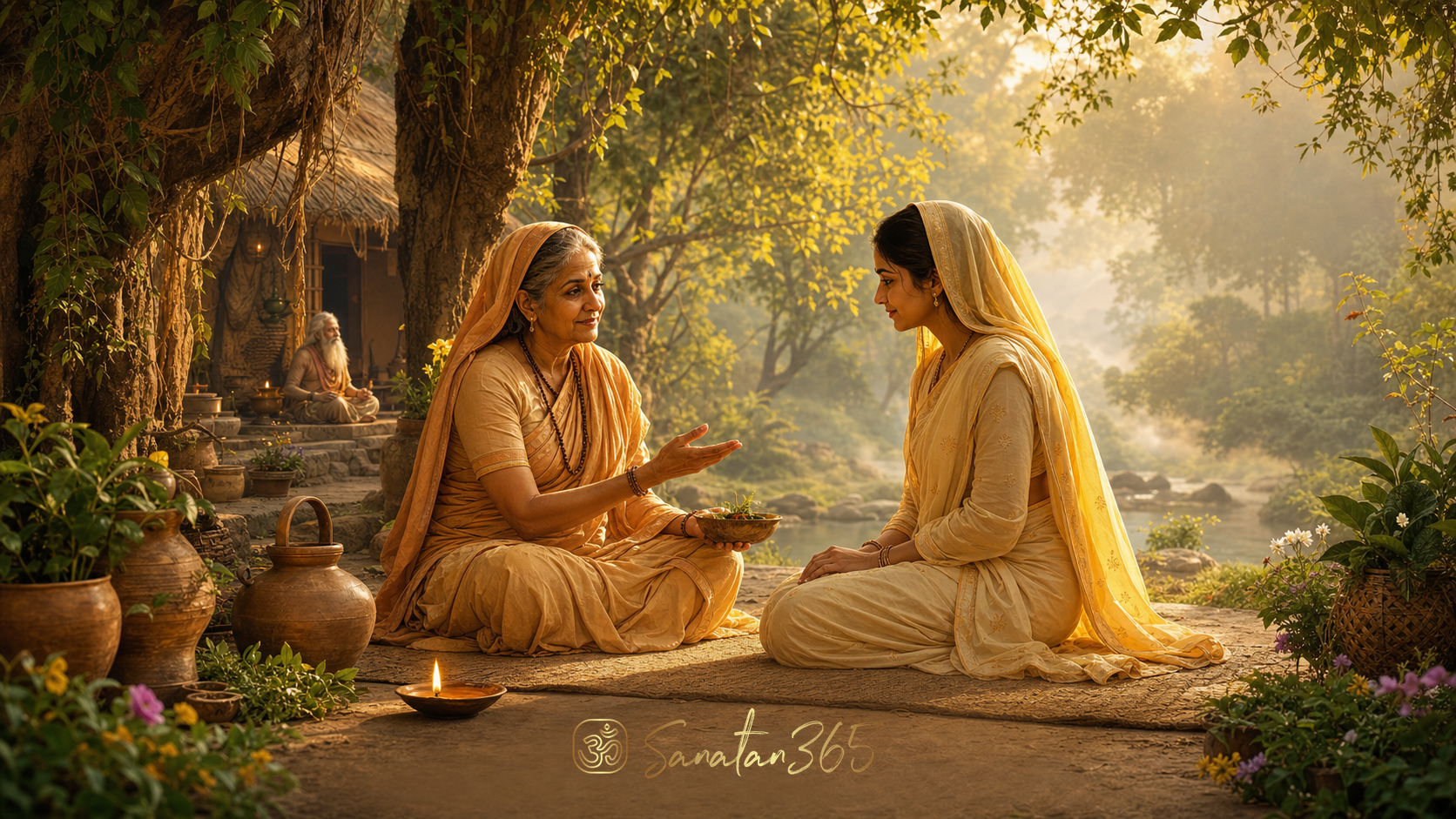
The clearest early portrait appears in the Ayodhya Kanda of Valmiki’s Ramayana. During Rama, Sita, and Lakshmana’s forest exile, they visit the hermitage of Atri. The aged Anusuya receives Sita warmly. Their conversation is not staged as a contest between two ideal women. It is an intimate meeting across generations.
Anusuya speaks about faithfulness, shared duty, and steadiness during hardship. Sita responds by recounting her marriage and affirming her freely chosen commitment to Rama. The exchange matters because Sita is not silent. She listens, answers, remembers her own mother’s counsel, and locates her conduct within love and discernment.
Anusuya then gives Sita garments, ornaments, and fragrant preparations described as enduring through the rigours of forest life. These gifts are more than decoration. A woman living in an austere hermitage sees the strain of exile and offers practical tenderness. Spiritual instruction arrives with material care.
This scene corrects a common misunderstanding: renunciation does not require indifference to beauty or bodily needs. Anusuya’s gifts restore comfort and dignity without denying the seriousness of exile. Her hospitality recognises the whole guest.
The episode also shows a healthy form of elder guidance. Anusuya does not seize control of Sita’s life. She offers the fruit of experience; Sita receives it through her own understanding. Wisdom moves through relationship rather than command.
Key takeaway: The meeting of Anusuya and Sita joins spiritual counsel with practical kindness and preserves the younger woman’s voice.
How Do Later Traditions Tell Anusuya’s Test of Hospitality?
Later devotional narratives describe a dramatic test of Anusuya’s chastity and hospitality. Versions vary, but a widely told form says that the divine triad—Brahma, Vishnu, and Shiva—arrived at her hermitage disguised as mendicants and placed her in an impossible situation. They requested hospitality under a condition that threatened her marital dignity.
Anusuya neither abandons the sacred duty of welcoming guests nor accepts humiliation as the price of service. Through spiritual insight, she transforms the visitors into infants and feeds them with maternal innocence. The situation is resolved without violence, and the divinities acknowledge her purity and power.
This story requires sensitive reading. It should not be used to romanticise coercive tests, blame women for impossible demands, or suggest that hospitality cancels personal boundaries. Its ethical force lies in Anusuya’s refusal of the false choice placed before her. She protects both atithi dharma—the duty of honouring a guest—and her own dignity by changing the moral terms of the encounter.
The transformation into infancy is symbolically rich. Power that arrives as pressure becomes vulnerable in the presence of maternal wisdom. Anusuya does not defeat the visitors through domination. She removes the threat and responds from a level where exploitation has no foothold.
Because this episode belongs to later Puranic and regional tellings, readers should allow differences among versions. Sacred storytelling often preserves theological insight through variation rather than through a single modern-style transcript.
Key takeaway: Anusuya’s famous test is best read as discernment under pressure: true hospitality does not require surrendering dignity or moral clarity.
Why Is Anusuya Connected With Dattatreya?
Anusuya and Atri are revered as the parents of Dattatreya. Dattatreya is a distinctive divine teacher associated in many traditions with the combined presence or blessings of Brahma, Vishnu, and Shiva. The name is often understood as “Datta, the one given, to Atri.”
Accounts of his birth vary across Puranas and devotional lineages. Some connect his birth directly with the divine test; others describe Atri and Anusuya’s austerities and the grace of the three deities. These variations need not be forced into artificial agreement. Each highlights a shared theological theme: disciplined devotion becomes a vessel for wisdom that transcends narrow boundaries.
Dattatreya later emerges as an unconventional guru, especially important in parts of Maharashtra, Karnataka, Telangana, Andhra Pradesh, Gujarat, and beyond. His traditions often emphasise learning from the whole world, seeing the Divine in many teachers, and moving beyond possessiveness. Those themes resonate with Anusuya’s name and character. Freedom from envy makes it possible to learn widely; inner security makes reverence expansive rather than competitive.
Anusuya’s motherhood is therefore not only biological within the narrative. It is theological. The wisdom associated with Dattatreya is imagined as arising in a home formed by Atri’s contemplation and Anusuya’s disciplined, hospitable strength.
Key takeaway: Anusuya’s link with Dattatreya presents the household as a sacred ground from which expansive spiritual wisdom can emerge.
What Does Anusuya Teach About Devotion and Dignity?
Anusuya’s stories remain relevant because they refuse several false oppositions.
First, devotion and agency are not enemies. Her commitments do not erase her judgment; they refine it. Second, kindness and boundaries are not enemies. She welcomes the guest while refusing degradation. Third, household life and spiritual depth are not enemies. Food, gifts, marriage, motherhood, and hospitality become fields of practice.
Her name also challenges envy-driven living. Envy is not merely wanting what someone else has. It can become the habit of shrinking another person’s goodness so that we feel less threatened. Anasuya suggests another freedom: appreciating excellence without self-erasure, giving counsel without superiority, and remaining rooted when comparison appears.
This reading must not be turned into a demand that women alone carry patience, hospitality, or sacrifice. The virtues in Anusuya’s story are human disciplines. Partners, families, teachers, leaders, and guests all share responsibility for creating relationships in which dignity is protected.
The story also distinguishes quietness from weakness. Anusuya’s speech is measured because her centre is firm. In a culture that often equates visibility with influence, she represents authority that does not depend on performance.
Key takeaway: Anusuya’s quiet strength unites commitment, clear boundaries, freedom from envy, and respect for every person’s dignity.
How Can Her Wisdom Be Practised Today?
Anusuya’s world is a forest hermitage, but her disciplines can enter contemporary homes and workplaces.
- Welcome the whole person. Hospitality is not display. Ask what would genuinely help: food, water, rest, privacy, listening, or practical support.
- Refuse false choices. When pressured to choose between kindness and self-respect, pause. A wise third response may protect both.
- Offer counsel without control. Share experience as Anusuya does with Sita, while leaving the other person room to speak and decide.
- Notice comparison early. When envy arises, name it without shame. Turn attention toward gratitude, learning, and your own dharma.
- Make ordinary care sacred. A meal, a clean room, a thoughtful gift, or reliable presence can carry spiritual meaning.
- Build reciprocal households. Do not assign service and emotional labour to one person. Shared dharma requires shared responsibility.
Readers who value stories of ethical hospitality may also explore Atithi Devo Bhava and sacred welcome. For another Ramayana portrait of devotion grounded in patience, read the story of Shabari.
Sanatan365’s library of 85+ Sanatan Stories for Kids and 75+ Lessons on Sanatan Dharma can help families continue such conversations in age-appropriate ways. The aim is not merely to remember exemplary figures, but to ask how their virtues become habits.
Key takeaway: Practising Anusuya’s wisdom means making care practical, boundaries ethical, and freedom from envy a daily discipline.
FAQ
Is Anusuya in the Ramayana?
Yes. In Valmiki’s Ramayana, Rama, Sita, and Lakshmana visit the hermitage of Atri and Anusuya. Anusuya offers Sita counsel and gifts during the forest exile.
What does the name Anusuya mean?
It is commonly understood as “free from envy” or “free from fault-finding.” The name points toward inner security and goodwill, not the absence of discernment.
Who was Anusuya’s husband?
Her husband was Atri Rishi, a revered sage. Tradition remembers their household and ashram as a centre of spiritual discipline and hospitality.
Who is the son of Atri and Anusuya?
Dattatreya is their best-known son in Puranic and devotional traditions. Some accounts also connect Soma and Durvasa with the couple. Details vary across textual traditions.
What is the main lesson of the Anusuya story?
Its central lesson is that devotion can be intelligent and strong. Anusuya welcomes others, protects dignity, acts without envy, and responds to pressure without hatred.
A Strength That Does Not Need to Shout
Anusuya’s legacy is not a single miracle detached from life. It is a pattern: sustained practice, faithful relationship, open-handed care, and moral imagination under pressure. She teaches that a hospitable heart need not be defenceless, and that a clear boundary need not be cruel.
In the forest, Sita meets an elder who has nothing to prove. Anusuya listens, speaks, gives, and blesses. That quiet exchange may be the story’s most enduring image—a woman whose spiritual power makes another person feel more dignified, not less.
Sources and Further Reading
- Valmiki Ramayana, Ayodhya Kanda, the visit to Atri’s hermitage and the conversation between Anusuya and Sita.
- Bhagavata Purana and other Puranic traditions concerning Atri, Anusuya, and Dattatreya.
- Regional Dattatreya traditions and commentarial accounts of Anusuya’s hospitality and tapas.
- Encyclopaedia Britannica: Dattatreya
Sacred narratives may differ across texts, regions, and lineages. This article distinguishes the Ramayana episode from later Puranic retellings and presents their shared ethical themes without treating one variant as the only valid tradition.
About the author
Sanatan365 Editorial
Bringing Sanatan Dharma to modern seekers through authentic, scripture-grounded content.
Related in Stories
 Stories
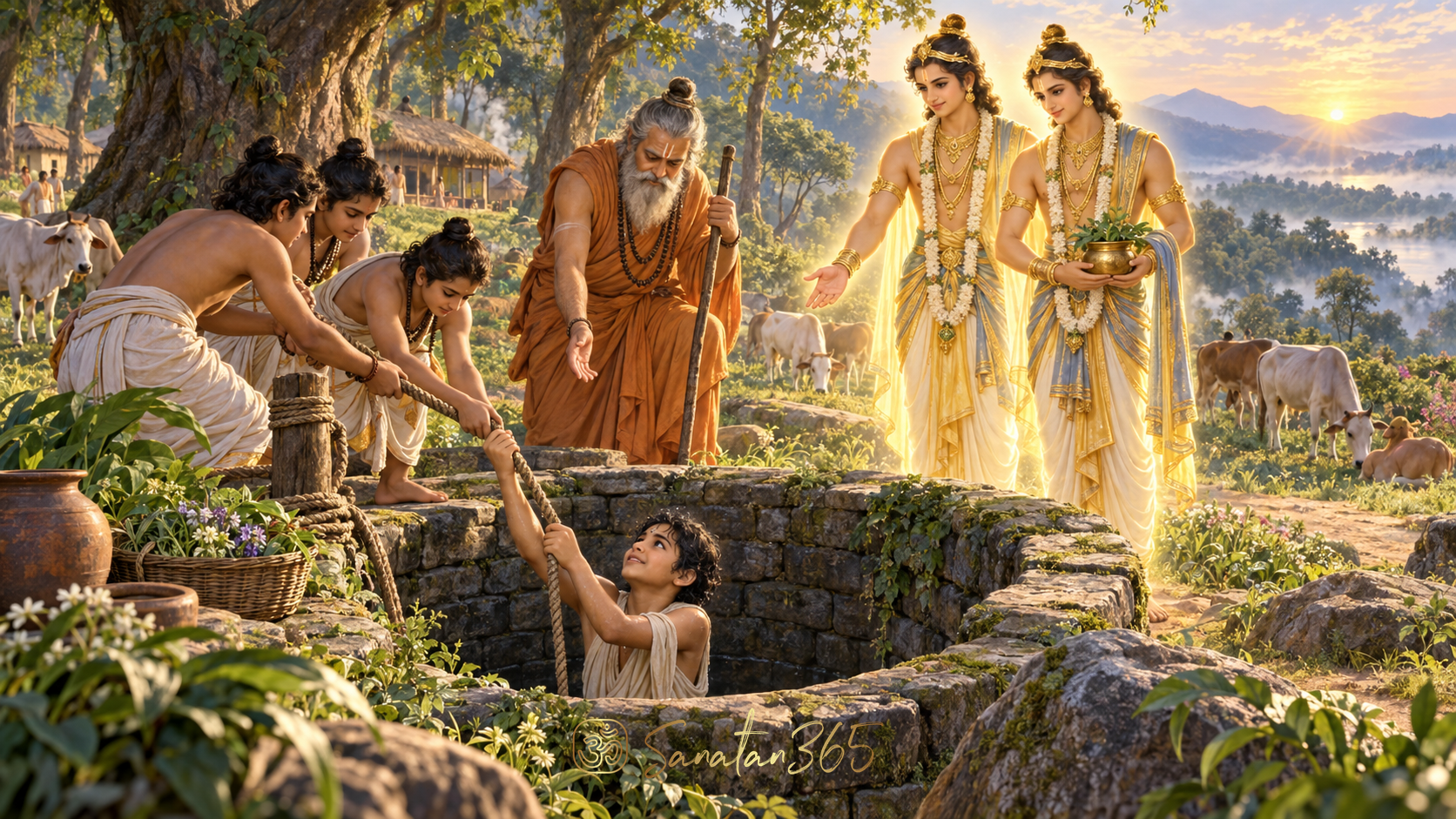
Upamanyu’s Story: Discipline, Discernment, and the Ashvins’ Grace
Upamanyu’s early Mahabharata story follows a hungry student tested by his teacher, blinded after eating harmful leaves, and restored by the…
 Stories
King Parikshit and Shukadeva: Seven Days of Sacred Listening
When King Parikshit learned that only seven days remained, the Bhagavata Purana says he turned from power toward one urgent question: what…
 Stories
Arundhati Vashistha Star Meaning: A Hindu Wedding Guide
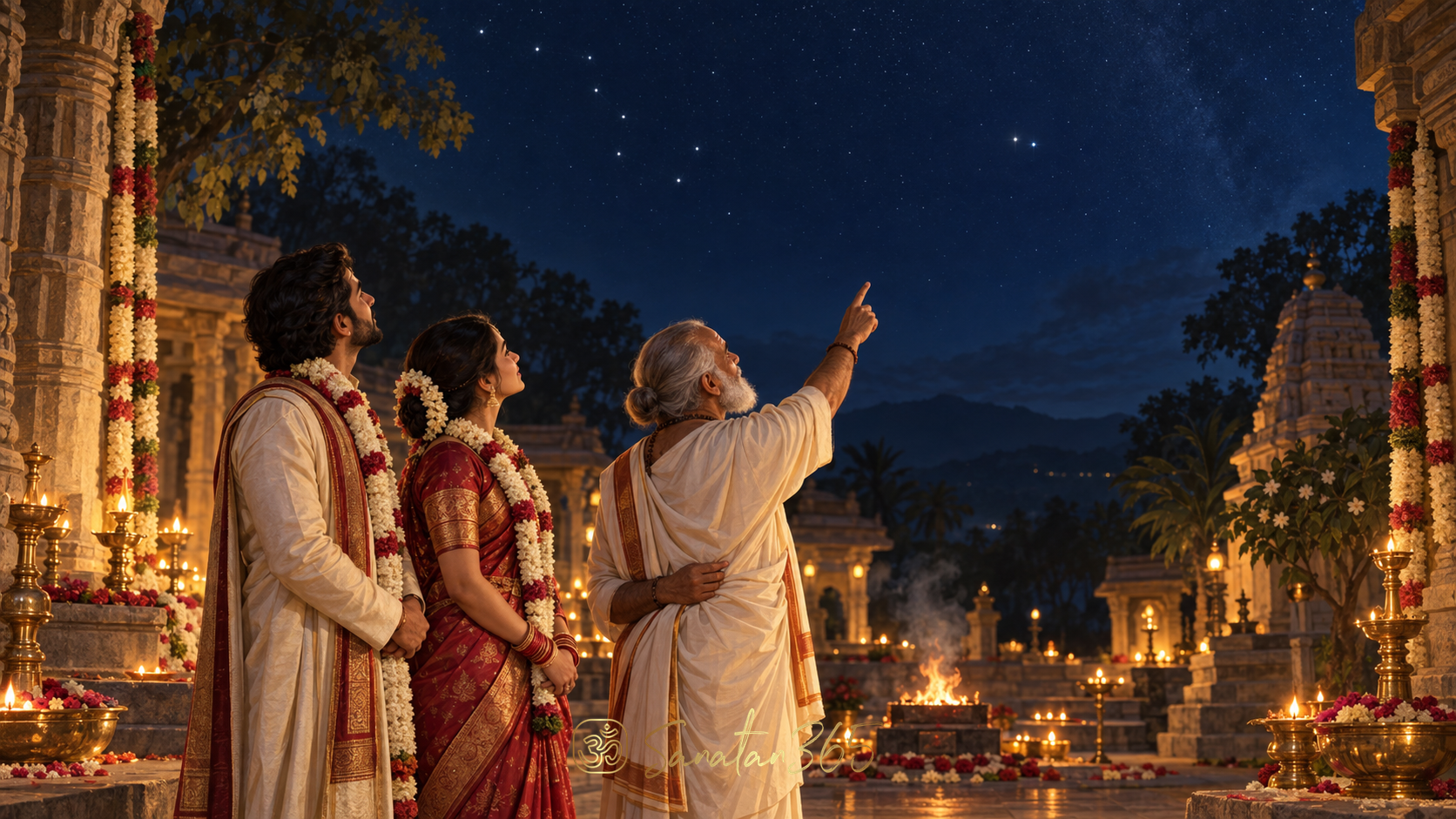
The Arundhati–Vashistha star pair joins an ancient story of companionship with a living Hindu wedding custom. Learn who they are, why the s…