Arundhati Vashistha Star Meaning: A Hindu Wedding Guide
The Arundhati–Vashistha star pair joins an ancient story of companionship with a living Hindu wedding custom. Learn who they are, why the stars are shown to newlyweds, and how the ritual varies across regions.
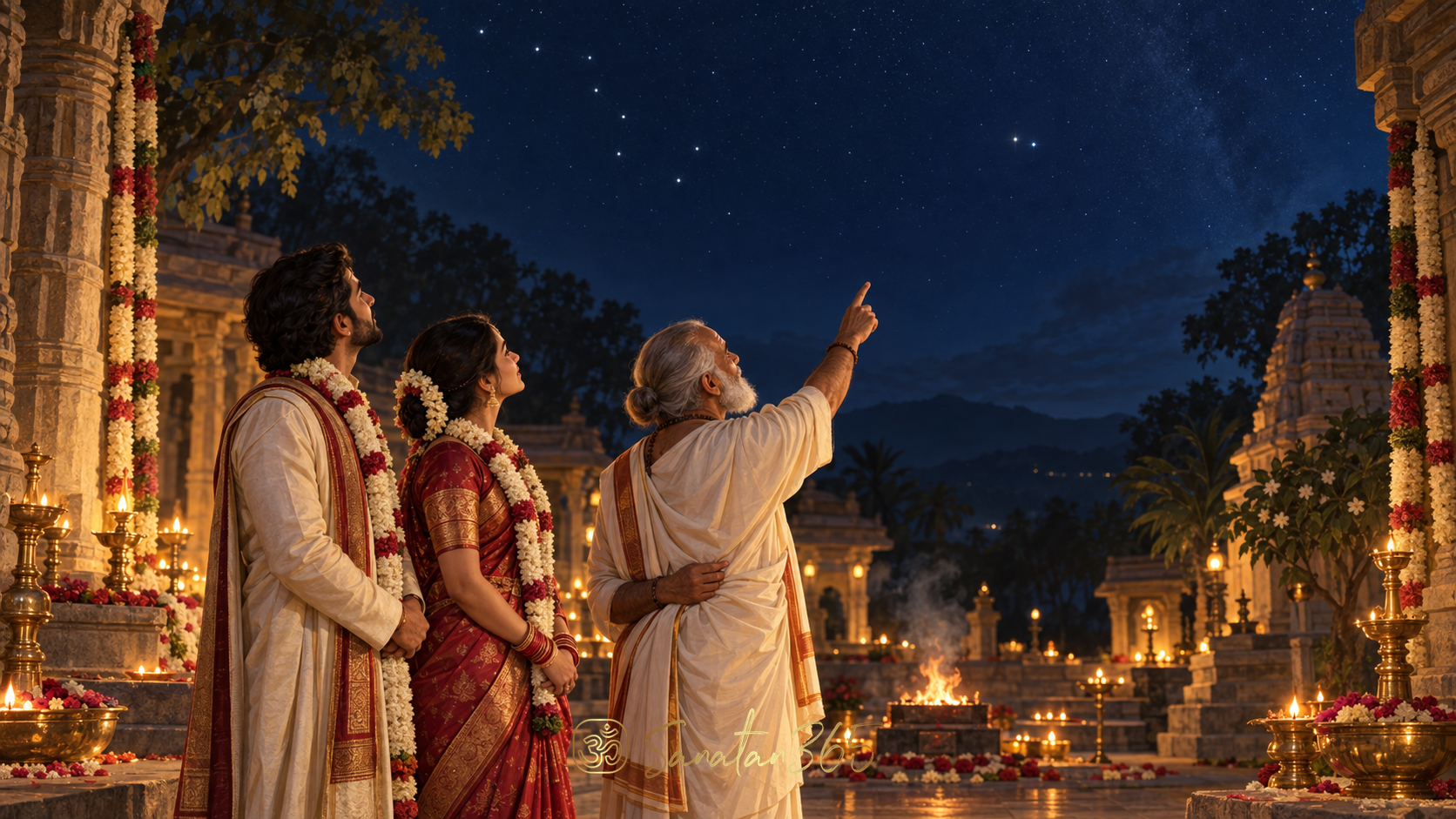
After the sacred fire, vows, and blessings, some Hindu wedding traditions invite the newly married couple to look upward. The Arundhati Vashistha star pair turns that glance into a lesson about companionship. An elder or priest points toward Vashistha, a star in the familiar Saptarishi pattern, and then toward the faint companion beside it: Arundhati. The moment is called Arundhati darshan (अरुन्धती दर्शन), “the viewing of Arundhati.”
The gesture joins sky, story, and household life. Arundhati and the sage Vashistha are remembered as a married pair associated with steadfastness, wisdom, and shared spiritual purpose. Their closely seen stars offer newlyweds an image of companionship: two distinct lights moving together. The ritual is meaningful precisely because it is a teaching through attention, not a claim that every Hindu wedding follows one identical script.
Who Are Arundhati and Vashistha in Hindu Tradition?
Vashistha is one of the great rishis (ऋषि, seers or sages) remembered across Vedic, epic, and later Hindu literature. He is commonly counted among the Saptarishi (सप्तर्षि, Seven Sages) and appears as a teacher, priest, and guardian of sacred knowledge. Different texts and eras preserve different lists and narratives, so “the Seven Sages” should be understood as a living traditional category rather than one unchanging historical roster.
Arundhati is remembered as Vashistha’s wife and as a figure of spiritual strength in her own right. Epic and Puranic narratives praise her discipline, insight, fidelity, and moral authority. In the Mahabharata, Arundhati belongs to the world of revered sages whose household life is not treated as separate from spiritual accomplishment. Later retellings often call her an exemplar of pativratā (पतिव्रता, a woman devoted to the ethical and sacred commitments of marriage), but reducing her to obedience misses the larger portrait. She is remembered for tapas (तपस्, disciplined spiritual ardour), knowledge, steadiness, and participation in a shared sacred life.
That distinction matters today. The couple is not asked to imitate an unequal stereotype frozen outside history. The enduring ideal is reciprocal: loyalty joined to wisdom, commitment joined to moral purpose, and two lives oriented toward dharma (धर्म, the sustaining order of right relationship and responsibility).
The Mahabharata translation archive at the Internet Sacred Text Archive allows readers to explore the epic’s many references to Vashistha, Arundhati, and the communities of sages. For example, the epic’s Shalya Parva includes Arundhati in a pilgrimage narrative involving Vashistha and other sages, while the Anushasana Parva remembers her among honoured women of ascetic and household virtue. As with any vast layered text, one passage should not be made to carry every later interpretation of the pair.
Key takeaway: Arundhati is remembered not merely as “the sage’s wife,” but as a respected spiritual figure whose partnership with Vashistha became an image of steadfast household dharma.
What Is the Arundhati Vashistha Star Pair?
The visible pair is known internationally as Mizar and Alcor in the constellation Ursa Major, the Great Bear. In Indian sky tradition, the larger pattern is associated with the Saptarishi. Mizar is identified with Vashistha; the smaller nearby Alcor is identified with Arundhati.
To the unaided eye under a reasonably dark, clear sky, the two points appear close together. Modern astronomy shows that the Mizar system itself contains multiple stars, while Alcor is another stellar system moving through space near it. The NASA Astronomy Picture of the Day explanation of Mizar and Alcor describes both their naked-eye appearance and their complexity when observed with instruments.
The ritual meaning does not depend on the stars being a simple two-body “married couple” in modern astrophysical terms. Traditional cultures regularly use the visible sky as a field of memory and instruction. What a wedding participant sees is a close pair that generations learned to name, locate, and connect with a story.
Finding Arundhati can require patience. Alcor is fainter than Mizar; city light, clouds, haze, season, latitude, eyesight, and the position of Ursa Major can all affect visibility. Failure to distinguish it is not an omen and should never be used to frighten a couple. The ethical purpose of the custom is blessing and reflection, not prediction.
Key takeaway: Vashistha and Arundhati are identified with Mizar and Alcor, a close naked-eye pairing whose cultural meaning is distinct from its modern astronomical description.
Why Are the Stars Shown During Some Hindu Weddings?
Hindu marriage rites are transmitted through Sanskrit ritual texts, family practice, regional custom, and community lineages. Several gṛhya sūtras (गृह्यसूत्र, concise texts governing household rites) include acts in which the bride, or the couple, is directed toward significant stars. Hermann Oldenberg’s translations in The Grihya-Sutras, Part I, Sacred Books of the East, volume 29 document household ritual instructions from more than one Vedic school, including marriage sequences and stellar invocations. The collection is valuable precisely because it shows plurality: a textual witness belongs to a particular ritual school and does not describe every later Hindu wedding.
Exact sequences and words differ. In living ceremonies, Arundhati darshan may occur after the main fire rites, after the seven steps, or at another suitable moment when the sky is visible. Oral explanation, local-language verses, and family customs can sit beside Sanskrit directions. That layered transmission explains why two weddings may share the same symbolic pair while staging the moment differently.
The stars carry several connected teachings:
- Companionship: Arundhati and Vashistha are seen together, giving the couple an image of enduring partnership.
- Shared direction: Both lights occupy one field without becoming one indistinguishable point. Marriage joins lives while preserving personhood.
- Steadiness: The recurring sky suggests constancy across changing circumstances.
- Household as a sacred path: The remembered pair belongs to the world of sages, showing that learning, service, hospitality, and spiritual discipline can inhabit family life.
- Humility before a larger order: Looking up briefly moves attention beyond ceremony and social display toward time, cosmos, and responsibility.
Older explanations sometimes frame the act only as instructing the bride to emulate Arundhati. Many contemporary families understand the symbol more mutually: both spouses are invited to practise fidelity, patience, truthfulness, and support. This reciprocal reading fits the visual itself—two stars, not one person carrying the whole ethical burden of marriage.
The custom is therefore less like a magical guarantee and more like a compact lesson. A ritual can place an ideal before people; it cannot replace daily conduct. Respect, consent, communication, care, and responsibility are what make the symbol real in household life.
The skyward gesture also changes the scale of the ceremony. Weddings can be crowded with movement, expectation, and display. Looking for a faint companion star requires stillness. The couple must pause, receive guidance, and attend to something that is not immediately obvious. In that sense, the act performs its own teaching: durable relationships are often sustained by quiet attention rather than dramatic declarations.
Key takeaway: The star-viewing offers an ethical image of marriage—two people maintaining distinct dignity while sharing direction and responsibility.
What Does Arundhati Darshan Teach About Shared Dharma?
The word dharma is broader than a rulebook. In marriage, it can point to the responsibilities that sustain trust, family, community, and spiritual growth. Arundhati darshan expresses this through relationship rather than abstraction.
Walk toward the same horizon
Partnership does not require identical talents, opinions, or roles. The star pair suggests orientation: two distinct presences can move through life with a shared commitment to truth, care, and purpose.
Let steadiness include adaptation
Stars look fixed within a human lifetime, but married life constantly changes. Work, health, caregiving, grief, celebration, and age ask a couple to renegotiate how support is given. Steadiness is not rigidity; it is the willingness to return to a promise under new conditions.
Make responsibility reciprocal
A culturally responsible reading does not place sacrifice, virtue, or family honour on one spouse alone. Shared dharma asks each partner to protect the other’s dignity, listen honestly, and contribute according to circumstance. No sacred story should be used to excuse coercion, humiliation, or harm.
Keep learning within household life
Vashistha and Arundhati belong to a sage tradition. Their memory connects marriage with study, reflection, hospitality, and service. The home can become a place where spiritual values are practised in ordinary decisions—not only during formal worship.
The pair also teaches careful seeing. Arundhati is the fainter point; finding it may take time and guidance. Symbolically, marriage too asks people to notice what is subtle: unspoken effort, quiet courage, changing needs, and the consequences of everyday words.
Key takeaway: Shared dharma means reciprocal responsibility, patient attention, and a common ethical direction—not the erasure of either spouse.
How Does the Wedding Custom Vary Across Regions?
There is no single ceremony performed by every Hindu community. Wedding traditions differ across regions, languages, family lineages, sects, and priestly schools. A rite familiar in a Tamil, Telugu, Kannada, Marathi, Gujarati, or other wedding setting may be absent, renamed, repositioned, or interpreted differently elsewhere.
Some ceremonies point out Arundhati and Vashistha together. Some emphasize the bride’s viewing of Arundhati. Some connect the moment with another star or with blessings recited after saptapadi (सप्तपदी, the seven steps). Indoor venues, daylight schedules, weather, and urban light pollution may make literal viewing impossible; a priest may explain the meaning instead.
These differences do not make one family’s wedding incomplete. Hindu ritual culture often preserves unity through shared principles while allowing diversity in form. The most respectful approach is to ask the officiating priest and elders what the rite means in that community, while avoiding claims that their version is universal.
The regional question also cautions against treating a single English label as the whole tradition. Families may use Sanskrit-derived names, local-language names, or no special title at all. Some explain the stars through the lives of the sages; others emphasize visual closeness, household prosperity, or constancy. Contemporary couples may hear an explicitly mutual interpretation, while an older ritual commentary may address the bride in the gendered language of its period. Responsible explanation can acknowledge that history without turning it into a command for unequal marriage today.
Similarly, the astronomical identification should be presented with care. Indian observers mapped familiar star groups into systems of sacred memory long before modern telescopes revealed their physical complexity. Contemporary astronomy neither cancels the cultural symbol nor proves its ethical lesson. The two forms of knowledge answer different questions: astronomy asks what the systems are and how they move; ritual asks what human beings may remember when they look toward them.
For readers exploring another widely shared but regionally varied wedding rite, the guide to Saptapadi and the seven steps explains how vows and wording can differ while retaining a common orientation toward partnership.
If a couple wishes to include Arundhati darshan, practical preparation can help: ask the priest when it occurs, identify Ursa Major beforehand, use a reputable sky map, and treat poor visibility calmly. The purpose is contemplation and blessing. A phone pointed at the sky should support the moment, not replace it.
Key takeaway: Arundhati darshan is a meaningful Hindu wedding custom, but its form and presence vary; regional and family traditions deserve precise, respectful representation.
FAQ
Which stars are Arundhati and Vashistha?
They are commonly identified with Alcor and Mizar in Ursa Major. Mizar is associated with Vashistha and the fainter nearby Alcor with Arundhati. In Indian tradition, the larger star pattern is linked with the Saptarishi.
Why is Arundhati shown to a newly married couple?
The pair is shown as an image of companionship, fidelity, steadiness, and shared dharma. Interpretations vary, but a reciprocal reading asks both spouses to sustain trust and responsibility.
Is Arundhati darshan part of every Hindu wedding?
No. Hindu wedding rites vary considerably by region, community, family, and ritual lineage. The custom is important in several traditions but should not be presented as universal.
What if the Arundhati star cannot be seen?
Clouds, daylight, light pollution, the season, and eyesight can make Alcor difficult to distinguish. Not seeing it is not a bad omen. The priest or family may explain the symbol without literal viewing.
Is the star pair scientifically a binary star?
The naked eye sees Mizar and Alcor as close companions, but modern astronomy reveals multiple stars and a more complex physical relationship. The ritual uses their visible pairing as cultural symbolism; it is not an astronomy lesson claiming a simple two-star system.
Arundhati darshan gives a wedding a rare pause: after words spoken on earth, the couple is invited to look beyond itself. The nearby lights of Vashistha and Arundhati do not promise an effortless marriage. They offer a direction: steadiness without stagnation, intimacy without erasure, and two lives made luminous through shared dharma.
Key takeaway: The Arundhati–Vashistha pair endures as a wedding image because it holds partnership, individuality, patience, and sacred responsibility in one glance.
About the author
Sanatan365 Editorial
Bringing Sanatan Dharma to modern seekers through authentic, scripture-grounded content.
Related in Stories
 Stories
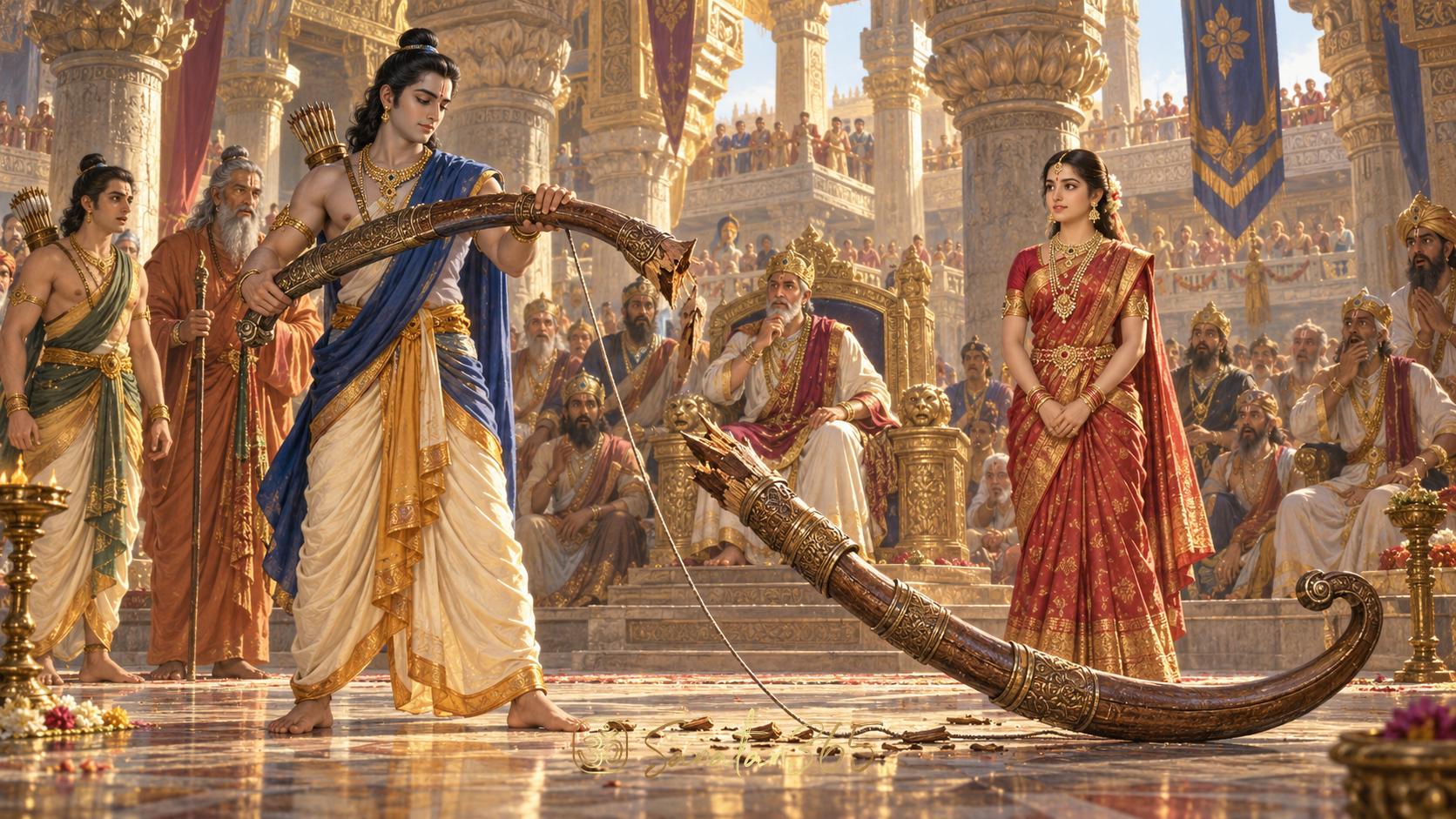
Sita Swayamvara in the Ramayana: Shiva's Bow and the Meaning of the Marriage
Read the Bala Kanda account of Rama, Sita, Janaka and Shiva's bow, and separate the text's sequence from later devotional retellings.
 Stories
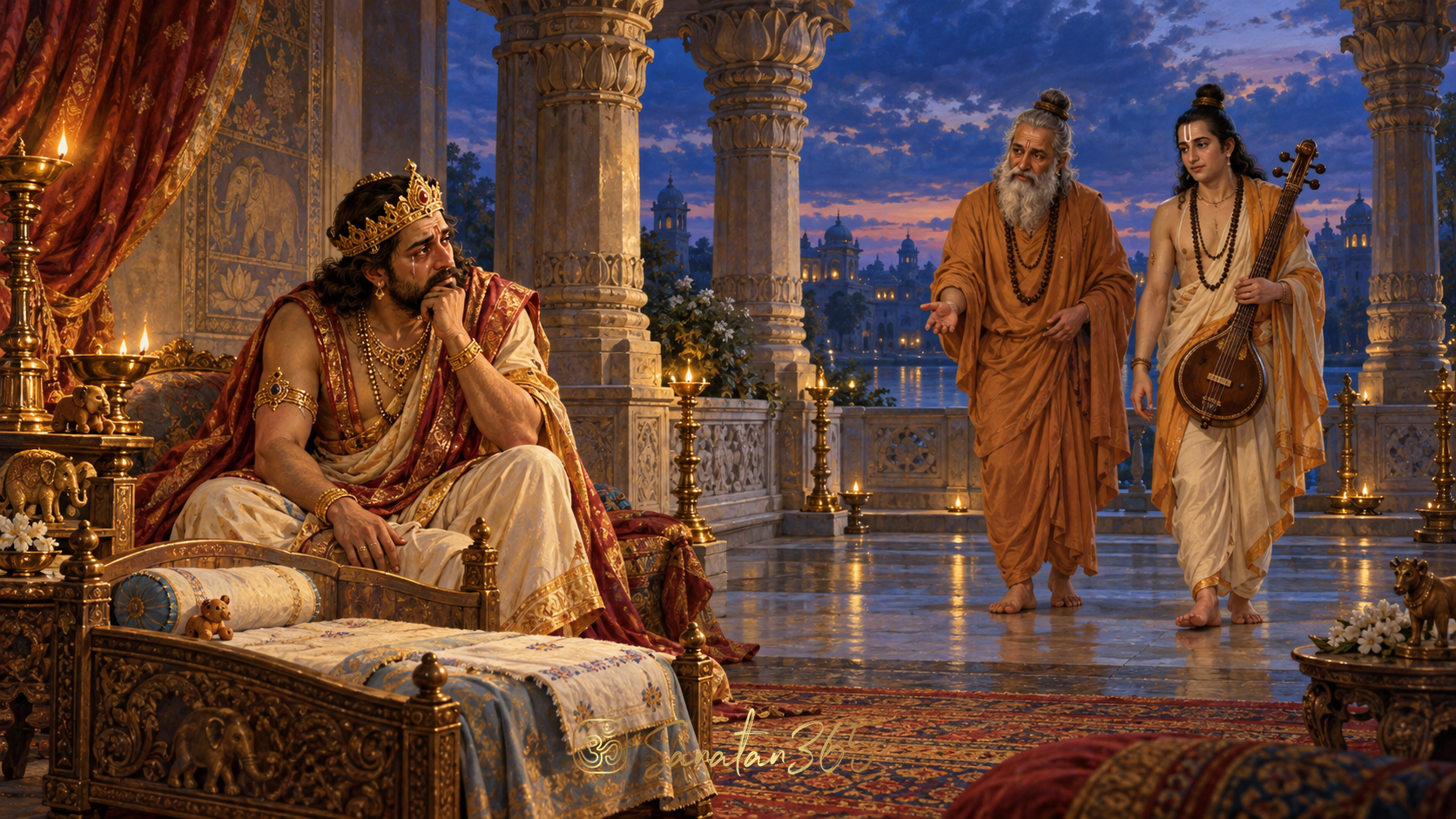
King Chitraketu Story: Grief, Wisdom, and Humility in the Bhagavata
The Bhagavata Purana tells how King Chitraketu met devastating loss, listened to Narada and Angira, and learned a difficult humility. Read…
 Stories
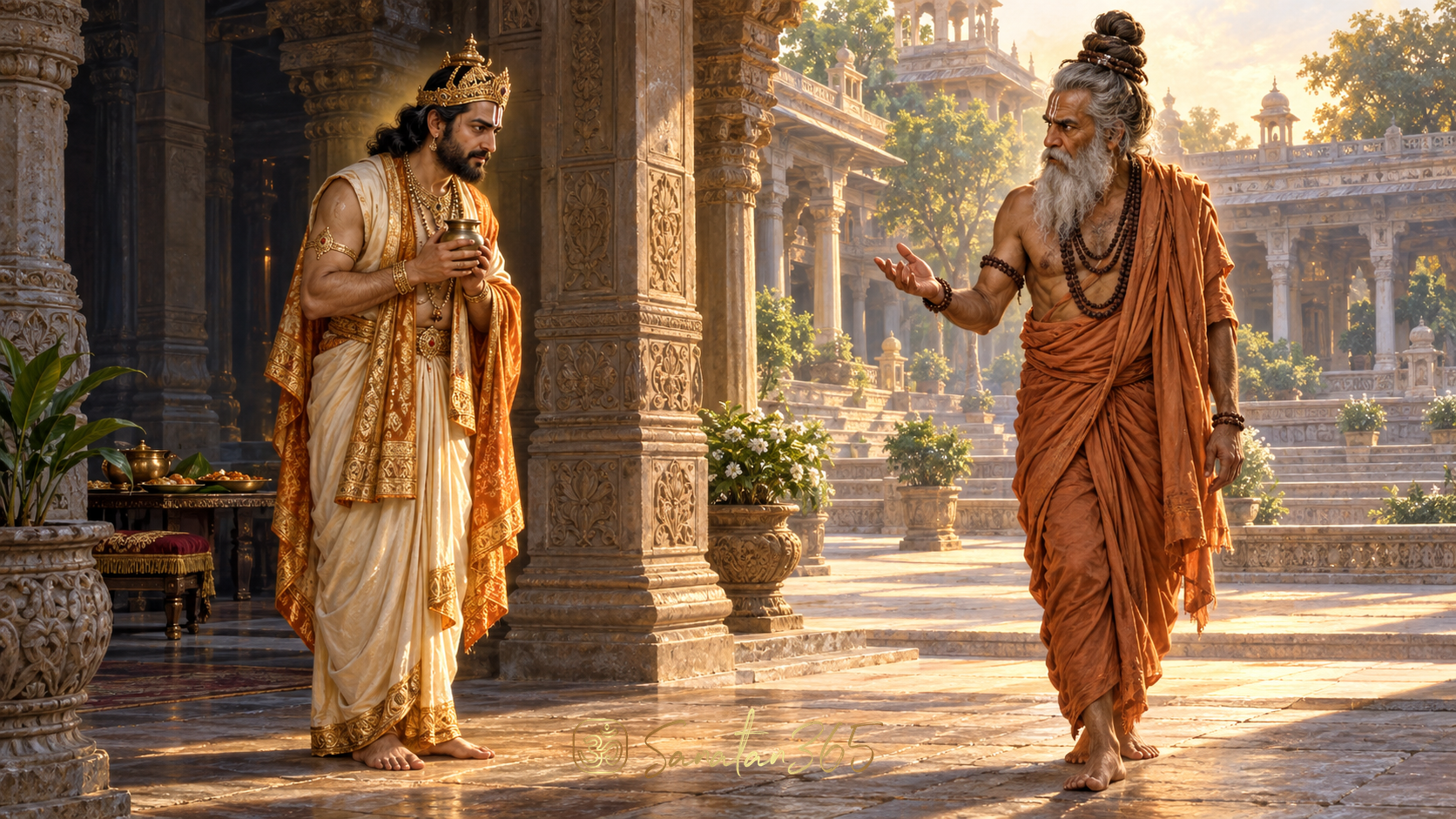
King Ambarisha and Durvasa: A Story of Devotion and Humility
The Bhagavata Purana story of King Ambarisha and Sage Durvasa explores a difficult fast, an angry visitor, and the restraint behind devotio…

