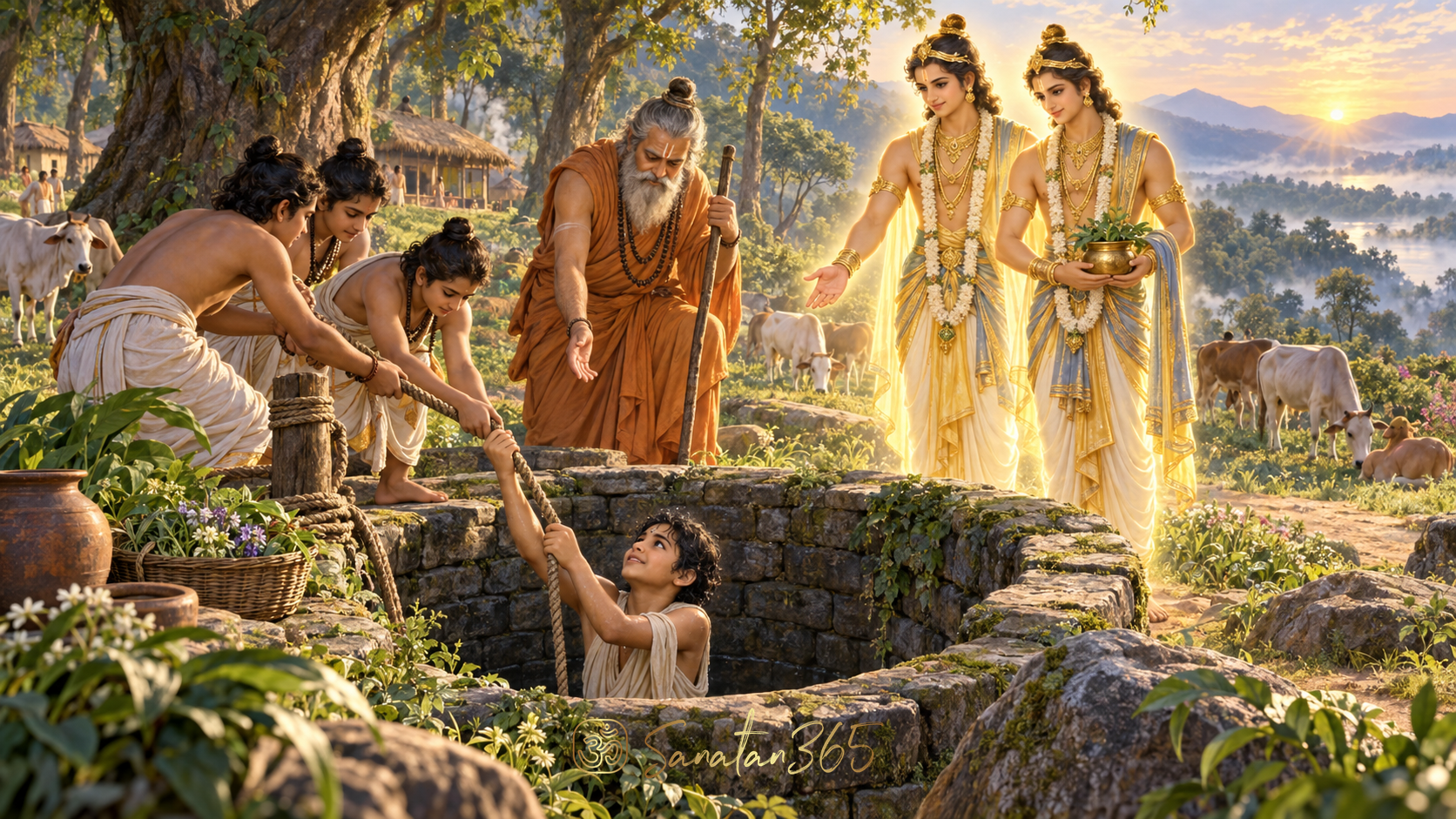
Upamanyu’s Story: Discipline, Discernment, and the Ashvins’ Grace
Upamanyu’s early Mahabharata story follows a hungry student tested by his teacher, blinded after eating harmful leaves, and restored by the Ashvins. Read carefully, it raises enduring questions about discipline, care, and discernment.
A student goes out with his teacher’s cattle, disappears by evening, and answers a worried call from the bottom of a well. That stark scene lies near the beginning of the Mahabharata, long before its great war.
The Upamanyu story follows a pupil of the sage Ayoda Dhaumya through hunger, injury, prayer, and recovery. It honours steadiness and fidelity, yet it also asks modern readers to think carefully about a teacher’s responsibility for a student’s welfare. Its deepest lesson is not that suffering should be copied. It is that disciplined learning needs humility, truthful communication, compassionate supervision, and discernment.
Who Was Upamanyu in the Mahabharata?
Upamanyu appears in the Paushya Parva, an early section of the Adi Parva of the Mahabharata. He is one of three pupils associated with the sage Ayoda Dhaumya, alongside Aruni and Veda. Their brief narratives introduce the epic’s interest in education, duty, authority, and character before the larger Kuru history unfolds. The public-domain translation of the Adi Parva places these episodes near the opening of the work.
The setting is a gurukula (गुरुकुल, a teacher’s household or residential place of learning). Education there is not shown as classroom instruction alone. Service, observation, memory, self-restraint, and participation in daily work all form part of training. Upamanyu is assigned to tend Dhaumya’s cattle. The task demands patience and reliability: he must protect living beings, remain attentive in the forest, and return them safely.
Upamanyu’s account should also be distinguished from other traditions about figures with the same name. Later texts remember an Upamanyu connected with devotion to Shiva. The early Mahabharata episode discussed here concerns Dhaumya’s student and the tests surrounding food, cattle tending, and the Ashvins.
Like the Satyakama Jabala story, this is a narrative about what makes learning truthful. But its emotional center is different. Satyakama’s truthfulness opens the door to study; Upamanyu’s ordeal tests how endurance, obedience, and judgment relate once study has begun.
Key takeaway: Upamanyu is presented not merely as an obedient pupil, but as a learner whose character is revealed through ordinary responsibility under pressure.
Why Did Dhaumya Test Upamanyu’s Discipline?
When Upamanyu returns from tending the cattle, Dhaumya notices that he remains physically well nourished. The teacher asks what he has been eating. Upamanyu explains that he has lived on food received as alms. Dhaumya instructs him that alms collected by a student should first be offered to the teacher. Upamanyu complies, but then seeks alms a second time for himself. Dhaumya objects that this takes resources that might otherwise support other mendicants.
Upamanyu next drinks milk from the cows. Dhaumya tells him that he has not been authorized to do so. The pupil then consumes the froth left around the calves’ mouths after they suckle. Dhaumya again stops him, reasoning that the compassionate calves may be releasing extra froth for his sake and losing nourishment themselves.
The sequence is severe. Yet each exchange reveals an important feature: Upamanyu answers honestly. He does not conceal his strategy, fabricate permission, or pretend that hunger has vanished. He reports what he has done, receives another instruction, and returns to his duty.
This honesty matters more than a superficial celebration of compliance. The narrative repeatedly places appetite, shared resources, animal care, and institutional discipline in tension. It resembles the broader Hindu idea of brahmacharya (ब्रह्मचर्य, disciplined conduct during a life of study), explored further in the meaning of disciplined energy. Here, discipline is not simply denial. It is the difficult work of ordering desire while remaining accountable to others.
At the same time, a responsible contemporary reading cannot romanticize deprivation. A teacher has a duty of care. The story’s extremity belongs to an ancient epic narrative, not to a method that parents, schools, ashrams, or mentors should reproduce. Hunger, unsafe plants, and bodily harm are not legitimate educational tools.
Key takeaway: Dhaumya’s tests expose the social consequences of each choice, while Upamanyu’s honest replies show that discipline without truthfulness is hollow.
How Did Upamanyu Lose His Sight and Fall into a Well?
Unable to use the food sources he had previously relied on, Upamanyu becomes intensely hungry. He eats leaves from the arka plant (अर्क, commonly identified with Calotropis species). The epic says the leaves affect his eyes and he becomes blind. While moving through the forest, he falls into a pit or well.
The episode should not be treated as herbal guidance. Calotropis plants contain potent substances and can be harmful. No one should eat an unknown or ritually significant plant because an epic character did so. The Royal Botanic Gardens, Kew database is useful for botanical identification, but any suspected poisoning requires immediate professional medical help.
When Upamanyu does not return, Dhaumya goes looking for him and calls his name. The pupil answers from below and explains what happened. The call-and-response changes the moral atmosphere of the story. Dhaumya is no longer only issuing restrictions; he is actively searching for a missing student. Upamanyu, despite his condition, communicates clearly enough to be found.
This moment makes relational responsibility visible. Self-discipline cannot eliminate dependence. Human beings sometimes need to call out, and communities must notice when someone has not returned. The pupil’s endurance does not absolve the teacher from searching. Nor does the teacher’s concern erase the danger that preceded it. The narrative holds both facts together.
For modern readers, this is an essential distinction. Tapas (तपस्, disciplined effort or spiritual heat) can strengthen attention and resolve, as discussed in the meaning of tapas. But tapas is not self-neglect. A practice that destroys judgment, conceals harm, or prevents a person from seeking help has departed from wisdom.
Key takeaway: Upamanyu’s fall shows the limit of solitary endurance: disciplined people still need safe conditions, attentive teachers, and the freedom to call for help.
Why Did Upamanyu Refuse the Ashvins’ Offering at First?
Dhaumya tells Upamanyu to praise the Ashvins, the divine twins associated in Vedic literature with rescue, restoration, and healing. Upamanyu invokes them, and they appear. They offer him a restorative cake or preparation that can cure his blindness.
Upamanyu does not immediately eat it. He says he must first offer it to his teacher. The Ashvins respond that Dhaumya once accepted a similar offering without first presenting it to his own teacher, so Upamanyu may do the same. Still, the student refuses to bypass the principle he has been following.
This is the story’s most subtle test. Upamanyu is no longer merely hungry and reacting. He has been offered relief by divine healers, along with a precedent that could justify accepting it. Yet he pauses. His refusal expresses guru-bhakti (गुरुभक्ति, devotion and loyalty toward one’s teacher), but it also displays consistency under pressure. He will not adopt a convenient exception simply because it benefits him.
The scene does not teach that a person should reject urgent treatment until an authority approves it. In present-day life, emergency care should never be delayed. The epic’s point operates at the level of character: Upamanyu remembers his commitment even when distress makes rationalization easy.
The Ashvins are pleased by his steadiness. Their grace is not portrayed as a reward for reckless injury. It arrives as restoration after a crisis, and it affirms a quality they perceive in him. Vedic hymns often celebrate the Ashvins as swift helpers who bring beings out of danger; readers can consult translations through the GRETIL collection of Sanskrit texts and compare them with scholarly editions.
Key takeaway: Upamanyu’s pause before accepting relief symbolizes integrity under pressure, but it must never be used to justify delaying real medical care.
What Blessings Did Upamanyu Receive?
The Ashvins restore Upamanyu’s sight and bless him. When he returns, Dhaumya expresses satisfaction and grants a further blessing: Upamanyu will gain knowledge of the Vedas and the dharma texts. The pupil who began the episode tending cattle emerges recognized as capable of sacred learning.
The movement is significant:
- Service reveals habits. Routine work shows whether attention is dependable.
- Questioning reveals truthfulness. Upamanyu explains each choice without deception.
- Crisis reveals relationship. The teacher searches; the student answers.
- Divine encounter reveals consistency. Upamanyu does not abandon his commitment for immediate advantage.
- Blessing redirects the ordeal toward knowledge. The narrative ends with learning, not with suffering as an end in itself.
This pattern helps explain why the story appears near the beginning of an enormous teaching text. The Mahabharata repeatedly asks whether knowledge is merely possessed or embodied. Upamanyu receives learning after demonstrating memory, candour, endurance, and loyalty. Yet the story also leaves readers responsible for judging the methods around him.
The culmination resembles the progression described in Shravana, Manana, and Nididhyasana: hearing, reflection, and assimilation each matter. Upamanyu’s blessing is not a magical substitute for study. It signals readiness for knowledge to become part of character.
Key takeaway: The final blessing places knowledge above ordeal; hardship has meaning only insofar as it matures truthfulness, responsibility, and understanding.
What Does the Upamanyu Story Teach About Discipline and Discernment Today?
The Upamanyu story can support a mature ethics of learning when its tensions are not flattened into “obey without question.” Five principles stand out.
1. Tell the truth about what sustains you
Upamanyu repeatedly names how he found food. Students and seekers need the same honesty about exhaustion, finances, health, confusion, and support. Concealed distress does not become spiritual strength.
2. Consider who else bears the cost
Dhaumya’s objections concern shared alms, the cows’ milk, and the calves’ nourishment. Discipline includes seeing the wider field of consequence, not merely proving personal toughness.
3. Teachers must notice absence
Dhaumya searches when Upamanyu does not return. Mentorship is not only instruction; it includes attention, safeguarding, and accountability. Reverence for a teacher never removes a teacher’s duty of care.
4. Integrity should survive inconvenience
Upamanyu does not change his principle when a convenient exception appears. Modern discernment asks a parallel question: is a value still being upheld when there is no applause, and when abandoning it would be easier?
5. Do not imitate narrative danger
Epic stories intensify moral questions through extreme events. They are not procedural manuals. No reader should consume arka leaves, refuse necessary food, enter unsafe austerity, or delay treatment. The wise application is ethical, not literal.
The Sanskrit word viveka (विवेक, discernment or the capacity to distinguish) is crucial here. Discipline without viveka can become rigidity. Viveka without discipline can become endless rationalization. The story invites their cooperation: commitments should be steady, but they should serve life, truth, and learning.
Key takeaway: The Upamanyu story is strongest when read as a call for disciplined integrity joined to safety, compassion, and responsible judgment.
FAQ
Where is the Upamanyu story found?
The account of Upamanyu as Ayoda Dhaumya’s student appears near the beginning of the Mahabharata, in the Paushya Parva within the Adi Parva. Other Hindu texts also contain traditions about figures named Upamanyu, so the narrative context should be identified carefully.
Why did Upamanyu become blind?
According to the epic, hunger led him to eat arka leaves, after which his eyesight was affected and he fell into a well. This is a narrative event, not a recommended practice. Unknown plants should never be consumed, and poisoning requires professional medical help.
Who healed Upamanyu?
The Ashvins, divine twins celebrated in Vedic tradition for rescue and healing, answer his praise and restore him. Their appearance shifts the story from ordeal toward grace and renewal.
Does the story teach blind obedience to a guru?
A responsible reading should not reduce it to blind obedience. Upamanyu shows honesty and consistency, while Dhaumya’s search shows a teacher’s responsibility. Modern teachers and institutions must safeguard students, and no spiritual authority justifies abuse, deprivation, or delayed medical care.
What is the main lesson of the Upamanyu story?
Its central lesson is that disciplined learning requires truthfulness, care for shared resources, integrity under pressure, and discernment. Endurance is meaningful only when it remains connected to wisdom and the protection of life.
The Upamanyu story does not ask readers to reproduce an ancient ordeal. It asks whether learning has made a person more truthful, responsible, attentive, and wise. Key takeaway: real discipline is not the refusal of care; it is the steadiness to honour truth while receiving and extending care responsibly.
About the author
Sanatan365 Editorial
Bringing Sanatan Dharma to modern seekers through authentic, scripture-grounded content.
Related in Stories
 Stories
King Parikshit and Shukadeva: Seven Days of Sacred Listening
When King Parikshit learned that only seven days remained, the Bhagavata Purana says he turned from power toward one urgent question: what…
 Stories
Arundhati Vashistha Star Meaning: A Hindu Wedding Guide
The Arundhati–Vashistha star pair joins an ancient story of companionship with a living Hindu wedding custom. Learn who they are, why the s…
 Stories
Pundalik and Vithoba: Why the Divine Waits on a Brick
The Pundalik and Vithoba story explains the brick beneath Vitthala's feet, the dignity of caring service, and how a regional legend shaped…

