Aranyani Meaning: Listening to the Vedic Forest Goddess
Aranyani’s six-verse forest hymn listens to insects, uncertain sounds and life beyond cultivated fields. Its quiet divine presence invites a more attentive reading of the woods.
A forest can sound inhabited long before anyone becomes visible. An insect answers another; a distant noise resembles a voice; a shadow briefly looks like a dwelling.
Aranyani meaning begins with अरण्यानी (Araṇyānī), the Vedic goddess of the forest. In ऋग्वेद (Ṛgveda, the collection of Vedic hymns) 10.146, she is approached through elusive presence, woodland sounds and the nourishment of uncultivated life. The hymn invites attention to a place whose life does not revolve around the village.
Its six short verses offer an unusual introduction to a deity. Rather than beginning with a catalogue of weapons or a long narrative of victory, the poem lets the forest gradually become perceptible. Aranyani is encountered through a way of listening.
What is the Aranyani meaning in her forest hymn?
Griffith’s translation of Rigveda 10.146 opens by addressing a goddess who seems to disappear. The speaker asks why she does not seek the village and whether she feels afraid. The scene begins with questions, allowing the speaker’s uncertainty to remain audible.
That opening establishes a relationship between two kinds of place: the familiar human settlement and the forest beyond it. Aranyani does not appear to need the village as the speaker might. The questions therefore reveal something about the questioner as well as the goddess.
A useful interpretive distinction follows. The forest is unfamiliar to the visitor, but that does not mean it is empty. What feels like remoteness from one perspective can be a complete living place from another. The hymn’s address gives the woods a presence that cannot be reduced to the visitor’s convenience.
This is a devotional reading of the poem’s movement, rather than an assertion that it sets out a modern environmental philosophy. Its power lies partly in how little explanation is imposed. The speaker notices, wonders and asks.
For a reader accustomed to meeting deities through dramatic stories, that quieter approach can be revealing. Recognition need not begin with spectacle. It can begin when a place stops being treated as unimportant background.
The goddess’s elusiveness also resists a simple demand to see everything immediately. In ordinary life, seeing is often treated as the strongest form of knowing: a place is photographed, identified and moved past. Here, the voice addresses a presence that cannot be held so easily.
The question is therefore more interesting than “Where is the goddess standing?” It becomes “What allows the speaker to recognize that this is her world?” The poem makes room for an encounter that remains partly mysterious without becoming an invitation to invent unsupported facts.
Key takeaway: Aranyani’s hymn introduces divine presence through the forest’s own life and the visitor’s uncertain attention.
Why does the forest seem full of familiar sounds?
The Sanskrit text and accompanying translations show how the middle verses repeatedly move between sound and interpretation. Insects resemble bells; apparent cattle, a dwelling and evening carts enter the description. Another verse evokes calling, woodcutting and what someone thinks is a cry.
These details matter because the poem does not simply announce a silent wilderness. The woods have a soundscape. What remains uncertain is how the listener understands it.
A person hearing an unfamiliar noise often reaches first for a familiar explanation. Was that a human voice? An animal? Something moving just beyond sight? The poem’s shifting impressions can be read as an attentive portrayal of that experience, without converting every sound into a supernatural message.
The interpretive lesson is modest: hearing and understanding are related, but they are not identical. A noise may be real while the explanation attached to it remains uncertain. Wonder becomes more thoughtful when that distinction is retained.
This also changes the meaning of quiet. Quiet does not have to mean the absence of living activity. It may mean the absence of the particular human sounds that usually occupy attention. Once those recede, smaller rhythms become noticeable.
The hymn is particularly effective when read slowly enough for these impressions to remain separate. A reader need not decide that every perceived cart or dwelling was literally present. The language allows the forest to move between the recognizable and the difficult to place.
That uncertainty should not be turned into a rule that every unexpected woodland noise is a divine sign. Such a claim would add something the passage does not establish. The poem can be appreciated without making private predictions from its images.
A contemporary reader might try a simpler response: pause before naming a sound with confidence. Notice what was actually heard, then distinguish it from the story the mind supplied. That is a suggested reading practice, not a new ritual requirement.
Key takeaway: The forest hymn asks the reader to hear carefully while remaining honest about uncertain interpretations.
What does mother of wild creatures express?
The final verse praises fragrance, abundant food without ploughing, and Aranyani as मृगाणां मातरम् (mṛgāṇāṃ mātaram, mother of wild creatures). The ending gives the woodland a nurturing character without presenting it as a cultivated field.
One way to read this image is through the difference between receiving life and having produced everything that sustains it. A forest’s value need not begin when a visitor finds a use for it. The maternal address allows its creatures and its own forms of abundance to remain central.
This is an interpretive possibility grounded in the verse, rather than a claim that the hymn contains a complete theory of land management. The distinction matters. Reverent reading does not require ancient poetry to answer every contemporary policy question.
Nor does “without ploughing” need to become a criticism of cultivation. The verse can appreciate one form of nourishment without making another form contemptible. A field and a forest need not be forced into a contest for spiritual legitimacy.
For a household reader, the idea may invite gratitude for what is received before personal effort begins. Human labour matters; so do the conditions that make labour possible. The passage can encourage appreciation without erasing either side of that relationship.
The maternal image also affects how wild animals appear within the poem’s world. They are not merely an entertaining addition to a human outing. Calling the goddess their mother gives them belonging. The visitor is entering a place already inhabited by others.
That reading has a practical ethical extension: attention should leave room for lives that cannot explain themselves in human language. A creature does not have to approach, perform or become tame for its presence to matter.
The extension is contemporary reflection, not a direct command quoted from the hymn. Keeping that boundary visible lets the source remain itself while allowing a reader to think responsibly with it. Poetry can influence conduct without being made to say words it never said.
Key takeaway: The maternal image places wild creatures within a living world of belonging and nourishment.
Does Aranyani have one fixed image or ritual?
The six verses considered here do not provide a detailed sculptural specification or a complete procedure for worship. A reader should therefore be careful about presenting a particular modern painting, colour, weapon or animal companion as something prescribed by this hymn.
That limited statement does not deny the existence of later or regional traditions. It distinguishes what this particular source establishes from what would need separate evidence. A brief hymn cannot be expected to contain every later development associated with a divine name.
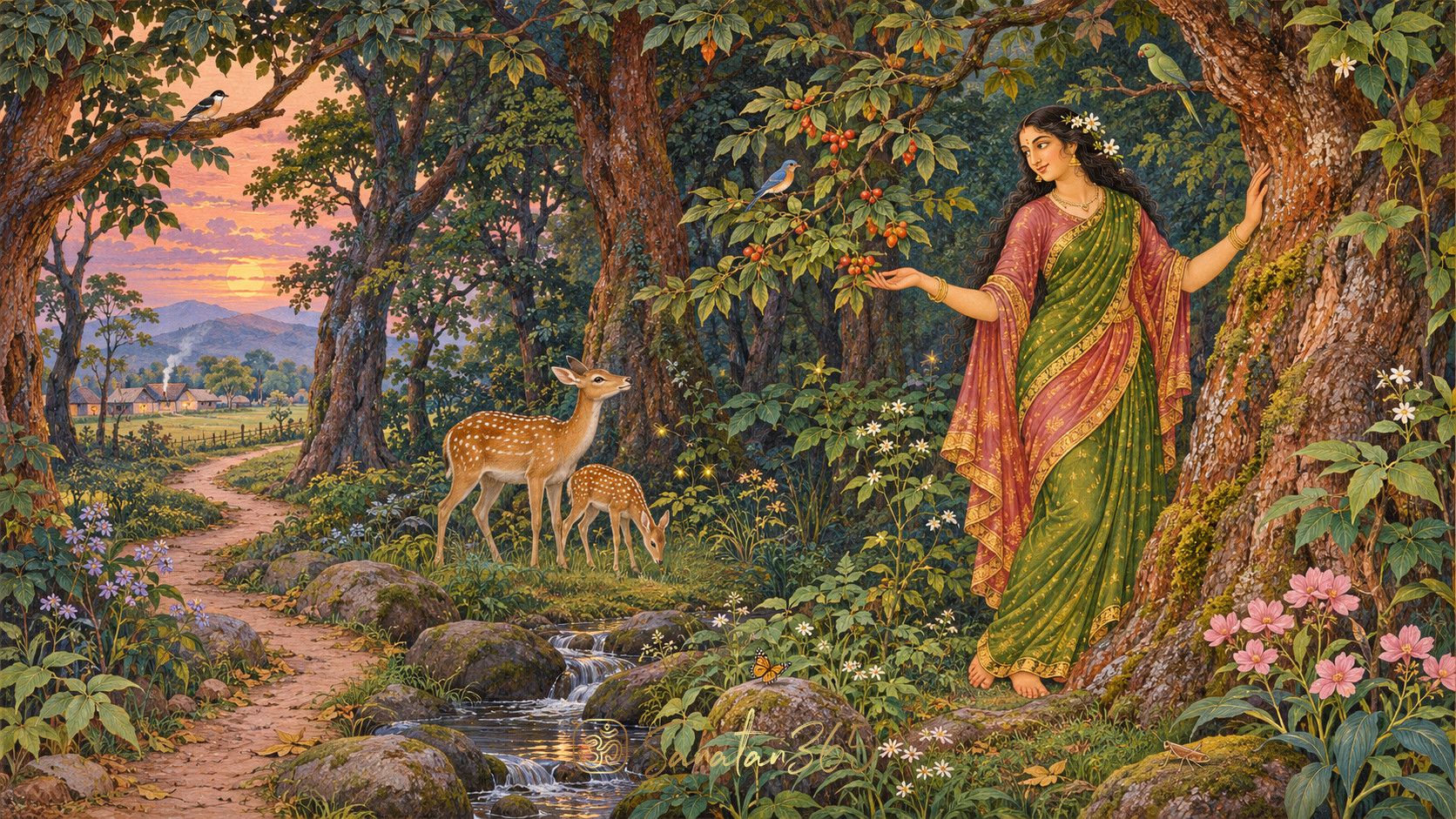
The same care applies to illustrations. An artist may personify the forest through a feminine figure among trees, filtered evening light or the attentive presence of animals. Such choices can make a thoughtful devotional image. They should be understood as interpretation unless a particular iconographic tradition has been documented.
The question of a ritual also deserves precision. Understanding the hymn’s meaning does not, by itself, establish a universal offering, repetition count or promise of a particular result. Adding confident instructions merely to make an article feel more practical would weaken its reliability.
Someone who wishes to learn a specific form of worship can consult a trusted teacher or a documented tradition. Someone who wishes to read the hymn can begin with its words. These are related interests, but they are not the same task.
Aranyani should also retain her distinct identity within the discussion. The Vedic goddess of night in the Ratri hymn offers a different divine address, even where the imagery of evening might bring the two articles close together. Similar atmosphere does not make two hymns interchangeable.
Likewise, the hymns associated with Ushas, the dawn goddess can enrich an appreciation of Vedic divine imagery without becoming a substitute for Aranyani’s forest setting. Keeping names and sources distinct is a form of respect.
Key takeaway: Appreciate a devotional interpretation while distinguishing it from a source-backed iconographic or ritual prescription.
How can the hymn change the way a forest is approached?
A contemporary response can begin with a change in attention. Instead of treating every natural place as a backdrop for a photograph, a reader might ask what is already happening there. Which sounds belong to insects, birds, water or people? What remains uncertain?
This does not require a remote expedition. A permitted woodland path, a managed nature area or even a familiar patch of trees may offer an opportunity to notice more carefully. A place need not be dramatic to deserve unhurried attention.
A few simple distinctions keep that response grounded:
- Observe before interpreting. Describe what was heard or seen before deciding what it must mean.
- Respect existing life. Leave wildlife undisturbed and follow the rules of the place.
- Keep the source visible. Identify a personal reflection as a reflection, rather than a command attributed to the Veda.
- Retain ordinary judgment. A poetic description of rest or non-harm does not guarantee that a real forest is safe.
The last point is essential to a responsible reading. Verse 5 includes language of non-harm and rest, with qualifications whose English renderings vary. It should not be used as advice to ignore dangerous conditions, eat unfamiliar wild fruit or approach animals.
Reverence is compatible with caution. Following local access rules, staying on permitted routes and avoiding disturbance need not diminish the devotional significance of the experience. Attention becomes more respectful when it recognizes limits.
A reader who cannot visit woodland can still work with the poem. Read one verse at a time. Notice where the description seems definite and where it remains uncertain. Ask how the final maternal address changes the earlier feeling of strangeness.
This approach also prevents the hymn from becoming merely a quotation selected to support a conclusion already reached. The difficult or unfamiliar elements deserve attention alongside the comforting ones. A poem can be loved without being made entirely predictable.
The single practical lesson is to arrive as a guest in a living place. That is a contemporary way of responding to Aranyani’s hymn: listen before claiming to understand, and allow the forest to matter beyond its usefulness to the visitor.
A forest may remain unfamiliar while becoming more worthy of patient, respectful attention.
Key takeaway: Let reverent attention produce patient observation and respectful conduct, while keeping real-world caution intact.
FAQ
Who is Aranyani in the Rigveda?
Aranyani is the forest goddess addressed in Rigveda 10.146. The hymn evokes her through an elusive presence, woodland sounds, fragrance, nourishment and wild creatures, rather than through a long narrative biography.
What is the central Aranyani meaning for a reader?
The central subject is the forest encountered as a divine, living presence. The article’s suggested reflection is to listen carefully and recognize a place whose life extends beyond the visitor’s needs.
Is every modern picture of Aranyani a prescribed Vedic image?
No. This hymn does not specify a complete visual form. A painting may be a respectful poetic interpretation, while claims about a particular established iconography require their own evidence.
Does reading the hymn guarantee protection in a forest?
No such practical guarantee should be inferred. Its poetic language does not replace ordinary caution, wildlife rules or local guidance. Reading it respectfully does not require taking risks or disturbing living creatures.
About the author
Sanatan365 Editorial
Bringing Sanatan Dharma to modern seekers through authentic, scripture-grounded content.
Related in Deities
 Deities
Apam Napat Meaning: The Rigveda’s Child of the Waters
Rigveda 2.35 places a golden, shining presence among rivers and clouds. Read how its images of birth, nourishment and fire belong together.
 Deities
Parjanya Meaning: Rain, Nourishment and the Prayer for Enough
A Vedic rain hymn ends with a request for rain to cease. Read Parjanya through thunder, growing plants, cattle and the prayer for enough.
 Deities
Ratri Sukta Meaning: The Vedic Goddess Who Shelters the Night
Read Rigveda 10.127 through its images of Night’s light, birds returning to a tree, a prayer for protection and the arrival of dawn.

