Parjanya Meaning: Rain, Nourishment and the Prayer for Enough
A Vedic rain hymn ends with a request for rain to cease. Read Parjanya through thunder, growing plants, cattle and the prayer for enough.
A prayer for rain can end with a request that the rain stop. That is the striking turn at the close of Rigveda 5.83.
Parjanya meaning in this hymn centres on the divine giver of rain and the life that rain makes possible. Parjanya (पर्जन्य, the Vedic rain deity) is praised through thunder, moisture, growing plants and water for cattle. The closing request asks him to cease after pouring rain. Read together, the verses express gratitude for nourishment alongside awareness of a storm’s power.
What is Parjanya meaning in the Vedic rain hymn?
A name becomes easier to understand when the reader watches what its bearer does. The Ṛgveda (ऋग्वेद, Veda of hymns) addresses Parjanya in a world of weather, vegetation and living creatures. The meaning considered here comes from one particular hymn, numbered 5.83: the eighty-third hymn of its fifth book. It is a focused reading rather than a survey of every later reference to the deity.
The primary hymn in Ralph T. H. Griffith’s translation supplies ten short verses. Praise opens the poem, while a request to withhold further rain comes near its close. The reader can keep those two moments in view while moving through the images between them. Their relationship gives this brief hymn much of its force.
Rain appears here through its effects on a shared world. The attention moves beyond the person speaking to plants and animals that also need water. This is a useful starting point for understanding the devotional address. The prayer arises within relationships of dependence: what grows, what drinks and what becomes food.
A modern reader may first encounter Parjanya as an entry in a list of Vedic deities. Reading the hymn gives that entry texture. There are sounds, movements and changes in the ground. The name belongs to an address of praise, with the speaker asking for a response. It helps to hear that voice before reducing the poem to a definition.
This article uses the hymn’s images as its guide. It does not assign Parjanya a fixed costume, mount or set of hand-held attributes. Those details would require their own sources. The rain-filled world of this particular poem already offers enough material for a careful introduction.
Key takeaway: Understand Parjanya through the hymn’s rain, growth and nourishment. The divine name is part of a living address of praise.
How does Rigveda 5.83 move from thunder to nourishment?
The hymn’s early storm is formidable. In verses two and three, the description includes shattered trees, fear and an approaching roar. The fourth verse turns attention toward the growth that follows rain. The sequence allows a reader to feel the power of the storm and then notice what it makes possible.
Both aspects deserve attention. A retelling that keeps only the gentle rain would lose part of the poem. One that keeps only frightening thunder would leave out its gratitude for life. The reader is asked to hold a larger picture, allowing different effects of the same storm to appear together.
The movement also changes the scale of attention. A thunderclap can fill the whole sky with sound. A new shoot may be small enough to miss. The poem places such different scales within one act of praise. Reading slowly makes room for the quiet consequence after the dramatic arrival.
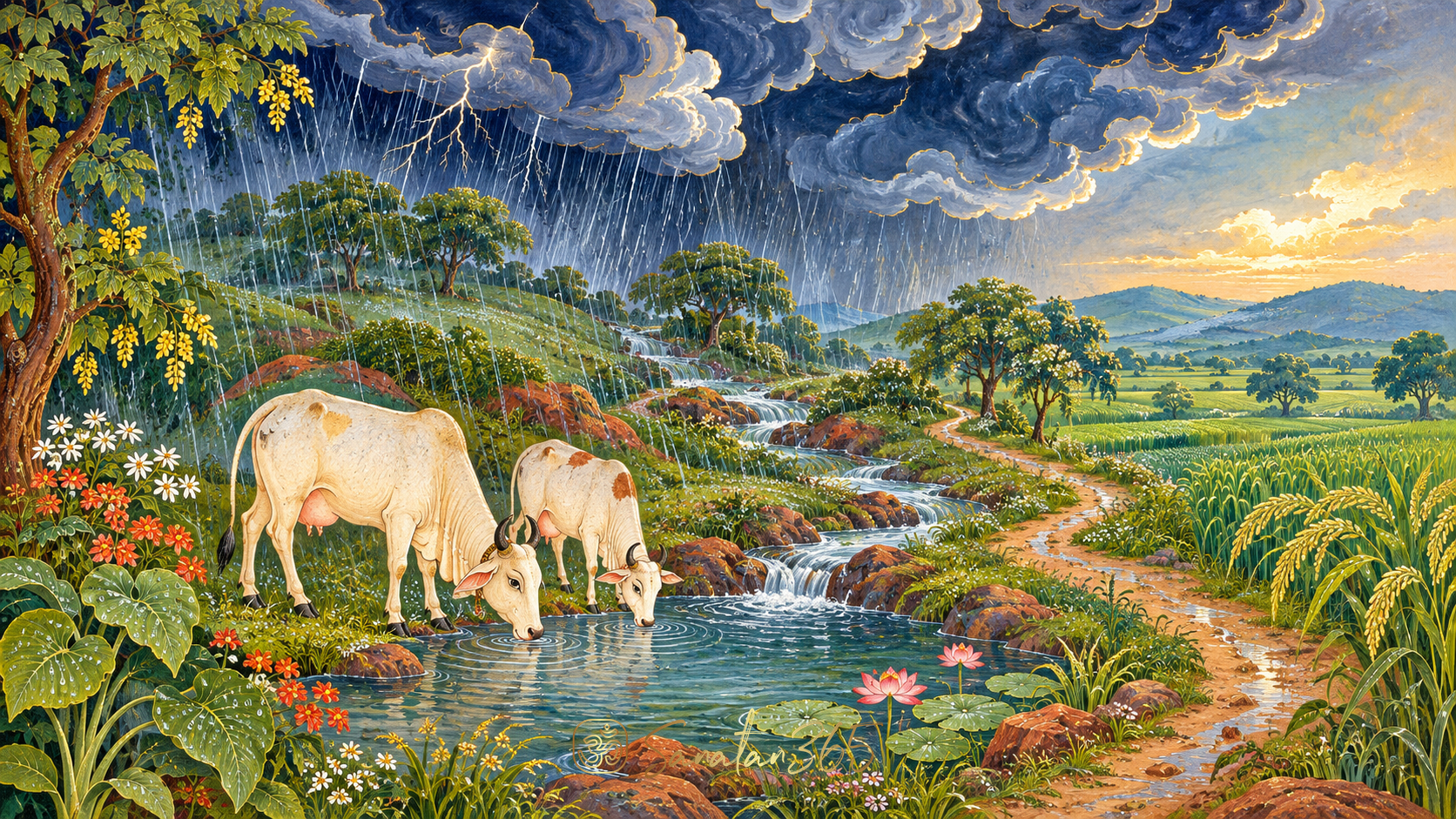
Verse eight brings the request down to water for cattle. That concrete need helps the reader understand nourishment as something lived. It has a location and a recipient. A drinking place matters to a creature with a thirsty body, just as moisture matters to a growing plant.
The speaker’s concern reaches outward in these details. They can be followed without turning each one into a separate hidden code. The cattle need water; plants need conditions for growth. Their ordinary needs carry the devotional meaning. Attention to them gives the prayer a grounded tenderness.
The article on Indra’s rain and responsible power offers another Vedic subject connected with weather. Each hymn still deserves to be read on its own terms. Here the chosen sequence centres on Parjanya’s rainfall and the world it nourishes, so the reader can let that specific voice remain clear.
Key takeaway: The hymn holds storm power and nourishment together. Its movement from sky to growing and drinking creatures gives praise a concrete shape.
Why does the prayer for rain end by asking it to cease?
The final verse changes the request. Rain has been poured down, and now the speaker asks for its cessation. The turn is brief, but it changes how the earlier appeals sound when the hymn is read again.
A prayer can acknowledge that a needed gift has arrived. In this reading, the closing request makes room for sufficiency: rain has a purpose in sustaining life, and the speaker can recognise a point at which further rain is no longer what is being asked for. This is an interpretation of the poem’s sequence, rather than a separate rule stated in technical language.
The reader should also notice that the ending remains an address to Parjanya. The deity is still being spoken to with reverence. Gratitude and a request for cessation can belong within the same relationship. The hymn does not have to abandon praise in order to ask that the downpour end.
A family reading the verse may recognise a familiar question: how is enough recognised? A seedling needs watering, yet tending it includes noticing its actual condition. This small comparison can make the question approachable. It is a present-day illustration, not an agricultural instruction supplied by the hymn.
The same question can be brought to receiving a gift. Attention to what has arrived makes gratitude more precise. A person can name the need that has been met and the care that remains. Such reflection follows from reading the ending carefully, without claiming that the text offers a complete modern philosophy of consumption.
The force of the final turn depends on remembering the earlier appeals. Read only the last line and the request might seem surprising. Read the whole hymn and it belongs to a sequence of invocation, arrival, nourishment and response. The poem has allowed the situation to change before the speaker changes the request.
There is no need to turn this into a promise that recitation controls the weather. The text records devotional praise and petition. Its value as sacred poetry can be approached through attention to its words and meanings, without guaranteeing a particular rainfall result.
Key takeaway: The closing request recognises a changed situation. Asking for rain to cease after its arrival gives the hymn a profound sense of enough.
What do Parjanya’s poetic images help a reader see?
Several images make invisible or distant processes imaginable. The hymn speaks through a bull, the sound of a lion, a charioteer and containers releasing water. A. A. Macdonell’s primary translation lets readers compare how the same sequence is carried into English. Differences in wording invite a return to the verse rather than a rush to build a single literal scene.
The opening bull image conveys generative vigour. The lion comparison gives distant thunder a voice. The charioteer suggests directed movement. These images work through different senses and associations. One need not combine them into a single creature in order to appreciate how each serves the prayer.
The water-bearing images are especially tangible. A vessel can be lifted and poured; a skin can be opened. Such actions let a listener imagine release from something held. The scale of the sky becomes approachable through gestures that can be pictured.
It helps to distinguish poetic imagery from a prescribed icon. A painter might create a symbolic rain landscape from these verses. That choice would be an interpretation of the hymn, with its own artistic decisions. It would not establish that the poem requires one definitive image of Parjanya.
The reader can practise the same distinction in discussion. “The verse compares the thunder to a lion” is a more careful statement than “Parjanya must always look like a lion.” The first stays close to the poetic action. It gives the comparison room to do its work without turning it into an unsupported iconographic rule.
The storm’s fear also calls for careful handling. Verse two includes even the guiltless among those who flee. The poem must not be used to declare that people harmed by storms have deserved their suffering. That inference would go beyond its description and ignore a detail the verse itself preserves.
For a wider comparison, Varuna and the meaning of sacred order introduces another distinct Vedic divine address. Reading different hymns carefully helps protect their particular images and concerns. Shared references to water do not make every prayer interchangeable.
Key takeaway: Read the imagery as poetry doing specific work. It can convey force, sound, movement and release without defining a fixed statue or judging disaster victims.
How can a family read the Parjanya hymn with attention?
Begin with the whole ten-verse sequence in a reliable translation. A first reading can simply follow the changing scene. Let one person read aloud while the others listen for places where attention moves from the sky toward life on the ground.
On a second reading, choose one question. What can be heard? What can be seen moving? Which living beings appear? Working with one question at a time helps a younger listener offer an observation without needing a complete explanation of Vedic poetry.
A page can be divided into three simple headings: storm, nourishment and closing request. Under each, write a detail from the hymn. The exercise is a modern study aid. Its purpose is to make the structure visible, so that an interpretation can point back to something actually read.
Three questions can then open a conversation:
- Which detail makes the storm feel powerful?
- Who receives nourishment or water in the hymn?
- What has changed by the time the speaker asks the rain to cease?
Different answers can lead to another reading. A child might remember the cattle, while another listener remembers the plants. Returning to the relevant verse lets both observations become part of a shared explanation. The conversation grows through evidence in the poem.
A drawing can offer another way in. Let the image connect a rain cloud with what happens below it. A stream, a growing plant or a drinking animal can carry the idea. There is no need to invent a deity portrait if the family has no reliable source for its features.
For Sanskrit recitation, a learner can seek guidance from a qualified teacher in the relevant tradition. Reading an English translation serves a different purpose from learning pronunciation and Vedic accent. A family can enjoy understanding the hymn while recognising those different kinds of learning.
This is an evergreen reading, with no universal ceremony time or regional rainfall prediction attached to it. Families may meet the text in different places and seasons. Its immediate invitation is to attend to the prayer’s movement and to the living world it names.
The Ratri Sukta reading about the shelter of night offers a related exercise in listening to another Vedic hymn. Reading them separately allows night and rain to retain their own voices. Together they can encourage patience with sacred poetry’s concrete details.
Return, finally, to the last request. The rain has arrived; the speaker has noticed its gifts; the prayer can ask for a pause. One lasting takeaway is the value of attention to what sustains life, including the moment when a needed gift has become enough.
Key takeaway: Follow the sequence, ask questions that point back to the verses and let gratitude become specific about the life being nourished.
FAQ
What is Parjanya meaning in simple terms?
Parjanya is the Vedic rain deity. Rigveda 5.83 praises him through rain, thunder, growing plants and nourishment for living creatures.
Which hymn is discussed here?
This reading focuses on Rigveda 5.83, a ten-verse hymn. It does not attempt to summarise every scriptural reference to Parjanya.
Why does the hymn ask the rain to stop?
Its final verse asks for cessation after rain has been poured down. Read in sequence, the turn supports reflection on a needed gift becoming enough.
Does reading the hymn guarantee rainfall?
No such result is promised here. Readers can approach it as devotional praise and sacred poetry, while learning traditional recitation separately with qualified guidance.
About the author
Sanatan365 Editorial
Bringing Sanatan Dharma to modern seekers through authentic, scripture-grounded content.
Related in Deities
 Deities
Ratri Sukta Meaning: The Vedic Goddess Who Shelters the Night
Read Rigveda 10.127 through its images of Night’s light, birds returning to a tree, a prayer for protection and the arrival of dawn.
 Deities
Pushan: The Vedic Deity of Paths, Cattle, and Care
Meet Pushan through Vedic prayers for a knowledgeable guide, protected cattle, reliable movement, and the safe return of what has strayed.
 Deities
Mitra Vedic Deity: Friendship, Trust, and Sacred Order
The Rig Veda praises Mitra as a sustainer of human community and sacred order. Read his hymn through trust, watchful care, and dependable a…

