Archana Puja Meaning: Names, Flowers, and Personal Temple Worship
Archana Puja is focused Hindu worship through sacred names, mantra, and offerings, often performed on behalf of a devotee or family.
A single flower can become a complete sentence of worship when it is offered with one sacred name.
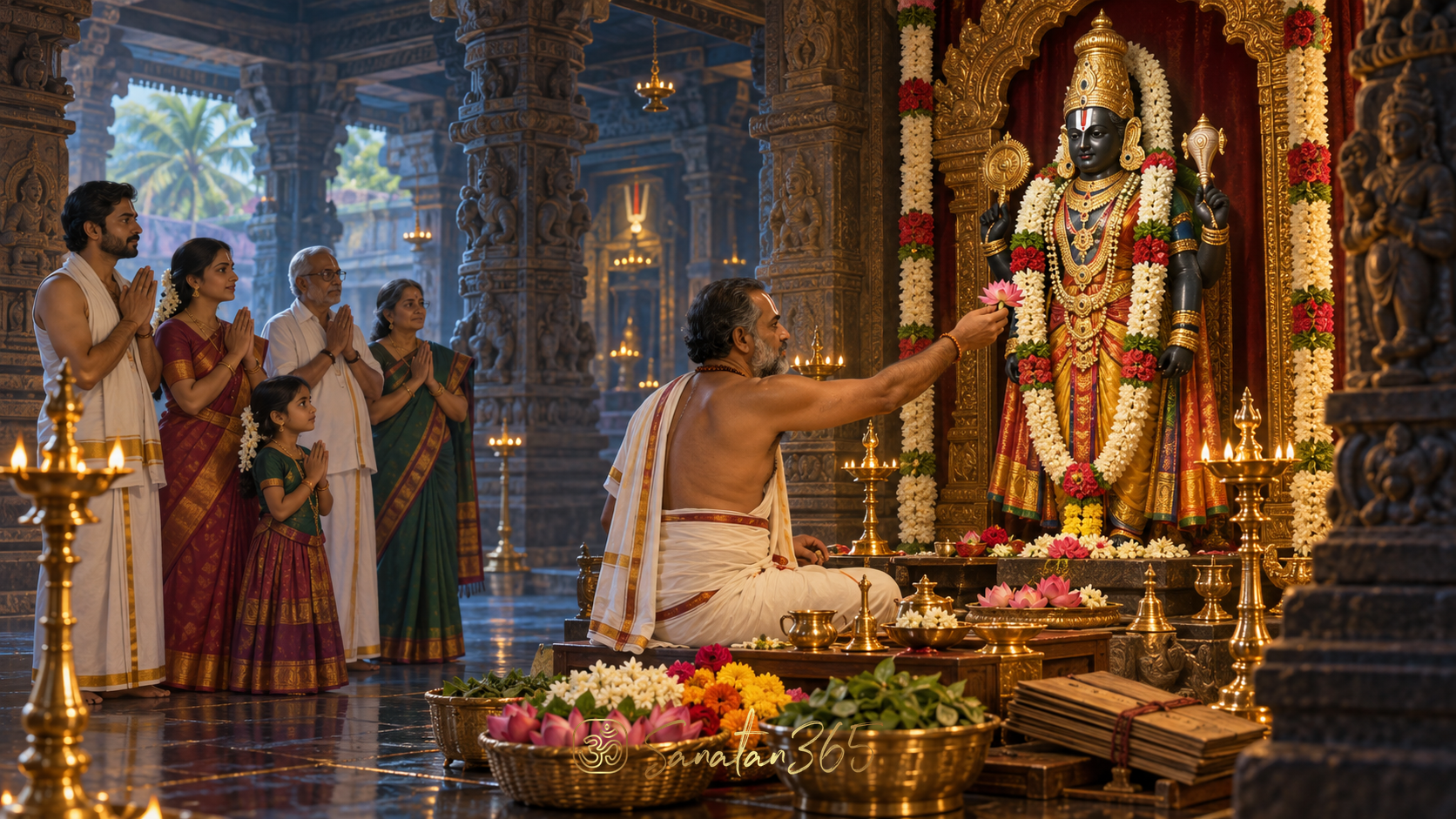
Archana Puja meaning begins with focused honour: arcanā (अर्चना, reverential worship or praise) is a form of pūjā (पूजा, devotional honouring) in which a deity is worshipped through mantra, sacred names, and offerings such as flowers or leaves. In many temples, a priest may perform it on behalf of a devotee, naming the devotee within a prayerful intention. At home, archana may be simpler: a family chants the names of its chosen form of the Divine and offers what is available with care. The details vary, but the centre remains attention rather than transaction.
What Is the Meaning of Archana Puja?
The English word “worship” can make archana sound like one isolated ceremony. Hindu practice is more relational. A murti is approached as a sacred presence, and puja follows the grammar of receiving an honoured guest: welcoming, offering water or fragrance, presenting flowers and food, and taking darśana (दर्शन, the sacred act of seeing and being seen by the Divine).
Encyclopaedia Britannica’s account of Hindu practice describes puja as honouring the deity and notes temple worship by a priest as archana. This broad usage exists alongside a more specific, familiar temple meaning: a shorter, devotee-connected act in which the priest chants divine names and may state the worshipper’s details before the deity. Hinduism Today’s overview of puja describes archana as an abbreviated temple puja in which a devotee’s name, birth star, and spiritual lineage may be intoned.
These descriptions are complementary. “Archana” may refer broadly to reverential worship and, in temple schedules, to a focused service offered for a person or family. It is not a single universally identical script. Shaiva, Vaishnava, Shakta, Smarta, and regional traditions preserve distinct mantras, materials, languages, and ritual sequences.
Key takeaway: Archana is focused reverence made audible through sacred names and tangible through offerings.
How Does an Archana Puja Usually Unfold?
There is no one sequence that governs every temple, yet a recognisable pattern often appears:
- The worshipper gives the priest the requested details, where that temple’s custom uses them.
- A saṅkalpa (सङ्कल्प, a clearly stated sacred intention) may identify the occasion or the person for whom the worship is offered.
- The priest invokes and honours the deity according to the temple’s established paddhati (पद्धति, ritual procedure).
- A series of divine names is recited, often with one flower, petal, leaf, or pinch of sacred rice offered at each name.
- The archana concludes within the larger temple rhythm, which may include lamp worship, darshan, and the return of prasāda (प्रसाद, a gracious offering received back after worship).
The devotee does not need to understand every syllable to participate meaningfully. Listening, watching, remembering the Divine, and joining the palms in añjali (अञ्जलि, a gesture of reverence) are themselves forms of participation. Asking the temple politely about local procedure is wiser than assuming every mandir follows the same custom.
Archana also belongs within the wider language of puja. A reader who wants to understand how offerings form a sequence can explore Panchopachara Puja and its five offerings. The purpose is not to collect ritual steps as objects, but to let each step gather the mind around sacred presence.
Key takeaway: The sequence supports attention; it is not a mechanical formula that produces a guaranteed result.
Why Are a Deity’s Sacred Names Chanted?
In Hindu devotional traditions, a sacred name is more than a label. A nāma (नाम, name) recalls a quality, action, relationship, place, or theological insight connected with the deity. One name may praise compassion; another may remember protection, wisdom, beauty, courage, or the power that sustains cosmic order.
An aṣṭottara-śata-nāmāvali (अष्टोत्तरशतनामावलि, a garland of 108 names) is common in archana. Some observances use a sahasranāma (सहस्रनाम, a hymn or sequence of one thousand names). The number and text depend on the deity, lineage, temple, and occasion. The recitation is often responsive in spirit even when only the priest speaks: the worshipper listens for the Divine through many attributes rather than reducing sacred reality to one idea.
This is why archana can feel both structured and intimate. The names belong to a received tradition, but each name gives the devotee a fresh point of remembrance. Sound, meaning, gesture, and offering meet in one repeated act.
Repetition does not have to mean haste. If the mind wanders, it can return at the next name. If the Sanskrit is unfamiliar, a translation may be studied before or after worship without interrupting the temple’s practice. The aim is reverent remembrance, not performance.
Key takeaway: Each sacred name opens a distinct way of remembering the one worshipped presence.
Why May a Devotee’s Name, Gotra, and Nakshatra Be Recited?
In many temples, especially in South Indian practice, the priest may ask for a devotee’s name and nakṣatra (नक्षत्र, the lunar mansion associated with birth). Some traditions also ask for gotra (गोत्र, a remembered lineage affiliation). These details locate the prayer within a particular human life. They say, in effect: this act of reverence is being consciously offered by or for this person, within their relationships and responsibilities.
That does not make archana a contract for guaranteed outcomes. A devotee may bring gratitude, a family milestone, concern for someone’s welfare, remembrance of an ancestor, or no request beyond devotion itself. Hindu worship includes kāmya intentions, directed toward a particular wish, as well as niṣkāma devotion, offered without bargaining for a result. Both require humility about what worship can promise.
Temple customs differ. Some ask only for a name. Some use name and nakshatra. Some include gotra; others do not. A person who does not know their gotra or birth star need not invent one. The appropriate response is simply to tell the priest or temple desk what is known and follow local guidance. Archana should welcome honest devotion, not turn missing biographical details into anxiety.
Key takeaway: Personal details identify the prayerful intention; they do not determine a person’s spiritual worth.
What Is Offered During Archana?
Fresh flowers are the most visible archana offering because they can accompany the names one by one. Their beauty is temporary, which makes them fitting signs of attention given now. Depending on the deity and tradition, priests may instead or also use sacred leaves, petals, akṣata (अक्षत, unbroken rice prepared for worship), or another approved material.
The choice is not interchangeable everywhere. Tulsi leaves are closely associated with Vishnu and Krishna worship; bilva leaves are especially associated with Shiva. Ganesha traditions may use durva grass. Temple priests follow the installed deity’s ritual tradition, so visitors should not arrive with internet-derived lists and insist on a particular material.
The offering gains meaning through relationship. The devotee is not giving the Divine something the Divine lacks. The flower represents beauty, freshness, effort, and the willingness to place one’s attention before what is sacred. Bhagavad Gita 9.26 expresses this devotional principle through leaf, flower, fruit, or water offered with devotion.
For a deeper look at one offering, why flowers are offered in Hindu puja explains how freshness, beauty, and impermanence shape the gesture. Naivedya and the meaning of offering food shows the same logic of sacred hospitality in another form.
Key takeaway: The material supports devotion, but sincerity does not erase temple-specific rules or cultural care.
How Do Temple and Home Archana Practices Differ?
Temple archana belongs to a consecrated public tradition. The deity’s daily worship follows an authorised ritual system, and trained priests maintain its continuity. Timings, ticket or donation arrangements, language, mantras, allowed offerings, and whether devotee details are spoken aloud vary by institution. A temple service may therefore be brief without being casual: it fits inside a much larger cycle of worship already taking place.
At home, archana may be more modest. A devotee may light a lamp safely, offer a flower or water, and recite a short nāmāvali (नामावलि, sequence of sacred names) before a clean home shrine. The Hindu American Foundation’s guide to traditional puja explains puja through the image of welcoming the chosen deity as an honoured guest and notes that Hindu rituals range from elaborate to simple.
Simplicity is not incompleteness. A home practice should match the family’s tradition, available time, physical ability, and guidance. Advanced mantras or deity-installation rites should not be improvised from fragments found online. When unsure, a family priest, temple, or trusted lineage teacher can clarify what belongs in daily worship.
The difference can be summarised simply:
- Temple archana: priest-led, institutionally ordered, linked to a consecrated deity and local ritual tradition.
- Home archana: household-led, usually shorter, adapted responsibly to the family’s inherited or learned practice.
- Both: centred on reverence, remembrance, and offering rather than display.
Key takeaway: Temple and home archana share a devotional grammar while preserving different responsibilities.
How Can a Devotee Approach Archana with Attention?
Preparation need not become elaborate. A few habits protect the heart of the practice:
- Learn the temple’s custom. Check timing, dress, offerings, and whether advance booking is used.
- State details truthfully. If a birth star or gotra is unknown, say so rather than guessing.
- Choose an intention without demanding an outcome. Gratitude, remembrance, clarity, and the welfare of others are all fitting concerns.
- Listen to the names. Even without full fluency, let the rhythm draw attention back to the deity.
- Receive prasada respectfully. The conclusion is part of worship, not an administrative afterthought.
- Carry one quality into action. If a name praises compassion, courage, patience, or truth, let worship shape conduct after leaving the shrine.
Archana becomes shallow only when it is treated as a spiritual transaction or social performance. Its repeated names offer another possibility: to let the scattered mind become one-pointed, to remember the Divine through many qualities, and to place an ordinary human concern inside a larger sacred relationship.
Key takeaway: The finest continuation of archana is a life that reflects the qualities praised during worship.
Conclusion
Archana Puja joins voice, gesture, offering, and personal intention. Its sacred names widen remembrance; its flowers make attention visible; its temple form connects an individual prayer to a living ritual tradition. Regional and lineage differences deserve respect, yet the central movement is clear: the devotee approaches not to control the Divine, but to honour, remember, and receive with humility.
Key takeaway: Archana turns one person’s prayer into disciplined attention through the shared language of sacred names and offerings.
FAQ
What does Archana Puja mean?
Archana Puja means reverential worship or praise offered to a deity, commonly through mantra, sacred names, and flowers or leaves. In temples, a priest may perform it on behalf of a named devotee or family.
Why is a nakshatra asked for during archana?
Some temple traditions use a devotee’s name and nakshatra to identify the person connected with the sankalpa, or sacred intention. Customs differ, and a person who does not know their nakshatra should simply tell the priest rather than guess.
Is Archana Puja the same in every Hindu temple?
No. Mantras, languages, offerings, personal details, and ritual order vary across deities, regions, temples, and lineages. Visitors should follow the guidance of the temple where the worship is performed.
Can Archana Puja be performed at home?
Yes, many households practise a simple form by reciting a deity’s names and offering a flower, water, or another tradition-appropriate item. The practice should remain proportionate to the family’s training and should not imitate advanced temple rites without guidance.
Does performing archana guarantee a particular result?
No. Archana can hold a sincere wish, gratitude, or prayer for well-being, but it is not a guaranteed transaction. Hindu devotional practice places emphasis on reverence, right effort, humility, and openness to divine grace.
About the author
Sanatan365 Editorial
Bringing Sanatan Dharma to modern seekers through authentic, scripture-grounded content.
Related in Rituals
 Rituals
Vastra Offering Meaning: Why Clothing Is Offered in Puja
The offering of cloth turns ordinary care into sacred hospitality. Understand vastra in Hindu worship without confusing expense with devoti…
 Rituals
Madhuparka Meaning: Sweetness and Sacred Hospitality
Read madhuparka as a ceremonial honey mixture of welcome, exploring textual recipes, guest reception and its distinction from panchamrita.
 Rituals
Samavartana Meaning: Returning Home After Sacred Study
Samavartana marks the completion of traditional study through a ceremonial bath and return. Its lasting question is how learning becomes re…

