Bhajan Meaning: Devotional Singing as Everyday Bhakti
A clear guide to bhajan meaning in Hindu practice, including devotional song, bhakti, kirtan, regional traditions, family singing, and respectful daily use.
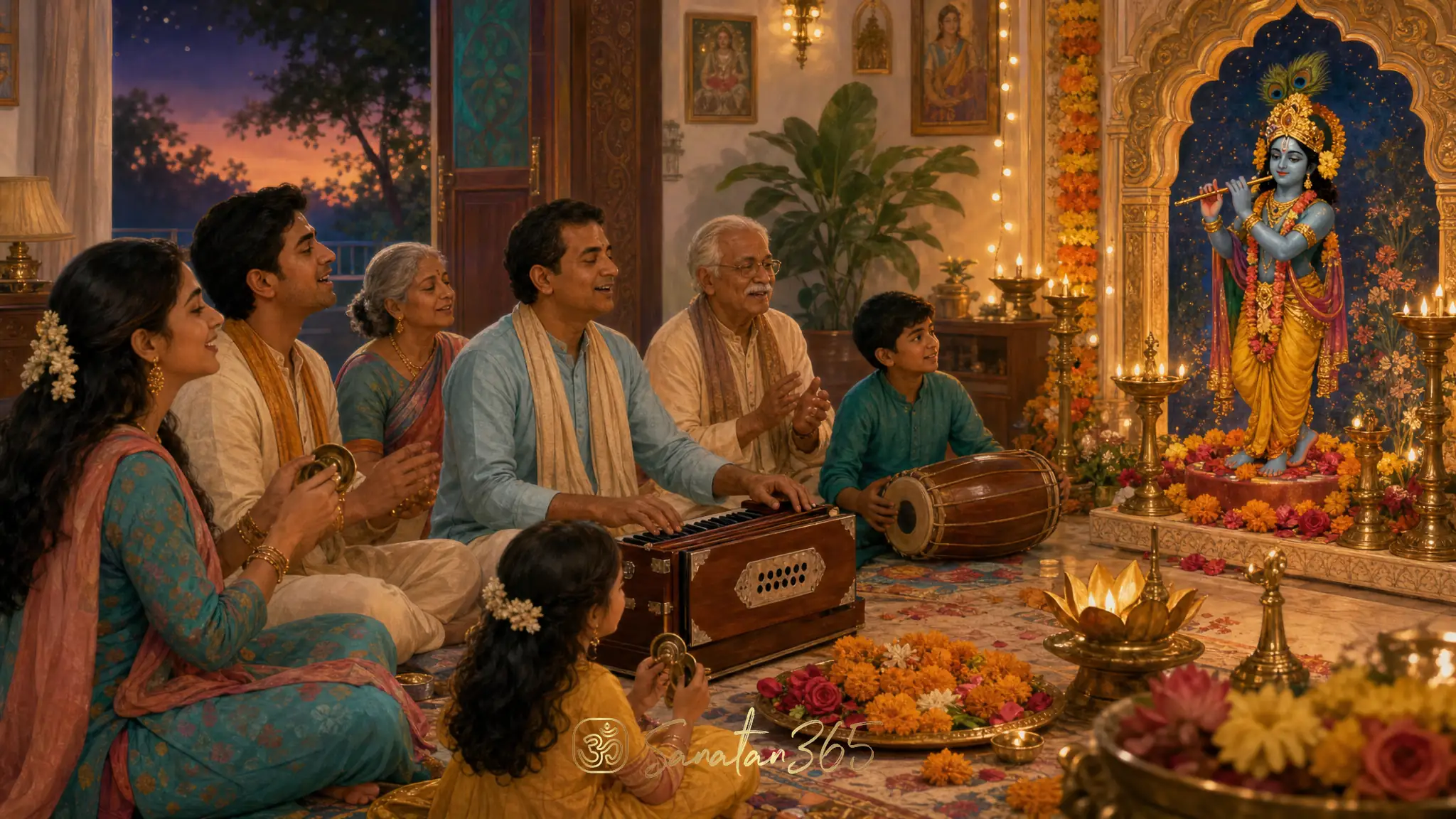
A bhajan can turn an ordinary room into a small mandir of memory.
Bhajan meaning begins with devotional singing: a bhajan (भजन, devotional song) is a Hindu song of praise, remembrance, and love for the Divine, often sung at home, in temples, during satsang (सत्संग, gathering in truth), or at festivals. Unlike a formal Sanskrit mantra, a bhajan is usually lyrical, melodic, and easy for a group or family to sing together. Its purpose is not performance alone. It helps the heart remember, the voice soften, and bhakti (भक्ति, loving devotion) become shared practice.
What is Bhajan meaning in Hindu devotional singing?
The simplest Bhajan meaning is "devotional song." Encyclopedia.com describes bhajan as a Hindu devotional and ritual song, often performed privately or communally. This definition is useful because it captures two sides of the practice: bhajan can be intimate and personal, yet it can also become collective worship.
The word is linked with the Sanskrit root bhaj, which carries meanings such as sharing, serving, loving, and worshipping. That root is close to bhakti, the devotional path in which love, surrender, remembrance, and nearness to the Divine become central. Britannica's overview of bhakti explains the devotional orientation that shaped many Hindu traditions, especially through the songs of saints, regional poets, and temple communities.
A bhajan may praise Krishna, Rama, Shiva, Devi, Hanuman, Ganesha, Vishnu, or a guru. It may be simple enough for children or poetically rich enough for lifelong reflection. It can be sung with harmonium, tabla, manjira, kartal, mridangam, tanpura, or only clapping hands. Some bhajans are slow and meditative. Others are bright and rhythmic. The form changes, but the inner movement remains: the singer turns attention from scattered thought toward sacred remembrance.
This is why bhajan belongs beside aarti, japa, and dhyana. The lamp offers light, the mala counts repetition, meditation steadies awareness, and bhajan gives devotion a voice.
Key takeaway: Bhajan is devotional singing that makes bhakti audible, communal, and emotionally present.
How is bhajan different from kirtan and mantra?
Bhajan, kirtan, and mantra are related, but they are not identical. Understanding the difference helps a seeker practice with more clarity.
A mantra (मन्त्र, sacred sound or formula) is usually a repeated sacred utterance, often short, exact, and received through tradition. Mantra japa may repeat a name, seed syllable, or verse many times with a mala or mental focus. A bhajan is usually a composed song with lyrics, melody, and emotional expression. It may include divine names, but it is sung as a song rather than counted as a fixed repetition.
Kirtan (कीर्तन, praising or glorifying through song) is often more call-and-response and congregational. Britannica describes kirtana as devotional singing connected with bhakti worship, and the Hindu American Foundation explains kirtan as a practice of praising and calling out to the Divine together. In many communities, people use "bhajan" and "kirtan" loosely, and the boundary can overlap. Still, a practical distinction is useful:
- Mantra is usually repeated sacred sound.
- Bhajan is usually a lyrical devotional song.
- Kirtan is usually collective praise, often call-and-response.
- Aarti is the offering of light, often accompanied by song.
These are not competing paths. A single evening gathering may include all four: opening mantra, several bhajans, energetic kirtan, and a concluding aarti. In that sequence, devotion moves through sound, rhythm, gesture, and shared attention.
The difference also shapes the mood. Mantra can be inward and precise. Bhajan can be expressive and story-rich. Kirtan can become collective and participatory. Aarti can gather the devotion into a visible offering. Hindu practice is generous enough to hold all these modes.
Key takeaway: Bhajan is songful devotion, while mantra is sacred repetition and kirtan is often participatory praise.
Why do Hindus sing bhajans at home and in temples?
Hindus sing bhajans because song reaches places that explanation often cannot. A child may not understand a long commentary on Rama's dharma, but a simple Rama bhajan can plant affection. A tired adult may not have the focus for extended study, but one familiar Krishna bhajan can bring the mind back to tenderness. A family may struggle to gather for formal practice, but a short evening bhajan can create shared rhythm.
In temples, bhajan helps devotees move from individual prayer into shared worship. People who do not know one another can still sing one refrain together. The music holds them in one devotional field without requiring identical life stories, languages, or levels of learning.
At home, bhajan often becomes part of daily or weekly rhythm. Families may sing before aarti, during Thursday guru worship, on Ekadashi, at Navratri gatherings, after reading from the Ramcharitmanas, or on a loved one's birthday or death anniversary. In some homes, bhajans are learned from grandparents. In others, diaspora parents use bhajan evenings to keep children connected with language, melody, and sacred memory.
The practice is also emotionally honest. Many bhajans speak in the language of longing, gratitude, helplessness, wonder, repentance, surrender, and joy. This makes them especially powerful in difficult seasons. A bhajan does not need to solve every problem. It gives pain a reverent direction.
Good bhajan practice is not about musical perfection. A trained singer may offer beauty through raga and voice, but an ordinary devotee can offer sincerity through a simple tune. The inner question is not "Was it impressive?" The better question is "Did it bring the heart closer to remembrance?"
Key takeaway: Hindus sing bhajans because devotional song turns worship into shared memory, family practice, and heartfelt remembrance.
What are the regional forms of Hindu bhajan?
Bhajan is not one uniform style across India. It changes with language, region, deity, saint tradition, and musical culture.
In North India, Rama, Krishna, Hanuman, Shiva, Devi, and guru bhajans are often sung in Hindi, Braj, Awadhi, Bhojpuri, Rajasthani, Punjabi, and other regional languages. Tulsidas, Surdas, Meera Bai, Kabir, and many other saint-poets shaped the devotional imagination through songs that still live in temples and homes. Britannica's discussion of Hindu vernacular literature notes the importance of devotional songs and saint-poets in regional Hindu expression.
In Gujarat and Maharashtra, bhajan may sit alongside garba, abhang, kirtan, and Varkari devotional singing. In Bengal, Vaishnava kirtan traditions associated with Krishna, Radha, and Chaitanya Mahaprabhu carry a distinct emotional color. In Tamil Nadu, Karnataka, Andhra Pradesh, Telangana, and Kerala, devotional music may include kritis, namasankirtana, bhakti poetry, and temple-centered singing in Tamil, Kannada, Telugu, Malayalam, and Sanskrit.
Diaspora bhajan has its own shape. A gathering in New Jersey, London, Singapore, Nairobi, Toronto, or Sydney may include Hindi bhajans, Tamil songs, Gujarati garba-style devotion, Sanskrit chants, and English explanations in the same evening. This mixture is not a weakness. It reflects the way Sanatan Dharma travels through families, memory, migration, and community.
The language of the bhajan matters, but not only as information. A child who hears "Raghupati Raghav" or a Meera bhajan may first absorb melody before meaning. Later, the words open. Devotion often enters through sound before it becomes philosophy.
Regional diversity should be treated with humility. A song that feels ordinary in one family may be sacred inheritance in another. A style that sounds unfamiliar may belong to a deep lineage. Listening respectfully is part of bhajan culture.
Key takeaway: Bhajan lives through regional languages and saint traditions, making Hindu devotion local, musical, and deeply personal.
How can someone sing bhajan respectfully at home?
Someone can begin bhajan practice at home in a simple way: choose one or two devotional songs, understand the meaning, keep the space clean, sing with attention, and close with gratitude. The goal is not to create a concert. The goal is to create a truthful devotional moment.
A gentle home practice may look like this:
- Clean the puja space or choose a quiet corner.
- Light a diya if that is part of the household tradition.
- Sit comfortably with family or alone.
- Begin with a short prayer or Om.
- Sing one familiar bhajan slowly enough to feel the words.
- If using instruments, keep them supportive rather than distracting.
- Conclude with aarti, silent prayer, or a simple bow.
For beginners, it helps to learn the meaning before singing. If the bhajan is in Hindi, Braj, Sanskrit, Tamil, Gujarati, Marathi, Bengali, or another language, read a translation and notice the emotional movement. Is the singer praising Krishna's sweetness, asking Rama for refuge, remembering Shiva's stillness, invoking Devi's protection, or thanking the guru? Meaning deepens melody.
It is also wise not to treat bhajan as background noise only. Playing devotional music while cooking or driving can be beautiful, but singing even one line consciously is different. The body participates. Breath, memory, ear, tongue, and heart all join the practice.
Families can keep the practice short. Five minutes done weekly with sincerity is better than an elaborate plan that disappears after two attempts. Children can clap, repeat refrains, learn one meaning, or choose one song for the week. Elders can share the story of where a bhajan came from. In this way, bhajan becomes intergenerational.
Key takeaway: Respectful bhajan practice begins with clean intention, understood lyrics, steady attention, and a willingness to sing sincerely rather than impressively.
What does bhajan teach about devotion in daily life?
Bhajan teaches that devotion is not only thought or ritual accuracy. It is also relationship. The singer may address the Divine as mother, father, friend, child, king, beloved, guru, witness, protector, or inner guide. These relationships make theology intimate without making it shallow.
Many bhajans repeat divine names because repetition softens the restless mind. A name sung once may pass quickly. A name sung again and again begins to gather feeling. This is close to nama-smarana (नामस्मरण, remembrance of the divine name), a practice central to many bhakti lineages.
Bhajan also trains humility. In a group, a person must listen, follow rhythm, leave space for others, and blend voice with community. At home, a person must let go of embarrassment long enough to sing. In both cases, devotion asks the ego to loosen.
There is a moral dimension too. A bhajan that praises compassion, truth, surrender, courage, or service should not remain only in the throat. If a person sings of Rama's dharma, Krishna's wisdom, Shiva's detachment, Devi's strength, or Hanuman's seva, the song quietly asks for conduct to follow. Devotional music becomes most powerful when it shapes speech, family life, and choices after the singing ends.
This is why bhajan has endured through temples, villages, cities, recordings, satsangs, and diaspora homes. It can be carried without a library. It can survive through memory. It can bring people back to practice after years away.
Key takeaway: Bhajan teaches that devotion is sung, remembered, shared, and then tested through everyday conduct.
FAQ
What is the basic Bhajan meaning?
Bhajan meaning refers to a Hindu devotional song sung in praise, remembrance, gratitude, or love for the Divine. It may be sung alone, with family, in temples, or during satsang.
Is bhajan the same as kirtan?
Bhajan and kirtan overlap, but they are not always the same. Bhajan is often a lyrical devotional song, while kirtan is commonly collective praise or call-and-response singing. Many communities use the words flexibly.
Can bhajans be sung without instruments?
Yes. Bhajans can be sung with harmonium, tabla, manjira, mridangam, or clapping, but instruments are not required. A simple voice offered with devotion is enough for home practice.
Which language should a bhajan be sung in?
Bhajans may be sung in Sanskrit, Hindi, Braj, Awadhi, Tamil, Gujarati, Marathi, Bengali, Kannada, Telugu, Malayalam, English, and many other languages. Understanding the meaning is more important than choosing one language for everyone.
How can beginners start singing bhajan at home?
Beginners can start with one familiar bhajan, read its meaning, keep the puja space clean, sing slowly, and close with a short prayer or aarti. Consistency matters more than musical skill.
Bhajan is one of the most approachable doors into Hindu devotion because it asks for no elaborate scholarship before the heart can begin. The single key takeaway is simple: a bhajan is not merely a song about the Divine; it is a way of remembering the Divine through voice, feeling, and shared presence.
About the author
Sanatan365 Editorial
Bringing Sanatan Dharma to modern seekers through authentic, scripture-grounded content.
Related in Aarti
 Aarti
Durge Durghat Bhari Aarti Meaning: A Marathi Prayer for Refuge
Read the Marathi Durga aarti through its appeal for compassion, the limits of description, and its closing image of devotion at the Mother’…
 Aarti
Aarti Kunj Bihari Ki Meaning: Seeing Krishna Through Song
Read the names and poetic images of Aarti Kunj Bihari Ki, from Krishna's flute and forest grove to Radha, Ganga and attentive devotional si…
 Aarti
Jai Ganesh Deva Aarti Meaning: Reading the Song With Reverence
Understand the familiar Hindi Ganesh aarti through its refrain, sacred imagery, offerings and language of refuge, without turning devotiona…

