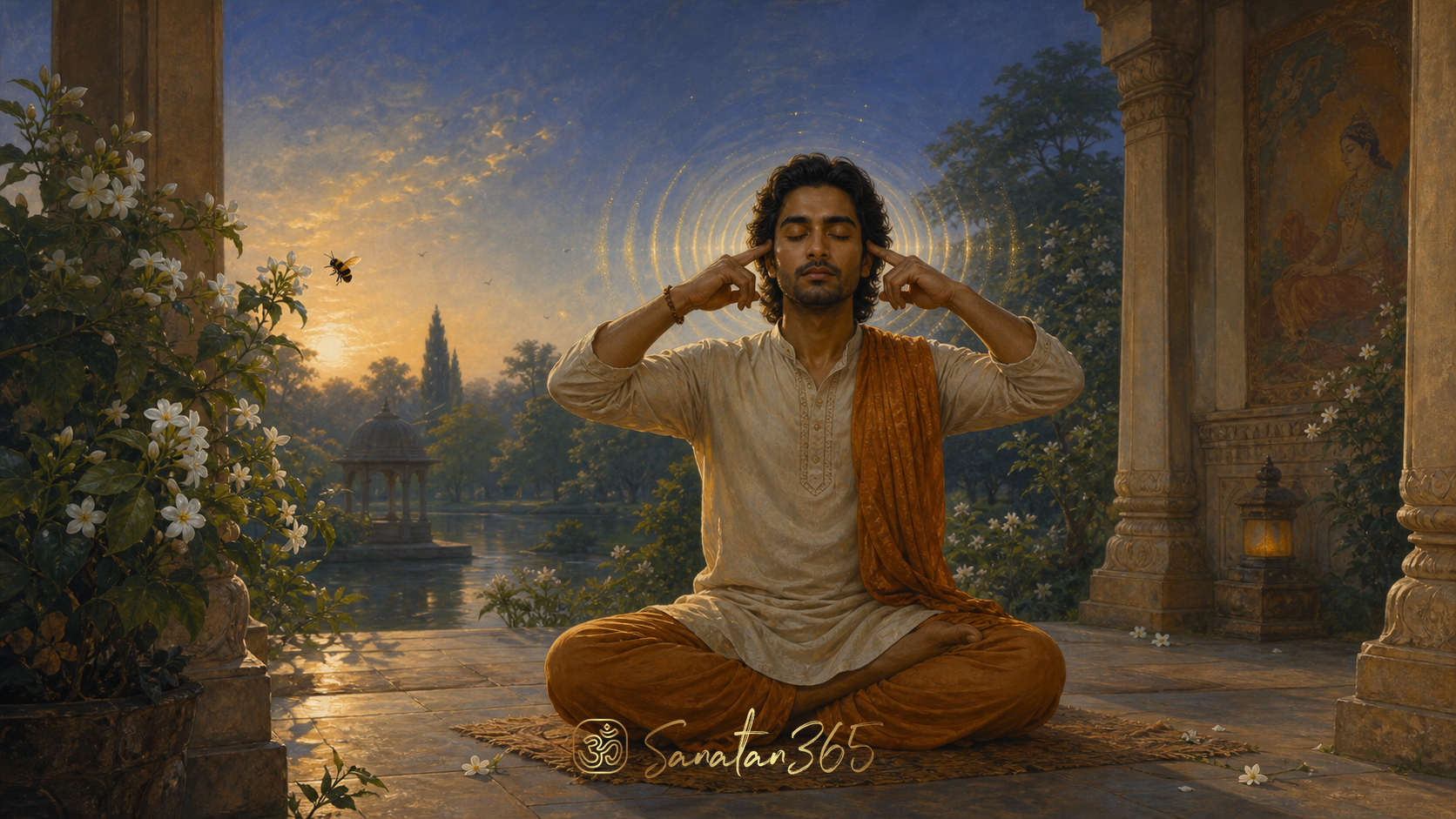
Bhramari Pranayama Meaning: A Careful Guide to Humming Bee Breath
Bhramari Pranayama is the humming bee breath described in the Hatha Yoga tradition. Learn its meaning, classical method, safety limits, and a gentle daily practice.
A single steady hum can make the breath audible without making it forceful. Bhramari Pranayama meaning begins with this simple idea: Bhramari is the “bee-like” yogic breathing practice in which a soft, sustained humming sound accompanies the exhalation. Classical Hatha Yoga texts describe the sound through the image of a bee, while modern practitioners often use a gentle version to gather attention before meditation. It is a contemplative discipline, not a medical treatment or a contest in breath control.
The Sanskrit name combines bhramara (भ्रमर, bee) with prāṇāyāma (प्राणायाम, the yogic regulation or expansion of vital breath). Its most recognisable feature is the resonant hum made with the mouth closed. That vibration gives an unsettled mind one clear object: sound joined to breath.
What Is Bhramari Pranayama Meaning in Yoga?
Bhramari Pranayama is commonly translated as “humming bee breath” because its exhalation resembles the deep, continuous sound of a bee. The practice belongs to the wider discipline of prāṇāyāma, a Sanskrit term formed from prāṇa (प्राण, vital breath or life-energy) and āyāma (आयाम, extension, regulation, or expansion). Pranayama is therefore more than taking large breaths. It is the deliberate refinement of breathing in service of steadiness, attention, and inner discipline.
In Bhramari, the sound is not decoration. The hum gives the exhalation an even pace and makes attention tangible. Instead of chasing many thoughts, the practitioner listens to one unbroken tone and feels its vibration. This can create a natural bridge from outward activity to inward observation.
The bee image also carries a useful practical lesson. A healthy hum is smooth and continuous, never squeezed from the throat. Its quality matters more than its volume. The practice should feel composed enough that the next inhalation arrives comfortably.
Three elements define a gentle beginner form:
- An upright but unstrained posture.
- A quiet inhalation through the nose.
- A soft nasal hum during an easy exhalation.
Some lineages add hand gestures, breath retention, or more advanced internal locks. Those variations should not be treated as mandatory. Beginners can receive the contemplative value of Bhramari without closing the ears, holding the breath, or applying pressure around the face.
Key takeaway: Bhramari is a sound-centred pranayama in which a comfortable humming exhalation helps collect attention.
Where Does the Humming Bee Breath Appear in Classical Texts?
The Haṭha Yoga Pradīpikā (Hatha Yoga Pradipika), a major Sanskrit manual of Hatha Yoga, describes Bhramari in chapter 2, verse 68. Its imagery contrasts two bee-like tones: an inhalation associated with a deeper male-bee sound and an exhalation associated with a gentler female-bee sound. Translations differ in wording, and contemporary beginner teaching often simplifies the technique to quiet nasal inhalation followed by humming exhalation. The enduring principle is sonic continuity rather than theatrical imitation.
The Gheraṇḍa Saṃhitā (Gheranda Samhita), another influential Hatha Yoga text, also presents Bhramari among pranayama methods. Its instructions belong to a premodern discipline with assumptions, preparations, and teacher-guided practices that cannot always be lifted unchanged into a general wellness class. Reading classical sources respectfully means noticing both continuity and context.
This distinction prevents two common errors. The first is claiming that every popular modern variation is exactly what an ancient verse prescribes. The second is dismissing a living practice because it has been adapted for accessibility. Yoga traditions have long included teacher-to-student interpretation. A responsible approach identifies what is classical, what is a later teaching convention, and what is a beginner modification.
The Hatha Yoga Pradipika text and translation allows readers to examine the broader pranayama chapter rather than isolating one verse. For contemporary public guidance, the Government of India’s Ministry of AYUSH provides yoga resources within a modern institutional setting. Neither source replaces individual instruction where health concerns are present.
Bhramari also illustrates a broader Sanatan insight: disciplined sound can orient awareness. Mantra, aarti, Vedic recitation, and devotional singing use sound in different ways, with different purposes and authorities. Bhramari is not itself a mantra. Its hum usually has no verbal sacred formula. Yet it shares the understanding that careful listening can transform the quality of attention. Readers exploring this wider culture of sacred sound may also appreciate Dhyana Shloka as a meditation verse and Japa Mala as a support for mantra repetition.
Key takeaway: Classical texts ground Bhramari in Hatha Yoga, while a careful modern practice should clearly distinguish textual instructions from accessible beginner adaptations.
How Can a Beginner Practise Bhramari Pranayama?
Choose a quiet place where breathing can remain natural. Sit on a chair or cushion with the spine comfortably upright. The hands may rest on the thighs. A practitioner who feels strained sitting cross-legged loses nothing by choosing a chair; steadiness is more valuable than performing a particular shape.
Try this simple sequence:
- Arrive. Let the eyes close softly, or lower the gaze. Notice two or three ordinary breaths without changing them.
- Inhale gently. Breathe in through the nose at a comfortable pace. Avoid drawing the breath to maximum capacity.
- Hum on the exhalation. With lips lightly closed and teeth unclenched, release a smooth “mmm” sound. Let it be low to moderate in volume.
- Pause naturally. Do not hold the breath. Allow the next inhalation to begin when the body asks for it.
- Repeat modestly. Begin with three rounds. If all remains comfortable, continue to five rounds.
- Sit in quiet. After the final hum, rest for several ordinary breaths and observe the remaining sensation of sound.
Keep the face soft. The jaw, tongue, eyes, and shoulders should not brace. The exhalation may become a little longer because sound slows its release, but length should arise without pressure. If the hum breaks, fades, or changes pitch, simply notice it. Musical perfection is irrelevant.
Listening is the heart of the exercise. Some practitioners focus on the audible tone; others notice vibration around the lips, cheeks, throat, or skull. Neither sensation needs to be intensified. Bhramari becomes inward-facing when the practitioner receives the sound instead of merely producing it.
Traditional or studio instruction sometimes uses Śanmukhī Mudrā (षण्मुखी मुद्रा, the “six-gated” gesture), in which fingers are placed around the sensory openings of the face. Pressure on the eyes or ears is unnecessary and should be avoided. Anyone curious about that form should learn it from a qualified teacher who can demonstrate light, accurate placement.
A useful practice rhythm is three to five gentle rounds before seated meditation, scriptural study, or evening prayer. It can also follow a few minutes of ordinary breathing. More rounds are not automatically more beneficial. Consistency, ease, and clear attention make a better measure than quantity.
Key takeaway: Begin with three comfortable humming exhalations, no breath holding, no facial pressure, and a short period of silence afterward.
What Should Practitioners Avoid or Modify?
Breath practices deserve humility because the same instruction can feel different across bodies and circumstances. Bhramari should stop immediately if it causes dizziness, breathlessness, pain, panic, unusual pressure, or worsening discomfort. Return to ordinary breathing and seek appropriate guidance if symptoms persist.
Avoid forcing a very long exhalation, making the hum painfully loud, locking the throat, or competing with another practitioner. Do not practise while driving, bathing, swimming, or doing any activity that requires full external attention. Breath retention and advanced locks should not be added from a short online guide.
People who are pregnant, recovering from surgery, living with respiratory or cardiovascular conditions, prone to fainting, or managing significant ear, sinus, neurological, or mental-health concerns should consult a qualified healthcare professional and an appropriately trained yoga teacher before beginning or modifying pranayama. Spiritual and wellness practices can complement professional care; they do not replace diagnosis or treatment.
Active ear infection, severe nasal congestion, or painful pressure in the head may make humming uncomfortable. In such circumstances, postponing the practice is wiser than pushing through. A person who finds internal sound distressing can choose simple breath observation instead.
Children may enjoy a brief bee-like hum, but an adult should keep it playful, gentle, and free of breath holding. The aim is not to maximise duration. For older adults or anyone with limited breath capacity, one or two quiet rounds may be sufficient.
Online claims sometimes promise that Bhramari will cure a disease, guarantee sleep, or produce a specific neurological outcome. Such guarantees exceed what a responsible spiritual article can say. Research on humming and slow breathing continues, but study conditions, participant groups, and methods vary. The honest claim is simpler: many practitioners use Bhramari as an attention-gathering breath practice, and each person should assess comfort carefully.
Key takeaway: Comfort is the gatekeeper. Stop with adverse symptoms, avoid force and retention, and seek professional guidance when health conditions may affect breathing practice.
How Can Bhramari Support a Daily Spiritual Routine?
Bhramari works best as a threshold practice. It can mark the movement from conversation to prayer, from work to evening reflection, or from reading to meditation. The hum does not need to create a dramatic state. Its purpose can be as modest as making one minute fully attentive.
A simple seven-minute routine might look like this:
- Two minutes of natural breathing.
- Three to five rounds of gentle Bhramari.
- Two minutes of silent sitting.
- A brief prayer, mantra, or study passage according to one’s tradition.
This sequence keeps the technique in proportion. The breathing prepares attention; it does not become an end in itself. Those building a broader contemplative discipline can connect it with Pratyahara and the gathering of the senses or Dharana as yogic concentration. Each practice has its own meaning, but together they show how yoga gradually turns scattered awareness toward steadiness.
It can help to record one observation after practice: “The hum felt easy,” “I strained near the end,” or “Silence felt clearer afterward.” This is not a scorecard. It is svādhyāya (स्वाध्याय, disciplined self-study), the honest observation that keeps practice responsive rather than mechanical.
The deepest lesson of the bee image may be restraint. A bee’s hum is distinctive without being argumentative. Likewise, Bhramari asks the practitioner to create sound and listen at the same time. That paired action can reveal whether effort is coarse or refined, restless or settled.
In a home with others, quiet volume is also an ethical consideration. Practice should not disturb someone sleeping, studying, or praying. Yogic discipline includes sensitivity to context, not only personal technique.
Key takeaway: Use Bhramari as a brief doorway into silence, prayer, or study, and judge progress by ease, awareness, and consistency rather than intensity.
Conclusion
Bhramari Pranayama is a classical humming breath whose accessible form joins a gentle nasal inhalation with a smooth, bee-like exhalation. Its value lies in the meeting of breath, sound, and listening. Practised without strain, it can help a person arrive more fully before meditation or prayer. Practised with force or unrealistic promises, it loses the very steadiness it is meant to cultivate.
Key takeaway: Let the hum be comfortable, the rounds be few, and the silence after them be the real centre of the practice.
FAQ
What is Bhramari Pranayama in simple words?
Bhramari Pranayama is a yogic breathing practice in which a person inhales gently through the nose and makes a soft, steady humming sound while exhaling. Its name refers to the sound of a bee.
How many rounds of humming bee breath should a beginner do?
Three rounds are a sensible beginning. If breathing remains easy and no adverse symptoms appear, a beginner may try up to five gentle rounds. There is no need to hold the breath.
Should the ears be closed during Bhramari?
Not in the simplest beginner form. Some traditions teach a hand gesture around the ears and face, but it should involve no painful pressure and is best learned from a qualified teacher.
Is Bhramari Pranayama a medical treatment?
No. It is a yoga and contemplative practice, not a substitute for medical or mental-health care. Anyone with relevant health concerns should seek professional advice before changing breath practices.
When is a good time to practise Bhramari breathing?
A quiet moment before meditation, prayer, or evening reflection can work well. Practise away from driving and other tasks that require full attention, and stop if discomfort appears.
About the author
Sanatan365 Editorial
Bringing Sanatan Dharma to modern seekers through authentic, scripture-grounded content.
Related in Wellness
 Wellness
Nadi Shodhana Pranayama: Meaning and a Gentle Practice
Nadi Shodhana is alternate-nostril breathing practiced with steady attention. Its deeper yogic purpose is preparing breath and mind for cla…
 Wellness
Shavasana Meaning: Why Corpse Pose Is a Practice of Conscious Rest
Explore Shavasana's meaning in Hatha Yoga, why stillness is not the same as sleep, and how beginners can practise corpse pose with attentio…
 Wellness
Mitahara Meaning: Yoga's Practice of Moderation in Food
Mitahara is the yogic discipline of measured, thoughtful eating. Learn its scriptural roots, what it does and does not require, and how to…