Shavasana Meaning: Why Corpse Pose Is a Practice of Conscious Rest
Explore Shavasana's meaning in Hatha Yoga, why stillness is not the same as sleep, and how beginners can practise corpse pose with attention, comfort, and care.
Shavasana looks like the moment when yoga ends. In practice, it may be the moment when its central lesson becomes hardest to avoid: can the body release effort while awareness remains present?
The Shavasana meaning comes from two Sanskrit words: shava (शव, corpse) and asana (आसन, posture or seat). The familiar English name “corpse pose” can sound severe, but the image is deliberate. A corpse does not brace, perform, grasp, or resist. By lying still, the practitioner rehearses a temporary release of unnecessary effort—not a rejection of life, but a clearer return to it.
The Hatha Yoga Pradipika, a foundational Hatha Yoga text, describes Shavasana in verse 1.32 as lying flat like a corpse and associates it with easing fatigue and calming the mind. That concise instruction contains the posture's paradox: outwardly, almost nothing happens; inwardly, the practitioner learns the difference between collapse and conscious rest.
What Does Shavasana Mean?
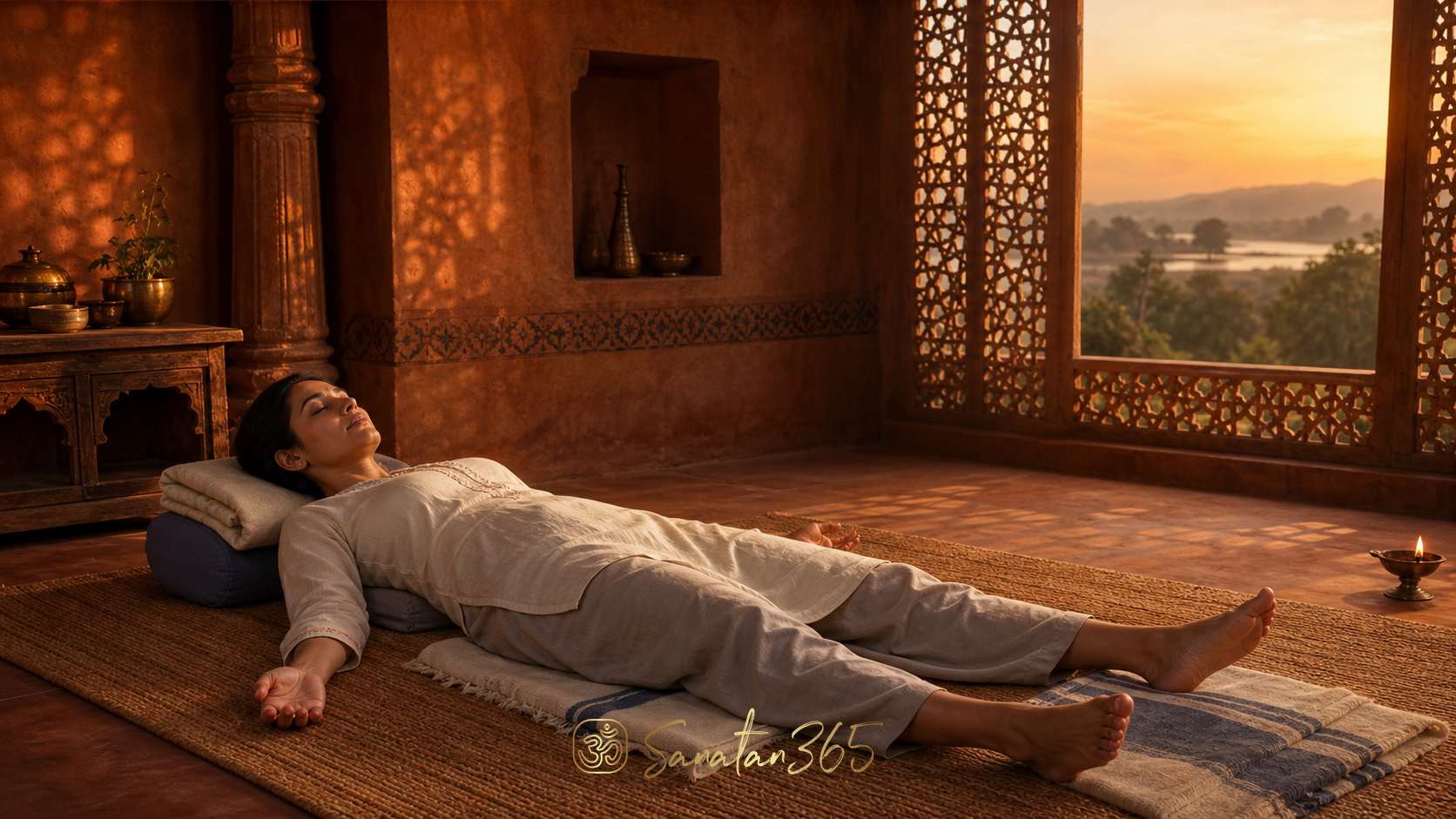
In Shavasana, a person usually lies on the back with the legs comfortably apart, arms resting away from the torso, and palms open. The arrangement matters less than its purpose: the body should feel sufficiently supported that it no longer needs to negotiate with gravity.
The Sanskrit term asana originally carries the sense of a seat or stable posture, not merely an athletic shape. Shavasana makes this especially visible. There is no impressive balance to display and no range of motion to prove. Its work begins when performance ends.
Calling it “corpse pose” invites reflection on impermanence, but the posture should not be forced into one universal philosophical interpretation. Teachers and lineages emphasize different dimensions: recovery after physical practice, sensory settling, integration, meditation, surrender, or preparation for deeper relaxation. These readings can coexist when they remain grounded in the actual discipline of attentive stillness.
Key takeaway: Shavasana is a posture of deliberate release: the body becomes quiet enough for the practitioner to notice what effort, sensation, and awareness are doing.
Why Hatha Yoga Uses the Image of a Corpse
The image of a corpse is uncompromising because it removes ordinary social signals. There is no achievement, possession, title, or appearance to defend. For a few minutes, the practitioner stops arranging the body for usefulness or approval.
This does not make Shavasana morbid. Hindu and yogic traditions repeatedly use remembrance of impermanence to sharpen attention to life. What changes, passes, or cannot be controlled becomes a teacher of discernment. In Shavasana, that insight is physical rather than merely intellectual: muscles soften, breath moves without being commanded, and the floor carries the body's weight.
The pose also reveals how difficult non-doing can be. A person may clench the jaw while believing they are relaxed, rehearse tomorrow's conversations, or become impatient for the next instruction. None of this means the posture has failed. Noticing the impulse to manage every moment is itself part of the practice.
Release is not indifference. When the bell sounds and movement returns, the question is whether a little less grasping can accompany action. Shavasana therefore complements, rather than opposes, disciplined effort. Yoga asks for wholehearted practice and the wisdom to stop adding force when force is no longer useful.
Key takeaway: The corpse image temporarily removes performance and control, allowing stillness to expose habits of tension without condemning them.
Rest Without Sleep: The Inner Skill of Shavasana
Sleep is valuable, and falling asleep in Shavasana is not a moral failure. Yet the posture traditionally points toward a different quality: the body rests while attention stays lightly awake.
That quality can be described as receptive rather than controlling. The practitioner may notice contact with the floor, the natural rhythm of breathing, distant sounds, and changing sensations. There is no need to chase each experience or manufacture a blank mind. Thoughts can arise and pass without becoming a new task.
This is why Shavasana is more than a pause inserted after exercise. A vigorous sequence may make stillness easier to enter, but the final posture integrates more than muscular effort. It lets the nervous system settle gradually, gives the mind a quieter field, and allows the emotional tone of practice to become visible.
Claims about yoga should remain responsible. Shavasana may support relaxation and contemplative awareness, but it is not a guaranteed treatment for insomnia, anxiety, trauma, pain, or any medical condition. Anyone dealing with persistent physical or mental-health symptoms should seek qualified professional care; spiritual and yogic practices may be complementary, not replacements.
Key takeaway: Conscious rest does not require an empty mind. It asks for ease in the body and a gentle willingness to remain present.
How to Practise Shavasana Gently
A simple Shavasana can last five to ten minutes, though the appropriate duration depends on context, comfort, and guidance. Beginners can use this sequence:
- Choose a stable surface. Use a yoga mat, folded blanket, or firm carpet where the body feels secure and the temperature is comfortable.
- Lower down without hurry. Sit first, then use the arms to come onto one side and roll onto the back. This avoids turning the transition into a drop.
- Let the legs find space. Move the feet apart only as far as the hips and lower back can comfortably allow. Let the feet fall outward naturally.
- Place the arms with ease. Rest them slightly away from the torso, palms up or in another neutral position that does not strain the shoulders.
- Support what does not settle. A bolster or folded blanket beneath the knees may ease the lower back. A thin support under the head may help if the chin tips upward, but it should not force the neck forward.
- Notice before adjusting. Feel the back of the body meet the ground. Soften the eyes, tongue, jaw, hands, abdomen, and feet without demanding complete relaxation.
- Let breathing be natural. A few slower exhalations may help at first, then release deliberate control unless a trained teacher has given another instruction.
- Return gradually. Deepen the breath, move fingers and toes, bend the knees, roll to one side, pause, and rise with the support of the hands.
People who are pregnant, become breathless when lying flat, experience vertigo, have significant back or neck discomfort, or carry trauma that makes closed-eye stillness distressing should adapt the posture with qualified guidance. Side-lying rest, bent knees, feet on the floor, a chair-supported lower leg position, or keeping the eyes softly open may be more appropriate.
Comfort is not a loophole in the practice. Support makes honest stillness possible. Enduring sharp pain, numbness, panic, or breathing difficulty is not a spiritual achievement; come out of the posture and seek suitable help.
Key takeaway: The best alignment is the one that allows alert ease without pain, strain, breath restriction, or emotional overwhelm.
Common Difficulties and Thoughtful Adjustments
“My mind becomes busier”
Activity may feel louder when outer movement stops. Instead of fighting every thought, return to one simple anchor: the weight of the heels, the touch of the hands, or the sound of natural breathing. The goal is not to win an argument with the mind.
“My lower back feels uncomfortable”
Try bending the knees with feet on the floor or placing a bolster beneath the knees. If discomfort persists, leave the pose. A teacher or healthcare professional can help identify an appropriate alternative.
“I always fall asleep”
Practise earlier in the day, shorten the duration, remove an overly warm covering, or keep the forearms lifted briefly. More importantly, consider whether the body is simply sleep-deprived. Yoga should not romanticize exhaustion.
“Stillness feels unsafe”
Keep the eyes open, remain near a trusted teacher, choose a side-lying position, or use a shorter interval. Trauma-sensitive practice respects choice and orientation to the room. A person may stop at any time.
“I get impatient”
Notice impatience as sensation: heat, tightness, restlessness, or an urge to move. If there is no pain or distress, stay for three more breaths and observe. Gradual capacity is more useful than forced endurance.
Key takeaway: Difficulty in Shavasana is information. Thoughtful adjustment protects the practice from becoming another contest of willpower.
What Shavasana Can Teach Beyond the Yoga Mat
Modern life often treats rest as preparation for more output. Shavasana offers a subtler possibility: rest has dignity even when it produces nothing measurable.
That does not mean withdrawing from responsibility. The posture can sharpen the rhythm between effort and release. A person who never rests may become careless, reactive, or numb; a person who avoids necessary effort cannot call avoidance surrender. Yoga asks for discernment between the two.
One practical way to carry Shavasana into daily life is to place a brief pause after completion. When a work task ends, let the hands rest for three breaths before opening another tab. After a difficult conversation, feel the feet on the floor before composing a reply. At bedtime, release the face and shoulders without demanding immediate sleep. These are not substitutes for the full posture, but they preserve its lesson: an ending deserves to be felt.
The posture also unsettles the idea that stillness is empty. When unnecessary movement quiets, sensation, memory, gratitude, and vulnerability may become clearer. The practitioner learns to receive that clarity without turning it into drama.
Shavasana ends by returning. Fingers move, knees bend, the body turns, and a person sits up again. Its wisdom lies in that return. Temporary surrender does not erase individuality or duty; it loosens the grip with which they are carried.
Key takeaway: Shavasana teaches a living rhythm—act fully, release honestly, and return with less unnecessary tension.
Frequently Asked Questions
Is Shavasana the same as meditation?
Shavasana is an asana that can support meditative awareness, but the terms are not identical. Its primary form is a supported supine posture; meditation includes many methods and positions.
How long should a beginner stay in Shavasana?
Five to ten minutes is common, but even two or three attentive minutes can be worthwhile. Comfort, context, and appropriate guidance matter more than reaching a fixed number.
Is it wrong to fall asleep in corpse pose?
No. Sleep may reveal genuine fatigue. The intended skill, however, is relaxed wakefulness, so a rested practitioner may experiment with shorter duration or softly open eyes.
Can Shavasana be practised by itself?
Yes, it can be used as a brief practice of supported stillness. Enter and leave gradually, use props as needed, and do not treat it as medical care.
Why is Shavasana usually placed at the end of yoga?
It gives effort time to settle and lets the physical, mental, and emotional effects of practice become integrated before ordinary activity resumes.
Sources and Further Reading
- Hatha Yoga Pradipika, 1.32, consulted in established Sanskrit editions and translations.
- Ministry of AYUSH, Government of India, Common Yoga Protocol.
- Encyclopaedia Britannica, Yoga.
- Georg Feuerstein, The Yoga Tradition, for historical and philosophical context.
Shavasana is simple enough to describe in one sentence and subtle enough to practise for a lifetime. Lie down. Let the ground carry what it can. Remain present. Then rise—not as someone who escaped life, but as someone who has briefly stopped gripping it.
About the author
Sanatan365 Editorial
Bringing Sanatan Dharma to modern seekers through authentic, scripture-grounded content.
Related in Wellness
 Wellness
Sukhasana Meaning: Finding Ease in a Supported Seat
Sukhasana is a simple cross-legged yoga seat, not a test of flexibility. Learn its meaning, practical supports and the value of choosing st…
 Wellness
Tadasana Meaning: Mountain Pose and the Art of Standing Well
Why a simple standing posture deserves careful attention, how Mountain Pose differs from the raised-arm Palm Tree version, and how to pract…
 Wellness
Nadi Shodhana Pranayama: Meaning and a Gentle Practice
Nadi Shodhana is alternate-nostril breathing practiced with steady attention. Its deeper yogic purpose is preparing breath and mind for cla…

