Brahmacharya Meaning: Disciplined Energy for Modern Hindu Life
Brahmacharya is often reduced to celibacy, but Hindu and yogic traditions frame it more deeply as disciplined energy, self-mastery, and the wise direction of attention.
A person can waste energy without doing anything visibly wrong.
Brahmacharya meaning begins with brahmacharya (ब्रह्मचर्य, disciplined movement toward Brahman or sacred self-mastery): the wise direction of body, speech, senses, attention, and desire toward dharma. It is often translated as celibacy, and celibacy is part of its traditional meaning in certain life stages and vows. But in Hindu and yogic practice, brahmacharya is also a larger discipline of conserving life force, protecting clarity, and refusing to let impulse rule the mind.
For modern seekers, this makes brahmacharya practical rather than remote. It asks a simple daily question: where is one's energy going, and does that direction make the person more truthful, steady, loving, and spiritually awake?
What Is Brahmacharya Meaning in Hindu Life?
The word brahmacharya is usually explained from two parts: Brahman (ब्रह्मन्, the ultimate reality or sacred truth) and charya (चर्या, conduct, movement, or way of living). In that sense, brahmacharya is not merely the absence of indulgence. It is conduct that moves toward the sacred.
In Patanjali's Yoga Sutras, brahmacharya appears as one of the five yamas (यम, ethical restraints): ahimsa (अहिंसा, non-harming), satya (सत्य, truthfulness), asteya (अस्तेय, non-stealing), brahmacharya, and aparigraha (अपरिग्रह, non-grasping). The Yoga Sutra Study resource lists this sequence in Yoga Sutra 2.30, placing brahmacharya among the foundational disciplines of yoga rather than treating it as an optional moral extra Yoga Sutra 2.30.
Traditional Hindu life also uses brahmacharya as the name of the student stage in the ashrama (आश्रम, life-stage discipline) system. Britannica describes ashrama as a Hindu framework of life stages, beginning with the student period and moving through household, retirement, and renunciation Britannica, Ashrama. In that older setting, the student learned restraint, service, study, memorization, humility, and disciplined conduct under a teacher. Readers who want the wider life-stage context can also see Grihastha Ashrama Meaning: Householder Dharma in Hindu Life.
These two meanings belong together. As a life stage, brahmacharya protects learning. As a yama, it protects spiritual force. In both cases, the core is not repression. The core is reverent direction.
Key takeaway: Brahmacharya is best understood as sacred discipline: the art of directing one's energy toward truth, learning, devotion, and inner steadiness.
Why Is Brahmacharya More Than Celibacy?
Celibacy matters in many traditional contexts. Students, renunciants, and certain vow-based practitioners may understand brahmacharya as strict abstinence. That meaning should not be erased. But reducing brahmacharya only to celibacy can make the teaching feel either impossible for householders or irrelevant to everyday life.
Hindu tradition has always recognized different duties for different stages of life. A grihastha (गृहस्थ, householder) has family, work, social responsibility, and often marriage. For such a person, brahmacharya cannot mean rejecting the householder path. It means living that path with restraint, fidelity, dignity, and clear boundaries.
This is why many teachers explain brahmacharya as wise use of energy. The senses are not enemies; they are powerful instruments. Desire is not automatically sinful; it becomes harmful when it rules judgment. Pleasure is not the problem; unconscious slavery to pleasure is the problem. The ethical foundation connects closely with Yama and Niyama Meaning: Yoga's Ethical Foundation for Daily Life. Brahmacharya asks the seeker to bring awareness into the places where energy leaks:
- Compulsive scrolling that leaves the mind restless.
- Speech that wastes force through gossip, complaint, or exaggeration.
- Consumption that promises comfort but creates dullness.
- Relationships that use attention without responsibility.
- Ambition that burns the body while calling itself productivity.
For a modern Hindu household, this interpretation is demanding but livable. It does not ask every person to become a monk. It asks every person to become honest about what weakens the will and what strengthens it.
Key takeaway: Brahmacharya includes celibacy in specific contexts, but for many householders it means faithful, disciplined, and dharmic use of desire, attention, and life force.
How Do the Yoga Sutras Explain Brahmacharya?
Patanjali gives brahmacharya a striking result. Yoga Sutra 2.38 is commonly translated to mean that when one is established in brahmacharya, virya (वीर्य, vigor, strength, or spiritual potency) is gained. The Sanskrit aphorism is brief, but the implication is deep: scattered energy weakens; disciplined energy gathers force Yoga Sutra 2.38.
This does not need to be read as a crude promise of power. In yoga, virya can be understood as the strength to continue practice, the courage to resist lower impulses, and the vitality to live with purpose. A person established in brahmacharya becomes less divided. Thought, speech, habit, and action begin to support the same aim.
That is why brahmacharya belongs among the yamas. It is ethical before it is mystical, and it prepares the deeper limbs explained in Ashtanga Yoga Meaning: Patanjali's Eight Limbs of Inner Discipline. The practice asks:
- Is this action using another person for my desire?
- Is this habit making my mind clearer or more agitated?
- Is this pleasure leaving gratitude or craving behind?
- Is this relationship protected by responsibility?
- Is this use of attention worthy of the life I have been given?
The Yoga Sutras place these questions before advanced meditation because an unsettled life produces an unsettled mind. If attention is trained all day toward distraction, the mind cannot become still simply because the person sits on a mat. If speech is undisciplined, inner silence becomes fragile. If desire constantly overrides judgment, spiritual insight remains unstable.
Brahmacharya therefore prepares the ground for meditation. It reduces noise at the source.
Key takeaway: In the Yoga Sutras, brahmacharya gathers strength by reducing inner division and training energy to serve practice.
What Does Brahmacharya Look Like for Householders?
For householders, brahmacharya is not a rejection of family life. It is the purification of family life. The discipline becomes visible in how a person loves, works, speaks, eats, rests, studies, and uses digital attention.
In marriage or committed partnership, brahmacharya can mean fidelity, tenderness, respect for consent, and refusal to treat another person as an object. In parenting, it can mean modeling restraint instead of preaching it. In work, it can mean ambition without addiction to recognition. In devotion, it can mean keeping some energy reserved for japa, puja, study, and service rather than giving the whole day to noise.
One useful householder practice is to define sacred boundaries:
- Morning boundary: begin with prayer, silence, or scripture before entering the phone.
- Speech boundary: avoid gossip and unnecessary complaint for one chosen window each day.
- Consumption boundary: choose simplicity in food, media, and spending on at least one day each week.
- Relationship boundary: protect loyalty, privacy, and respectful conduct.
- Night boundary: close the day without feeding the mind restless images.
These practices are not meant to create pride. They are meant to create space. Brahmacharya is weakened when discipline becomes ego. A person who boasts of restraint may still be ruled by self-image. A person who quietly protects attention, honors commitments, and returns to prayer after failure may be closer to the heart of the teaching.
Key takeaway: Householder brahmacharya is disciplined love: faithful relationships, clean attention, measured consumption, and enough inner space for worship and wisdom.
Why Does Brahmacharya Matter in Digital Life?
The modern world monetizes distraction. Every app, advertisement, feed, and notification competes for the same inner resource that brahmacharya protects: attention. In earlier settings, a student may have struggled with laziness, sensual distraction, pride, or scattered study. The modern seeker faces the same human tendencies, but delivered through devices that never sleep.
This makes brahmacharya unusually relevant. The question is no longer only whether one controls physical desire. It is also whether one can protect the mind from endless stimulation.
A digital brahmacharya practice may include:
- Keeping the phone outside the prayer or meditation space.
- Avoiding content that inflames envy, lust, anger, or comparison.
- Choosing one period of the day for deep work or study without notifications.
- Practicing mauna (मौन, sacred silence) for a short window before sleep.
- Replacing one passive media habit with japa, walking, reading, or seva.
This is not anti-technology. It is pro-sovereignty. Technology can serve dharma when it is used deliberately. It becomes a problem when it trains the senses to expect constant novelty and the mind to fear quiet.
In the diaspora, this discipline can be especially helpful. Many seekers balance long work hours, family expectations, cultural distance, and digital overstimulation. Brahmacharya gives them a practical way to preserve spiritual identity without needing an ideal environment.
Key takeaway: Digital brahmacharya means using technology without letting technology own attention, emotion, and desire.
How Can Someone Begin Brahmacharya Gently?
Brahmacharya should begin with honesty, not harshness. Extreme vows taken from guilt often collapse quickly. A steadier path is to notice where energy leaks and choose one repair.
Start with a seven-day self-audit:
- Where do I feel most drained after seeking pleasure?
- Which habit makes my prayer or meditation weaker?
- Which relationship needs more dignity or clearer boundaries?
- Where does my speech waste energy?
- What one daily practice restores strength?
Then choose one vow that is specific and humane. For example: no phone for the first 20 minutes after waking; no gossip at lunch; no late-night scrolling; one mala of mantra before entertainment; one evening walk without headphones; one weekly act of seva before personal leisure.
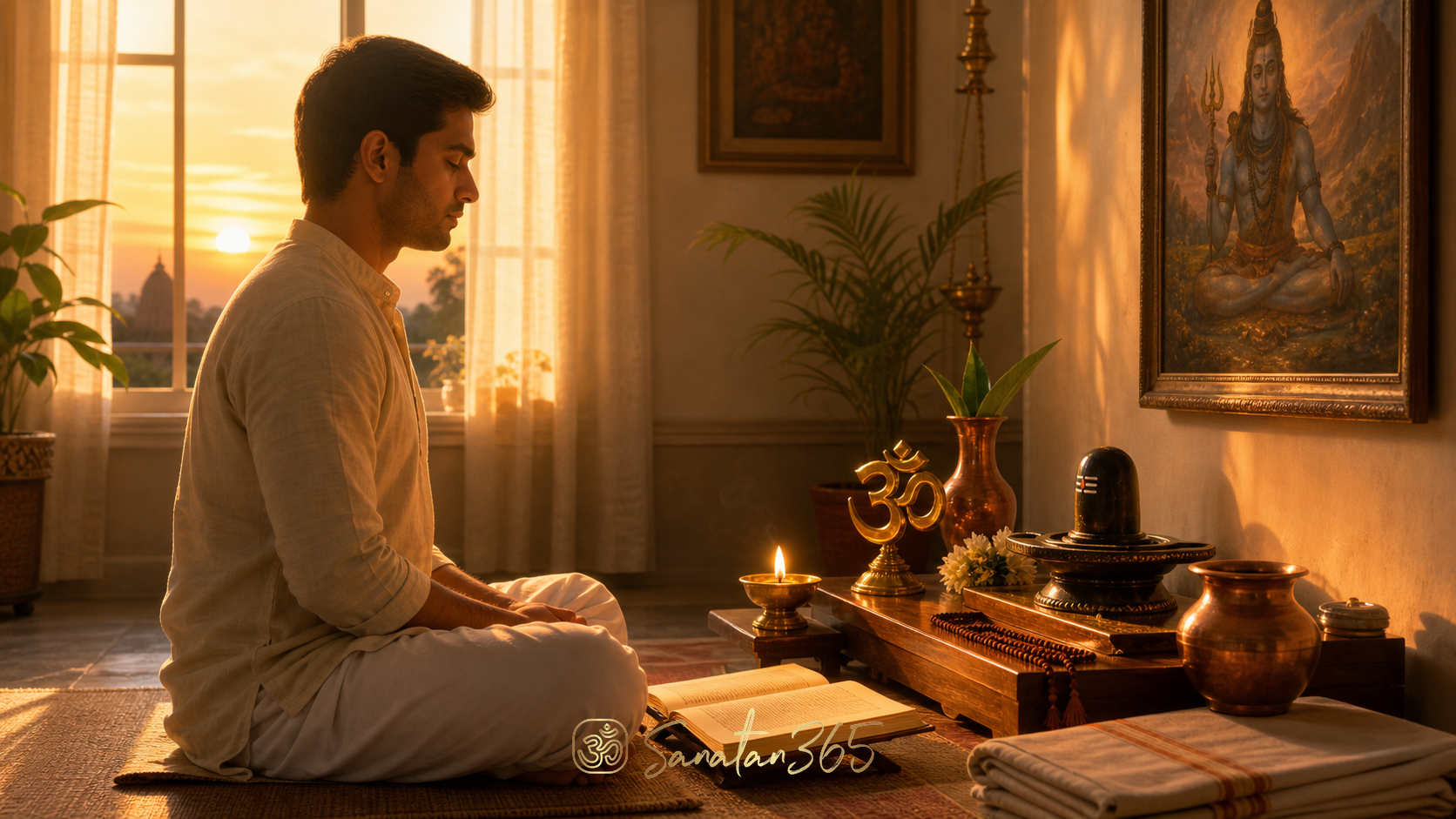
The vow should be small enough to keep and meaningful enough to teach. When it breaks, the seeker should return without drama. In Hindu practice, discipline is strengthened by repetition, humility, and grace. Shame rarely produces purity; steady remembrance does.
It also helps to pair restraint with a higher joy. If a person only removes a habit, the mind may feel deprived. If the person replaces it with chanting, study, exercise, creative work, family presence, or temple time, energy finds a better channel. Brahmacharya is not emptiness. It is redirection.
Key takeaway: Begin brahmacharya with one honest, sustainable vow that protects energy and gives the mind a higher place to rest.
Conclusion
Brahmacharya is not a rejection of life. It is the discipline of giving life its highest direction. The practice becomes real when energy stops leaking into compulsion and begins flowing toward truth, love, study, worship, and service.
Key takeaway: Brahmacharya makes modern life more sacred by teaching the seeker to protect energy and offer it back to dharma.
FAQ
What is the simplest Brahmacharya meaning?
Brahmacharya means disciplined conduct that directs one's energy toward the sacred. It can include celibacy, especially for students, renunciants, or vow-based practitioners, but its wider meaning is self-mastery over desire, attention, speech, and habit.
Is Brahmacharya only for monks?
No. Monks and renunciants may practice strict celibacy, but householders can practice brahmacharya through fidelity, moderation, clean media habits, responsible relationships, and daily spiritual discipline.
What does Brahmacharya mean in the Yoga Sutras?
In the Yoga Sutras, brahmacharya is one of the five yamas, or ethical restraints. Yoga Sutra 2.38 teaches that when brahmacharya is firmly established, strength or vitality arises.
Can married people practice Brahmacharya?
Yes. For married people, brahmacharya can mean loyalty, restraint, mutual respect, mindful intimacy, and not allowing desire to harm dharma, dignity, or spiritual practice.
How do beginners practice Brahmacharya today?
Beginners can start with one clear boundary: protect the first minutes of the morning, reduce one draining digital habit, avoid gossip, keep a short daily mantra practice, or create a respectful relationship boundary.
About the author
Sanatan365 Editorial
Bringing Sanatan Dharma to modern seekers through authentic, scripture-grounded content.