Chidambaram Nataraja Temple: Where Shiva Dances as Space
Explore the meaning of Chidambaram Nataraja Temple, its vision of Shiva as cosmic dancer, the Akasha element, sacred architecture, and respectful pilgrimage practice.
A temple can reveal the Divine through an image, a mantra, or a flame. Chidambaram Nataraja Temple adds a startling fourth language: space itself.
At Chidambaram in Tamil Nadu, Lord Shiva is worshipped as Nataraja, the Lord of Dance, and as akasha (आकाश, space or ether), the subtlest of the five elements. The temple brings visible form and sacred emptiness into one vision. Its bronze dancer expresses ceaseless divine activity; the sanctum’s association with unbounded space points to the consciousness in which all activity appears. Chidambaram therefore asks a profound question: what if the universe is not a machine set in motion long ago, but a sacred rhythm occurring within awareness now?
Why Is Chidambaram Nataraja Temple Sacred?
The Chidambaram Nataraja Temple is sacred because it joins several living streams of Hindu tradition: Tamil Shaiva devotion, the theology of Shiva’s cosmic dance, the elemental symbolism of akasha, temple ritual, sacred architecture, music, and classical dance. Its older name, Thillai, recalls the tillai mangrove trees historically associated with the region. In Tamil Shaiva usage, devotees often call it simply Kovil (கோவில், “the Temple”), a sign of its singular place in memory and worship.
The complex is one of the Pancha Bhuta Sthalas (पञ्चभूत स्थल, five elemental sacred places), a group of South Indian Shiva temples traditionally related to earth, water, fire, air, and space. Chidambaram corresponds to akasha. This does not mean the temple merely labels Shiva with a natural substance. Space is the condition that allows every form to arise without itself being limited to any one form. In the same way, consciousness makes experience possible while remaining more spacious than a single thought, emotion, or identity.
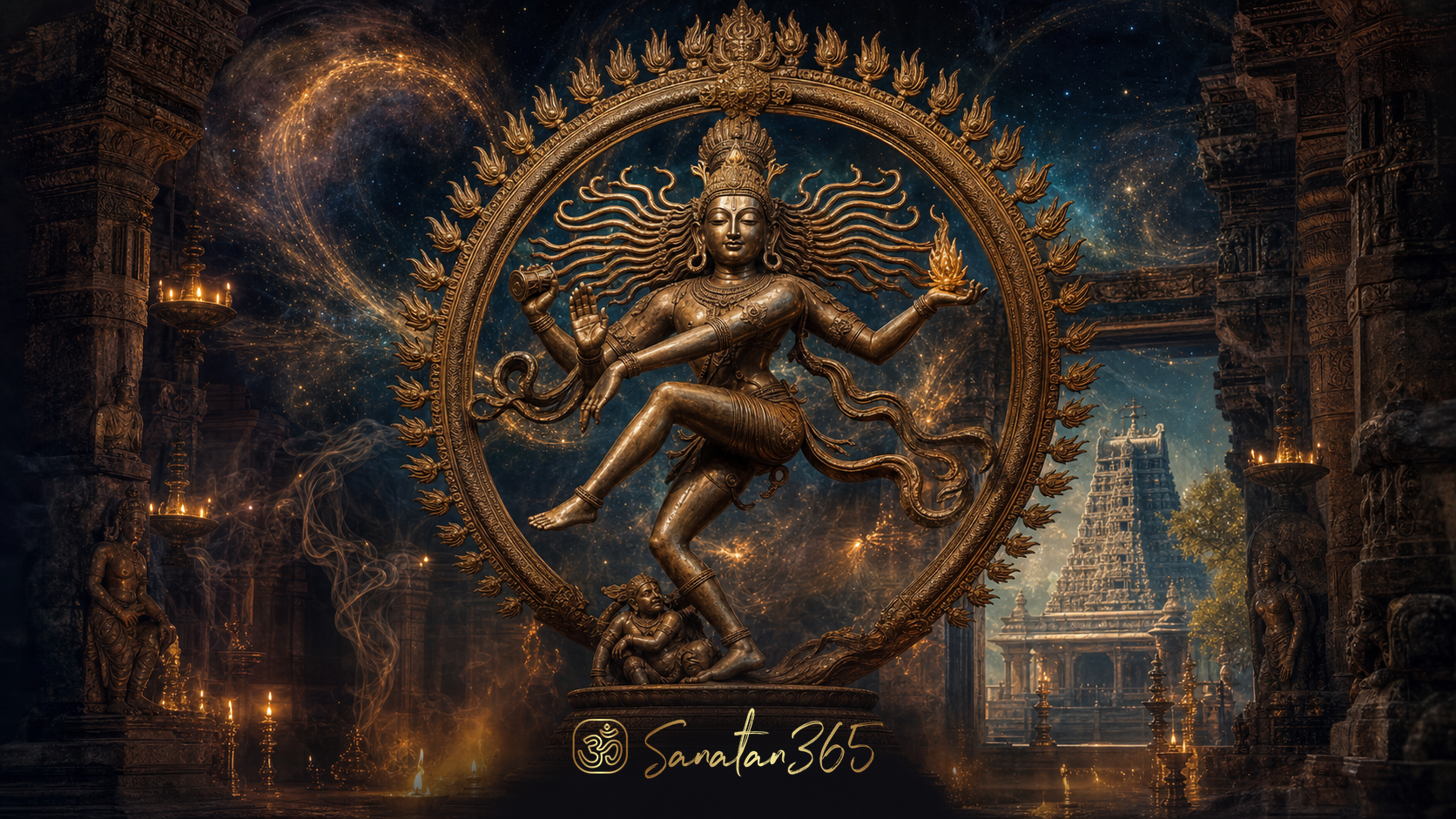
The temple’s central devotional form is Nataraja, Shiva dancing within a circle of flame. Major museum collections explain the mature Chola Nataraja image through a precise symbolic grammar: the drum evokes creation, fire dissolution, one hand offers reassurance, and the lifted foot promises release. The figure does not divide creation and destruction into enemies. Both belong to one rhythm. The Metropolitan Museum of Art’s account of Shiva as Lord of Dance provides a careful introduction to this iconography.
Key takeaway: Chidambaram is sacred not because it chooses form over formlessness, but because it teaches devotees to encounter both together.
What Does Nataraja’s Cosmic Dance Mean?
Nataraja’s dance is often called ananda tandava (आनन्द ताण्डव, the dance of bliss). “Bliss” here should not be reduced to a pleasant mood. It suggests the fullness of reality expressing itself through movement without losing its underlying wholeness.
The image can be read through five divine activities, commonly described in Shaiva thought:
- Srishti (सृष्टि, manifestation or creation): the drum marks the emergence of rhythm, time, and form.
- Sthiti (स्थिति, sustaining): the poised balance of the dance holds the cosmos in order.
- Samhara (संहार, dissolution): the flame shows that every conditioned form changes and ends.
- Tirobhava (तिरोभाव, concealment): limited perception can hide the deeper nature of reality.
- Anugraha (अनुग्रह, grace): the raised foot and assuring hand point toward freedom.
Under Shiva’s foot lies Apasmara, a dwarf-like figure associated with forgetfulness or contracted awareness. The image is not permission to despise ignorance in other people. It is a mirror held before one’s own confusion. Knowledge becomes liberating when vanity, distraction, and false certainty no longer command the centre.
The front hand forms abhaya mudra (अभय मुद्रा, gesture of fearlessness), a sign of reassurance that also appears across Hindu sacred art. Readers can explore its wider meaning in this guide to Abhaya Mudra. The gesture matters because the cosmic dance is otherwise overwhelming: worlds arise, endure, and pass. Shiva’s hand says that change need not end in despair when awareness rests in the sacred ground beneath change.
Ananda Coomaraswamy’s influential essay “The Dance of Shiva” helped international readers see Nataraja as a theological and philosophical image rather than decorative sculpture. Yet no essay replaces the living devotional context. In Chidambaram, Nataraja is not merely an idea about physics, energy, or aesthetics. He is worshipped as Bhagavan, the Divine Lord, through daily ritual, festival, music, and intimate prayer.
Key takeaway: Nataraja’s dance holds creation, continuity, transformation, concealment, and grace within a single sacred movement.
Why Does Chidambaram Represent Akasha, or Space?
Among the five elements, akasha is difficult to picture. Earth has weight, water flows, fire shines, and air moves. Space seems to be “nothing,” yet without it no object can appear and no sound can travel. Hindu philosophical traditions use the term in different technical ways, so it should not be forced into one simplistic definition. At Chidambaram, its devotional power lies in spaciousness, subtlety, and the presence that cannot be confined to an object.
The temple’s famous Chidambara Rahasyam (चिदम्बर रहस्यम्, “the secret of Chidambaram”) is approached within a living ritual tradition. Popular explanations associate it with the worship of the formless Divine through a curtained sacred space near the manifest image of Nataraja. Visitors should resist treating it as a puzzle to expose or a tourist secret to photograph. Rahasya can mean a sacred mystery received through reverence, not merely concealed information.
The name “Chidambaram” is commonly interpreted through chit or chid (चित्, consciousness) and ambaram (अम्बरम्, space or atmosphere): the “space of consciousness.” Etymological explanations vary in devotional and scholarly sources, but the spiritual interpretation is clear. The outer temple invites an inner recognition: awareness contains sensations, memories, fears, and hopes, yet is not exhausted by any of them.
This pairing changes how one sees the sanctum:
- Nataraja is manifest beauty, movement, relation, and divine personality.
- Akasha suggests immeasurable presence beyond the limits of one image.
- Worship honours the manifest without claiming that the Infinite is confined.
- Silence does not oppose music and dance; it gives them room to be heard.
The symbolism also guards against a common misunderstanding. “Formless” does not mean empty of devotion, while “form” does not mean philosophically shallow. Hindu worship can approach the Divine as saguna (सगुण, with attributes) and nirguna (निर्गुण, beyond attributes) without requiring devotees to erase one in favour of the other.
Key takeaway: Chidambaram’s Akasha symbolism turns apparent emptiness into an invitation to recognise all-pervading sacred presence.
How Does the Temple’s Architecture Teach Through Movement?
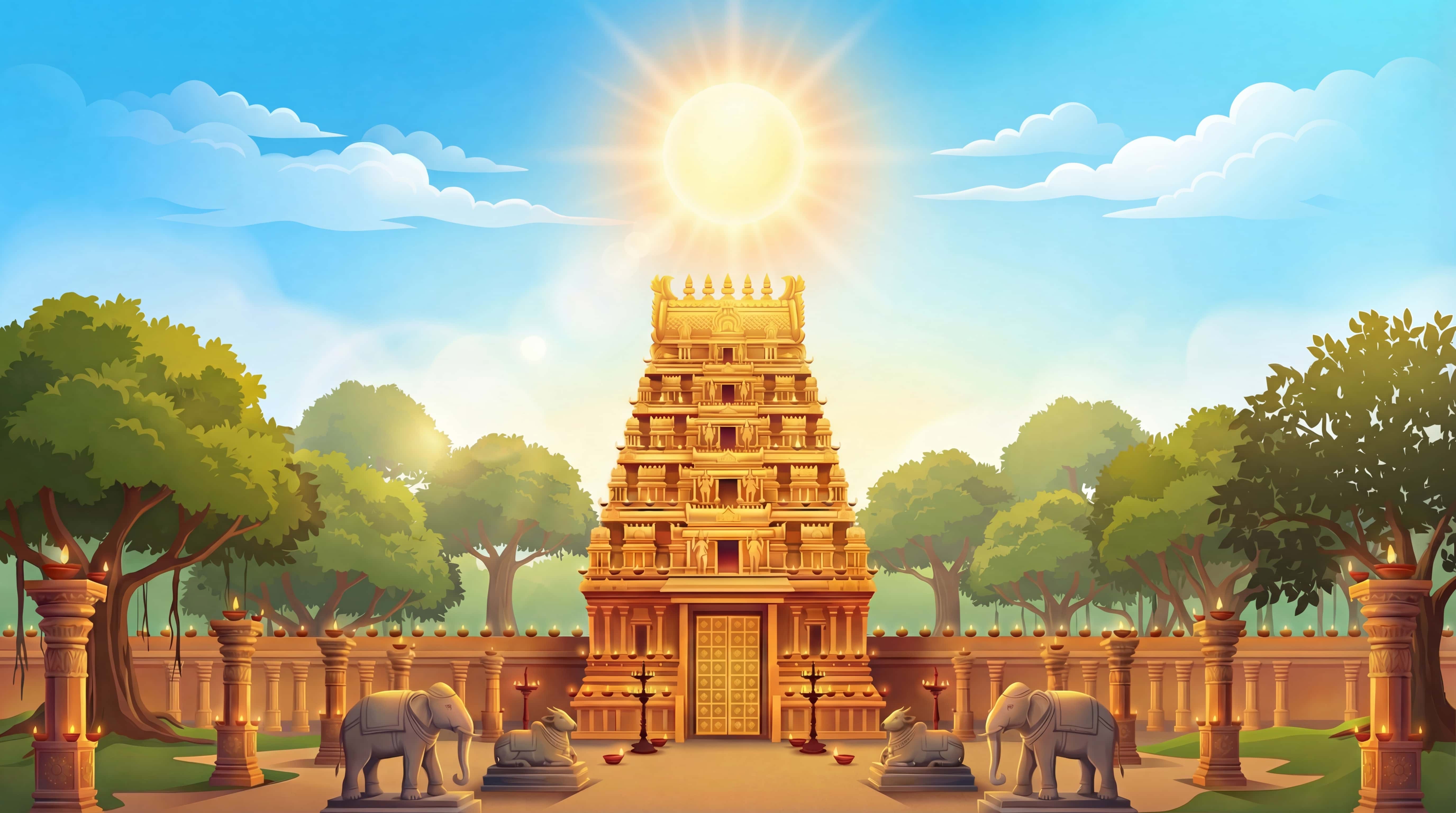
Chidambaram was shaped over centuries rather than completed as one frozen monument. Royal patronage, priestly service, artisan knowledge, festival use, and community devotion all contributed to the complex. Its monumental gopurams (गोपुरम्, gateway towers) announce entry into sacred space, while successive courts guide the visitor from the scale of the town toward the intimacy of the sanctum.
The gateways are especially important to the relationship between temple and dance. Sculpted panels represent the karanas (करण, coordinated units of classical dance movement) described in the Natya Shastra. Scholarship by James C. Harle and later art historians has examined the architecture and iconography of these Chidambaram gateways in detail. The carvings are not a stone instruction manual in the modern sense; they demonstrate how bodily movement, sacred narrative, and architectural surface can belong to one devotional world.
Several temple halls contribute distinct layers of experience. Their traditional names, histories, and ritual functions are best learned from qualified temple sources, because simplified travel summaries often mix symbolism with later speculation. What is unmistakable is the choreography of pilgrimage itself:
- The devotee crosses a threshold.
- The gaze adjusts from bright exterior space to layered enclosure.
- The body moves through corridors, courts, and queues.
- Sound changes from town noise to bells, chants, and footfall.
- The approach culminates not in possession of an object, but in darshan (दर्शन, sacred seeing and being seen).
This is architecture as spiritual discipline. It slows attention. It makes the body participate. It teaches that insight is not always obtained by standing outside and analysing; sometimes it comes through a respectful sequence of approach, waiting, seeing, and stepping back.
Chidambaram’s association with dance remains alive in public imagination and festival culture. Classical performers frequently understand Nataraja as the divine source and witness of movement. This connection should not be flattened into the claim that one modern dance form began in one building at one date. The history of South Indian performance is richer and more distributed. The temple instead stands as one of its most powerful sacred centres.
Key takeaway: Chidambaram’s architecture teaches through the pilgrim’s moving body, turning entry, waiting, seeing, and silence into parts of worship.
What Is the Story of Patanjali and Vyaghrapada at Chidambaram?
Temple tradition links Chidambaram with two sages who longed to witness Shiva’s blissful dance: Patanjali and Vyaghrapada. Patanjali is depicted with a serpent-associated lower form in sacred iconography. Vyaghrapada, whose name means “tiger-footed,” is said to have received tiger-like feet and keen sight so he could gather pristine flowers for worship without harming them or allowing insects to touch them first.
Their story is less about supernatural novelty than the quality of attention brought to worship. Vyaghrapada’s transformed limbs express devoted care; Patanjali represents disciplined knowledge and practice. Together, they wait for a vision that cannot be demanded. Shiva’s dance appears as grace, yet the sages prepare themselves through sustained devotion.
This pattern offers a practical teaching:
- Prepare carefully. Sacred attention is strengthened through order and sincerity.
- Do not confuse preparation with control. Grace is not manufactured by technique.
- Let knowledge and devotion cooperate. Study without reverence can become dry; feeling without discernment can become unstable.
- Receive, then release. Darshan is not a possession or proof of superiority.
The story also helps explain why Chidambaram cannot be understood only through architecture or only through abstract philosophy. It is a place of encounter. Texts, images, priests, dancers, pilgrims, and local memory all contribute to the temple’s meaning, but the centre remains Shiva’s gracious dance.
Key takeaway: Patanjali and Vyaghrapada model disciplined preparation without entitlement to spiritual experience.
How Can Pilgrims Visit Chidambaram Respectfully?
Chidambaram is an active temple, not an archaeological set. Customs, access rules, schedules, and festival arrangements can change. Pilgrims should verify current guidance through official or reliable local sources before travelling, particularly during Arudra Darshan, Ani Thirumanjanam, or other crowded observances.
A respectful visit can follow six principles:
- Dress and behave for worship. Modest clothing, a quiet voice, and patient movement honour the temple community.
- Follow current photography rules. Never assume that a phone may be used near a sanctum or ritual.
- Accept access boundaries. Different areas may have specific customs; argument at the threshold is not spiritual inquiry.
- Avoid intrusive “secret hunting.” Approach Chidambara Rahasyam as sacred tradition, not content bait.
- Make offerings responsibly. Follow temple guidance and avoid wasteful materials.
- Leave room for local devotees. A visitor’s curiosity should not obstruct someone else’s daily worship.
Those unable to travel can still contemplate Chidambaram’s central teaching. Sit quietly for a few minutes. Notice sound emerging into silence and fading back into it. Observe thoughts as movements within awareness. This is not a substitute for temple ritual, initiation, or a teacher’s guidance. It is a simple reflection: every inner event needs “space” to appear.
Devotees drawn to Shiva worship may also read about Jalabhishek and the offering of water to the Shiva lingam. For a complementary reflection on sacred mystery and intellectual humility, the Nasadiya Sukta’s questioning vision of creation offers another doorway.
Key takeaway: Respectful pilgrimage seeks darshan, follows living temple customs, and refuses to turn sacred mystery into spectacle.
Conclusion
Chidambaram Nataraja Temple makes a daring spiritual claim through image, space, sound, and movement. Reality is not spiritually meaningful only when it becomes still. Shiva dances. Forms arise and dissolve. The devotee is invited to recognise the fearless awareness within which the dance unfolds.
The bronze Nataraja and the symbolism of Akasha do not cancel one another. One reveals the splendour of the Divine in form; the other refuses to imprison the Infinite within form. Between them stands the pilgrim, learning to see activity without losing stillness, and mystery without abandoning devotion.
Key takeaway: Chidambaram teaches that the Divine is present both as the dance of existence and as the boundless consciousness that gives every movement room to arise.
FAQ
What is special about Chidambaram Nataraja Temple?
Chidambaram uniquely centres Shiva as Nataraja, the Lord of Dance, while also representing akasha, or space, among the five elemental Shiva temples. Its devotional life joins sacred dance, Tamil Shaiva tradition, temple architecture, ritual, and the mystery of consciousness.
What is the meaning of Chidambara Rahasyam?
Chidambara Rahasyam means the “secret” or sacred mystery of Chidambaram. It is commonly associated with the formless, all-pervading presence of Shiva represented through sacred space near the manifest image of Nataraja. It should be approached reverently within living temple tradition, not treated as a spectacle.
Why is Shiva shown dancing as Nataraja?
Nataraja’s dance expresses the divine activities of manifestation, sustaining, dissolution, concealment, and grace. The image shows change not as chaos outside the Divine, but as a rhythm held within sacred order and consciousness.
Which element does Chidambaram Temple represent?
Chidambaram represents akasha (space or ether) in the Pancha Bhuta Sthala tradition. Space symbolises subtle, unbounded presence and the field in which forms and experiences appear.
When are the major festivals at Chidambaram?
Arudra Darshan and Ani Thirumanjanam are among the major observances associated with Nataraja at Chidambaram. Dates follow the Hindu and Tamil calendars and vary by year, so pilgrims should verify the current temple schedule before travel.
About the author
Sanatan365 Editorial
Bringing Sanatan Dharma to modern seekers through authentic, scripture-grounded content.
Related in Temples
 Temples
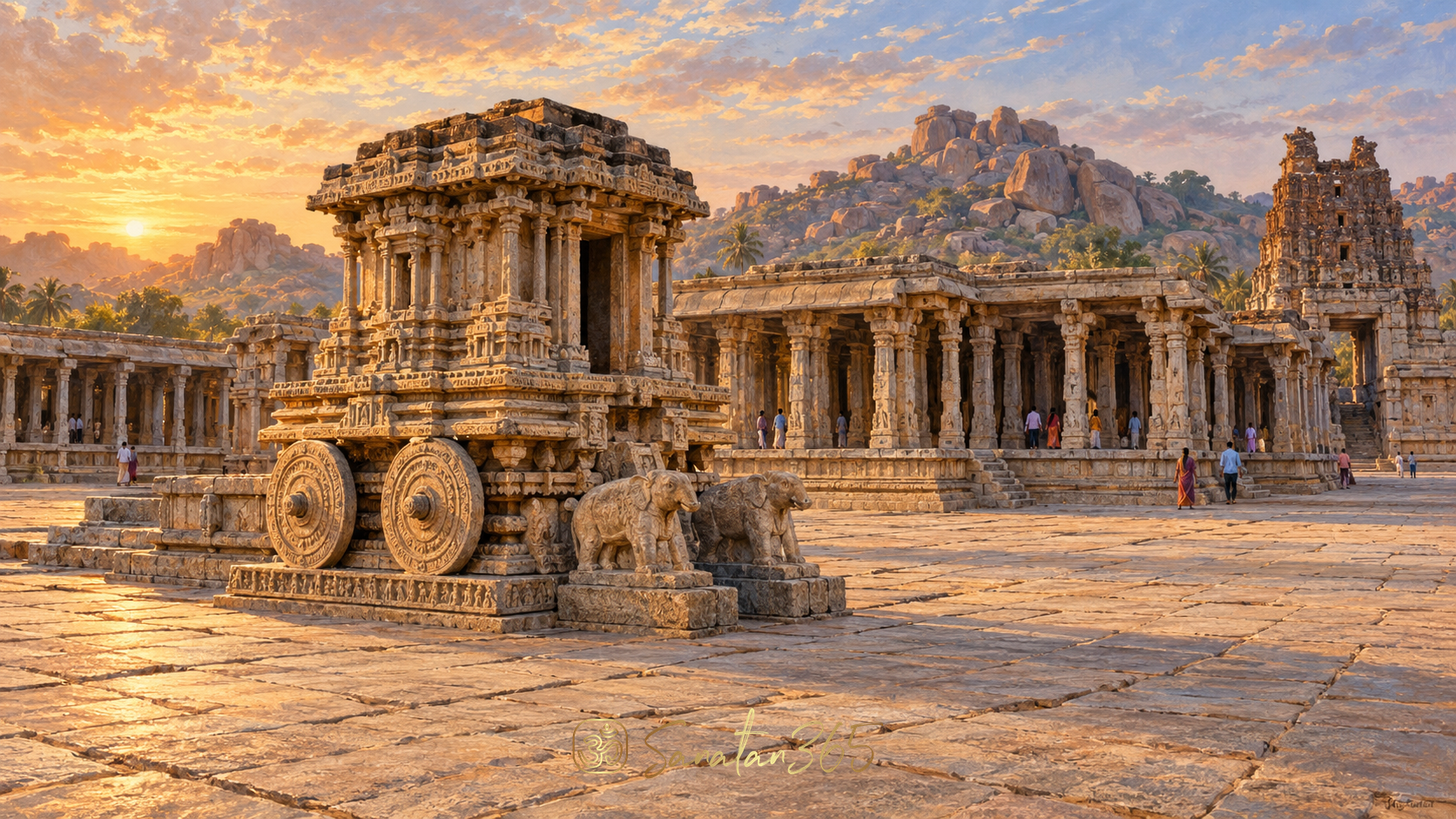
Vittala Temple Hampi: Reading the Stone Chariot and Sacred Courtyard
Understand Hampi’s Vittala Temple through its Garuda stone chariot, pillared halls, Vishnu devotion, and careful heritage visiting.
 Temples
Kirtimukha Meaning: The Face of Glory Above the Temple Door
The fierce face above a temple doorway is not a warning to turn away. Learn to recognize Kirtimukha, read its sacred story, and notice how…
 Temples
Somanathapura Keshava Temple: Three Shrines and the Art of Looking
Read the star-shaped plan, three Vishnu shrines and carved narratives of Somanathapura, with a respectful guide to a protected Hoysala monu…