Jalabhishek Meaning: Why Water Is Offered to the Shiva Lingam
Jalabhishek is the reverent pouring of water over a Shiva lingam. Learn its meaning, Shravan significance, regional forms, and a simple, respectful home practice.
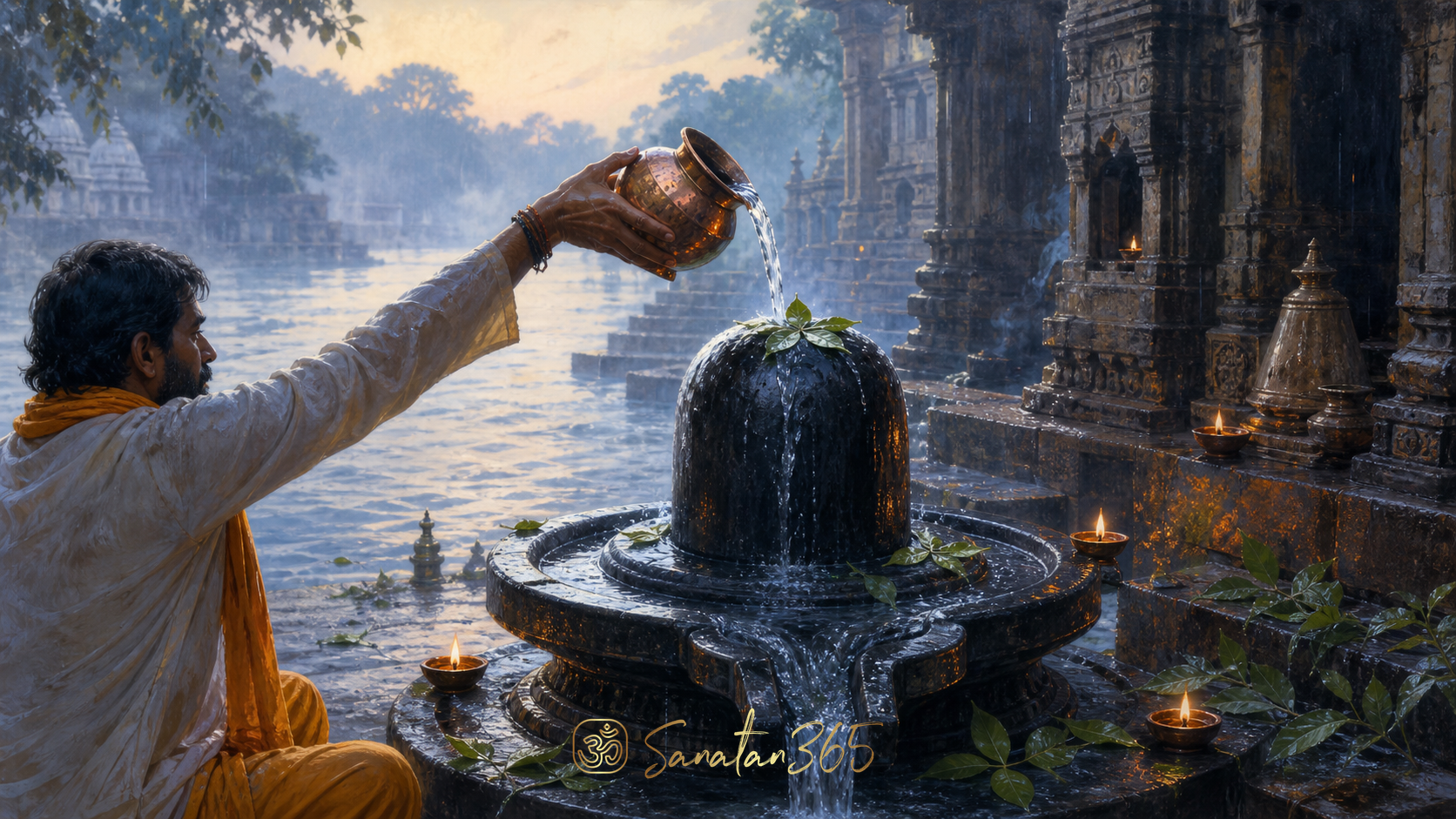
A single stream of water can turn an ordinary moment into worship. Jalabhishek means the reverent pouring of water over a Shiva lingam as an offering to Lord Shiva, especially during Shravan, on Mondays, and on Maha Shivaratri. The act is simple, but its inner grammar is rich: water expresses purity, surrender, cooling grace, and the devotee’s willingness to place restless thought before the stillness Shiva represents.
The term combines jala (जल, water) and abhiṣeka (अभिषेक, ritual bathing or consecration). It belongs to the wider Hindu practice of bathing a sacred image with water or other prescribed substances while offering prayer. Jalabhishek is therefore not a technique for forcing an outcome. It is an act of bhakti (भक्ति, loving devotion) shaped by attention, cleanliness, humility, and care.
What Is the Jalabhishek Meaning in Shiva Worship?
The central Jalabhishek meaning is devotional offering through sacred water. A clean stream is poured over a Shiva lingam while the worshipper remembers Lord Shiva, chants a mantra, or remains quietly attentive. The water flows over the lingam and outward through the base, called the yoni pitha in temple-art terminology, completing a visual movement from offering to release.
The Encyclopaedia Britannica overview of the lingam describes it as the principal emblem of Shiva and notes that it is commonly anointed in worship. Museum scholarship likewise treats the Shiva lingam as a sacred, aniconic form rather than a portrait-like image. “Aniconic” simply means that the Divine is represented through a symbolic form instead of a human figure.
Several meanings meet in the water:
- Purity: Water cleanses the vessel, altar, and hands, while reminding the devotee to approach worship honestly.
- Cooling: Shiva is associated with immense tapas (तपस्, disciplined spiritual heat). Water becomes an image of calm offered to transforming power.
- Surrender: Once poured, water cannot be gathered back in the same form. The action teaches release without carelessness.
- Continuity: A steady stream mirrors attention that returns again and again to the sacred.
- Life: Water sustains bodies, fields, rivers, and communities. Offering it also calls for gratitude and responsible use.
These interpretations need not compete. Hindu ritual often works through several layers at once: physical action, remembered story, philosophical symbol, and personal prayer.
Key takeaway: Jalabhishek uses the most essential substance of daily life to express purity, steady devotion, and the release of possessiveness before Shiva.
Why Is Water Offered to the Shiva Lingam?
Water is offered because it is accessible, purifying, and symbolically suited to Shiva worship. Elaborate materials are not necessary for sincere devotion. A small amount of clean water, offered respectfully, can carry the whole intention of the rite.
One widely told Puranic explanation connects the practice with Samudra Manthana (समुद्र मन्थन, the churning of the cosmic ocean). When the dangerous halahala poison emerged, Shiva contained it to protect creation and became Nilakantha, “the blue-throated one.” Later devotional retellings describe water being offered to cool the intensity of the poison. This story offers a moral image: strength is not domination; it is the capacity to hold danger without passing it onward.
Another layer comes from the meeting of Ganga and Shiva. Sacred narratives describe the celestial river descending with overwhelming force and Shiva receiving her in his matted locks before releasing her gently toward Earth. The image joins power with restraint. Water poured over the lingam can recall Ganga’s descent: what is mighty becomes life-giving when held with wisdom.
The rite also resonates with Vedic praise. Sri Rudram, a celebrated hymn of the Krishna Yajurveda, addresses Rudra through the many places and forms in which sacred presence is encountered. In temple and household practice, its recitation often accompanies abhishekam (अभिषेकम्, ritual bathing). The hymn does not reduce Shiva to one location or image; it trains the mind to recognize divine presence throughout life.
None of these explanations makes water a magical transaction. A devotee may pray for strength, clarity, family welfare, or relief while still understanding that worship does not guarantee a preferred result. The deeper offering is the quality of one’s attention and conduct.
Key takeaway: Water is offered to Shiva as a sign of cooling grace, sacred memory, life, restraint, and devotion—not as a bargain with the Divine.
Why Is Jalabhishek During Shravan Especially Important?
Jalabhishek during Shravan receives special emphasis because Shravana (श्रावण, the monsoon month also called Sawan) is widely dedicated to Shiva worship. Rain renews the land, rivers swell, and the season itself makes water a visible teacher. The rite turns that seasonal reality into gratitude.
Calendar traditions vary across India. In many North Indian communities following the Purnimanta calendar, Shravan begins earlier than it does in several western and southern regions following the Amanta calendar. Solar calendars create further local differences. Readers can consult the verified guide to Shravan month 2026 dates and Shiva practices rather than assuming one start date applies everywhere.
Mondays, called Shravan Somvar, are especially associated with Shiva. Some devotees fast according to family custom, visit a temple, recite “Om Namah Shivaya,” or perform a simple water offering. Others participate in the Kanwar Yatra, carrying sacred water from the Ganga or another revered source to a Shiva shrine. These are related expressions of devotion, but no one practice is required of every worshipper.
Shravan also sharpens an ethical question: if water is sacred at the altar, how should it be treated outside the altar? Responsible worship avoids waste, plastic litter, polluted offerings, and unsafe crowds. Reverence for Ganga is incomplete if sacred rivers and pilgrimage routes are left dirtier after devotion.
For diaspora families, Shravan may be observed with local clean water and a home shrine. Sacred meaning does not depend on imitating every regional custom. It depends on sincerity, cultural understanding, and a practice that fits the household safely.
Key takeaway: Shravan strengthens Jalabhishek by placing the offering within the monsoon’s renewal, Shiva remembrance, Monday observances, pilgrimage, and ecological responsibility.
How to Do Jalabhishek at Home Respectfully
A home Jalabhishek can remain modest. Family traditions, sampradaya (सम्प्रदाय, a living spiritual lineage), and temple instructions should take precedence over generic internet rules. Where there is uncertainty, simple water is the safest and most universal offering.
1. Prepare a clean, stable worship space
Place the Shiva lingam in a clean tray or vessel that can safely collect the water. Ensure the base is stable and that runoff will not damage furniture or create a slipping hazard. Wash the hands and approach in clean clothing.
2. Bring a small amount of clean water
Use potable water in a clean copper, brass, steel, or ordinary household vessel. Ganga water may be included if it has been respectfully obtained, but it is not necessary for a sincere home offering. Avoid treating water volume as a measure of devotion.
3. Centre the mind
Sit or stand quietly for a few breaths. Remember Lord Shiva and state a simple sankalpa (संकल्प, prayerful intention), such as gratitude, steadiness, or the welfare of all beings. A sankalpa is not a demand; it gives the mind a wholesome direction.
4. Pour slowly and attentively
Offer a gentle stream over the top of the lingam. One may chant:
Om Namah Shivaya “Reverence to Shiva.”
The meaning of Om Namah Shivaya is deeper than a quick translation: the mantra expresses reverent inward turning and surrender. It may be repeated softly, or the devotee may worship in silence.
5. Add only appropriate offerings
If family tradition permits, bilva leaves may be offered after the water. They should be clean and placed respectfully. The article on why bilva leaves are offered to Shiva explains their threefold symbolism and devotional context.
Milk, yoghurt, honey, ghee, sugar, flowers, ash, and sandal paste appear in various forms of Shiva abhishekam, but they are not required for Jalabhishek. Temple priests may follow specific liturgical sequences that should not be improvised without guidance. At home, water alone is complete.
6. Close with gratitude
After the offering, sit for a moment. Pray for clarity in action, compassion in speech, and restraint in consumption. Clean the shrine and dispose of the collected water respectfully according to local conditions. Where safe, plain water without additives may nourish a plant; water containing dairy, oils, pigments, or other substances requires more careful disposal.
Key takeaway: A respectful home Jalabhishek needs only a stable shrine, clean water, focused remembrance, a gentle offering, and responsible cleanup.
What Jalabhishek Rules Protect the Spirit of the Ritual?
Lists of “rules” often circulate without context. Some reflect genuine lineage or temple customs; others present regional preferences as universal commands. The most reliable principles protect sacred attention, people, and the environment.
- Follow the temple’s instructions. Do not cross barriers, touch a shrine, pour substances, or enter a sanctum unless the temple explicitly permits it.
- Choose simplicity over waste. A small clean offering is preferable to litres of water or food products used for display.
- Do not make fear-based claims. A missed Monday, imperfect pronunciation, or unavailable ingredient does not justify anxiety or commercial pressure.
- Respect regional variation. North Indian jalabhishek, South Indian abhishekam, and lineage-specific temple rites may differ in vessel, chant, timing, and materials.
- Keep the physical setting safe. Wet stone is slippery. Crowds, children, older adults, and people with mobility needs require space and patience.
- Protect rivers and public places. Carry reusable vessels where possible and leave no plastic, cloth, food, or decorative waste behind.
- Do not replace ethical life with ritual. Worship should deepen truthfulness, compassion, discipline, and care for others.
Temple worship can be witnessed reverently even when direct pouring is not available. Darshan, mantra, listening to Sri Rudram, or offering a flower according to local rules are all meaningful forms of participation.
Key takeaway: The best Jalabhishek rules preserve reverence, safety, ecological care, regional humility, and the link between worship and ethical conduct.
How Does the Ritual Differ Across India and the Diaspora?
The underlying action is widely recognized, but its social setting changes.
In North India, Shravan Jalabhishek is strongly visible in Shiva temples and along Kanwar routes connected with Haridwar, Gangotri, Gaumukh, and local river traditions. Devotees may bring Gangajal (गंगाजल, sacred Ganga water) to neighbourhood shrines or major temples.
In Bihar and Jharkhand, the Sultanganj-to-Deoghar route has a distinctive place in Shravan pilgrimage. Devotees carry Ganga water toward the Baidyanath Jyotirlinga. The continuity of carrying water over distance makes the body part of the prayer.
In South Indian temples, the Sanskrit-derived form abhishekam is common. Priests may bathe the lingam with water and other substances according to an established agama (आगम, temple ritual scripture and tradition). Devotees usually participate through sponsorship, darshan, recitation, or receiving blessed water rather than independently approaching the central image.
In Maharashtra, Gujarat, Bengal, Nepal, and other regions, local calendars, Shiva forms, river geographies, and household customs shape the observance. Diaspora temples often adapt the practice to water regulations, building safety, scheduled services, and multicultural congregations.
Variation is not dilution. Sanatan Dharma has long carried shared sacred principles through diverse local forms. The respectful question is not “Which version is the only correct one?” but “What does this temple, family, or lineage preserve, and how can one participate with understanding?”
Key takeaway: Jalabhishek remains recognizable across regions while temple authority, language, materials, calendar, and participation differ.
The Inner Practice After the Water Stops
The most revealing part of Jalabhishek begins after the vessel is empty. Water has flowed away, but the worshipper returns to conversations, deadlines, family duties, and difficult choices. Can the qualities enacted at the shrine continue there?
Purity becomes truthful speech. Cooling becomes refusing to pass anger onward. Continuity becomes daily discipline. Surrender becomes releasing control without abandoning responsibility. Ecological reverence becomes using water carefully and protecting shared spaces.
The lingam’s spare form helps focus the mind beyond surface detail. The Metropolitan Museum of Art presents Shiva lingam worship within a long artistic and devotional history in which a concentrated form carries vast theological meaning. The devotee pours something transparent over something still. That image can become a meditation on letting the agitated mind meet steady awareness.
Ritual is strongest when it changes conduct without producing superiority. Someone who performs elaborate abhishekam is not spiritually above someone who offers one spoon of water, chants inwardly, or serves a thirsty person. The offering’s scale is visible; its sincerity is not.
Jalabhishek meaning can therefore be held in one sentence: offer what sustains life, remember the sacred, and return to the world a little less possessive and a little more steady.
Key takeaway: The true completion of Jalabhishek is carrying its purity, restraint, steadiness, and care into ordinary life.
FAQ
What is Jalabhishek?
Jalabhishek is the ritual offering of clean water over a sacred image, especially a Shiva lingam. In Shiva worship it expresses purity, cooling grace, devotion, surrender, and steady remembrance.
Why do devotees pour water on the Shiva lingam?
Devotees offer water because it is life-giving, purifying, and symbolically linked with Shiva, Ganga, and the cooling of intense spiritual power. The act is devotional, not a guaranteed method for obtaining a particular result.
Can Jalabhishek be done at home?
Yes. A simple home practice may use a stable Shiva lingam, a clean tray, a small amount of potable water, and quiet repetition of “Om Namah Shivaya.” Household or lineage traditions should be followed where available.
Is milk required for Shiva abhishekam?
No. Milk and other substances appear in some temple and family traditions, but clean water alone is sufficient for Jalabhishek. Simplicity, non-waste, cleanliness, and sincere attention matter more than quantity.
When is the best time for Jalabhishek?
Jalabhishek may be offered year-round. Mondays, Shravan, Pradosh, and Maha Shivaratri are widely observed times, but regional calendars and temple schedules vary. Devotion need not be postponed when a special date is unavailable.
Jalabhishek turns water into a lesson without changing what water is: clear, essential, flowing, and shared.
Key takeaway: Offer simply, understand deeply, waste nothing, and let Shiva worship cool the impulse to grasp or harm.
About the author
Sanatan365 Editorial
Bringing Sanatan Dharma to modern seekers through authentic, scripture-grounded content.
Related in Rituals
 Rituals
Vidyarambham Meaning: First Letters, Learning, and Reverence
Explore Kerala’s ceremony of beginning letters, its Vijayadashami setting, rice-writing customs, and the meaning of a gentle first step int…
 Rituals
Ganga Aarti Meaning: Why Lamps Are Offered to the River
Why devotees offer light to the Ganga, what the public ceremony in Varanasi expresses, and how visitors can participate with care.
 Rituals
Chandan Offering in Hindu Puja: The Meaning of Gandha
Why devotees offer sandalwood paste in Hindu worship, what gandha signifies, how the custom varies, and how to practise with care.