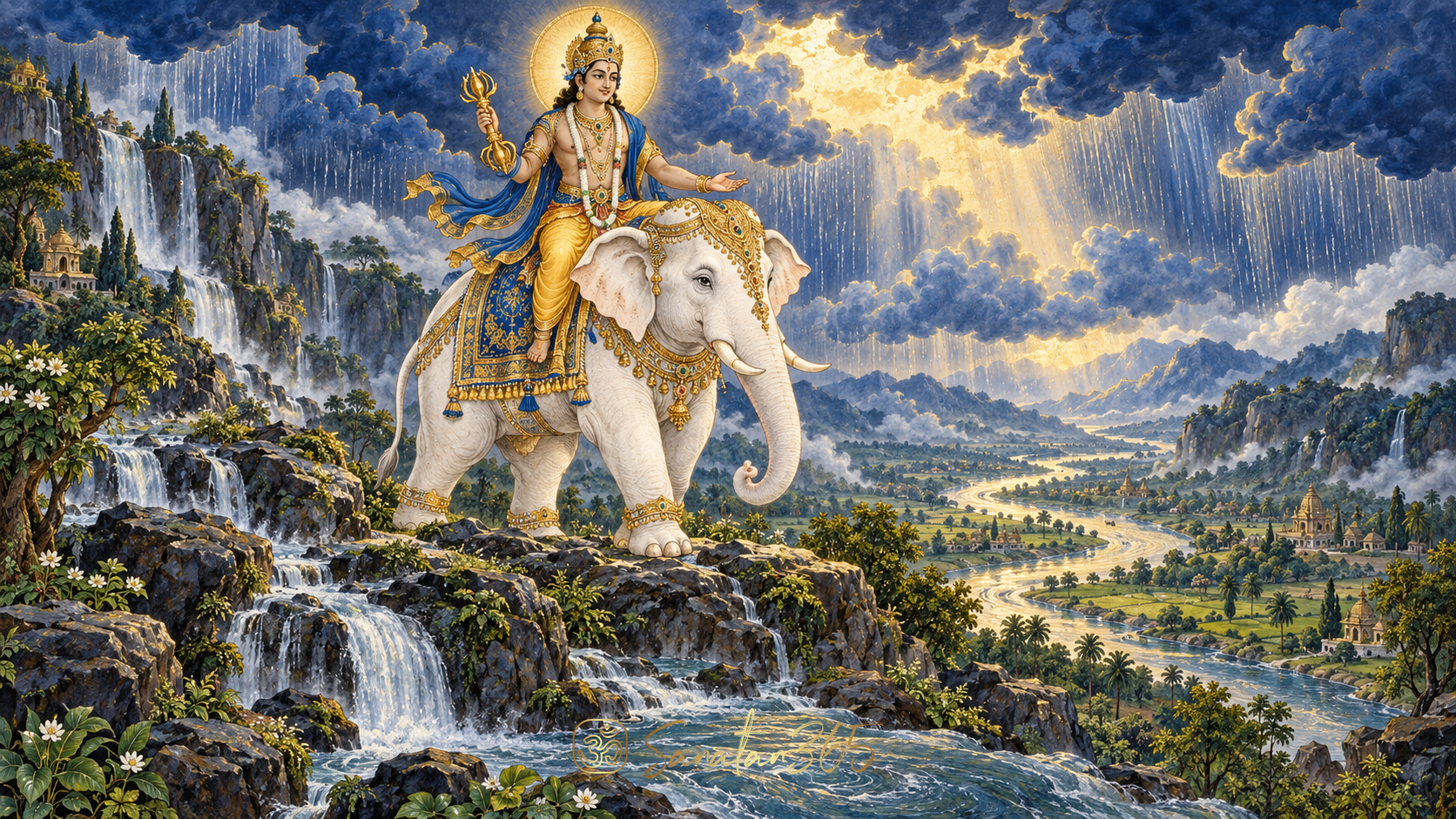
Indra Deva Meaning: The Vajra, Rain, and Responsible Power
Indra links the thunderbolt and released waters with a demanding question: what is strength for? Read his Vedic imagery and later lessons with care.
A thunderbolt is easy to remember. The river flowing after it deserves just as much attention.
Indra Deva meaning begins with a major Vedic deity associated with thunder, rain, strength, and the release of waters. Indra (इन्द्र, the deity's name) is praised as a powerful protector; deva (देव, a divine being) identifies his sacred status. His vajra (वज्र, thunderbolt weapon) and the waters freed after his victory over Vritra (वृत्र, the obstructing adversary) carry the central imagery. Later Hindu art often shows him with Airavata (ऐरावत, the name of his white elephant mount), as recorded in Encyclopaedia Britannica, “Indra,” and standard iconographic references. These images invite reflection on power that sustains life, while later narratives also examine power's limits.
Reading Indra carefully means allowing these different settings to remain different. A Vedic hymn of praise, an artistic attribute, and a later story of humility are not interchangeable descriptions. Together they reveal more than a simple label such as “rain god.”
What does Indra Deva meaning reveal in the Vedic hymns?
The Rig Veda, an ancient collection of sacred hymns, presents Indra through acts of extraordinary strength. One particularly vivid example is hymn 1.32: he defeats the serpent-like Vritra, opens the waters, and clears their passage through the mountains. In the following verse, those waters move toward the ocean with the urgency of lowing cattle. The sequence matters: obstruction, decisive action, then renewed movement. See Rig Veda 1.32, especially verses 1–2, in Ralph T. H. Griffith's historical English translation.
This is sacred poetry, not a modern weather bulletin. The hymn joins storm, water, landscape, and divine agency in a language of praise. Its imaginative force should not be reduced to a claim that every detail is a coded scientific formula. Nor does acknowledging poetic imagery require treating the devotional meaning as insignificant.
An attentive reader can begin with what the hymn actually places before the mind: waters held back, a formidable impediment, a thunder-wielder, and the opening of channels. These are concrete images before they become abstract lessons. Their material stakes are also clear. Flowing water supports life; the poem's victory is not merely a trophy held by its hero.
The title “king of the devas” appears in broader accounts of Indra, but it should not be used to rank contemporary Hindu devotional paths. A hymn may praise its addressed deity with expansive language. Different Hindu traditions understand divine relationships in different ways, and reverence toward Indra need not diminish reverence toward any other sacred form.
A useful companion is the account of Vayu as wind, life-breath, and strength in service. The comparison shows how divine imagery can connect an elemental presence with human dependence. It does not make the two deities interchangeable: Indra's thunderbolt and released waters form a distinctive poetic world.
Key takeaway: Begin with Indra's particular Vedic images rather than forcing every later story or philosophical interpretation into one definition.
Why does the vajra matter more than a weapon?
Indra's thunderbolt is his most recognizable attribute. In Rig Veda 1.32.2, the divine craftsman Tvashtr (त्वष्टृ, the sacred maker or fashioner) shapes the weapon. The detail prevents the scene from becoming simply a celebration of raw force: the decisive instrument has been fashioned. The hymn gives making a place within the act of overcoming obstruction.
Later artistic representations make the vajra visible as an object, often a double-ended thunderbolt. The Metropolitan Museum of Art's educational guide, The Art of South and Southeast Asia (Metropolitan Museum of Art, educational guide, glossary entry “vajra”), identifies the vajra as the double-headed thunderbolt originally held by Indra and later carried by other Hindu and Buddhist sacred figures. The attribute therefore has a history of artistic use; it should be read with the figure and setting around it.
For a beginner looking at an image, three questions are more helpful than memorizing a silhouette alone:
- Who is holding the object?
- What other attributes or companions identify the figure?
- What does the surrounding scene suggest about the action or sacred role?
A thunderbolt in one image does not automatically make that figure Indra. Sacred art communicates through relationships among attributes, posture, companions, and context. This is especially useful when encountering art beyond India, where related symbols may be represented through different regional forms.
There is also room for a careful contemporary reflection. A powerful tool can remove an obstacle, but possessing a tool does not settle how it should be used. That ethical question is an interpretation drawn from the imagery, not a translation of the Sanskrit word. Keeping that distinction clear allows the image to be meaningful without making the text say something it does not explicitly say.
In everyday terms, expertise, resources, and authority can all become instruments. Their worth depends partly on the result. Does a decision clear a real difficulty, or only make its maker appear formidable? Does the instrument serve people, or become an object of admiration detached from their needs?
Key takeaway: The vajra identifies decisive strength, but its meaning becomes richer when read alongside the obstruction removed and the life supported afterward.
What do the released waters reveal about strength?
The waters are not background decoration in the Vritra hymn. They are part of its announced accomplishment. Griffith's translation of verse 2 describes them descending toward the ocean; verse 8 returns to their movement across the defeated obstruction. The narrative directs attention outward, from the victorious deity to what can now flow.
This is the strongest starting point for reflecting on Indra and rain. The familiar association is not only with the sound of thunder or the spectacle of lightning. It also concerns access to water, renewed channels, and the conditions in which life can continue. The image carries dependence as well as grandeur.
Consider the difference between looking at a storm from a sheltered window and waiting for rain in a landscape whose fields need water. The same cloud can appear as spectacle in one setting and as a condition of livelihood in another. The hymn's imagery asks the reader to notice the second perspective too. This is a contemporary observation about the image, not a claim that the poem describes a particular modern region or season.
The theme can support responsible reflection without promising that devotion controls rainfall. Prayer and reverence belong to religious life; weather forecasting, water management, and practical precautions retain their own responsibilities. No particular chant, offering, or image should be presented here as a guaranteed way to summon rain or avert a storm.
The distinction between Indra and Varuna is also worth preserving. Both connect with waters in Hindu sacred literature, but their identities and emphases are not identical. The article on Varuna, waters, and cosmic order provides context for reading a related deity without merging the two into a generic water symbol.
As an ethical interpretation, the released waters suggest a test for strength: what becomes possible for others after it acts? A household decision may create time for someone to study. A teacher may remove confusion through patient explanation. An experienced worker may clear a practical bottleneck rather than guarding knowledge as a private advantage. These examples are present-day applications, not instructions attributed to the hymn's composer.
The point is not that every difficulty is a Vritra or that every disagreement needs a thunderbolt. That would turn a sacred image into an excuse for aggression. Some obstacles need patient negotiation, better information, or shared effort. The nourishing result, rather than the dramatic gesture, remains the useful measure.
Key takeaway: Indra's released waters make renewed life, not domination for its own sake, a compelling focus for reflection.
How does later art show the king of the devas?
Later Hindu imagery commonly presents Indra as a regal figure associated with the white elephant Airavata, Indra's elephant mount. The pairing gives viewers a different visual register from the rushing mountain waters of the Vedic hymn. Crown, bearing, vehicle, and thunderbolt make sacred authority visible.
The elephant should be understood as an identifying companion, not merely an exotic detail added to a portrait. In a respectful illustration, Airavata contributes dignity and scale. Indra's weapon gives a clear attribute, while the surrounding atmosphere may emphasize rain, celestial kingship, or the story depicted. Not every representation uses exactly the same arrangement.
This also explains why an illustration of Indra seated on Airavata should not be presented as a literal picture of every Rig Vedic passage. Early hymns and later iconography belong to connected but different textual and artistic settings. Combining them for devotional art can be appropriate when the image's purpose is clear; claiming that a particular hymn describes all the depicted details would require separate evidence.
The same care applies to later narratives. Accounts associated with Govardhana, the mountain sheltered beneath Krishna's protection, examine a situation in which Indra's anger and authority are corrected. The familiar narrative is part of the later Hindu literary setting summarized in Encyclopaedia Britannica’s account of Indra. It is not the storyline of Rig Veda 1.32.
These differing portrayals need not be treated as a contradiction to be hurriedly erased. Sacred literature can praise a divine role in one setting and use a narrative of error, correction, and renewed understanding in another. Respectful reading attends to what each text is doing. It avoids mocking Indra, and it avoids turning one episode into a blanket claim that one community's devotional path is superior.
For India and the diaspora alike, this is a helpful habit when reading illustrated books or visiting museum collections: identify the textual setting before drawing a universal conclusion. “Indra with Airavata,” “Indra in the Vritra hymn,” and “Indra in the Govardhana narrative” name different encounters. A clear caption can preserve those differences even when the image itself is immediately familiar.
Key takeaway: Later kingship imagery and stories add dimensions to Indra's portrayal; they should illuminate the Vedic hymns without replacing their particular context.
How can the imagery of Indra guide responsible power?
Indra's imagery offers a demanding question for daily life: is strength making space for life, or insisting that everything acknowledge its owner? The question is a reflective application of the material explored here. It is not a newly discovered command hidden in the thunderbolt.
Responsible power has a purpose beyond display. A person entrusted with a task needs enough firmness to act, but also enough attention to understand the task's consequences. A household, school, or workplace depends on more than a single decisive individual. Knowledge, preparation, cooperation, and the needs of others remain part of the situation.
The Vedic sequence of obstruction and released waters can become a simple reflection practice:
- Name the actual obstruction. Separate a concrete problem from wounded pride or a desire to win.
- Choose a proportionate response. Not every difficulty requires confrontation; sometimes the right instrument is clarification.
- Notice who benefits. A successful action should be assessed by what it enables, not only by how impressive it looks.
- Remain open to correction. A decision can be necessary and still need adjustment when new information arrives.
These steps do not turn Indra into a modern management slogan. They are a way for a reader to respond thoughtfully to sacred imagery while respecting its original devotional setting. A deity is more than a useful metaphor, and a hymn deserves to be read as a hymn before it is adapted into advice.
One practical example is the sharing of knowledge. Someone who understands a difficult process may be tempted to remain indispensable by keeping it obscure. Clearing the obstruction means explaining it well enough that others can act. Strength has then opened a channel instead of becoming the gatekeeper of one.
Another example is a correction made at home. Firmness may be needed, but humiliation is not evidence of strength. The useful question is whether the response restores understanding and responsibility. A dramatic outburst can make the speaker feel powerful while leaving everyone less able to cooperate.
The image of rain also invites ordinary care for the conditions of shared life: using water thoughtfully, respecting local safety guidance during storms, and recognizing the work that keeps common resources usable. These are practical responsibilities, not promises of a supernatural reward. Reverence and responsible conduct can accompany each other without becoming a transaction.
Key takeaway: The most useful reflection on Indra's strength asks what it protects, what it releases, and whether it remains willing to learn.
FAQ
Who is Indra Deva in Hindu tradition?
Indra is a major Vedic deity associated with thunder, rain, powerful action, and the release of waters. Broader Hindu accounts also describe him as king of the devas. His portrayal varies across hymns, later narratives, and sacred art, so a specific text or image should be read in its own setting.
What does Indra's vajra symbolize?
The vajra is Indra's thunderbolt weapon and a recognizable artistic attribute. In Rig Veda 1.32 it is used against Vritra, after which the waters flow. Reading it as strength that removes obstruction is a useful interpretation, but the surrounding narrative matters more than an isolated symbol.
Why is Indra associated with rain?
Vedic hymns connect his actions with the release of waters, and later tradition commonly associates him with thunder and rain. This devotional association is not a guarantee that a particular prayer or offering changes the weather. Religious practice and practical weather precautions have different purposes.
Why is Indra shown on a white elephant?
Airavata is Indra's elephant mount in later sacred imagery. The regal figure, elephant, and thunderbolt together help identify him. This artistic pairing should not be assumed to appear in every early Vedic description.
What is the central lesson of reading Indra's imagery carefully?
Keep praise, symbolism, and later narrative distinct before drawing a lesson. A thoughtful contemporary takeaway is that strength deserves to be measured by the life it supports, not merely by the fear or admiration it creates.
About the author
Sanatan365 Editorial
Bringing Sanatan Dharma to modern seekers through authentic, scripture-grounded content.
Related in Deities
 Deities
Agni Deva Meaning: Sacred Fire and the Divine Messenger
Meet Agni as the Vedic priest and messenger, read the first Rig Veda hymn, and understand sacred fire without reducing a living deity to a…
 Deities
Brahma Deva Meaning: Four Faces, Creation, and Sacred Knowledge
Understand Brahma, the Hindu creator deity, through his four faces, lotus imagery, sacred knowledge, and a careful distinction from Brahman…
 Deities
Ushas, the Vedic Goddess of Dawn: Light, Renewal, and Time
Ushas, the Vedic goddess of dawn, appears in the Rigveda as radiant light that awakens life, calls beings to activity, and reveals both ren…

