Dakshinamurti Meaning: Shiva as the Silent Teacher
Discover Dakshinamurti, the south-facing form of Shiva who teaches through silence, and understand the banyan tree, hand gesture, sages, and practical wisdom in his sacred image.
A teacher speaks, yet the deepest lesson in this image arrives without a sound. The Dakshinamurti meaning is Shiva revealed as the supreme guru: the youthful, south-facing teacher whose stillness helps seekers recognize the awareness already present within them.
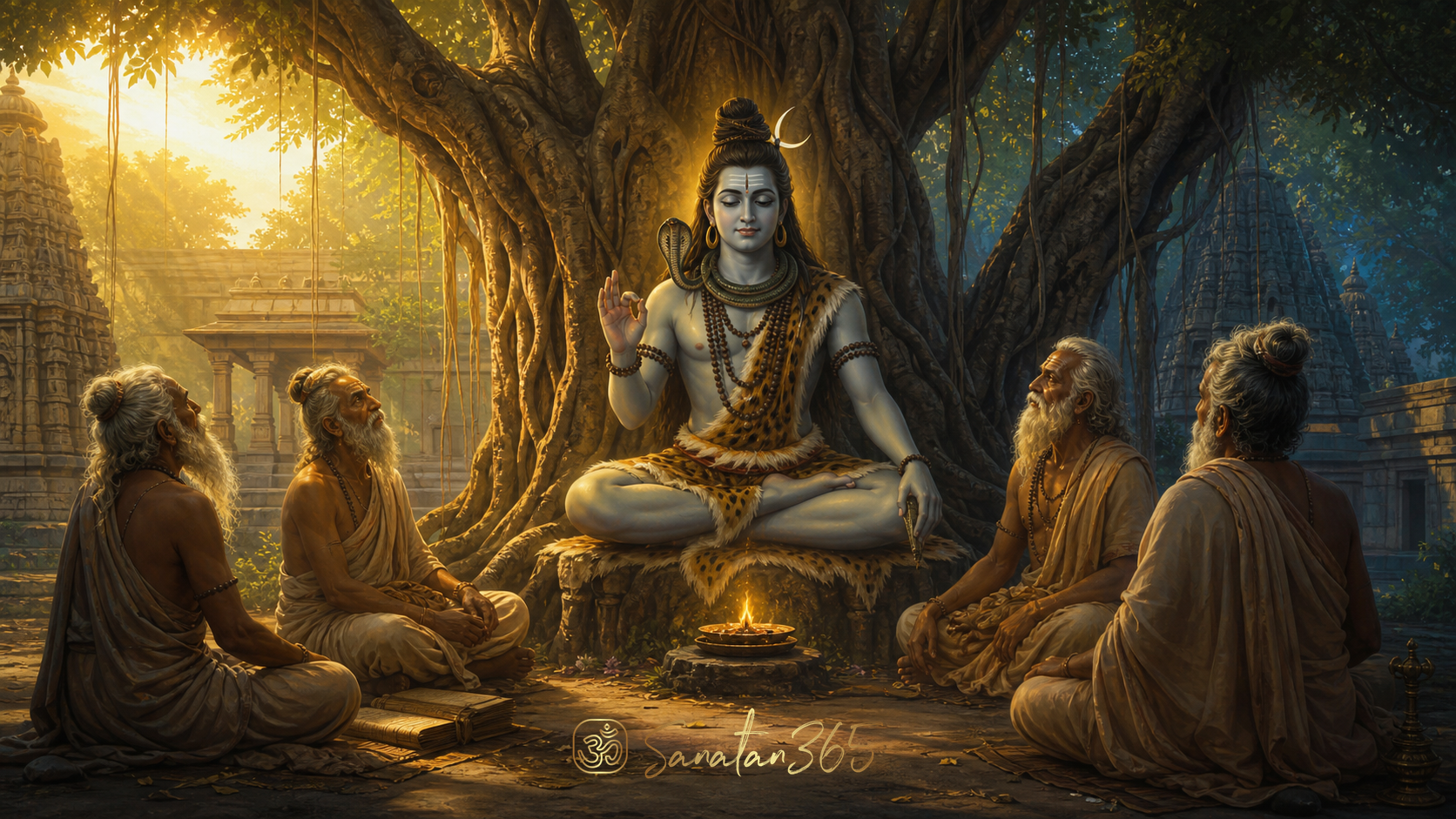
Dakshinamurti (दक्षिणामूर्ति, Dakṣiṇāmūrti, “the south-facing form”) is worshipped as an aspect of Lord Shiva associated with knowledge, meditation, yoga, music, and liberating insight. His sacred image usually places him beneath a banyan tree, surrounded by elder sages, with one hand forming a gesture of teaching. Each detail turns philosophy into something the eye can contemplate. Silence here is not an absence of instruction. It is instruction refined to its essence.
What Is the Dakshinamurti Meaning?
The name combines dakṣiṇa (दक्षिण, “south” or “right side,” depending on context) and mūrti (मूर्ति, “form” or “embodied image”). In the most direct iconographic sense, Dakshinamurti is the south-facing form of Shiva. The Walters Art Museum describes Dakshinamurti as Shiva assuming the role of the supreme teacher and notes the meaning “south-facing image.”
In many South Indian Shiva temples, Dakshinamurti appears in a niche on the southern exterior wall of the central sanctum. A devotee walking clockwise around the shrine encounters Shiva not only as the deity within but also as guru: one who illuminates the nature of the seeker, the world, and knowledge itself.
The direction is significant because south is traditionally associated with Yama, death, and the human awareness of mortality. Dakshinamurti faces that direction without fear. His teaching does not promise that the body will escape change. It points toward knowledge of the Self that is not reduced to the body's arrival and departure. This is close to the spirit of the Upanishadic inquiry into the true Self, where liberation begins by distinguishing enduring awareness from changing experience.
There are also devotional interpretations connecting dakṣiṇā with generosity, skill, or the offering given to a teacher. Such readings can deepen reflection, but they should not erase the straightforward visual truth: this is Shiva in a form characteristically oriented toward the south.
Key takeaway: Dakshinamurti is Shiva made visible as the guru who faces mortality and teaches liberating knowledge.
Why Does Dakshinamurti Teach Through Silence?
Indian teaching traditions have never treated silence as mere muteness. Mauna (मौन, mauna, “intentional silence”) can create the inward space in which hurried conclusions loosen and direct observation becomes possible. Words can describe truth, correct misunderstanding, and guide practice. Yet words remain symbols. They cannot substitute for the recognition to which they point.
The traditional image of Dakshinamurti makes this distinction unforgettable. The guru is youthful, while the disciples around him are old. Their age suggests extensive learning and long seeking. His youth suggests that awareness itself does not age. The disciples' questions are not mocked or dismissed; they are brought to stillness in the presence of clear seeing.
A celebrated verse associated with the Dakshinamurti tradition expresses the paradox:
चित्रं वटतरोर्मूले वृद्धाः शिष्या गुरुर्युवा । गुरोस्तु मौनं व्याख्यानं शिष्यास्तु छिन्नसंशयाः ॥
Citram vaṭataror mūle vṛddhāḥ śiṣyā gurur yuvā; gurostu maunaṁ vyākhyānaṁ śiṣyāstu chinna-saṁśayāḥ. “Wondrous: beneath the banyan are aged disciples and a youthful teacher; the teacher's exposition is silence, and the disciples' doubts are cut away.”
The verse should not be read as an argument against study. The Dakshinamurti Stotram tradition is itself verbal, philosophical, and carefully transmitted. Silence becomes fruitful after listening, reflection, and disciplined contemplation have prepared the mind. Otherwise, silence may remain only blankness or avoidance.
This balance matters in modern life. A person can collect explanations endlessly while never pausing to test them against experience. Dakshinamurti's silence asks a sharper question: after the concept is understood, what remains true when the commentary stops?
Key takeaway: The silent guru does not reject words; he leads the seeker from explanation toward direct recognition.
What Does Dakshinamurti Iconography Symbolize?
Dakshinamurti iconography varies across regions, periods, and temple traditions. No single checklist captures every sculpture. Still, several recurring elements form a coherent language of knowledge.
The banyan tree: shelter and unfolding knowledge
The banyan's branches descend and take root, allowing one tree to appear like a grove. It becomes a natural image of continuity, lineage, and teachings that spread without losing their source. Its broad shade creates a place where teacher and students can gather. Beneath it, wisdom is not isolated from life; it is rooted, sheltering, and shared.
The tree can also recall the inverted aśvattha (अश्वत्थ, aśvattha, “sacred fig tree”) of Bhagavad Gita 15, whose roots and branches represent conditioned existence. The banyan and the ashvattha are not botanically identical in every reference, so their symbolism should not be casually merged. Yet both invite reflection on roots, continuity, and the world of branching experience. The sacred peepal tree tradition offers a fuller exploration of that related image.
The teaching hand: knowledge joining the individual and the whole
One hand commonly forms jñāna mudrā (ज्ञान मुद्रा, jñāna mudrā, “gesture of knowledge”) or a closely related teaching gesture. The thumb and index finger meet in a circle while the other fingers extend. Later interpretive traditions often see the joined fingers as the apparent individual recognizing inseparability from ultimate reality. The gesture should be approached as a contemplative symbol, not a mechanical code with only one authorized reading.
The open, composed hand also communicates a practical truth: knowledge is being offered without coercion. A real teacher does not seize the student's mind. The teacher makes seeing possible.
The sages: humility after learning
The elder sages around the youthful Shiva overturn ordinary assumptions about authority. Their presence honors study, maturity, and disciplined inquiry, while their receptive posture shows that accumulated knowledge does not eliminate the need for humility. The more one learns, the more clearly one can perceive the limits of second-hand certainty.
Some traditions identify the disciples with the four mind-born sons of Brahma, the Sanaka sages. Whether a particular sculpture makes that identity explicit depends on its context. The durable symbolism is the same: accomplished seekers remain students before truth.
The subdued figure: ignorance brought under discernment
In some forms, Dakshinamurti's foot rests upon a dwarf-like figure interpreted as apasmāra (अपस्मार, apasmāra, “forgetfulness” or personified ignorance). Similar imagery appears in Nataraja iconography. It does not license contempt for human beings, disability, or illness. The figure is symbolic: confusion, forgetfulness of one's deeper nature, and unstable knowing are placed beneath steady awareness.
The symbolism is inward. The “defeated” force is not another community, rival path, or imperfect person. It is the seeker's own misidentification and carelessness.
The objects in his hands
Depending on the form, Dakshinamurti may hold scripture, a rosary, flame, drum, serpent, or other attributes. Scripture honors transmitted knowledge; a rosary suggests sustained contemplation; flame indicates illumination; the drum evokes primal rhythm and expression. Regional sculptural manuals and temple lineages shape the exact arrangement, so one should observe a specific image before assigning every object a universal meaning.
Key takeaway: Dakshinamurti's image turns a whole philosophy of learning—roots, humility, discernment, transmission, and direct insight—into sacred form.
Why Is Shiva the Teacher in This Form?
Shiva is often remembered as ascetic, householder, dancer, protector, and transformer. Dakshinamurti reveals that these are not disconnected roles. Transformation requires discernment; meditation requires instruction; and the ending of ignorance can be understood as a form of dissolution.
As Nataraja, Shiva's dance presents creation, preservation, concealment, revelation, and dissolution in motion. As Dakshinamurti, those same depths appear in stillness. The contrast is not a contradiction. It shows that truth may be approached through movement and repose, ritual and inquiry, sound and silence.
The guru principle here is larger than personality worship. Guru (गुरु, guru, “teacher” or “one who dispels darkness”) refers both to a respected human guide and to the illuminating function of wisdom itself. Hindu traditions honor living teachers, scriptures, reasoned reflection, and the Divine as sources of guidance. Dakshinamurti gathers these strands into one icon: Shiva as the light by which confusion becomes visible and understanding becomes possible.
This also guards against a common misunderstanding. The image does not suggest that a seeker should obey every self-appointed teacher without question. The meaning of Guru Tattva includes discernment, ethical responsibility, and the difference between reverence and surrendering one's judgment. A teacher worthy of the name turns attention toward truth, not toward dependence on the teacher's ego.
Key takeaway: Shiva as Dakshinamurti represents the power of wisdom to dissolve ignorance without demanding blind dependence.
How Can Dakshinamurti's Teaching Be Practised Today?
The image belongs in temples and devotional life, but its discipline can also shape study, work, and relationships. Practising its wisdom does not require pretending to have transcended ordinary responsibilities. It begins with better attention.
- Pause after learning. After reading a verse, commentary, or serious idea, sit quietly for three minutes. Ask what the teaching reveals in direct experience rather than immediately collecting another explanation.
- Separate observation from assumption. Write down what is actually known, what is inferred, and what remains uncertain. This simple act weakens the mind's habit of presenting opinion as fact.
- Listen without preparing a reply. In one conversation each day, give full attention until the other person finishes. Silence becomes service when it makes room for another person to be understood.
- Choose a question worthy of contemplation. “What am I defending?” or “What remains when this role changes?” can expose deeper patterns. A question should clarify life, not become an escape from action.
- Return insight to conduct. If contemplation does not make speech more truthful, work more responsible, or relationships more compassionate, it has not yet matured into wisdom.
Silence should also be used responsibly. It must not become a way to avoid apology, conceal harm, refuse necessary communication, or romanticize isolation. Dakshinamurti's silence cuts doubt because it rests on clarity and compassion. Evasive silence increases doubt.
For a structured complement, Sakshi Bhava meditation explores how witness-consciousness can be practised without becoming emotionally detached from life. The two themes meet in the discipline of observing clearly while remaining responsible.
Key takeaway: Modern practice begins when quiet attention improves the quality of one's next truthful action.
What Can Students and Teachers Learn from Dakshinamurti?
Students can learn that information is not the same as understanding. Memorization has value, but wisdom appears when a person can see relationships, test claims, admit uncertainty, and apply knowledge ethically. The sages beneath the banyan do not perform expertise; they remain receptive.
Teachers can learn that authority need not be loud. The strongest teacher does not fill every silence, advertise every insight, or make students dependent. Good teaching creates conditions in which the learner's intelligence becomes active. It explains when explanation is needed, questions when assumptions need testing, and steps back when the learner must see directly.
Families can use the image as a gentle educational principle. Instead of answering every spiritual question with a fixed slogan, adults can explore scripture, temple tradition, and regional practice with children. “Let us find out carefully” can be more faithful than a confident invention.
In workplaces and public life, the same principle becomes intellectual humility. Complex decisions require evidence, listening, and the courage to revise. Stillness is not passivity when it prevents a careless reaction. It is preparation for accurate action, much like Nishkama Karma asks a person to act wholeheartedly without making egoic control of results the measure of worth.
Key takeaway: Dakshinamurti models education as the awakening of discernment, not the performance of authority.
Conclusion
Dakshinamurti presents one of Sanatan Dharma's most refined images of learning: youthful Shiva faces south beneath a vast banyan while elder sages receive a teaching deeper than speech. His iconography honors scripture, lineage, meditation, humility, and direct insight without turning any one of them into a shortcut.
The image asks seekers to study carefully, listen fully, question honestly, and then become quiet enough to recognize what noise can hide. That quiet must return to the world as wise conduct.
Key takeaway: Dakshinamurti's silence becomes sacred when it removes confusion and ripens into truthful, compassionate action.
FAQ
Who is Dakshinamurti?
Dakshinamurti is a form of Lord Shiva revered as the supreme teacher or guru. He is associated with knowledge, yoga, meditation, music, scripture, and liberating insight, and is especially prominent in South Indian Shiva temple iconography.
What does the name Dakshinamurti mean?
Dakshinamurti (दक्षिणामूर्ति, Dakṣiṇāmūrti) most directly means “the south-facing form” or “south-facing image.” In many temples, his image occupies the southern wall of the Shiva sanctum.
Why is Dakshinamurti shown under a banyan tree?
The banyan suggests continuity, rooted wisdom, shelter, and a teaching lineage that expands while remaining connected to its source. It also provides the traditional setting in which the youthful guru teaches elder sages.
Why does Dakshinamurti teach in silence?
His silence represents the point at which conceptual explanation gives way to direct recognition. It does not reject scripture or study; it completes listening and reflection through contemplative seeing.
How can someone honour Dakshinamurti in daily life?
A person may study a trusted teaching, sit quietly with it, practise attentive listening, distinguish facts from assumptions, and translate insight into ethical action. Temple worship, stotra recitation, and meditation may also be followed according to one's family or lineage tradition.
About the author
Sanatan365 Editorial
Bringing Sanatan Dharma to modern seekers through authentic, scripture-grounded content.
Related in Deities
 Deities
Agni Deva Meaning: Sacred Fire and the Divine Messenger
Meet Agni as the Vedic priest and messenger, read the first Rig Veda hymn, and understand sacred fire without reducing a living deity to a…
 Deities
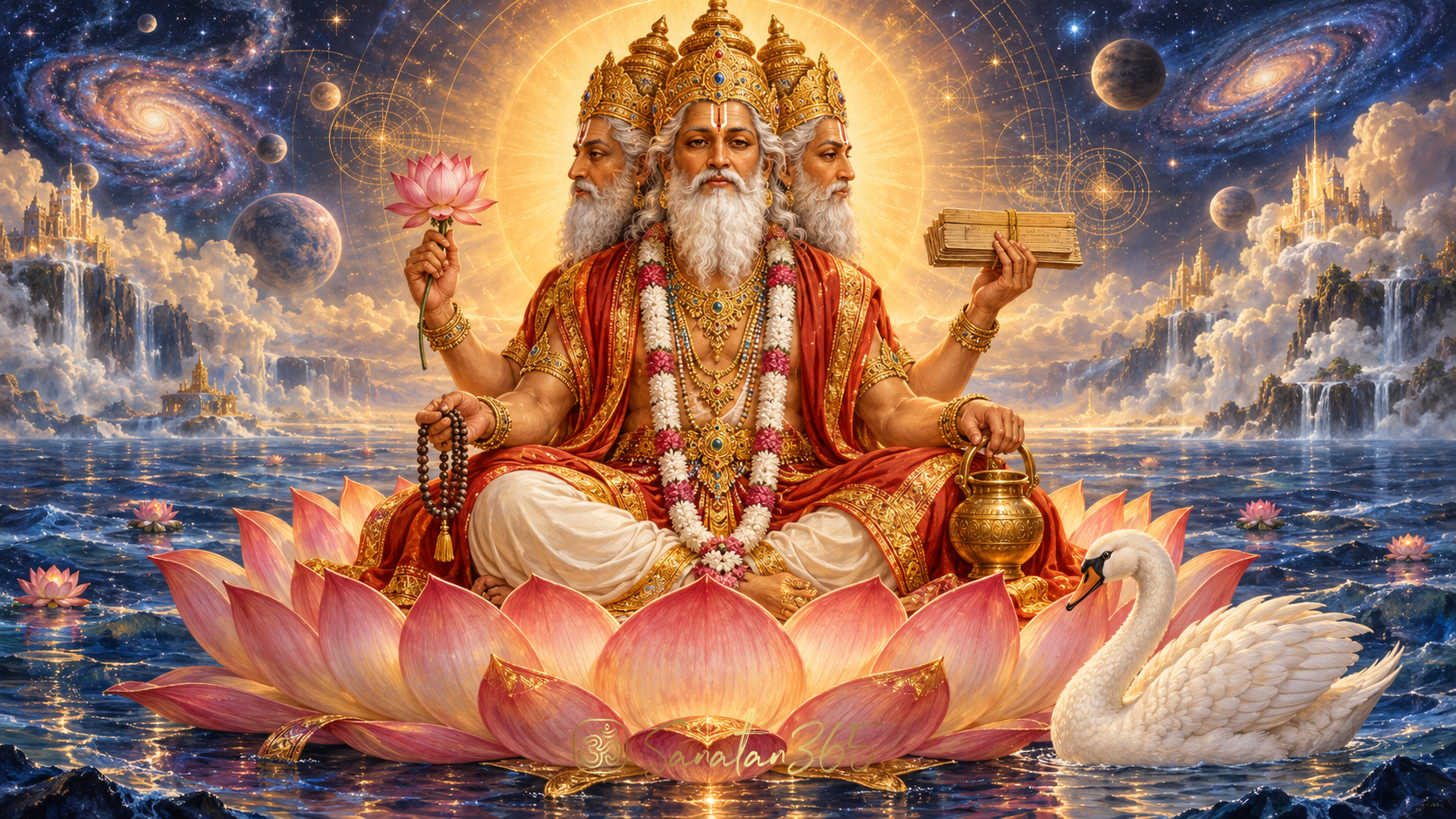
Brahma Deva Meaning: Four Faces, Creation, and Sacred Knowledge
Understand Brahma, the Hindu creator deity, through his four faces, lotus imagery, sacred knowledge, and a careful distinction from Brahman…
 Deities
Ushas, the Vedic Goddess of Dawn: Light, Renewal, and Time
Ushas, the Vedic goddess of dawn, appears in the Rigveda as radiant light that awakens life, calls beings to activity, and reveals both ren…