Drekkana Chart Meaning: How the D3 Divides a Birth Chart
Understand the Drekkana D3 chart through ten-degree divisions, worked examples, its traditional focus on siblings, and clear limits on interpretation.
A planet can remain in one zodiac sign in a birth chart and appear in another in its D3 chart without moving anywhere in the sky.
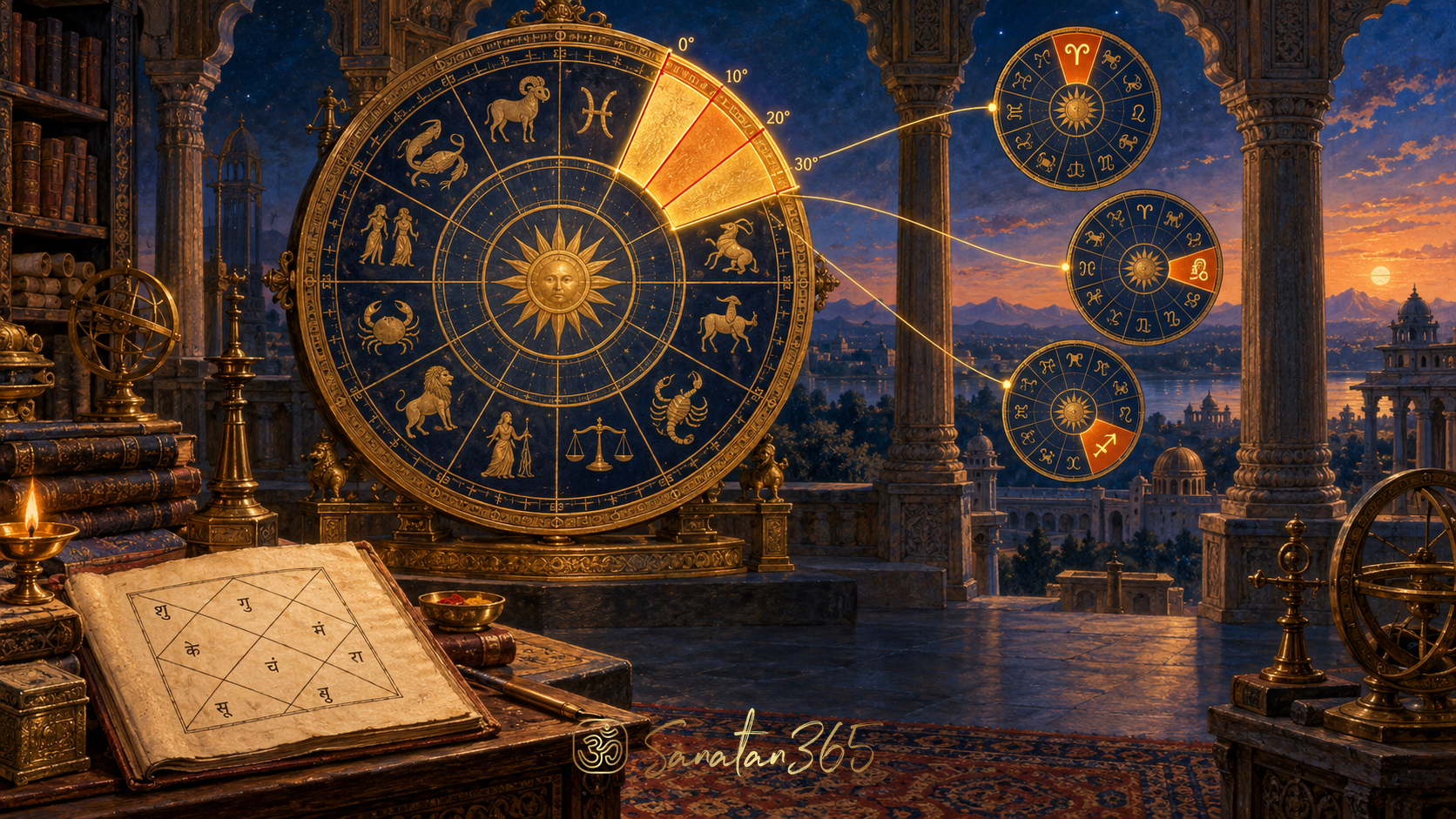
Drekkana chart meaning begins with division. A drekkāṇa (द्रेक्काण, a one-third portion of a zodiac sign) divides each thirty-degree sign into three ten-degree parts. In the common Parashari method, those parts map to the first, fifth and ninth signs counted from the original sign. The resulting D3 is a divisional chart traditionally consulted about siblings. It belongs to Jyotiṣa (ज्योतिष, the Indian astrological tradition), not to a scientifically established method of predicting family life.
Understanding the construction first makes the interpretation less mysterious. It also helps readers distinguish an exact calculation from a claim about what that calculation means.
Drekkana chart meaning: what does D3 represent?
A kuṇḍalī (कुण्डली, an astrological birth chart) commonly begins with the D1, the main chart showing the zodiac signs occupied by the planets and the ascendant. A rāśi (राशि, zodiac sign) spans thirty degrees. A varga (वर्ग, division or divisional chart) takes a position within that sign and assigns it to a sign in another chart according to a stated rule.
The number in D3 tells the reader that each sign is divided into three portions. It does not mean the third house has been copied, that the chart covers three years, or that a person has three siblings. Those are different kinds of statement.
The textual basis is specific. In the Brihat Parashara Hora Shastra, chapter 6, verses 7–8, a sign's three divisions are assigned to its first, fifth and ninth signs. Chapter 7, verses 1–8, associates the Drekkana with happiness through “co-born,” an older English expression for siblings. The text's discussion of divisional charts establishes the traditional rule and subject association; it does not establish the empirical accuracy of a prediction.
That distinction is respectful rather than dismissive. A reader can study a tradition carefully, understand its vocabulary and recognize its place in family culture without treating every interpretation as certainty. The D3 is best introduced as a particular interpretive lens within a larger system.
It also remains distinct from the D9. The Navamsa chart uses nine divisions and a different assignment rule. A familiar planetary name appearing in both charts does not make their purposes interchangeable.
Key takeaway: D3 names a threefold chart construction; its traditional sibling association is an interpretation, not a literal count or guaranteed forecast.
How do ten-degree divisions become a separate chart?
Begin with a planet's position within its sign, not its total longitude measured from the beginning of the zodiac. A planet at seventeen degrees of Taurus belongs to the second ten-degree portion of Taurus. The calculation has not yet said anything about its house or its relationships with other planets.
The common Parashari rule can be written in three steps:
- From 0° up to, but not including, 10°: assign the planet to the same sign in D3.
- From 10° up to, but not including, 20°: assign it to the fifth sign counted inclusively from its original sign.
- From 20° up to, but not including, 30°: assign it to the ninth sign counted inclusively from its original sign.
Inclusive counting is the detail most likely to cause a beginner's error. The starting sign is one, not zero. From Aries, the count runs Aries one, Taurus two, Gemini three, Cancer four, Leo five. The fifth sign from Aries is therefore Leo, not Virgo.
Each planet is processed separately. The sign occupied by the Sun does not determine the Moon's D3 sign. Nor does the ascendant's division replace the need to calculate every other position.
For readers who want the geometry, label the twelve signs from zero to eleven. If the original sign has index s, the destination index is s, s + 4, or s + 8, reduced to the twelve-sign cycle. This formula is simply another way of expressing inclusive first-fifth-ninth counting. It is not an additional predictive rule.
At exactly 10°00′, the second portion begins. At exactly 20°00′, the third begins. A display rounded to “10°” may hide a position of 9°59′50″. Checking the unrounded value prevents a boundary disagreement from being mistaken for an interpretive mystery.
Some software also displays degrees within the destination sign. For a straightforward proportional mapping, the offset inside the ten-degree portion is multiplied by three. The beginner's first task, however, is to confirm the destination sign and the selected method, rather than assume every application's extended display uses identical settings.
Key takeaway: Find the ten-degree portion, count from the original sign inclusively, and check exact boundary values before interpreting anything.
What do worked examples reveal about the first-fifth-ninth rule?
Consider three imaginary positions in Aries. They are arithmetic illustrations, not descriptions of anyone's temperament or future.
| Original position | Portion of Aries | D3 destination |
|---|---|---|
| 6° Aries | First ten degrees | Aries |
| 16° Aries | Second ten degrees | Leo |
| 26° Aries | Third ten degrees | Sagittarius |
All three begin in Aries in the D1. Their different D3 destinations reflect their different positions within Aries. Nothing in the table implies that a planet physically entered Leo or Sagittarius at the birth moment.
Now change the starting sign. A hypothetical planet at 17° Taurus lies in the second portion. Count Taurus one, Gemini two, Cancer three, Leo four and Virgo five. Its Parashari D3 destination is Virgo. A planet at 24° Taurus belongs to the third portion, assigned to Capricorn, the ninth sign from Taurus.
This second example matters because it blocks a common shortcut: “the second division is always Leo.” Leo is the second-division destination for Aries, not for every sign. The rule travels with the starting sign.
A third example shows the wraparound. At 23° Pisces, the third portion applies. Count Pisces as one and continue through Aries, Taurus, Gemini, Cancer, Leo, Virgo, Libra and Scorpio. Scorpio is nine. The end of the twelve-sign list is not the end of the calculation.
If the Taurus example is extended to degrees, 17° Taurus is seven degrees into its second ten-degree portion. Multiplying seven by three gives 21° in the destination sign, Virgo, under proportional mapping. That worked result should not be generalized to a different Drekkana method without checking its rules.
There is also a visual lesson. North Indian and South Indian chart layouts arrange signs and houses differently on the page. A sign label can occupy a different-looking box without the underlying destination sign changing. Read the labels and chart heading, not just the shape of the drawing.
Key takeaway: The destination depends on both the original sign and the portion; an altered diagram does not necessarily mean an altered calculation.
Why is the D3 associated with siblings and courage?
The clearest starting point is the classical sibling association, rather than a long list of modern claims. The divisional-considerations passage cited above assigns happiness through siblings to the Drekkana. Its language directs attention to a relationship theme; it does not invite a beginner to reduce another person's life to a single chart box.
Courage is often included in contemporary D3 discussions through its connection with third-house themes. That is a broader interpretive association, not a replacement for the classical passage's wording. Likewise, a D3 chart is not identical to the third house of the D1. The twelve houses in a birth chart form a separate framework that must be distinguished from the twelve signs and the chart's threefold construction.
Within traditional practice, an interpreter may compare the D3 with the main chart, examine the relevant house and its ruler, and consider planetary relationships. Such a reading involves choices of school, definitions and judgment. It cannot be recreated responsibly by seeing one planet in one box and searching for a dramatic verdict.
For family readers, the most useful boundary is straightforward: a chart should not become evidence that a sibling is untrustworthy, destined to fail, or responsible for difficulty. Actual conduct, communication and circumstances deserve direct attention. A symbolic reading cannot establish another person's motives.
Nor does the traditional word “co-born” justify ranking the value of different family forms. People grow up with siblings, cousins, step-siblings, adoptive siblings, or no siblings. A historical interpretive category is not a measure of the worth of those relationships.
One can retain an interest in inherited astrological language while acting generously in the present. Asking how to share responsibilities or repair a misunderstanding is more constructive than treating a chart interpretation as an irreversible family judgment. This is practical ethical reflection, not a claim that a particular D3 placement produces a virtue.
Key takeaway: Traditional relationship symbolism should invite careful interpretation, never become a verdict against a family member.
How should a beginner check a Drekkana reading responsibly?
Before accepting an interpretation, check whether the charts being compared were constructed on the same basis. Many apparent disagreements arise before interpretation begins.
A useful review follows this order:
- Confirm the chart label. Is the display D1, D3 or another division?
- Confirm the method. Does the software specify the common Parashari first-fifth-ninth rule, or another named Drekkana scheme?
- Confirm the input record. Check date, recorded time, birthplace and time-zone handling.
- Confirm the zodiac settings. Different underlying zodiac choices can change the starting sign or its precise degree.
- Inspect boundaries. Use the detailed position rather than a rounded sign-and-degree summary.
- Ask for reasoning. An interpreter should explain the stated rule and the limits of the conclusion.
The ascendant deserves particular care because it is derived from the time and location. Its D3 placement may change when the underlying ascending degree crosses a division boundary. Planetary positions also change at their own rates. It would be misleading to say that every planet changes its D3 sign whenever the recorded time changes by a few minutes.
An inaccurate birth time should therefore be acknowledged as uncertainty, not repaired by choosing whichever chart produces a pleasing story. The meaning of the ascendant is helpful background for understanding why time and location matter.
Regional language can add another layer without changing the basic calculation. A family may say kundali, horoscope or birth chart, while an astrologer may use Drekkana, Dreshkana or a related transliteration. Ask which calculation is intended instead of treating spelling differences as proof of different systems. Conversely, a shared spelling does not guarantee identical software settings.
Finally, separate cultural study from consequential decisions. The D3 cannot verify a sibling's intentions, replace a difficult conversation, or supply a guaranteed outcome. Understanding its arithmetic supports clearer questions; it does not eliminate the uncertainty of human life.
Key takeaway: A transparent method, honest inputs and modest conclusions matter more than a dramatic interpretation.
The most valuable beginning is neither fear nor blind confidence. It is the ability to see exactly what was calculated, recognize why tradition assigns it meaning, and keep responsibility for relationships in human hands.
FAQ
What is the difference between Drekkana and D3?
Drekkana is the traditional name for the threefold division and its associated chart. D3 is modern numerical shorthand. The name alone does not specify every software option, so confirm the calculation method when comparing results.
How is a Parashari D3 chart calculated?
Divide each thirty-degree sign into three ten-degree portions. Map the first portion to the same sign, the second to the fifth sign and the third to the ninth, counting the original sign as one. Apply the rule separately to each position.
Does a different D3 sign mean the birth chart is wrong?
No. A planet can occupy one sign in D1 and another in D3 because the D3 is derived from its position within the original sign. It is a mathematical reassignment, not a second observation of a planet moving in the sky.
Can the D3 determine exactly how many siblings someone has?
It should not be treated as a reliable counting device or a guaranteed description of family circumstances. Its traditional sibling focus belongs to a larger interpretive system and does not establish factual certainty about another person's life.
Is the D3 the same as the Navamsa chart?
No. D3 uses three divisions per sign; D9 uses nine and follows a different construction. Traditional texts give them different areas of emphasis. Understanding one chart does not justify applying its rules to the other.
About the author
Sanatan365 Editorial
Bringing Sanatan Dharma to modern seekers through authentic, scripture-grounded content.
Related in Kundali
 Kundali
Bhava Chalit Chart Meaning: Why Houses Change but Signs Do Not
Read a Bhava Chalit chart without confusing a planet’s zodiac sign with its calculated house. Understand midpoint conventions, a worked exa…
 Kundali
Vargottama Meaning: When D1 and D9 Repeat a Zodiac Sign
Understand the same-sign relationship between a birth chart and its Navamsa, how to identify it, and why it is not a stand-alone promise of…
 Kundali
Atmakaraka Meaning: The Soul Significator in Jaimini Astrology
Atmakaraka means the significator of the self or soul in Jaimini astrology. It is identified through a planet's relative degree within its…

