Navamsa Chart Meaning: D9, Marriage, Dharma, and Inner Strength
A clear guide to the Navamsa chart, or D9, in Vedic Kundali: what it means, how it is formed, and why it is read with care.
A birth chart may look complete at first glance, yet Jyotisha often asks for a second, quieter reading.
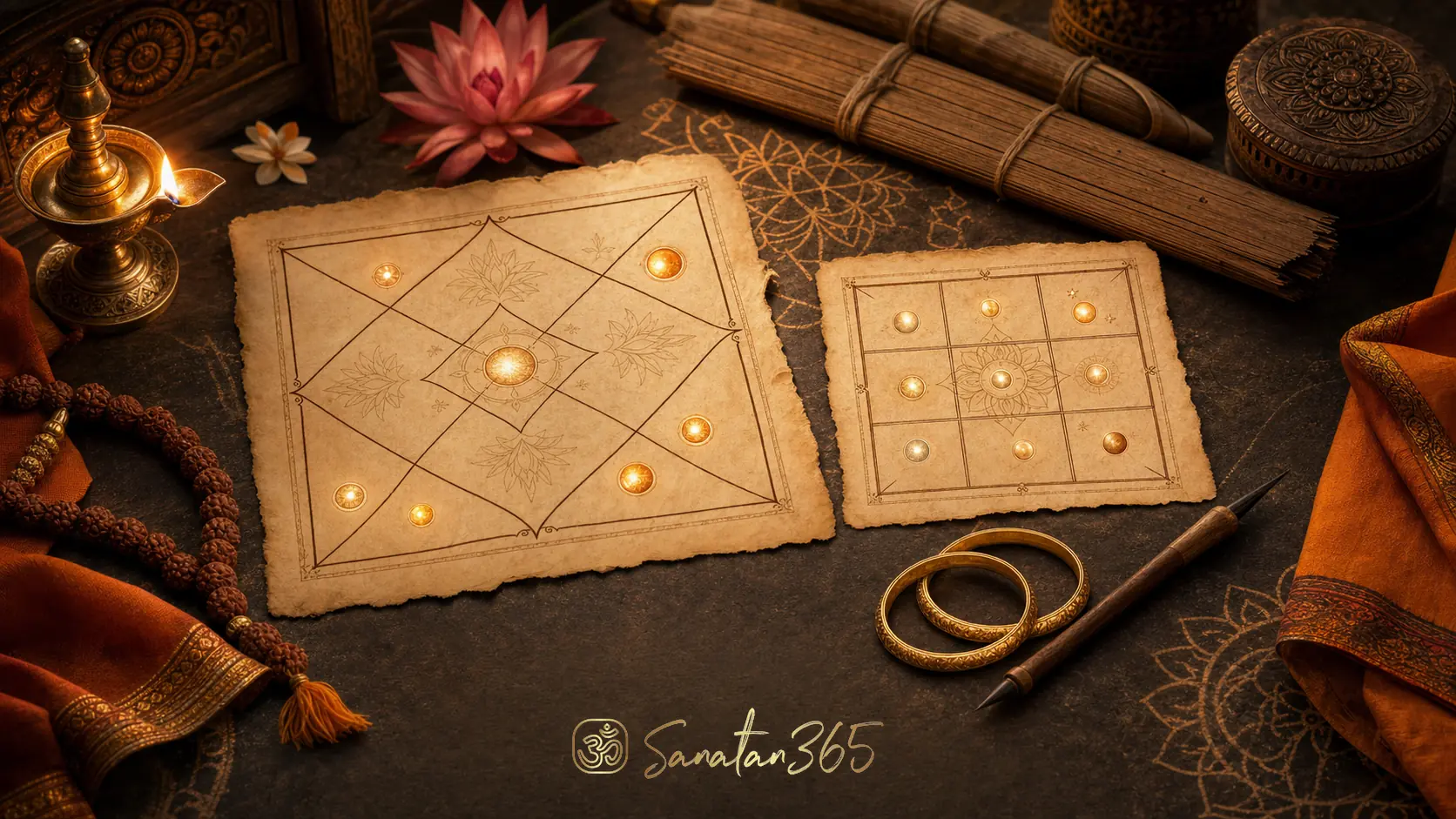
Navamsa chart meaning is simple at the surface: Navamsa (नवांश, navamsha, "one-ninth part") is the D9 divisional chart used with a Vedic Kundali to study the deeper strength of planets, marriage themes, dharma, and inner maturity. It does not replace the main birth chart, called the Rashi or D1 chart. It refines it, much like a close reading refines a first impression.
Key takeaway: The Navamsa chart is best understood as a supporting lens, not a standalone destiny statement.
What is the Navamsa chart meaning in Vedic Kundali?
The Navamsa chart meaning begins with the Sanskrit word itself. Nava means "nine" and amsa means "part" or "division." WisdomLib records navamsha as a one-ninth division in Sanskrit mathematical usage, which fits the astrological idea of dividing each zodiac sign into nine parts WisdomLib.
In Vedic astrology, or Jyotisha (ज्योतिष, the traditional study of light, time, and celestial indications), a Kundali is not read through one chart alone. Classical systems use vargas (वर्ग, divisions) to inspect a birth chart from different levels of detail. The D1 or Rashi chart gives the primary structure. The D9 or Navamsa chart gives a finer layer.
Each zodiac sign spans 30 degrees. In Navamsa, that sign is divided into nine equal parts. Each part is 3 degrees and 20 minutes. A planet's exact degree in the Rashi chart decides where it falls in the Navamsa chart. This is why two people born close together can share a similar Rashi rising sign while having a different Navamsa Lagna (लग्न, ascendant), especially when the birth time shifts by several minutes.
This does not mean D9 is more "true" than D1. A responsible reading keeps both together. The D1 chart shows the visible field of life. The D9 chart helps the astrologer ask whether the inner promise of a planet is steady, strained, refined, or still maturing.
Key takeaway: Navamsa is the one-ninth divisional chart that adds precision to the main Kundali.
Why is the D9 chart not only about marriage?
Many beginners first hear about the D9 chart in the context of marriage. That is understandable because Navamsa is traditionally important for spouse, partnership, and marital harmony. Contemporary Navamsa references often describe D9 as one of the most consulted charts after the birth chart for relationship analysis Prokerala.
But it is too narrow to say that Navamsa is only a marriage chart. Classical Jyotisha gives D9 broader importance because partnership itself is not merely social. In Hindu thought, marriage is connected with grihastha ashrama (गृहस्थ आश्रम, the householder stage), dharma (धर्म, sustaining duty and right order), responsibility, vows, and shared spiritual growth. A chart that speaks about marriage naturally touches character, maturity, values, and the capacity to honor commitment.
This is why many astrologers read Navamsa for:
- The deeper dignity and strength of planets.
- Marriage and long-term partnership themes.
- Dharma, maturity, and values that unfold with time.
- Whether a planet's outer promise is supported internally.
- The way a person grows through responsibility, devotion, and discipline.
For example, if a planet looks impressive in D1 but weak or unsettled in D9, an astrologer may read that planet with caution. If a planet has modest placement in D1 but gains strength in D9, the reading may become more nuanced. In both cases, the astrologer should avoid dramatic certainty. Jyotisha is a language of tendencies, not a license for fear.
Key takeaway: The D9 chart includes marriage, but its deeper subject is maturity through dharma.
How is Navamsa calculated?
The basic calculation is elegant. One sign equals 30 degrees. Divide 30 by nine and each Navamsa section becomes 3 degrees and 20 minutes. Applied Jyotish gives the same standard definition for the D9 division and notes its use in Parashari Jyotisha Applied Jyotish.
A simplified example:
- A planet is placed at 12 degrees of a sign in the D1 chart.
- Each Navamsa segment is 3 degrees and 20 minutes.
- The planet's degree falls into one of the nine segments.
- That segment maps into a Navamsa sign according to traditional rules.
- The D9 chart is drawn from these mapped positions.
This is why exact birth time matters. The Moon, planets, and especially the Lagna can shift in divisional charts more sensitively than in the main birth chart. A small birth-time error may not visibly change the D1 chart, but it can change key divisional placements.
The same principle helps explain why Navamsa should be read with humility. If the birth time is uncertain, the D9 Lagna and house positions may also be uncertain. An astrologer may still examine planetary Navamsa signs, but strong life conclusions should be made carefully.
Key takeaway: Navamsa divides each sign into nine precise sections, so accuracy and restraint matter.
What does Vargottama mean in the D9 chart?
Vargottama (वर्गोत्तम, "excellent in division") is one of the most discussed Navamsa ideas. A planet is commonly called Vargottama when it occupies the same zodiac sign in the D1 chart and the D9 chart. For instance, if Jupiter is in Cancer in the Rashi chart and also falls in Cancer in Navamsa, many astrologers treat that as a sign of strengthened consistency.
The concept matters because Jyotisha is not only asking, "Where is the planet placed?" It also asks, "Does the planet hold its promise across layers?" When a placement repeats across important vargas, the symbolism can become more stable.
But Vargottama should not be turned into a simplistic guarantee. A planet still needs context:
- Is it benefic or challenging for that Lagna?
- What houses does it rule?
- Is it afflicted by difficult aspects or conjunctions?
- What dasha (दशा, planetary period) is active?
- Does the overall chart support the promise?
This is the disciplined way to read Navamsa. The D9 chart sharpens the view, but it does not erase the rest of the Kundali. Readers who want the foundation of the main chart can pair this with Kundali Houses Meaning: The 12 Bhavas in a Vedic Birth Chart and Panchang Meaning: How Hindu Time Is Read Through Five Limbs.
Key takeaway: Vargottama can show consistency across D1 and D9, but it still needs whole-chart interpretation.
How should beginners read D9 without fear?
The safest beginner approach is to read the Navamsa chart as a contemplative layer, not as a verdict. In traditional Hindu culture, astrology is meant to support viveka (विवेक, discernment), not panic. A chart can invite discipline, prayer, self-knowledge, and better decisions. It should not make a person fatalistic.
Beginners can start with five questions:
- Which planets become stronger or more settled in D9?
- Which planets need patience, discipline, or conscious practice?
- Does the D9 support what the D1 seems to promise?
- What does the chart suggest about commitment and values?
- How can the person respond through dharma rather than fear?
This last question is the most important. If the chart shows relational lessons, the answer may be honesty, steadier communication, and humility. If it shows spiritual longing, the answer may be sadhana (साधना, regular spiritual practice). If it shows delayed maturity, the answer may be patience and skillful effort.
Navamsa is also a reminder that life ripens. Some parts of a person are visible early. Others are shaped through vows, family responsibilities, seva (सेवा, service), study, and inner discipline. The D9 chart is valuable because it points to this ripening process.
Key takeaway: A wise Navamsa reading should reduce confusion, not increase fear.
What are common mistakes in Navamsa interpretation?
The first mistake is reading D9 without D1. The Navamsa chart is powerful precisely because it is relational to the birth chart. Taking it alone is like reading a commentary without reading the original text.
The second mistake is using D9 to make harsh claims about marriage. A difficult placement may show work, delay, or lessons. It does not automatically mean misery. Hindu astrology at its best leaves room for karma (कर्म, action and consequence), upaya (उपाय, remedial discipline), grace, and human effort.
The third mistake is ignoring culture. Marriage readings in Jyotisha arose in a society where family, dharma, ritual duty, and household continuity were deeply linked. Modern readers, especially in diaspora families, may need careful translation. The language of partnership should be respectful, practical, and free from caste, gender, or social superiority claims.
The fourth mistake is chasing scattered online rules. One page may say the D9 activates after a certain age. Another may say it is only for spouse. Another may make sweeping statements about one planet. These rules can be useful as study notes, but a real Kundali reading requires synthesis.
The fifth mistake is turning astrology into prediction entertainment. The Brihat Parashara Hora Shastra tradition, preserved in editions available through Internet Archive, belongs to a serious Jyotisha lineage and should be approached with study rather than quick conclusions Internet Archive.
Key takeaway: Navamsa interpretation needs context, humility, and a whole-chart method.
How does Navamsa connect with dharma?
The number nine carries a natural connection with dharma in Jyotisha because the ninth house is associated with higher learning, blessings, teachers, pilgrimage, and sacred duty. This does not mean the D9 chart is simply "the ninth house." It means the symbolic atmosphere of the ninth division often points toward refinement, purpose, and the maturing of values.
That is why D9 can feel intimate. It asks what remains when the outer identity is tested. It asks how a person behaves inside commitment. It asks whether knowledge becomes character. It asks whether prosperity, love, talent, or status can be guided by dharma.
In this sense, the Navamsa chart can be read alongside articles like Guru Brahma Guru Vishnu Mantra Meaning: Honoring the Teacher or Yama and Niyama Meaning: Yoga's Ethical Foundation for Daily Life, because all three point toward the same principle: inner life matters. A chart is not just a map of events. It is also a mirror for discipline, reverence, and responsibility.
Key takeaway: Navamsa is valuable because it turns astrology from surface prediction toward inner alignment.
Conclusion
Navamsa chart meaning is best remembered in one line: the D9 chart is a one-ninth divisional chart that helps Vedic astrologers read marriage, dharma, planetary strength, and inner maturity alongside the main Kundali. It is precise, but it should be interpreted gently. It can show promise, pressure, and refinement, but it should never be used to frighten someone or flatten a life into one placement.
Key takeaway: Read Navamsa as a sacred second lens, with the D1 chart, with humility, and with faith in conscious action.
FAQ
What is the Navamsa chart in simple words?
The Navamsa chart, or D9 chart, is a divisional chart made by dividing each zodiac sign into nine equal parts. It is read with the main birth chart to understand deeper planetary strength, marriage themes, dharma, and maturity.
Is the D9 chart only for marriage?
No. Marriage is one important area of Navamsa, but the D9 chart is also used for dharma, inner character, planetary dignity, commitment, and how life matures through responsibility.
Can Navamsa override the birth chart?
No. Navamsa should not override the D1 birth chart. It refines and supports interpretation. A serious reading studies both charts together, along with dasha, house rulership, aspects, and the overall Kundali.
What does Vargottama mean?
Vargottama means a planet occupies the same sign in the main birth chart and in a divisional chart such as Navamsa. It is often read as added consistency or strength, but it still needs full-chart context.
Should beginners read their own D9 chart?
Beginners can study the D9 chart for learning, but they should avoid fearful conclusions. Start with basic meanings, check birth-time accuracy, compare D9 with D1, and use the chart for reflection rather than fatalistic prediction.
About the author
Sanatan365 Editorial
Bringing Sanatan Dharma to modern seekers through authentic, scripture-grounded content.
Related in Kundali
 Kundali
Atmakaraka Meaning: The Soul Significator in Jaimini Astrology
Atmakaraka means the significator of the self or soul in Jaimini astrology. It is identified through a planet's relative degree within its…
 Kundali
Ashtakavarga Meaning: How Bindus Help Read Planetary Support
Ashtakavarga is a classical Jyotisha method that maps planetary support across the twelve signs through bindus. Learn what the scores mean,…
 Kundali
Vimshottari Dasha Meaning: Mahadasha, Antardasha, and the 120-Year Cycle
A grounded guide to Vimshottari Dasha: how the birth nakshatra starts the sequence, how Mahadasha and Antardasha work, and how to read plan…