Lagna Meaning in Kundali: Ascendant, Houses, and Birth Time
Lagna is the rising sign at birth and the starting point of a Vedic birth chart. Learn how it shapes houses, timing, and careful Kundali reading.
A Kundali does not begin with a prediction. It begins with a direction in the sky.
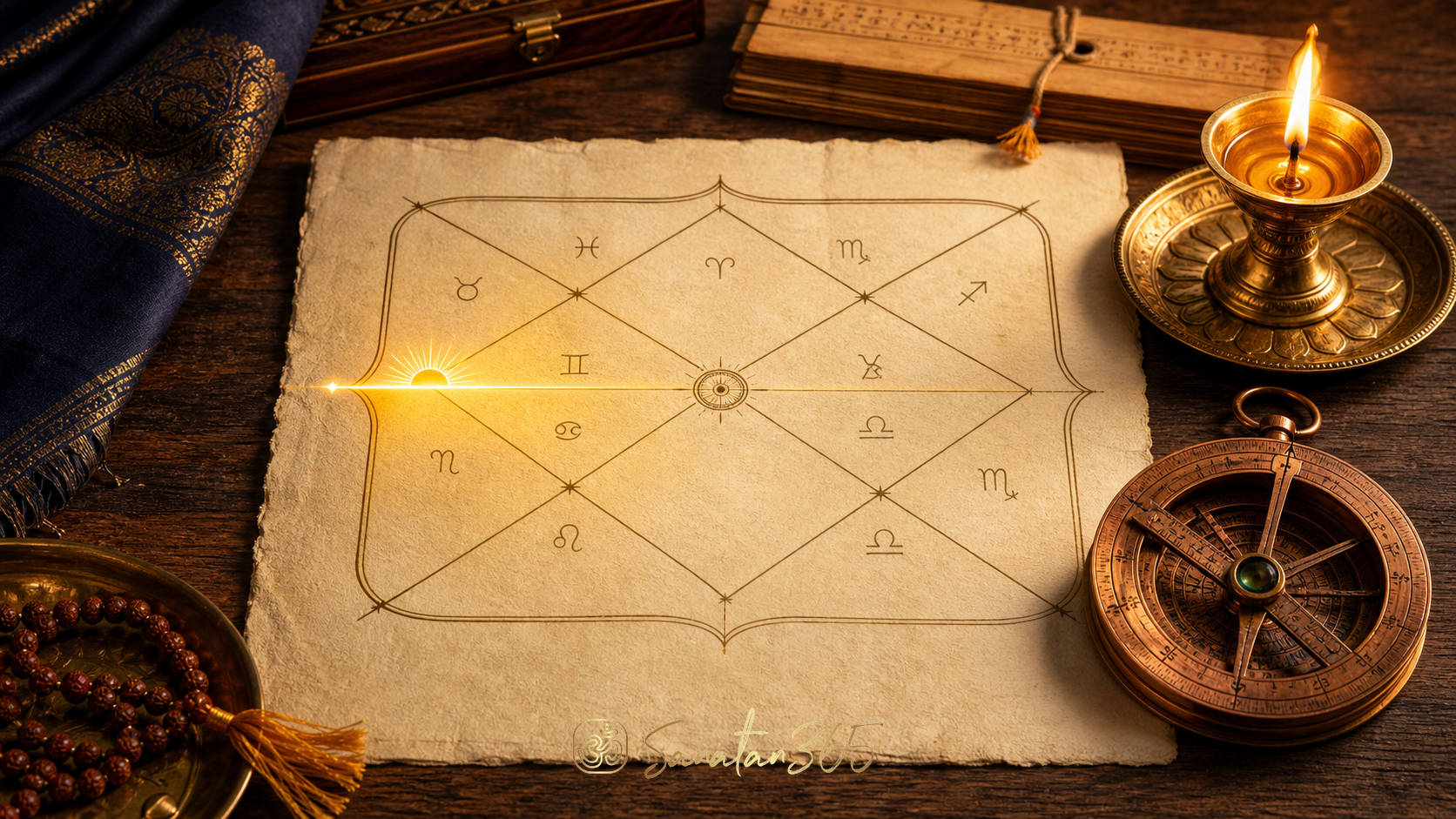
Lagna meaning in Kundali is simple at the surface: Lagna (लग्न, ascendant or rising sign) is the zodiac sign rising on the eastern horizon at the exact time and place of birth. In Vedic astrology, or Jyotisha (ज्योतिष, the traditional study of light and time), this point becomes the first house of the chart. From Lagna, the remaining houses are counted, the body's life setting is read, and many chart judgments begin. That is why birth time matters so deeply in Kundali reading.
This article explains Lagna with care: what it is, why it is different from the Moon sign or Sun sign, how it organizes the twelve houses, and how a seeker can approach it without superstition or fear.
What Is Lagna Meaning in Kundali?
Lagna is the point where the zodiac appears to rise in the east at birth. Traditional Vedic charting calls this Janma Lagna (जन्म लग्न, birth ascendant). Drik Panchang's Lagna calculator gives the same basic definition: Janma Lagna is the zodiac sign rising at the eastern horizon at the time of birth (Drik Panchang).
That definition sounds astronomical, but its role in Kundali is interpretive. Once the rising sign is identified, it becomes the first house. The next sign becomes the second house, the next becomes the third, and so on around the chart. In this way, Lagna is the chart's doorway.
If a person is born when Mesha (मेष, Aries) is rising, Mesha becomes the first house. Vrishabha (वृषभ, Taurus) becomes the second, Mithuna (मिथुन, Gemini) becomes the third, and the full house sequence follows from there. If Karka (कर्क, Cancer) is rising, Karka becomes the first house instead. The same planets can therefore fall into different houses depending on the exact birth time and place.
This is why Lagna is not only a label. It is the organizing principle of the chart.
Key takeaway: Lagna is the birth chart's first-house anchor, not merely another zodiac sign.
Why Does Birth Time Matter So Much for Lagna?
Lagna changes through the day because Earth rotates. The eastern horizon keeps moving through the zodiac, so a small change in birth time can shift the rising sign, the house placements, or the exact degree of Lagna. This is especially important near the boundary between two signs.
For a careful Kundali reading, three pieces of birth information are usually required:
- Date of birth.
- Exact time of birth.
- Place of birth.
The date helps determine planetary positions. The place fixes the local horizon. The time joins the two and reveals what was rising. Without reliable birth time, an astrologer may still discuss broad planetary themes, but house-based interpretation becomes weaker.
This is also why families in India often preserve birth times carefully in notebooks, hospital records, or family memory. The point is not blind fatalism. It is precision. A Kundali is a time map, and Lagna is one of its most time-sensitive points.
Traditional texts place high importance on the ascendant and house framework. The Brihat Parashara Hora Shastra, a major Jyotisha text attributed to Maharshi Parashara, treats Lagna and house lords as central tools for chart interpretation (Internet Archive text scan). Modern readers should approach such texts with respect and discernment, remembering that translations, lineages, and interpretive methods vary.
Key takeaway: Birth time matters because Lagna depends on the local eastern horizon at the moment of birth.
How Is Lagna Different from Rashi, Sun Sign, and Moon Sign?
Many beginners confuse Lagna with Rashi or with the popular Sun sign. They are connected, but they are not the same.
Lagna is the rising sign. It relates to the chart's starting point, the body, outward life setting, first impressions, and the way the twelve houses are arranged.
Rashi (राशि, sign) can mean a zodiac sign generally, but in common Indian usage it often refers to Chandra Rashi (चन्द्र राशि, Moon sign), the sign occupied by the Moon at birth. The Moon sign is important for mind, emotion, habit, and many timing systems.
The Sun sign is the sign occupied by the Sun. In popular Western astrology it is often treated as the main identity marker, but Vedic astrology usually gives major importance to Lagna and Moon sign, alongside the Sun and other grahas (ग्रह, planetary influences).
A simple comparison helps:
- Lagna asks: What sign was rising in the east when this life began?
- Moon sign asks: Where was the Moon, and how does the mind receive life?
- Sun sign asks: Where was the Sun, and what does it show about vitality and authority?
This distinction is useful for families who have heard different labels from elders, temple priests, newspaper columns, or online calculators. A person may say, "My Rashi is Simha," while another may ask, "What is your Lagna?" Both questions can be meaningful, but they are not interchangeable. Confusing them can lead to mismatched house readings, especially when discussing marriage matching, career houses, or the timing of major life phases.
No single point should be isolated from the whole chart. Lagna is foundational, but it is interpreted with planets, houses, aspects, dashas (दशा, planetary periods), and the larger pattern of the Kundali.
Key takeaway: Lagna sets the chart's house structure, while Moon sign and Sun sign answer different questions.
What Does Lagna Show in a Kundali?
In classical Kundali reading, Lagna is linked with the first house, also called Tanu Bhava (तनु भाव, house of the body or self). It can show the physical vessel, temperament, outward orientation, health pattern, and how a person begins things. This does not mean Lagna "decides everything." It means the first house is one of the first places a reader studies.
The planet ruling the Lagna sign is called Lagnesh (लग्नेश, lord of the ascendant). For example, if Mesha is Lagna, Mars is the Lagnesh. If Vrishabha is Lagna, Venus is the Lagnesh. The condition of the Lagnesh, its house, dignity, aspects, and relationships with other planets are studied to understand how the ascendant's energy functions.
A careful reader may ask:
- Is the Lagnesh strong, supported, or strained?
- Which house does the Lagnesh occupy?
- Are benefic or challenging influences connected to Lagna?
- Does the Moon support or complicate what Lagna suggests?
- Do divisional charts confirm or soften the main chart reading?
This is where Kundali reading becomes nuanced. Lagna may show the doorway, but the whole house has to be entered before conclusions are drawn.
For readers exploring related chart structure, Sanatan365's Kundali Reports by Jaimini Rishi can be used as a guided starting point, while deeper life decisions should always involve mature judgment and, where needed, qualified human advice.
Key takeaway: Lagna shows the first-house foundation, while Lagnesh reveals how that foundation acts in the chart.
How Does Lagna Shape the Twelve Houses?
The twelve houses of a Kundali are read from Lagna. This is one reason the same planet can mean different things in different charts. A planet in the same zodiac sign may occupy one person's second house and another person's tenth house, depending on Lagna.
The houses are commonly associated with broad life areas:
- First house: body, self, appearance, beginning.
- Second house: speech, family resources, food, values.
- Third house: effort, siblings, courage, skills.
- Fourth house: home, mother, emotional ground, property.
- Fifth house: learning, children, mantra, creativity.
- Sixth house: service, illness, debts, discipline.
- Seventh house: partnership, marriage, public dealings.
- Eighth house: transformation, inheritance, hidden matters.
- Ninth house: dharma, teacher, blessings, pilgrimage.
- Tenth house: karma, work, public responsibility.
- Eleventh house: gains, networks, elder siblings.
- Twelfth house: loss, liberation, sleep, foreign lands.
These meanings are broad guideposts, not mechanical verdicts. A house is read through its sign, lord, occupants, aspects, strength, and timing. That is why Kundali study rewards patience.
Readers who want to compare house frameworks can also read Kundali Houses Meaning: The 12 Bhavas in a Vedic Birth Chart and Navamsa Chart Meaning: D9, Marriage, Dharma, and Inner Strength. Those topics show how the main chart and divisional chart systems build on Lagna-based structure.
Key takeaway: Lagna determines the house order, so it changes how every planetary placement is interpreted.
How Should a Modern Seeker Read Lagna Without Fear?
Lagna should not be used to frighten people. Jyotisha at its best is a language of timing, tendencies, responsibility, and self-observation. It can help a person notice patterns, but it should not replace ethical action, devotion, medical care, legal guidance, or personal responsibility.
For modern readers, a balanced Lagna study can follow five principles:
- Start with definition, not prediction. First understand the rising sign and house structure.
- Read the whole chart. Do not judge life from Lagna alone.
- Respect birth-time uncertainty. If the time is approximate, say so clearly.
- Avoid fatalistic language. A Kundali points to tendencies and timing, not spiritual imprisonment.
- Keep dharma central. The purpose of insight is wiser action, not anxiety.
This balanced approach is close to the deeper spirit of Sanatan Dharma: life is shaped by karma (कर्म, action), dharma (धर्म, right order and duty), grace, and conscious choice. A chart can be a mirror, but the seeker still has to live with courage and humility.
Key takeaway: Lagna is useful when it supports self-knowledge, not when it becomes fear.
Conclusion
Lagna is one of the most important foundations of a Kundali because it shows the rising sign, begins the first house, and organizes the twelve-house structure of the birth chart. It is different from the Moon sign and Sun sign, and it depends strongly on accurate birth time and birthplace.
Key takeaway: Understand Lagna as the Kundali's doorway, then read it with the whole chart, ethical care, and spiritual steadiness.
FAQ
What is Lagna meaning in Kundali?
Lagna meaning in Kundali is the ascendant or rising sign at the time and place of birth. It becomes the first house of the Vedic birth chart and sets the order of the remaining houses.
Is Lagna the same as Rashi?
No. Lagna is the rising sign. Rashi often refers to the Moon sign in common Indian usage, though the word can mean any zodiac sign. Both are important, but they answer different chart questions.
Why is exact birth time needed for Lagna?
Exact birth time is needed because Lagna depends on the sign rising at the local eastern horizon. Since the horizon changes through the day, even a small birth-time error can affect the ascendant or house placements.
What is Lagnesh in Vedic astrology?
Lagnesh is the lord of the Lagna sign. If Taurus is rising, Venus is Lagnesh. If Leo is rising, the Sun is Lagnesh. Its position and condition help astrologers read the strength and expression of the first house.
Can Lagna predict everything about life?
No. Lagna is foundational, but it does not predict everything by itself. A careful Kundali reading considers planets, houses, aspects, dashas, divisional charts, and practical life context.
About the author
Sanatan365 Editorial
Bringing Sanatan Dharma to modern seekers through authentic, scripture-grounded content.
Related in Kundali
 Kundali
Atmakaraka Meaning: The Soul Significator in Jaimini Astrology
Atmakaraka means the significator of the self or soul in Jaimini astrology. It is identified through a planet's relative degree within its…
 Kundali
Ashtakavarga Meaning: How Bindus Help Read Planetary Support
Ashtakavarga is a classical Jyotisha method that maps planetary support across the twelve signs through bindus. Learn what the scores mean,…
 Kundali
Vimshottari Dasha Meaning: Mahadasha, Antardasha, and the 120-Year Cycle
A grounded guide to Vimshottari Dasha: how the birth nakshatra starts the sequence, how Mahadasha and Antardasha work, and how to read plan…