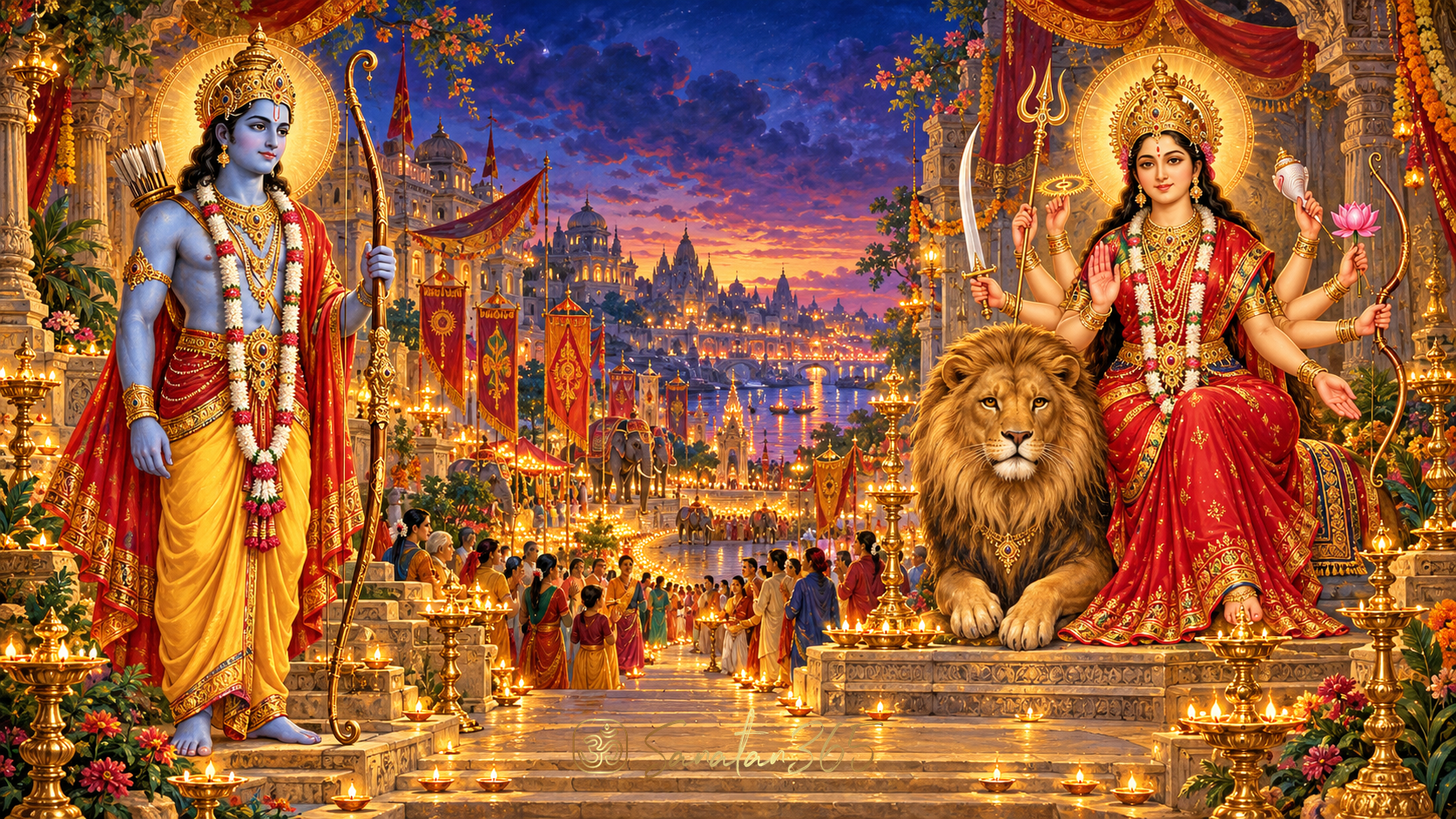
Dussehra 2026: Date, Vijayadashami Meaning, and Living Traditions
Understand the 2026 Dussehra date, the meanings of Rama and Durga’s victories, regional celebrations, and a thoughtful way to observe Vijayadashami.
A festival called “victory” asks a question that lasts longer than the celebration: what, exactly, should prevail?
Dussehra 2026 falls on Tuesday, 20 October in the general Dussehra calendar published by Drik Panchang. Also called Vijayadashami (विजयदशमी, Vijayadaśamī, “the tenth day of victory”), it honours Rama’s victory over Ravana and, in Goddess traditions, Durga’s victory over Mahishasura. These related celebrations have distinct regional forms. A local calendar and the organiser’s announcement should determine a household’s ritual timing or a visitor’s event plans; a national festival date is not one universal appointment.
The celebration can include dramatic performances, worship, processions, family visits, and the conclusion of the preceding nine nights. Its richness becomes clearer when those practices are understood on their own terms, rather than compressed into a single picture of burning effigies.
When is Dussehra 2026, and why should the location be checked?
Drik Panchang’s Dussehra calendar lists 20 October 2026, Tuesday. The same source places the festival on the bright fortnight’s tenth lunar day in the month of Ashwin. That lunar day is called a tithi (तिथि, tithi, a lunar date), which does not begin and end at the same moments as a midnight-to-midnight civil date.
This distinction explains why a calendar can contain more information than a printed holiday square. A lunar date can begin during one civil day and continue into the next. Different observances may select the relevant part of that interval according to their own calendrical rules. The timing of a public performance is another matter again: an organiser may schedule an evening programme for practical reasons.
A useful planning note therefore separates three questions:
- Festival date: Which date does the relevant calendar assign to this observance?
- Ritual window: Does the household’s tradition specify a local period for worship?
- Event schedule: When will the chosen procession, performance, or gathering actually happen?
These questions should not be answered by copying one city’s timings into every family’s calendar. A reader in Delhi, Kolkata, Chennai, or London may be looking at different local sunrise information, regional practice, and community arrangements. Check the calendar location before reading its time column, and confirm the named observance rather than assuming every related festival entry is interchangeable.
This article does not prescribe a universal auspicious minute. For a specific ceremony, a knowledgeable local priest or the family’s established calendar is a better guide. For a public programme, the current organiser’s notice matters more than an old travel listing.
Readers following the wider season can also consult the overview of Sharad Navratri’s nine nights. Navratri (नवरात्रि, Navarātri, “nine nights”) supplies important context, but its household customs should not be treated as identical everywhere.
Key takeaway: Use 20 October as the general 2026 Dussehra date, then verify the local observance and event schedule separately.
What does Vijayadashami mean in the Rama and Durga traditions?
The word “victory” connects the festival’s major devotional narratives without making them the same story. Drik Panchang’s festival account identifies both Rama’s defeat of Ravana and Durga’s defeat of Mahishasura. Each gives the day its own emotional and theological emphasis.
In the Rama tradition, the celebration recalls the defeat of the ruler who abducted Sita. The Ramayana (रामायण, Rāmāyaṇa, the epic narrative of Rama) places this conflict within a much larger account of relationships, exile, counsel, courage, and responsibility. A festival performance naturally highlights the decisive confrontation, but the narrative cannot be reduced to a contest of physical strength.
Rama’s victory is inseparable from the purpose for which the struggle is undertaken. Strength acquires ethical meaning through what it protects and how it is used. For a contemporary reader, that invites reflection on dharma (धर्म, dharma, right conduct and sustaining responsibility), not a search for human groups to label as enemies. The festival’s figures belong to sacred narrative; they are not permission to turn neighbours into symbols of evil.
Ramlila (रामलीला, Rāmalīlā, the dramatic enactment of Rama’s story) makes that narrative public and shared. Its spoken scenes, music, costumes, and recognisable relationships can offer more than the spectacle of a final evening. Listening to a difficult conversation or watching a character refuse good counsel may carry the story’s ethical weight as strongly as the culminating battle.
In Durga devotion, the victory over Mahishasura celebrates the Goddess confronting a destructive power that the gods cannot overcome alone. Shakti (शक्ति, śakti, divine power or capacity) is not merely an ornament attached to this story. The Goddess is its active centre. Her courage, protection, and luminous presence shape the festival’s devotional feeling.
The two traditions need not compete for ownership of the word Vijayadashami. A family may know one particularly well while respecting the other. Nor is a short summary an adequate substitute for the full texts, songs, and inherited practices through which communities understand them.
A responsible interpretation also avoids turning every detail into a fixed psychological code. The popular idea that Ravana’s ten heads must represent one universally agreed list of ten faults is an interpretation, not a definition required by every tradition. Symbolic reflection is useful when it is honestly presented as reflection.
Key takeaway: The Rama and Durga traditions share a celebration of victory while retaining distinct stories, devotional centres, and meanings.
How do regional celebrations express the same festival differently?
A single national image cannot contain Vijayadashami. The form of the celebration changes with region, language, temple tradition, performance culture, and household memory. Recognising those differences is part of understanding the festival, not a distraction from its meaning.
In many North Indian celebrations, Ramlila and the burning of Ravana effigies are prominent public forms. The final spectacle is most meaningful when connected with the story that precedes it. Families can explain that connection before attending, especially when children might otherwise remember only height, noise, and fire.
Mysuru offers a different public vocabulary. The Ministry of Tourism’s account of Mysuru Dasara describes a ten-day celebration associated with Goddess Chamundeshwari and the defeat of Mahishasura. The city’s palace setting, procession culture, and artistic programmes place the Goddess-centred narrative within a distinctive civic and devotional setting. The source supports the tradition’s character; its descriptive page should not replace the current organiser’s programme for 2026 timings.
That distinction is useful everywhere. An article can explain why a celebration matters without possessing the current route map, access rules, or ceremony schedule. Cultural understanding and travel logistics are different kinds of information, and both deserve care.
In Bengal, the conclusion of Durga Puja carries the emotional atmosphere of farewell and return. Puja (पूजा, pūjā, worship through reverent offerings and attention) is not simply a stage show with a religious subject. The Goddess’s presence, the community’s preparation, and the eventual departure belong to a devotional sequence. Visitors should follow the local celebration’s calendar rather than assume that a general Dussehra holiday settles its final-day timing.
South Indian households may connect the season with learning, honoured tools, and doll displays, although the sequence and emphasis differ between communities. These practices should not be assembled into a compulsory all-India checklist. A family continuing its own inherited form is not celebrating incompletely because it does not reproduce another region’s customs.
The existing guides to Golu’s dolls, stories, and hospitality and Garba’s devotional circle show how different seasonal expressions can carry distinct meanings. They offer context, not instructions to merge separate traditions into one event.
Diaspora celebrations add another practical distinction. A community may hold a large gathering on a convenient weekend while a household observes its religious date separately. Check how the organisers describe their programme. The advertised gathering date and the calendar’s ritual date can serve different purposes without either being concealed.
Key takeaway: Regional variety is part of the festival’s living richness; learn the meaning of the celebration being attended rather than expecting one universal format.
How can a household observe the day with attention?
A thoughtful observance begins with the family’s actual tradition, available time, and capacity. Elaborateness is not proof of reverence. A modest gathering with attention can be more meaningful than an anxious attempt to imitate every ritual encountered online.
Begin by deciding what the household wishes to understand. Is the focus Rama’s story, worship of the Goddess, a family custom, or participation in a community event? Naming that focus helps each activity belong to the day rather than become another item to finish.
One simple sequence might be:
- Confirm the date and family practice. Ask an elder or trusted local guide where details are uncertain.
- Read or hear a short, identified passage. Choose an appropriate retelling and say which narrative it comes from.
- Offer worship according to the household’s custom. Keep the space orderly and give any flame responsible adult attention.
- Make room for a conversation. Ask what the story suggests about courage, good counsel, and responsibility.
- Choose one concrete act of care. Help with a neglected task, thank someone whose work is usually unnoticed, or repair an avoidable unkindness.
The final step is a contemporary application, not a claim that every household has historically followed this exact sequence. That distinction keeps practical advice honest. A festival can inspire a new family habit without the habit being advertised as ancient ritual law.
Children’s questions deserve patient answers. “Why does Ravana have so many heads?” or “Why does the Goddess fight?” can lead to age-appropriate discussion of sacred storytelling. Adults can distinguish the narrative, a local explanation, and their own reflection instead of pretending that one quick answer exhausts the tradition.
It is equally helpful to leave space for quiet participation. Not every member of a household enjoys a loud public gathering. A shared reading, a familiar song, or helping prepare the worship space can provide another way to belong. Participation should not become a test of who is sufficiently devotional.
Finally, victory should not become a demand for instant moral perfection. A person can identify one habit that needs correction and take one realistic step. Apologising honestly, listening before responding, or fulfilling an overlooked responsibility gives ethical reflection a specific form. These actions do not replace worship; they allow the day’s meaning to continue after it.
Key takeaway: Let the observance join inherited devotion with one understandable story, one attentive conversation, and one practical act of care.
What should visitors check before attending a public celebration?
A public festival is both a devotional gathering and a real place with crowds, routes, weather, access needs, and volunteers. Respect includes preparing for those ordinary conditions. The most useful checklist is not a promise of a perfect experience but a way to reduce avoidable confusion.
Confirm the programme with the current organiser. Check whether the named time refers to entry, worship, a procession, a dramatic performance, or the concluding spectacle. Look for transport changes, restricted areas, and any separate guidance for photography. Do not assume that an attractive promotional image shows the exact access available to visitors.
For families, agree on a meeting point and make sure children know whom to approach if separated. Anyone who needs seating, shorter walking distances, or a quieter viewing area should check arrangements in advance. Follow barriers and the instructions of local staff, especially around fire, electrical installations, procession vehicles, and animals where present.
Inside a worship setting, allow devotees and ritual participants to complete what they came to do. Avoid blocking an offering queue for photographs, reaching across sacred arrangements, or treating a procession as a movable backdrop. Ask when photography is uncertain. A respectful visitor does not need to imitate every action in order to remain attentive.
Environmental care is equally concrete: use designated collection points, avoid leaving food packaging behind, and follow the organisers’ arrangements for offerings and ceremonial materials. Such actions support the people responsible for cleaning and restoring the shared space.
The festival’s lasting question is therefore quite close at hand. What will prevail in the small choices surrounding the celebration: impatience or consideration, spectacle alone or understanding, careless consumption or gratitude? No grand declaration is needed to begin answering it.
Key takeaway: Confirm current local arrangements, respect the worship taking place, and let consideration for others remain part of the celebration.
FAQ
What is the Dussehra 2026 date?
Drik Panchang’s general Dussehra calendar lists Tuesday, 20 October 2026. Verify the relevant local observance before planning a specific ceremony or regional celebration; its ritual timing and public event schedule are separate details.
Are Dussehra and Vijayadashami the same festival?
The names are commonly used for the same festival period and tenth-day celebration. Vijayadashami means “the tenth day of victory.” Regional traditions give the day different devotional expressions, including Rama’s victory over Ravana and Durga’s victory over Mahishasura.
Does every celebration include burning Ravana effigies?
No. Effigy burning is prominent in many Rama-centred public celebrations, but it is not a universal requirement. Goddess-centred observances, processions, family worship, learning-related customs, and other regional forms may have different emphases.
Can a family observe the festival without attending a large event?
Yes. A household can follow its inherited worship practice, read an appropriate story together, and make time for reflection and care. A large gathering is one form of participation, not a measure of a family’s sincerity.
About the author
Sanatan365 Editorial
Bringing Sanatan Dharma to modern seekers through authentic, scripture-grounded content.
Related in Festivals
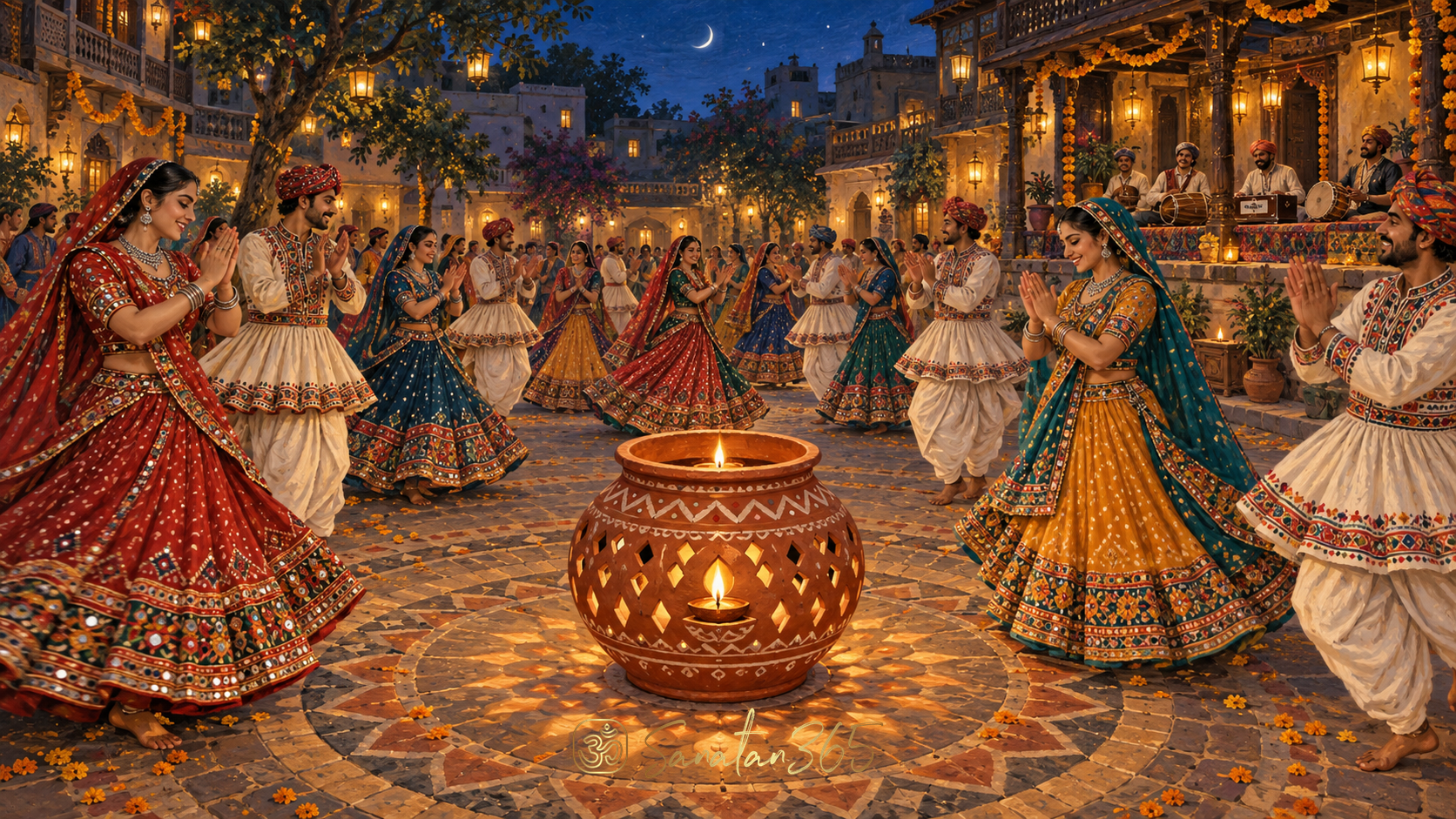 Festivals
Garba Meaning: The Lamp at the Heart of Navratri
Garba is a Gujarati devotional dance associated with Navratri. Its central lamp, shared circular rhythm and reverence for Goddess Amba expl…
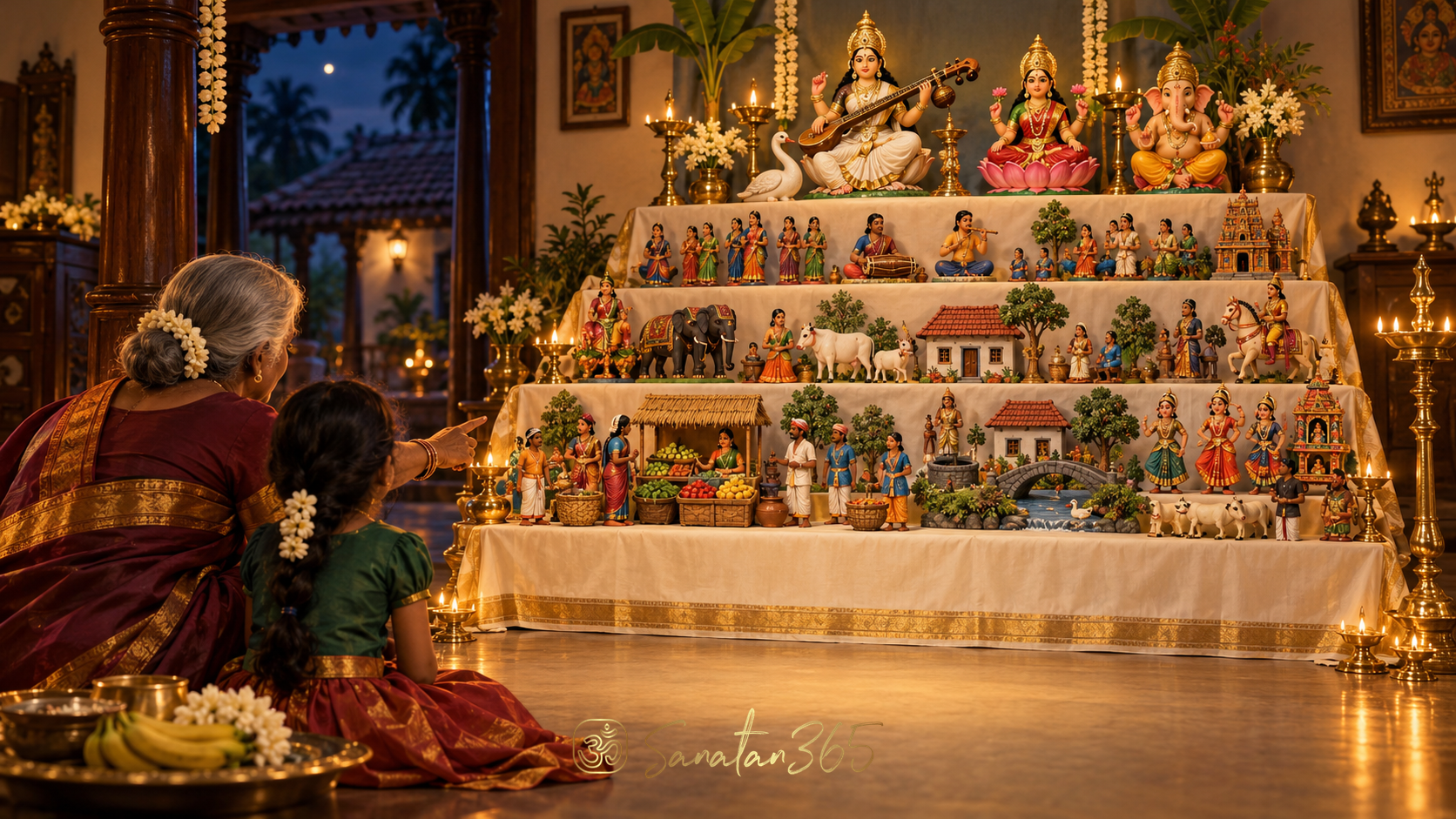 Festivals
Golu Meaning: Navratri Dolls, Living Stories, and Hospitality
Understand Navratri Golu through its handmade dolls, regional names, family stories and welcoming home visits, with thoughtful preparation…
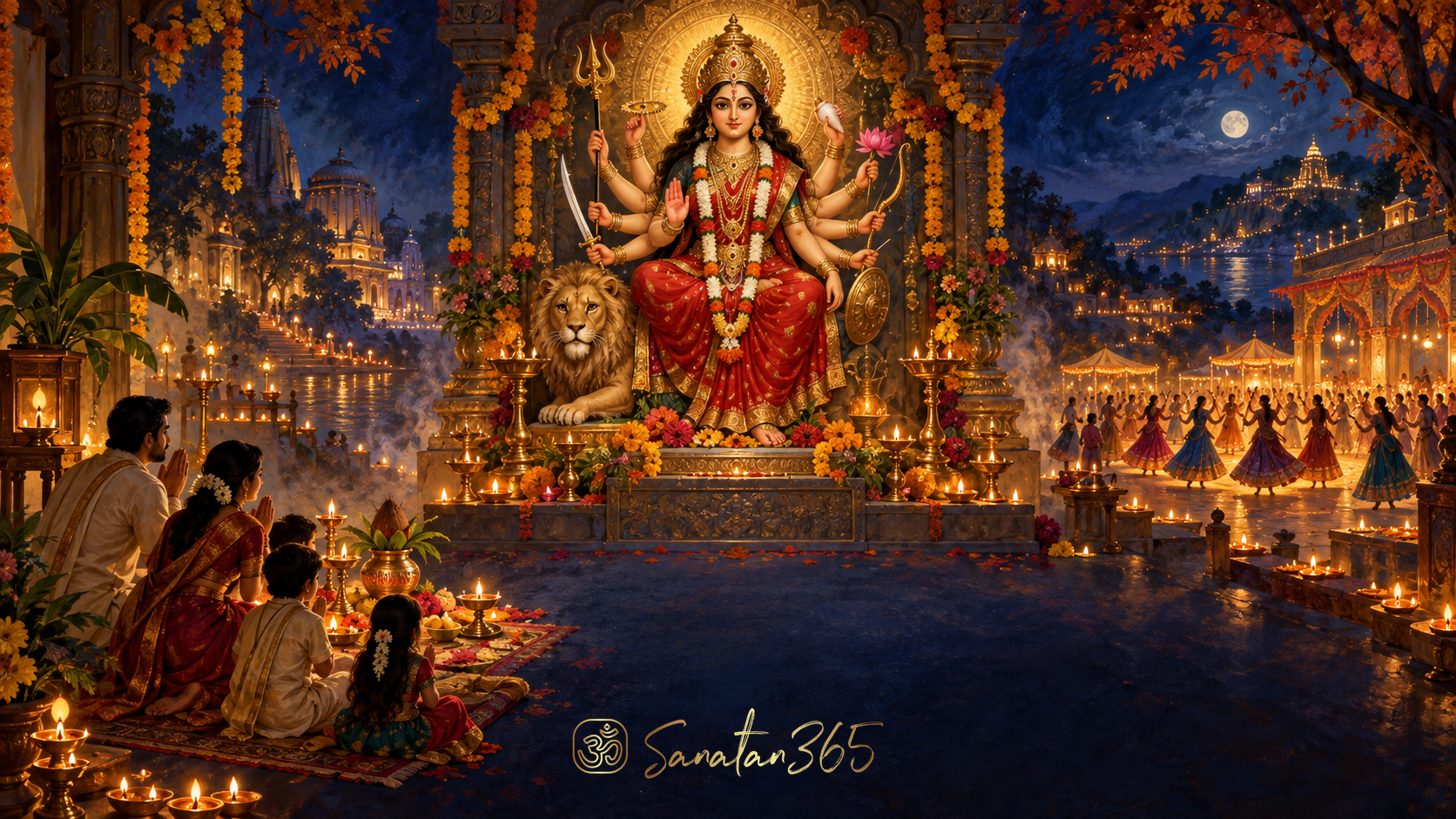 Festivals
Sharad Navratri 2026: Dates, Nine Nights, and Devotion at Home
Understand Sharad Navratri 2026, its October dates, the meaning of nine nights, regional traditions, and a thoughtful home observance witho…

