
Ganapati Atharvashirsha Meaning: Ganesha, Reality, and Truthful Speech
Read the Ganapati Upanishad as a movement from reverence to understanding: Ganesha as Brahman, care for speaker and listener, and worship without transactional promises.
A prayer to Ganesha can begin with an obstacle and end with a question about the whole of existence.
The Ganapati Atharvashirsha meaning is more expansive than a request for success. This short Upanishad, a scripture concerned with spiritual knowledge, addresses Ganesha as Brahman (ब्रह्मन्, ultimate reality) and Atman (आत्मन्, the Self). It joins reverence with inquiry, asks protection for both speaker and listener, and moves between sacred sound and the deity’s recognizable form. Its invitation is to understand what is being praised, not simply to accumulate repetitions.
That movement changes how the text can be approached. A familiar invocation becomes a lesson in truthful speaking, responsible learning and seeing the sacred beyond a single moment of worship. No Sanskrit expertise is needed to begin reading a translation carefully, although learning its traditional recitation benefits from an experienced teacher.
What is the Ganapati Atharvashirsha meaning beyond obstacles?
The text is also known as the Ganapati Upanishad. It belongs to the Upanishadic tradition associated with the Atharva Veda. Its structure combines direct praise, philosophical statements, prayer for protection, an explanation of a sacred syllable, meditation on Ganesha’s form and a concluding account of the fruits of worship. These are connected movements, not competing descriptions of what religion should be.
Chinmaya Mission’s introduction to Swami Tejomayananda’s commentary summarizes the central teaching clearly: Ganapati is the infinite Truth and the Self of all. It also identifies the text’s movement through the seed sound and its concluding statements about worship. That summary is a useful corrective to reading the whole scripture as a technique for obtaining a desired result.
Removing obstacles remains part of Ganesha devotion. But the text also asks a more searching question: what happens when the obstacle is a narrow understanding of the Divine? A person may approach with a particular difficulty and gradually become interested in the assumptions behind the request. What is being sought? What does the worshipper regard as lasting? What place do truth and understanding have within devotion?
This is interpretation of the text’s progression, not a promise that ordinary difficulties will disappear. An examination still requires preparation; a damaged relationship may require an apology; practical work cannot be replaced by recitation. The scripture can deepen the spirit in which these responsibilities are carried out without functioning as a guarantee of their outcome.
Readers already familiar with Ganesha’s devotional symbols can therefore read this work as another layer of understanding. It is not merely a longer version of a short opening prayer.
Key takeaway: The text welcomes devotion to Ganesha while directing attention toward the reality that devotion seeks to understand.
Why does the text call Ganesha Brahman?
Its opening teaching identifies Ganapati with the source, support and dissolution of the world. It then speaks of the whole as Brahman and addresses the deity as the directly present, eternal Self. The philosophical scale is deliberate: the familiar divine form becomes a way of contemplating what is not confined to one form.
A crucial distinction helps here. Brahman, ultimate reality, is not simply another spelling of Brahma (ब्रह्मा), the creator deity. Confusing the two obscures the text’s claim. The Upanishad is not only placing Ganesha beside a figure in a divine genealogy. It is addressing Ganesha through language of the underlying reality of everything.
The Vedanta Students study edition, in its opening passages and explanatory notes, presents this as a teaching about the relationship between worship and Self-knowledge. Its translations also trace the repeated movement from the deity to the whole world: the elements, the different conditions of experience and the deities are included within the contemplation.
This does not require an article to declare one deity superior to another. It is the theological voice of this particular Upanishad, speaking through Ganapati. A reader can honour that voice without turning it into a ranking of Hindu traditions. The text itself broadens its vision rather than ending with a small, isolated territory assigned to one divine name.
For a beginner, an ordinary analogy may help, provided its limits remain clear. A window has a particular shape, yet the light entering it is not limited to the shape of the frame. Likewise, a beloved form can focus devotion without implying that the sacred exists nowhere beyond it. This analogy illustrates an approach; it is not a literal translation of a verse.
The broader distinction between everyday identity and the Self is explored in this introduction to Atman. Here the distinctive point is that knowledge and worship are held together in direct address to Ganesha.
Key takeaway: Calling Ganapati Brahman expands the meaning of worship; it need not become a claim against any other devotional path.
Why protect both the speaker and the listener?
One of the most affecting passages asks for protection not only for the person praying, but also for the speaker, listener, giver, supporter, teacher and student. The prayer then extends in every direction. In the study edition, this appears immediately after the declaration concerning truth.
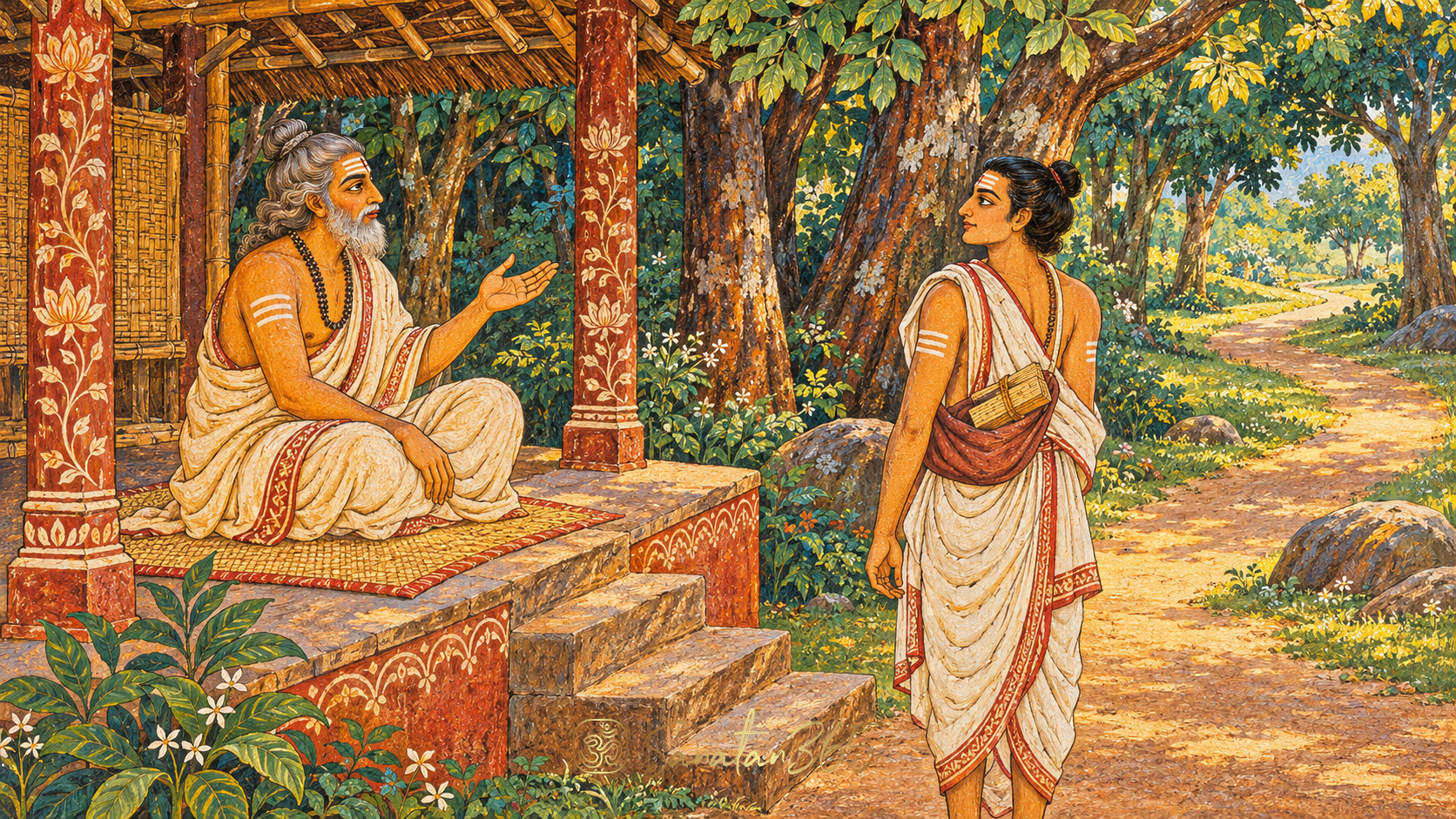
The sequence matters. Learning does not occur in the mind of an isolated individual. Someone speaks; someone listens; others make the encounter possible. A quiet room, preserved book, patient explanation or generous act can support understanding. The prayer gives these relationships spiritual weight.
Before that appeal comes a short declaration: satyam (सत्यम्, truth) is to be spoken. The neighbouring expression ritam (ऋतम्, truth or right order) carries its own interpretive richness. Translations differ in how they distinguish the two, so a beginner need not force a rigid English formula upon them. The clear point is a serious commitment to truth before teaching proceeds.
For contemporary readers, this offers a disciplined question: is the wish to sound knowledgeable stronger than the wish to be accurate? A sacred quotation should not gain authority merely because it is delivered confidently. A speaker can say, “This is the edition being followed,” or, “This is an interpretation rather than a direct translation.” Such clarity protects the listener’s trust.
Listening, in turn, is more than waiting for an opportunity to reply. It includes noticing an unfamiliar word, asking what a statement actually means and allowing a correction to settle. These are practical reflections inspired by the passage, not additional ritual requirements laid down by it.
A family reading illustrates the difference. One person reads a translated sentence aloud. Another asks whether “Self” means personality. Instead of hurrying to the next paragraph, the group pauses to clarify the term. That small pause honours both sides of the prayer: a speaker is helped to explain responsibly, and a listener is helped to understand.
Key takeaway: The request for protection treats understanding as a shared responsibility, supported by truthfulness on both sides.
How does the Upanishad connect sacred sound and visible form?
The text does not remain entirely abstract. It explains the construction of gam (गं), a bija (बीज, seed syllable) associated with Ganapati, and then turns toward meditation on the deity. Sound, meaning and form participate in the same devotional attention.
A seed syllable should not be confused with an ordinary sentence that can be translated word for word. Its significance belongs to a tradition of recitation and contemplation. A written English rendering can indicate pronunciation only approximately. The dot and nasal sound are not decorative extras, and a short article cannot reproduce the precision of oral teaching.
The study edition’s form meditation describes Ganesha through recognizable attributes: one tusk, four hands, a curved trunk, a noose, a goad, blessing, red colour and clothing, a generous belly and broad ears. The description is a focus for attentive contemplation. It is not permission to attach a new psychological meaning to every detail and present that invention as scripture.
What links this visible form with the earlier language of ultimate reality? The text allows a devotee to approach through something intimate and recognizable without abandoning its larger teaching. A person can attend to the divine face and gesture while remembering that the opening has already refused to confine reality to a small compartment.
There is also a valuable difference between understanding a text and attempting every practice associated with it. Reading an explanation of a syllable does not automatically confer training in all its ritual applications. A beginner can appreciate the passage and seek qualified guidance where a tradition calls for it.
This careful approach preserves both warmth and precision. The deity is not reduced to a diagram, and the sacred sound is not marketed as an instrument with mechanically guaranteed effects. Devotion can remain beautiful without becoming a technical claim about what a certain number of repetitions will produce.
Key takeaway: The Upanishad connects philosophical vision with sound and form, while traditional recitation deserves patient, informed learning.
How can a beginner study it without turning devotion into a bargain?
The closing phala-shruti (फलश्रुति, statement of the fruits of hearing or recitation) praises the value of study and worship in strong devotional language. It belongs to the text and should not be silently removed to make the work resemble a modern essay. Equally, those statements should not become commercial promises of wealth, status or a life without difficulty.
A responsible explanation distinguishes a scripture’s devotional assurances from a guarantee offered to a reader. It can describe what the text says without telling someone that recitation will certainly secure employment, erase consequences or replace necessary action. Respectful study and practical responsibility can coexist.
A simple reading method keeps the emphasis on understanding:
- Choose a clear edition. Keep the Sanskrit, transliteration and translation close enough to compare. Note that verse numbering can vary between editions.
- Read a short passage slowly. Begin with the opening address rather than rushing through the entire work.
- Identify its movement. Is it praising, defining, requesting protection, explaining sound or describing a form?
- Ask one precise question. For example: why is the listener named alongside the speaker?
- Take one reflection into conduct. Speak more carefully, acknowledge uncertainty or give another person fuller attention.
These steps are an optional study approach, not a substitute for the recitation method of a teacher or community. Homes in Maharashtra, other Indian regions and the diaspora may use different editions and learning settings. No single household pattern should be presented as the only legitimate way to encounter the text.
The most useful conclusion is modest. Learning a sacred work is not proven by how quickly it is finished. A phrase that changes the quality of one conversation may have been read more attentively than a page passed over without understanding. That is an invitation to depth, not a new numerical measure of spiritual achievement.
Key takeaway: Read the Ganapati Atharvashirsha as an invitation to understand and honour the sacred, not as a transaction that purchases a predictable result.
FAQ
Is the Ganapati Atharvashirsha the same as the Ganapati Upanishad?
Yes. These names commonly refer to the same text associated with the Atharva Veda. Spellings such as Atharvasirsha and Atharvashirsha reflect different transliteration conventions. Editions can divide and number its passages differently, so compare the wording as well as the verse number.
Is its meaning only about removing obstacles?
No. Ganesha’s role in overcoming obstacles is present, but the text also identifies Ganapati with Brahman and Atman, asks protection for learning, explains a seed syllable and offers meditation on the deity’s form. Its philosophical and devotional movements belong together.
Can someone begin by reading an English translation?
Yes, a clear translation can support an initial understanding of the text’s themes. Accurate traditional recitation involves sound and pronunciation that English spelling alone cannot fully convey. Where possible, learn from an experienced teacher and ask how the translation relates to the Sanskrit.
Does chanting guarantee wealth or success?
No guaranteed material outcome should be promised. The concluding praise of recitation belongs to the scripture’s devotional setting. Study and worship should accompany responsible action, not be sold as a certainty about money, examinations or other worldly results.
About the author
Sanatan365 Editorial
Bringing Sanatan Dharma to modern seekers through authentic, scripture-grounded content.
Related in Scriptures
 Scriptures
Taittiriya Upanishad 1.11 Meaning: What a Student Carries Forward
A teacher’s address after Vedic study connects truthful speech, right conduct and continued learning. Read the three commands in their sett…
 Scriptures
Manduka Sukta Meaning: Why the Rigveda Listens to Frogs
Read the Rigveda’s frog hymn through its rain-filled pool, contrasting voices, and memorable comparisons with a student and ritual singers.
 Scriptures
Sadhana Panchakam Meaning: From Daily Study to Self-Knowledge
Read the five verses and forty instructions of Sadhana Panchakam as a connected Advaita teaching on preparation, inquiry and freedom.

