Manduka Sukta Meaning: Why the Rigveda Listens to Frogs
Read the Rigveda’s frog hymn through its rain-filled pool, contrasting voices, and memorable comparisons with a student and ritual singers.
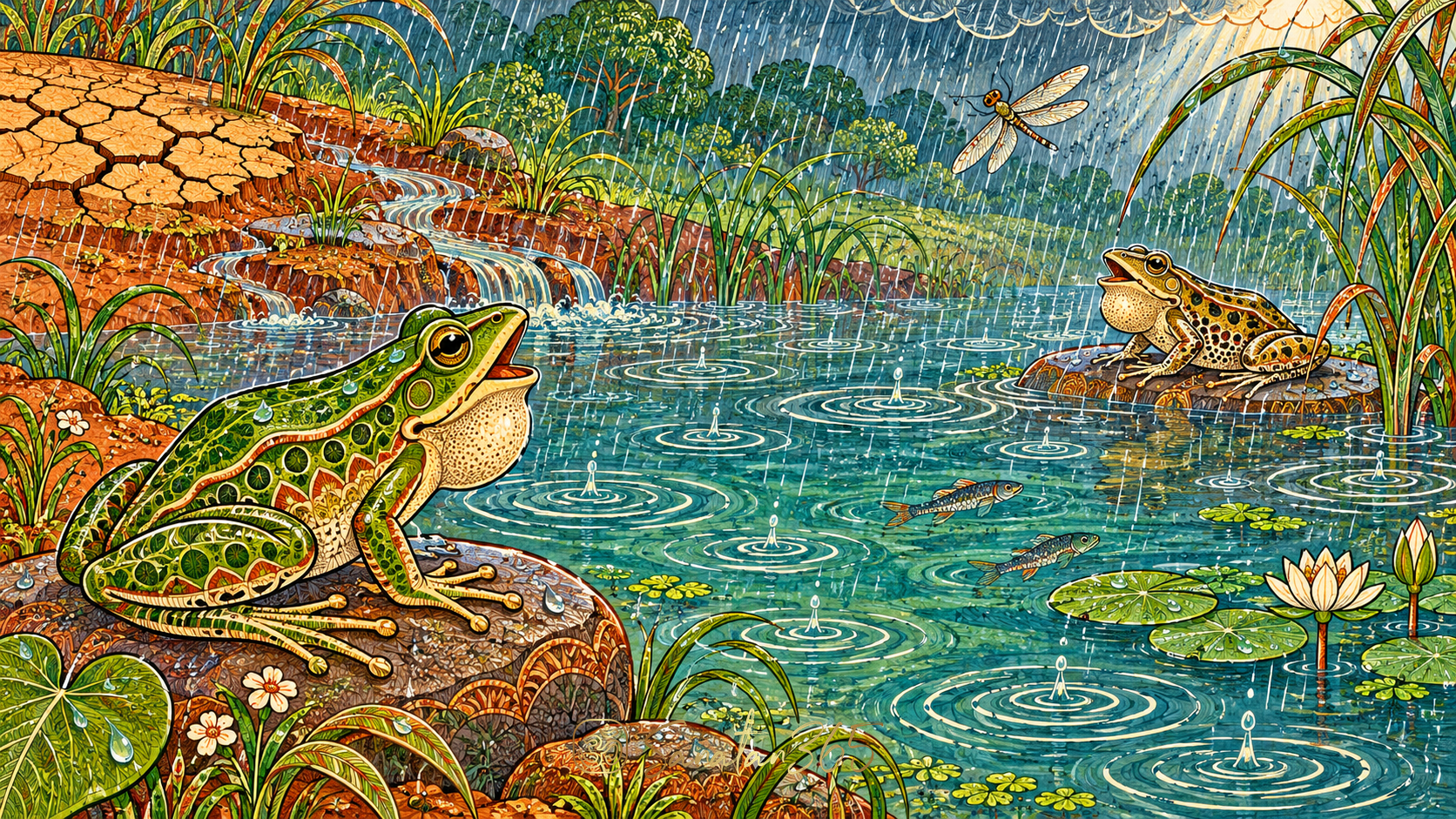
Rain strikes a dry pool bed, and a frog calls across the water. Another answers, and the poet hears a resemblance to a pupil repeating what a teacher has just said.
Manduka Sukta meaning begins with that shift from silence to sound. The Maṇḍūka Sūkta (मण्डूक सूक्त, hymn to the frogs) is hymn 7.103 of the Ṛgveda (ऋग्वेद, Veda of praise verses), a ten-verse poem that listens to frogs at the arrival of the rains. It compares their voices with cattle, family greetings, oral learning and ritual speech. Each comparison changes what the reader can hear in the same scene.
What is the Manduka Sukta meaning?
The Rigveda gives the frogs their own hymn. A maṇḍūka (मण्डूक, frog) is the animal at the centre of the scene, while a sūkta (सूक्त, hymn) is the unit of verse. The Sanskrit text, Griffith translation and Sāyaṇa commentary on Rigveda 7.103 allow a reader to follow the ten verses through several changes in scale. The opening describes the return of voice after a long quiet. A few verses later, the listener can distinguish a call from its answer. Toward the end, the pond becomes comparable to a gathering of ritual speakers.
The order is worth following. A brief label such as “the frogs make noise when it rains” supplies the occasion but loses the poem’s interest in the character of the sound. The poet notices a common event and listens closely enough to give it several descriptions. Some comparisons concern the quality of the call. Others concern the way sounds follow one another. Still others concern the time at which voices gather.
A reader need not decide in advance whether to call the poem solemn, playful or both. The comparisons can be surprising without being dismissive. A student repeating a teacher is an image of close hearing. A frog that sounds like a goat is also a vivid detail that may make someone smile. The hymn makes room for the familiarity of the animals and the dignity of the language in which they are heard.
The Vedic Heritage Portal’s introduction to the Rigveda explains its division into books and hymns. The number 7.103 directs a reader to hymn 103 of book 7. Using the reference is helpful when a title is spelled differently across editions. It gets a reader back to the same sequence of verses rather than to a similarly named text.
Key takeaway: The hymn listens to the frogs at the arrival of rain and builds its meaning from the differences it hears.
How does the Rigveda frog hymn begin with rain?
The opening verse brings quiet and voice into contact. It pictures the frogs after a long period of silence and connects their newly audible calls with Parjanya (पर्जन्य, the Vedic rain deity). The rain is part of what makes the event possible in the poem. It is not a decorative detail added after the frogs have begun to speak.
In the second verse, rain falls on the frogs lying in the pool bed, and the poet likens the frogs to dried hide. The comparison gives the reader a texture to set beside the sudden water. A pool receiving rain changes both in appearance and in what can be heard around it. Griffith’s rendering compares the emerging chorus with cows calling in the presence of their calves. That sound gives the reader a humanly familiar point of comparison without making the frogs disappear from the scene.
The third and fourth verses bring the listening closer. The third compares one frog approaching another’s voice with a son coming to his father. The fourth lets the green and mottled frogs combine their sounds. Those two moments are different in emphasis. The first makes a call into a greeting. The second allows different animals to be heard together. A reader can follow that progression even without identifying any real species from the descriptions.
A useful way to read the opening is to name what changes in each verse. In one, quiet gives way to calls. In another, water changes the pool. In the next, a sound has a direction because one creature is drawn toward another. This avoids flattening the sequence into one broad statement about the rainy season. The poem is attentive to what happens after the first drop.
Key takeaway: Rain changes the setting, and the poem follows the consequences all the way down to one call meeting another.
Why does a Vedic hymn about rain compare a frog to a student?
Verse five compares one frog repeating another’s voice with a pupil learning from a teacher. The first line can be read on its own before turning to the rest of the verse:
यद् एषाम् अन्यो अन्यस्य वाचं शाक्तस्येव वदति शिक्षमाणः ।
In a plain rendering of this line, one among them voices another’s speech, like a learner repeating the words of a capable teacher. Vāc (वाच्, speech or voice) is the feature that connects the two scenes. The comparison concerns how a sound is heard and repeated. It gives a familiar pattern to a voice that otherwise might seem indistinct.
A pupil listening to a spoken line can hear where it rises, where it stops, and what needs to be repeated. In the frog scene, the poet hears an answering shape. The image does not require the reader to suppose that frogs share a human lesson or that their calls carry Sanskrit words. It invites the reader to notice the relation between an initial voice and what follows it.
The next verse makes the chorus more varied. It gives one voice the quality of a cow’s lowing and another that of a goat’s bleat. It also distinguishes the green and mottled frogs. The shared name “frog” therefore does not require a single look or a uniform voice. Reading verses five and six together gives both parts of the observation: some calls sound like responses, and the group still contains differences.
The article on the Sama Veda and sacred sound gives wider context for the importance of hearing in Vedic tradition. The frog hymn has its own more particular task. Its teacher comparison lets a reader hear a pattern in one small part of the landscape. The pattern is easier to appreciate when the individual voices remain audible.
Key takeaway: The pupil image describes one voice following another. The following verse keeps the chorus varied.
How do ritual voices enter the monsoon hymn?
Verse seven puts a full pool beside a ritual gathering. It names Soma (सोम, the ritual offering in that setting) and invokes Atirātra (अतिरात्र, an overnight Soma rite). Griffith’s rendering hears the voices of officiants gathered around a filled vessel and compares them with frogs around water at the arrival of the rains. The resemblance involves sound, gathering and a full centre.
The comparison is especially clear after the earlier verses. A reader has already been given one call and another, as well as a teacher and pupil. The gathering is therefore a larger version of a scene whose elements can still be heard individually. A number of voices occupy the same place and time. The poem can turn its attention from the edge of a pond to ritual speech and back again without abandoning either.
The next verses bring in the duration of rites and the return of the season. The year that sounded long in the opening has reached its turning point. This return gives the first rains significance within the poem even for a reader who has never seen the ceremony being invoked. The ritual comparison belongs to a cycle of waiting and appearance. It helps the reader feel why the scene deserves more attention than a single croak.
In the Sanskrit of the last verse, the language turns toward gifts and length of life. That is part of the hymn’s poetic and ritual address. It can be read as an expression of abundance after the scene’s earlier dryness, with due care about what is interpretation. The poem offers an image of hope and prosperity within its own setting. It does not supply a method for producing rain or a promise about what recitation will bring.
Key takeaway: The ritual comparison gives the rainy gathering a sense of shared time, full water and many voices.
How can readers listen to the frogs in Rigveda 7.103 today?
Try one reading with only the opening scene in mind. Where does the water arrive, and when does the poem become audible? On another reading, follow the changes in comparisons. Note which ones describe a sound by comparing it to another sound, and which describe a relationship, such as a greeting or a pupil repeating a line. Those categories need not be rigid. They help the reader pay attention to what each comparison adds.
A family can try this without a long explanation of Vedic ritual. Read a short part of the translation aloud, pause, and ask someone to describe the scene in their own words. One person might remember the green and mottled frogs. Another might remember the teacher. Returning to the lines together lets both people point to something the poem actually includes. The conversation can become an exercise in listening to each other as well as to the verse.
For anyone comparing translations, it helps to keep the verse numbers beside the notes. A rendering may call a sound lowing or bellowing, or choose a different English word for a colour. The important question is what the translator has made audible or visible in that verse. The guide to reading Hindu scripture in translation offers a way to keep the text, translation and personal response distinct.
A reader may remember the hymn next time rain changes a familiar place. It might be the sound of drops entering a puddle or several animal calls coming from different directions. The experience need not reproduce the poem’s season or habitat. It can offer a small reminder of the kind of attention the poet brings to an ordinary event. At the end, the reader has heard more than the fact that frogs call. They have heard separate voices taking part in the life of a place.
Key takeaway: Follow the comparisons one at a time and listen for the detail each one helps bring forward.
FAQ
Where is the Manduka Sukta in the Rigveda?
It is Rigveda 7.103, the 103rd hymn of the seventh book. The Sanskrit text presented by Vande Mataram Library contains ten verses.
Why is it called the frog hymn?
Its central scene is the return of frog calls at the arrival of the rains. The Sanskrit word maṇḍūka means frog.
Why are the frogs compared to a pupil and ritual speakers?
The pupil comparison helps a reader hear one call following another. The ritual gathering brings out the chorus around the full pool and its place in the returning season.
Does the hymn describe one kind of frog?
The poem distinguishes voices and appearances, including green and mottled frogs. Its descriptions work as poetic observations without requiring a modern species identification.
About the author
Sanatan365 Editorial
Bringing Sanatan Dharma to modern seekers through authentic, scripture-grounded content.
Related in Scriptures
 Scriptures
Taittiriya Upanishad 1.11 Meaning: What a Student Carries Forward
A teacher’s address after Vedic study connects truthful speech, right conduct and continued learning. Read the three commands in their sett…
 Scriptures
Ganapati Atharvashirsha Meaning: Ganesha, Reality, and Truthful Speech
Read the Ganapati Upanishad as a movement from reverence to understanding: Ganesha as Brahman, care for speaker and listener, and worship w…
 Scriptures
Sadhana Panchakam Meaning: From Daily Study to Self-Knowledge
Read the five verses and forty instructions of Sadhana Panchakam as a connected Advaita teaching on preparation, inquiry and freedom.

