Ganesha Symbolism: Why the Remover of Obstacles Comes First
A clear guide to Ganesha symbolism, from the elephant head and broken tusk to modak, mouse, and the deeper discipline of beginning well.
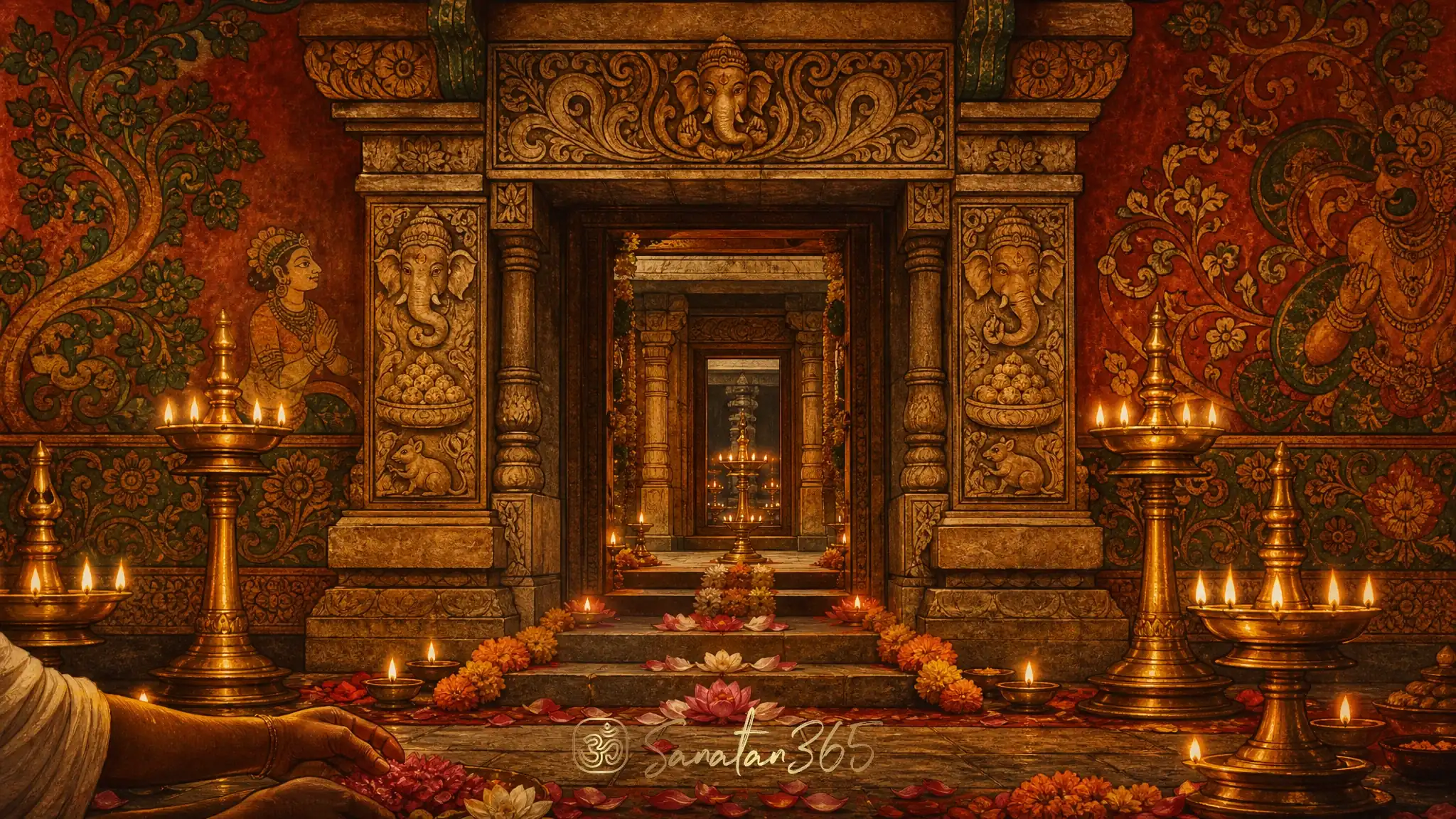
A doorway is never just a doorway when Lord Ganesha is remembered there.
Ganesha symbolism explains why Ganesha, also called Ganapati (गणपति, lord of the ganas or divine hosts), is invoked before new beginnings: he represents wise entry, obstacle-removal, humility, and disciplined intelligence. His elephant head points to expansive understanding, his broken tusk to sacrifice for a higher purpose, his modak to the sweetness of inner effort, and his mouse to the need to guide restless desire rather than be ruled by it.
In many Hindu homes, temples, shops, notebooks, wedding cards, and digital workspaces, Ganesha appears at the threshold. This is not superstition in its shallow sense. It is a cultural memory: before beginning, pause; before asking for success, ask for clarity; before removing outer obstacles, examine the inner ones.
Key takeaway: Ganesha comes first because every worthy beginning needs wisdom before speed.
What Does Ganesha Symbolism Teach About New Beginnings?
The most familiar name, Ganesha (गणेश), is closely related to Ganapati, the lord or leader of groups. Britannica summarizes Ganesha as one of the best-known Hindu deities and notes his role as a remover of obstacles and patron of beginnings Britannica. In lived practice, that role is seen in a simple pattern: devotees often remember Ganesha before study, travel, business, marriage, worship, or any serious undertaking.
This beginning-before-the-beginning matters. A project can fail not only because of external barriers, but because the starting intention is scattered. Ganesha worship asks the seeker to begin with sankalpa (संकल्प, sacred intention). The act of remembering him becomes a pause between impulse and action.
That pause is spiritually practical. It asks:
- Is the aim dharmic, aligned with right conduct?
- Is the mind steady enough to begin?
- Are obvious avoidable mistakes being ignored?
- Is pride pretending to be confidence?
- Is fear pretending to be caution?
In this sense, Ganesha is not merely the one who removes stones from the road. He also reveals which stones were carried in the mind. Some obstacles are delays, confusion, ego, haste, resentment, or poor preparation. Ganesha symbolism turns obstacle-removal into self-refinement.
The traditional invocation Om Gam Ganapataye Namah (ॐ गं गणपतये नमः, salutations to Ganapati) is often used as a seed of attention before action. The sound Gam is a bija mantra (बीज मन्त्र, seed syllable) associated with Ganesha in devotional practice. For many devotees, the mantra is less about demanding a result and more about aligning thought, speech, and effort before beginning.
Key takeaway: Ganesha is invoked first not to avoid effort, but to make effort wiser.
Why Is the Elephant Head Central to Ganesha Symbolism?
The elephant head is the most recognizable part of Ganesha iconography. Popular retellings describe Goddess Parvati creating a child to guard her doorway; after a confrontation with Lord Shiva, the child is restored with an elephant head. Different Puranic and regional traditions tell the story with variations, so careful writing should avoid presenting one version as the only version. A devotional overview from Amritapuri describes a widely known form of the Parvati-Shiva story and its symbolic reading Amritapuri.
The elephant head carries several layers of meaning.
First, it suggests intelligence with strength. An elephant is powerful, but not frantic. It moves with memory, patience, and deliberation. In spiritual life, this is a model for buddhi (बुद्धि, discerning intelligence). Ganesha does not symbolize cleverness alone. He symbolizes intelligence joined to steadiness.
Second, the large ears suggest the discipline of listening. In many households, elders explain Ganesha's ears as a reminder to listen more than one speaks. This is simple, but profound. Most conflicts become heavier because people respond before they hear. Most learning remains shallow because students collect information without listening deeply. Ganesha's ears quietly teach receptivity.
Third, the small eyes suggest concentration. The seeker who wants every distraction will not complete meaningful work. Ganesha's gaze is focused, suggesting ekagrata (एकाग्रता, one-pointed attention). Modern life rewards quick reaction, but dharma often asks for clear seeing.
Fourth, the trunk suggests adaptability. An elephant's trunk can uproot a tree or pick up a small object. This is a beautiful image for practical wisdom. A mature seeker should know when to use strength and when to use gentleness. Not every problem needs force. Not every sacred duty can be handled softly. Ganesha's trunk holds both possibilities.
In some images, the trunk curves to the left; in others, to the right. Traditions interpret these forms differently, and household worship often follows family or regional guidance. The larger lesson remains: wisdom is not rigid. It bends without losing its purpose.
Key takeaway: The elephant head teaches steady intelligence, deep listening, focus, and adaptable strength.
How Do the Broken Tusk, Modak, and Mouse Explain the Remover of Obstacles?
Ganesha's broken tusk is one of the most beloved symbols in Hindu storytelling. A popular tradition connects it to the writing of the Mahabharata: Sage Vyasa dictated the epic, and Ganesha served as the scribe, breaking his tusk when the writing instrument failed so the sacred work could continue. As with many sacred stories, the point is not merely biographical detail; it is symbolic teaching.
The broken tusk suggests sacrifice for knowledge. It also suggests the ability to accept imperfection in service of a higher purpose. A person waiting for perfect tools, perfect timing, perfect confidence, or perfect approval may never begin. Ganesha's tusk says: if the work is noble, offer something of yourself.
This is why Ganesha symbolism speaks directly to students, creators, founders, artists, parents, and seekers. The obstacle is often not the task. The obstacle is the refusal to give up comfort.
The modak (मोदक, sweet dumpling) in Ganesha's hand points to another truth. Spiritual discipline is not dry punishment. It has sweetness. A modak is offered with affection, and it also represents the joy hidden inside practice. The outer layer of a modak is simple; the inner filling is sweet. Likewise, japa, study, seva, and restraint may look plain from outside, but their inner fruit is deep contentment.
Then comes the mouse, often called Ganesha's vahana (वाहन, vehicle or mount). At first, the pairing seems surprising: a mighty elephant-headed deity with a tiny mouse. The symbolism is precise. The mouse can slip into small spaces, nibble constantly, and move restlessly. It represents desire, distraction, and the mind's habit of wandering into every corner.
Ganesha does not destroy the mouse. He rides it. That is the lesson. Desire is not managed by pretending it does not exist. It is guided, disciplined, and placed in service of dharma. When desire becomes the rider, life becomes scattered. When wisdom becomes the rider, even restless energy can serve a sacred direction.
Art of Living's symbolic reading also highlights Ganesha as a form through which abstract divinity becomes accessible to devotees, especially through visual elements that carry inner meanings Art of Living. Whether one approaches through temple ritual, family memory, or philosophical reflection, these symbols invite self-examination.
Key takeaway: Ganesha removes obstacles by teaching sacrifice, sweetness after discipline, and mastery over restless desire.
What Is the Deeper Meaning of Calling Ganesha Vighnaharta?
Ganesha is widely called Vighnaharta (विघ्नहर्ता, remover of obstacles). The word can be misunderstood if reduced to instant problem-solving. In dharmic life, an obstacle is not always an enemy. Sometimes it is a teacher. Sometimes it is protection. Sometimes it slows the seeker down until the intention becomes cleaner.
This is why Ganesha is also associated with Vighnakarta in some theological readings: the one who can place obstacles when needed. That idea may feel surprising, but it is spiritually mature. Not every blocked path is a curse. A delay can prevent arrogance. A failed plan can reveal weak preparation. A closed door can redirect a person toward a more dharmic one.
A gentle way to understand Vighnaharta is this: Ganesha removes the obstacle that prevents rightful movement and reveals the obstacle that prevents inner growth.
In daily life, this distinction matters. A student may pray to Ganesha before exams, but the prayer should not replace study. A family may invoke Ganesha before a wedding, but the ritual should be joined with patience, kindness, and responsible action. A business owner may place Ganesha near the entrance, but the image should remind the team to act honestly, serve customers well, and avoid greed.
This is aligned with the Bhagavad Gita's broader teaching on disciplined action. Krishna teaches that a person has a right to action, not control over results Bhagavad Gita 2.47. Ganesha worship can be seen in that light: begin clearly, act sincerely, remove avoidable obstacles, and surrender the final fruit without laziness or despair.
For diaspora families, this symbolism can be especially useful. Children may first meet Ganesha as the friendly elephant-headed deity. Over time, parents and teachers can help them see more: listening, focus, humility, wisdom, and ethical beginnings. The image becomes a bridge from affection to understanding.
Key takeaway: Vighnaharta does not mean life becomes effortless; it means the seeker learns to move through difficulty with clarity and dharma.
How Can Ganesha Symbolism Be Practiced at Home?
Ganesha symbolism becomes most meaningful when it shapes conduct. A simple home practice does not require complexity. It requires reverence and consistency.
A beginner-friendly practice may include:
- Clean the space. A small clean altar, desk corner, or prayer shelf can become a place of attention.
- Light a diya if appropriate. A diya (दीया, oil lamp) symbolizes the movement from confusion toward clarity.
- Offer something simple. Flowers, fruit, water, or modak may be offered according to family tradition.
- Chant slowly. Recite Om Gam Ganapataye Namah 11 or 21 times with attention rather than speed.
- Name the sankalpa. State the intention inwardly: study with focus, begin work honestly, speak gently, complete a duty.
- Act on the prayer. After worship, take one concrete step: open the book, make the call, apologize, organize the work, or remove one avoidable distraction.
This last step is essential. Ganesha practice should not become passive dependence. The devotee asks for grace and then participates in that grace through action.
For families, one weekly Ganesha reflection can be powerful. Ask children: What was one obstacle this week? Was it outside us or inside us? What would Ganesha's big ears teach us to hear? What would the mouse teach us about distraction? What would the broken tusk teach us to give up for something better?
These questions turn iconography into character formation. They help Sanatan wisdom move from wall art into daily behavior.
Readers who enjoy reflective symbolism may also appreciate the contemplative vision of wholeness in Isha Upanishad Meaning: Wholeness, Action, and Seeing the Divine in Daily Life or the devotional strength explored in Hanuman Chalisa Meaning: What Each Verse Reveals About Devotion, Strength, and Surrender. For practice-oriented readers, Ekadashi Fasting for Beginners: A Gentle Guide Before Nirjala Ekadashi shows how discipline can be approached gently and safely.
Key takeaway: The best way to honor Ganesha symbolism is to begin with reverence, then act with clarity.
How Does Ganesha Symbolism Guide a Seeker Beyond the Doorway?
The most useful reading of Ganesha is not only that he removes obstacles, but that he teaches the seeker how to begin. Listen deeply. Focus clearly. Sacrifice comfort for knowledge. Guide desire instead of obeying it. Take sweetness from discipline. Then step through the doorway with humility.
Key takeaway: Ganesha symbolism is a complete philosophy of beginning well, meeting obstacles wisely, and turning devotion into disciplined action.
FAQ
What is the main meaning of Ganesha symbolism?
Ganesha symbolism points to wisdom before action. His elephant head represents discerning intelligence, his ears deep listening, his trunk adaptability, his broken tusk sacrifice for knowledge, his modak the sweetness of spiritual effort, and his mouse the discipline of guiding restless desire.
Why is Ganesha called the remover of obstacles?
Ganesha is called Vighnaharta (विघ्नहर्ता, remover of obstacles) because devotees invoke him before beginnings and difficulties. The deeper meaning is not that every challenge disappears instantly, but that the seeker receives clarity, steadiness, and the wisdom to remove avoidable obstacles while learning from necessary ones.
What does Ganesha's mouse symbolize?
Ganesha's mouse, his vahana (वाहन, vehicle or mount), often symbolizes restless desire and the wandering mind. Because Ganesha rides the mouse, the image teaches that desire should be guided by wisdom rather than allowed to guide life.
Is Ganesha worship only for Ganesh Chaturthi?
No. Ganesh Chaturthi is the most famous festival dedicated to Ganesha, but many devotees remember him daily or before important beginnings such as study, travel, work, worship, and family ceremonies.
What is a simple Ganesha mantra for beginners?
A widely used mantra is Om Gam Ganapataye Namah (ॐ गं गणपतये नमः, salutations to Ganapati). Beginners may chant it slowly with a clean intention, remembering that mantra practice is meant to support sincere action, not replace it.
About the author
Sanatan365 Editorial
Bringing Sanatan Dharma to modern seekers through authentic, scripture-grounded content.
Related in Deities
 Deities
Agni Deva Meaning: Sacred Fire and the Divine Messenger
Meet Agni as the Vedic priest and messenger, read the first Rig Veda hymn, and understand sacred fire without reducing a living deity to a…
 Deities
Brahma Deva Meaning: Four Faces, Creation, and Sacred Knowledge
Understand Brahma, the Hindu creator deity, through his four faces, lotus imagery, sacred knowledge, and a careful distinction from Brahman…
 Deities
Ushas, the Vedic Goddess of Dawn: Light, Renewal, and Time
Ushas, the Vedic goddess of dawn, appears in the Rigveda as radiant light that awakens life, calls beings to activity, and reveals both ren…