Ganga Dussehra 2026: Date, Meaning, Puja, and the Descent of Ganga
A careful guide to Ganga Dussehra 2026, the sacred descent of Maa Ganga, with date, meaning, regional observance, home puja, snan, dana, and family-friendly practice.
The story of Ganga Dussehra begins with a river that is also remembered as grace descending into the human world.
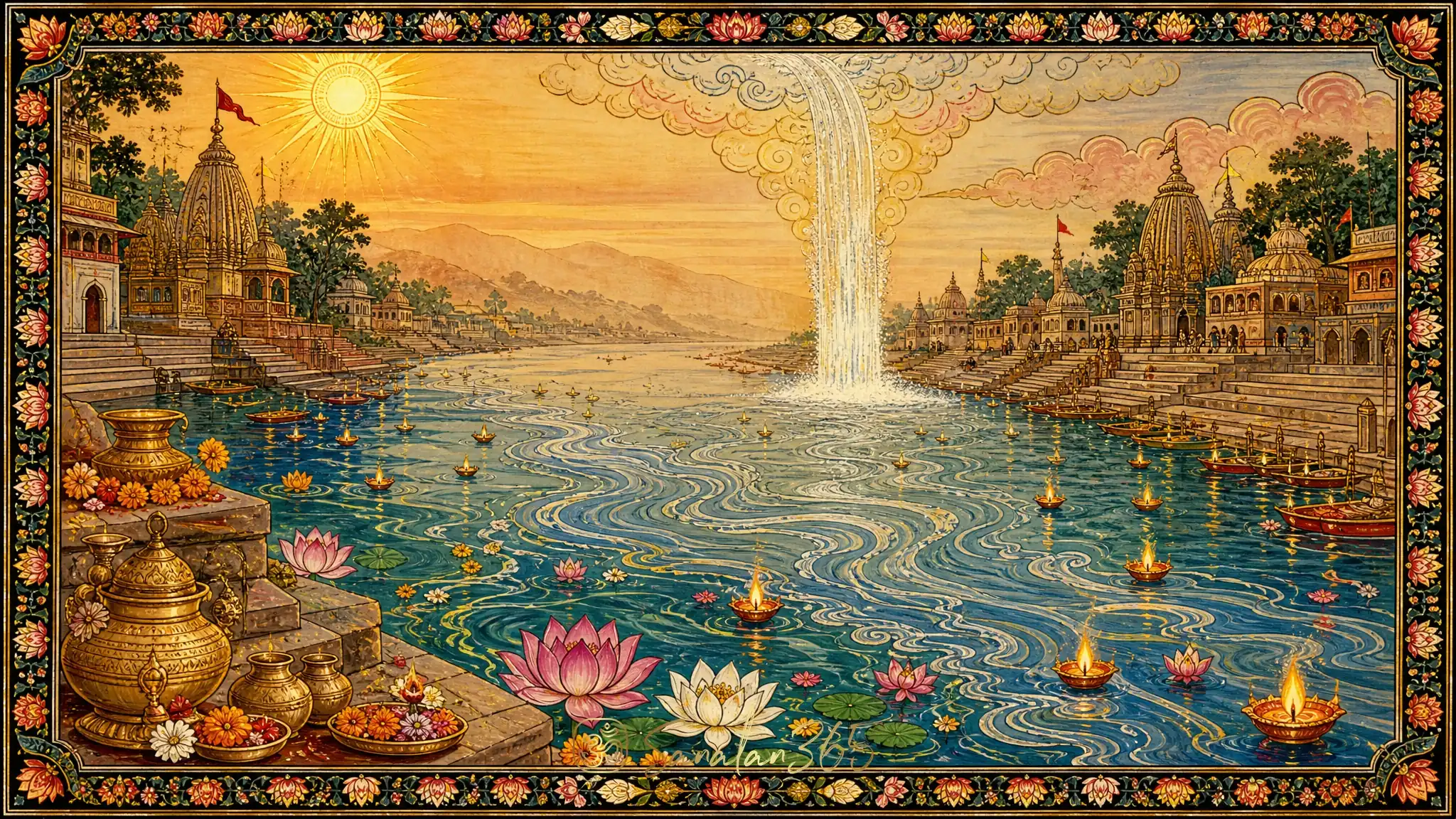
Ganga Dussehra 2026 falls on Monday, May 25, 2026, according to panchang listings for New Delhi published by Drik Panchang. The festival honors Gangavataran (गंगावतरण, the descent of Ganga), the sacred arrival of Maa Ganga from the heavens to earth. Devotees observe it through snan (स्नान, sacred bathing), puja (पूजा, worship), dana (दान, charitable giving), mantra, and remembrance of King Bhagiratha’s tapasya for the welfare of his ancestors and the world.
Unlike a festival that depends on spectacle, Ganga Dussehra asks for purification, gratitude, and responsibility. It is observed most visibly along the river in Varanasi, Haridwar, Rishikesh, Prayagraj, and other Ganga-connected regions, but its spirit can also be practiced at home with reverence, clean intention, and simple offerings.
Key takeaway: Ganga Dussehra is not only a river festival. It is a reminder that sacred flow, humility, and service can enter ordinary life.
Why Is Ganga Dussehra 2026 Observed on May 25?
Ganga Dussehra 2026 is observed on Jyeshtha Shukla Dashami, the tenth lunar day of the bright fortnight in the Hindu month of Jyeshtha (ज्येष्ठ, a summer month in the Hindu calendar). Drik Panchang lists Ganga Dussehra in 2026 on Monday, May 25, with Dashami tithi active around the observance window for New Delhi. Because Hindu festival timing follows lunar tithi and local panchang calculations, devotees outside India should check a reliable local panchang for their city.
The word Dussehra here is often understood through the sacred number ten: the Dashami tithi, and the devotional idea of cleansing ten kinds of impurities through remembrance, bathing, worship, and charity. Different families and regional traditions may explain the symbolism in slightly different ways, but the shared center remains the same: Maa Ganga’s descent is honored as a blessing for the world.
This date also falls in the heat of Jyeshtha, when water itself becomes a visible form of compassion. Offering water, serving travelers, giving cooling foods, and supporting those in need all fit naturally with the festival’s mood. Ganga is revered not as an abstract symbol alone, but as life-giving presence.
For families planning the day, the practical approach is simple:
- Check the Dashami tithi for your location.
- Plan a morning bath or symbolic cleansing.
- Offer water, flowers, lamp, and prayer to Maa Ganga.
- Practice dana in a way that is useful and sincere.
- Avoid treating sacred water casually or wastefully.
Key takeaway: The date matters, but the deeper observance is purity in action, speech, water use, and giving.
What Is the Meaning of Ganga Dussehra and Gangavataran?
The meaning of Ganga Dussehra rests in Gangavataran, the descent of Ganga from the celestial realm to earth. The remembered narrative centers on King Bhagiratha, whose intense tapasya (तपस्या, disciplined spiritual austerity) is said to have brought Ganga down for the liberation of his ancestors. In many retellings, Lord Shiva receives the force of Ganga in his matted locks so that her descent does not shatter the earth.
This story carries several layers of teaching.
First, Bhagiratha’s effort shows devotion joined with responsibility. His tapasya is not performed for personal pleasure. It is directed toward ancestral healing and collective welfare. This is why the phrase “Bhagiratha prayatna” survives in Indian languages as a way to describe extraordinary effort for a great purpose.
Second, Shiva’s role teaches containment. Power, even sacred power, must be received with steadiness. Ganga’s flow is divine, yet it requires a channel. In personal life, the same lesson appears when knowledge, emotion, ambition, or grief needs dharmic discipline to become healing rather than overwhelming.
Third, Ganga herself represents purification that moves. She does not purify by remaining distant. She flows through cities, villages, fields, ghats, memory, ritual, and song. That movement is part of her compassion.
Traditional sources and regional kathas remember Ganga as Maa Ganga (माँ गंगा, Mother Ganga), not merely as a river system; Encyclopaedia Britannica also identifies the Ganges as a river of exceptional sacred importance in Hindu tradition (Britannica). At the same time, reverence should increase ecological responsibility. A sacred river should not be praised in prayer and neglected in conduct. Devotion is more honest when it includes cleanliness, restraint, and care for water.
Key takeaway: Gangavataran teaches effort, humility, and the responsibility to receive grace without wasting it.
How Do Devotees Perform Ganga Dussehra Puja and Snan?
A traditional Ganga Dussehra puja is simple in form and deep in intention. Those near the river may take Ganga snan (गंगा स्नान, sacred bathing in the Ganga) at places such as Haridwar, Rishikesh, Prayagraj, or Varanasi. Those away from the river may bathe at home, add a small amount of Ganga jal if available, or offer water mentally with devotion.
A family-friendly home observance may include:
- Clean the puja space and keep a vessel of clean water.
- Light a diya and offer flowers or tulsi if part of one’s family tradition.
- Recite a short prayer to Maa Ganga with humility.
- Remember King Bhagiratha’s dedication and Shiva’s grace.
- Offer dana: water, food, clothes, cooling drinks, or support for someone in need.
- Teach children not to waste water and not to pollute rivers, ponds, or local water bodies.
Devotees often chant names or verses associated with Ganga. A simple and widely used prayer is:
Om Shri Gangayai Namah Salutations to the sacred Mother Ganga.
If a longer Sanskrit prayer is used, it should be learned from a family elder, temple priest, or trusted text. The goal is not performance. The goal is sincerity.
For many households, the most meaningful practice is to link ritual with conduct. If one lights a lamp to Maa Ganga in the morning but wastes water carelessly through the day, the ritual remains incomplete. If one cannot visit a river but serves drinking water to workers, donates to a clean-water cause, or helps keep a local water body clean, the festival becomes practical dharma.
A safe note matters: bathing in rivers should be done only where conditions are safe and permitted. Families should avoid risky currents, overcrowded ghats, and unsafe travel. Reverence never requires recklessness.
Key takeaway: Ganga Dussehra puja can be powerful at home when purity, prayer, charity, and water responsibility come together.
Where Is Ganga Dussehra Celebrated Most Deeply?
Ganga Dussehra is especially visible across North India and in sacred river cities connected to Maa Ganga. In Haridwar, devotees gather at ghats for snan and evening aarti. In Rishikesh, the river’s Himalayan presence gives the day a contemplative mood. In Prayagraj, the memory of sangam gives the festival a larger sacred geography. In Varanasi, Ganga is woven into daily worship so deeply that the festival feels both special and continuous.
The festival is also observed by families in Bengal, Bihar, Uttarakhand, Uttar Pradesh, Jharkhand, Delhi, and across the Indian diaspora. Regional emphasis differs. Some families focus on bathing and charity. Some emphasize Ganga aarti. Some tell the Bhagiratha story to children. Some keep the day quiet, offering water and prayer at home.
For diaspora families, the challenge is often distance from the river. That distance does not make the observance invalid. A home altar, a clean bowl of water, a lamp, a story session with children, and a commitment to water care can carry the spirit of the day. If Ganga jal is kept at home, it should be handled respectfully and never used casually.
This is also a good day to explain why Sanatan Dharma often treats nature as sacred. Rivers are not only resources. They are relationships. Mountains, trees, rivers, animals, seasons, and stars appear throughout the tradition as participants in a living cosmos. Ganga Dussehra makes that worldview visible through one beloved river.
Key takeaway: The festival is geographically centered on Ganga, but spiritually open to every home that observes with reverence.
How Can Families Prepare Children for Ganga Dussehra 2026?
Children understand sacred tradition best when it is connected to story, practice, and kindness. Ganga Dussehra offers all three.
A parent or grandparent can begin with the story of Bhagiratha: a king who did not give up, who performed tapasya for a purpose greater than himself, and whose effort helped bring Ganga to earth. Then the family can connect the story to everyday conduct: saving water, keeping surroundings clean, helping others, and saying thank you before using what nature gives.
A simple children’s activity list may include:
- Draw a river with ghats, lamps, trees, and people keeping it clean.
- Learn the words Ganga (गंगा, the sacred river), snan (bath), and dana (giving).
- Offer a small bowl of water at the home altar.
- Give water or fruit to someone who needs it.
- Make a “no water waste today” family pledge.
Families using Sanatan365 can also pair the day with daily stories or lessons for children when they want a gentle way to keep the meaning alive after the festival. The key is not to turn the day into content consumption. The key is to make children feel that devotion, gratitude, and responsible living belong together.
Key takeaway: For children, Ganga Dussehra becomes memorable when story leads to one small act of care.
What Should Devotees Avoid on Ganga Dussehra?
A sacred observance is shaped not only by what one does, but by what one avoids.
On Ganga Dussehra, devotees may avoid:
- Polluting rivers, ponds, lakes, or local water sources.
- Throwing plastic, synthetic cloth, or non-biodegradable puja material into water.
- Treating Ganga jal as decoration rather than sacred water.
- Turning charity into display.
- Making rigid claims that one regional method is the only valid method.
- Risky bathing in unsafe or overcrowded places.
- Using the festival to make fear-based promises about sin or punishment.
This restraint is not meant to make devotion anxious. It protects the spirit of the day. If Ganga is honored as mother, then care for water must become part of worship. If dana is offered, it should be useful. If snan is performed, it should be safe. If stories are told, they should inspire humility rather than superstition.
A modern observance can be deeply traditional when it keeps the essentials intact: remembrance of Gangavataran, purity, prayer, giving, gratitude, and responsibility.
Key takeaway: The cleanest Ganga Dussehra practice is reverence that continues after the puja ends.
Related Sanatan365 reading for festival and practice context: Vat Savitri Vrat 2026, Adhik Maas 2026, and Satya Meaning.
Ganga Dussehra 2026 invites the devotee to remember a sacred descent and then live more carefully with water, speech, family, and service. Its single key takeaway is simple: honor Maa Ganga not only with a lamp at the altar, but with a cleaner, kinder flow of daily conduct.
FAQ
When is Ganga Dussehra 2026?
Ganga Dussehra 2026 is observed on Monday, May 25, 2026, for New Delhi according to Drik Panchang. Because tithi timings vary by location, devotees outside India should check a local panchang.
What is the meaning of Ganga Dussehra?
Ganga Dussehra honors Gangavataran, the descent of Maa Ganga to earth. It remembers King Bhagiratha’s tapasya, Shiva’s role in receiving Ganga, and the sacred value of purification, gratitude, and service.
How can Ganga Dussehra be observed at home?
Families can bathe with a clean intention, offer water and flowers to Maa Ganga, light a diya, recite a simple prayer, tell the Bhagiratha story, practice dana, and avoid wasting or polluting water.
Is taking bath in the Ganga required on Ganga Dussehra?
No. Ganga snan is traditional where safe and possible, especially in places such as Haridwar, Rishikesh, Prayagraj, and Varanasi. Devotees away from the river may observe at home with reverence and symbolic water offering.
What is the best charity for Ganga Dussehra?
Useful dana is best: drinking water, food, cooling drinks, clothes, support for the poor, or responsible contributions to water protection. The spirit is service without display.
About the author
Sanatan365 Editorial
Bringing Sanatan Dharma to modern seekers through authentic, scripture-grounded content.
Related in Festivals
 Festivals
Parivartini Ekadashi 2026: Date, Meaning, and Gentle Vrat Guide
Parivartini Ekadashi 2026 falls on September 22. Learn why it is called Parsva or Vamana Ekadashi, how it relates to Chaturmas, and how to…
 Festivals
Hartalika Teej 2026: Date, Meaning, Puja, and Parvati's Resolve
Hartalika Teej 2026 is observed on September 14 in honour of Goddess Parvati and Lord Shiva. Learn the festival's story, vrat meaning, regi…
 Festivals
Radha Ashtami 2026: Date, Meaning, and Devotion at Home
Radha Ashtami falls on 19 September 2026 in India. Explore its meaning, Braj traditions, local timing guidance, and a thoughtful home obser…

