Vat Savitri Vrat 2026: Meaning, Savitri-Satyavan Story, Puja, and Regional Traditions
A careful guide to Vat Savitri Vrat 2026, including the Savitri-Satyavan katha, banyan tree symbolism, puja steps, regional dates, and inner meaning.
A banyan tree can look almost still, yet its aerial roots are quietly building a living shelter around it.
Vat Savitri Vrat 2026 is a sacred observance inspired by Savitri's courage, wisdom, and devotion in the story of Savitri and Satyavan. Vat (वट, banyan tree) is worshipped as a symbol of longevity, shelter, and rooted strength; vrat (व्रत, sacred vow or disciplined observance) means a devotional commitment made with sincerity. In 2026, many North Indian calendars list Vat Savitri Vrat around Jyeshtha Amavasya on May 16, while some regional traditions observe Vat Purnima later according to the full moon cycle. Families should confirm the exact date and timing with a trusted local panchang.
This guide explains the katha, the puja, the banyan symbolism, and the regional variations without turning a living tradition into a checklist.
Key takeaway: Vat Savitri is not only a marital ritual; it is a meditation on dharma, courage, speech, and steady devotion.
What Is Vat Savitri Vrat 2026 and When Is It Observed?
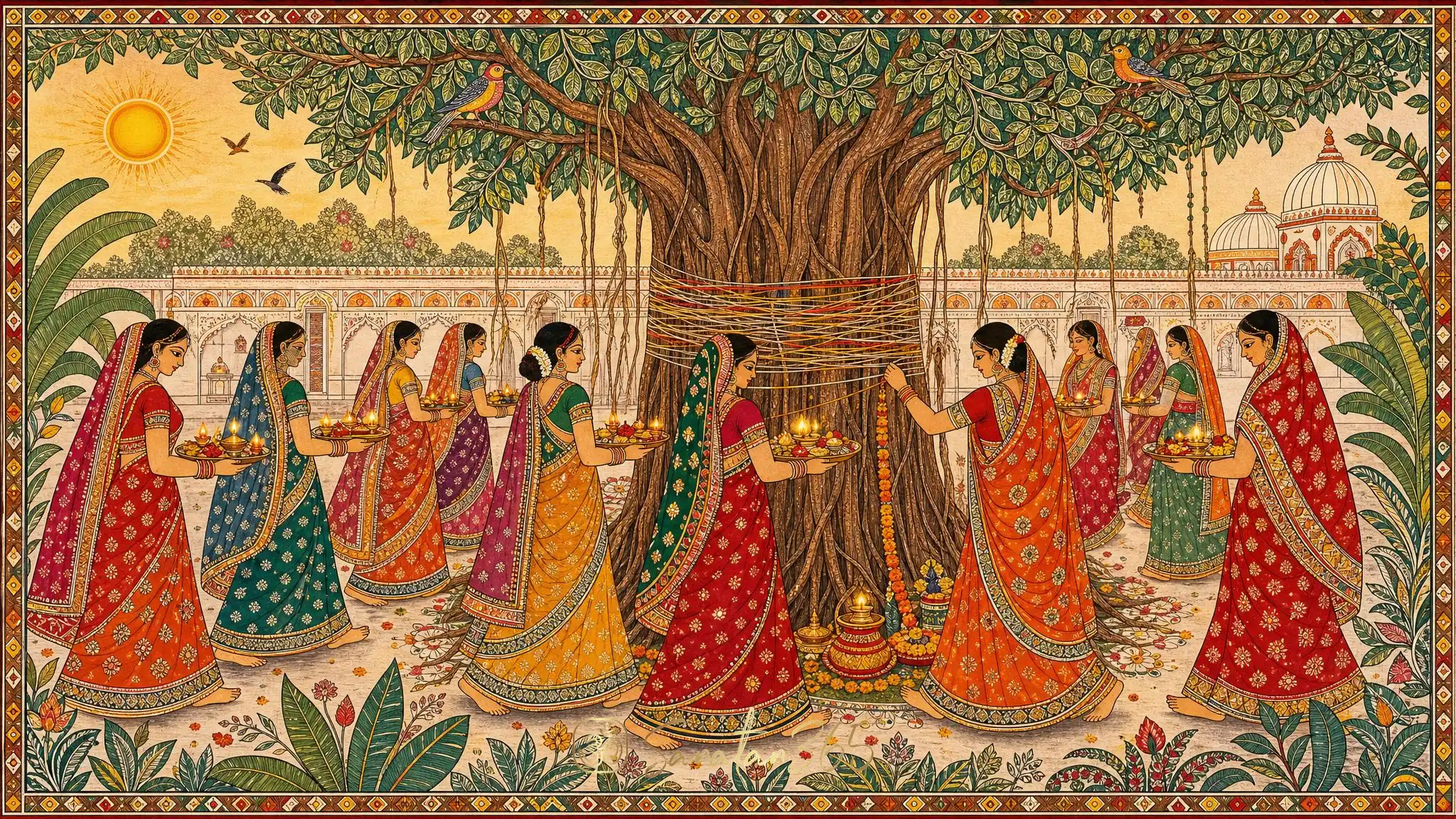
Vat Savitri Vrat 2026 is traditionally observed by many married Hindu women who pray for the well-being and long life of their husbands, while remembering the legendary firmness of Savitri. The observance centers on the banyan tree, Savitri-Satyavan katha, fasting or food discipline, puja offerings, and parikrama (परिक्रमा, sacred circumambulation) around the tree.
The date can vary because Hindu festivals follow tithi (तिथि, lunar day), not the fixed civil calendar. Several 2026 festival calendars list Vat Savitri Vrat and Shani Jayanti on May 16 for Jyeshtha Amavasya in North Indian practice, including Prokerala's May 2026 Hindu calendar. Some western and southern communities, especially in Maharashtra and Gujarat, keep the closely related Vat Purnima observance on the Jyeshtha Purnima date instead. This is why one family may say May 16 while another observes the vrata later.
A practical rule helps: follow the panchang used by the family, temple, or region where the vrata is being observed. For diaspora families, the local sunrise and tithi timing matter, so a city-specific panchang is better than a generic date graphic.
Common observance elements include:
- bathing and wearing clean or traditional clothes
- preparing a puja thali with water, flowers, rice, fruits, sweets, diya, and sacred thread
- worshipping the banyan tree with reverence
- tying thread while performing parikrama
- listening to or reciting the Savitri-Satyavan katha
- offering prayers for family well-being, strength, and auspiciousness
- completing the vrat according to family tradition and health capacity
Key takeaway: The correct date depends on regional tithi practice; the correct spirit depends on sincerity, steadiness, and reverence.
Why Does the Savitri-Satyavan Story Matter?
The heart of Vat Savitri is the story of Savitri and Satyavan, preserved in the Mahabharata's Vana Parva; an English translation of the relevant Pativrata-mahatmya section is available through Sacred Texts. Savitri, princess of Madra, chooses Satyavan as her husband even after learning that he is destined to die within a year. Her choice is not portrayed as naive attachment. It is presented as firm discernment, once dharma has been chosen.
When the destined day arrives, Savitri follows Satyavan into the forest. As he weakens and dies with his head resting in her lap, Yama, the lord of death and dharma, comes to take his life. Savitri does not collapse into helplessness. She walks behind Yama and speaks with clarity, humility, and intelligence.
Her dialogue with Yama is the spiritual center of the katha. Savitri does not shout at destiny. She does not insult cosmic law. She reasons from dharma. She speaks of companionship, righteousness, truth, compassion, and the duties of the noble. Pleased by her wisdom, Yama grants her boons, one after another. Through careful speech and unwavering devotion, she finally secures Satyavan's life.
The story is powerful because Savitri's strength is not merely emotional loyalty. It is tapas (तपस्, disciplined spiritual heat), satya (सत्य, truth), dhairya (धैर्य, courage and patience), and buddhi (बुद्धि, clear intelligence) acting together. Her devotion does not make her passive. It makes her fearless and precise.
Readers who want to understand the broader dharmic value of truthfulness may also read Satya meaning. Savitri's speech works because it is rooted in truth, not manipulation.
Key takeaway: Savitri is remembered not only as an ideal wife, but as a person of spiritual courage, disciplined speech, and dharmic intelligence.
Why Is the Banyan Tree Worshipped in Vat Savitri Puja?
The banyan tree, called vat vriksha (वट वृक्ष, banyan tree), is one of the most recognizable symbols of this vrata. Its trunk, shade, hanging roots, and long life make it a natural image of continuity. In many Indian villages, the banyan has also been a social and sacred center, a place where elders gathered, travelers rested, and worshippers offered prayers.
In Vat Savitri puja, the tree becomes a living symbol rather than a decorative backdrop. Devotees circumambulate it, tie thread around it, offer water and flowers, and remember Savitri's vow. The act can be understood at several levels:
- Longevity: The banyan is long-lived and expansive, so it becomes a sign of sustained life.
- Shelter: Its shade suggests protection, care, and family continuity.
- Rootedness: Its aerial roots remind devotees that a household must keep sending roots into dharma.
- Witness: A tree stands silently through seasons, reflecting patience and steadiness.
- Sacred ecology: Worship of a living tree keeps reverence for nature within daily religion.
The thread tied around the tree is often explained as a symbol of prayer, continuity, and commitment. The parikrama is not a mechanical circle. It is a bodily way of saying: may life revolve around dharma, not impulse.
Some families link the banyan to the Trimurti symbolically, while others emphasize its connection to Savitri's steadfastness. Local explanations vary, and that variety is normal within Sanatan practice. The safest way to hold the meaning is simple: the banyan represents life held together by roots that are both visible and invisible.
Key takeaway: The banyan tree in Vat Savitri is a symbol of longevity, shelter, ecological reverence, and dharmic rootedness.
How Is Vat Savitri Puja Performed at Home or Near a Banyan Tree?
Vat Savitri puja is best learned from one's family elders, temple priest, or regional tradition. Still, a general outline can help beginners approach the day respectfully.
Before the puja, devotees may prepare:
- a clean puja thali
- water in a kalash or small vessel
- roli or kumkum, akshata (अक्षत, unbroken rice), flowers, fruits, and sweets
- diya and incense, if used in the home tradition
- raw cotton thread or sacred thread for the parikrama
- a cloth or asana for sitting during katha
- offerings for charity, according to capacity
A common sequence is:
- Sankalpa: Make a sankalpa (संकल्प, sacred intention), naming the vrata and praying for family welfare, inner strength, and auspiciousness.
- Tree worship: Offer water, flowers, akshata, and respectful prayers to the vat vriksha.
- Parikrama: Walk around the banyan tree while tying thread, keeping the mind prayerful rather than hurried.
- Katha: Listen to or recite the Savitri-Satyavan story.
- Prayer: Offer prayers for the spouse, family, ancestors, and all beings who need protection and strength.
- Dana: Give charity or food according to local custom and personal capacity.
- Completion: Break the fast or complete the food discipline according to the family's tradition, health needs, and local timing.
Some observe a strict fast; others take fruits, water, or simple sattvic food. Sattvic (सात्त्विक, pure and harmonious) food usually means simple, clean, non-harmful food that supports clarity. The vrata should not become a contest of severity. Anyone with pregnancy, illness, medication needs, eating disorder history, dehydration risk, or demanding work should adapt safely and seek medical guidance where needed. Dharma is not served by harming the body.
For families that cannot access a banyan tree, especially outside India, a respectful alternative may be to visit a nearby temple, keep the katha at home, offer prayers to a symbolic image, and plant or care for a tree when possible. Local elders or priests can guide what is appropriate.
Key takeaway: Puja steps matter, but the deeper offering is disciplined intention, respectful speech, and care for life.
What Are the Regional Traditions of Vat Savitri and Vat Purnima?
Vat Savitri is especially visible across North India on Jyeshtha Amavasya. In regions such as Uttar Pradesh, Bihar, Madhya Pradesh, Rajasthan, and parts of Odisha, many women gather near banyan trees in the morning, perform puja, tie thread, and hear the katha together. The public nature of the ritual makes it both devotional and communal.
In Maharashtra, Gujarat, and some nearby traditions, the related observance is often called Vat Purnima and is kept around Jyeshtha Purnima. The story, banyan symbolism, and prayers for marital well-being are similar, while the calendar date and local puja details may differ. This is one reason search results and calendars may appear to disagree. They may be referring to different regional observances, not necessarily making an error.
In urban India, apartment communities may organize a shared puja around a local banyan tree or temple. In the diaspora, families often adapt with home puja, online katha listening, or temple gatherings on the nearest weekend. These adaptations can be meaningful when done with humility and continuity rather than convenience alone.
The tradition also invites a modern household to reflect on mutual care. Though the vrata has traditionally been observed by married women for husbands, the values within the story are wider: loyalty, truthful speech, protection, patience, gratitude, and spiritual partnership. A respectful modern family can honor the traditional form while also letting the day deepen mutual responsibility.
Related festival observances often appear close together in the calendar, including Amavasya practices, Shani Jayanti, and the beginning or continuation of sacred lunar periods. For a broader fasting context, Ekadashi fasting for beginners can help readers understand how vrat traditions balance discipline and devotion.
Key takeaway: Regional variation is not confusion; it is the natural diversity of Hindu practice across lunar calendars, families, and local customs.
What Is the Inner Meaning of Vat Savitri for Modern Families?
The most beautiful reading of Vat Savitri is not that love defeats death by force. It is that dharma gives love a language strong enough to stand before death without losing dignity.
Savitri's power is integrated. She chooses with clarity. She serves with devotion. She grieves without losing composure. She debates without arrogance. She asks for boons without greed. She protects her family without insulting cosmic law. In her, strength and tenderness are not opposites.
For modern families, this makes Vat Savitri more than an annual ritual. It can become a day to ask practical questions:
- Is the household rooted in truth or only routine?
- Do family members speak with care when fear rises?
- Are vows treated as living commitments or social performances?
- Is nature honored as sacred, or only used as background?
- Does devotion increase courage and kindness?
The banyan tree gives the answer quietly. A stable life needs roots. Some roots are seen: food, shelter, work, savings, health. Some are unseen: prayer, restraint, gratitude, fidelity, patience, forgiveness, and shared dharma. When the unseen roots are neglected, the visible structure becomes fragile.
Vat Savitri asks a family to strengthen both. That is why the ritual remains relevant across villages, cities, and diaspora homes. Its outer form may differ, but its inner teaching remains clear: love must be protected by truth, and truth must be practiced with courage.
For another reflection on symbolic worship and beginnings, readers may find Ganesha symbolism useful.
Key takeaway: Vat Savitri teaches that devotion becomes powerful when joined with truth, patience, and courageous action.
FAQ
What is Vat Savitri Vrat 2026?
Vat Savitri Vrat 2026 is a Hindu vrata centered on the Savitri-Satyavan story and worship of the banyan tree. Many North Indian calendars list it around Jyeshtha Amavasya on May 16, 2026, while related Vat Purnima observances follow regional full moon traditions.
Why is the banyan tree worshipped on Vat Savitri?
The banyan tree symbolizes longevity, shelter, continuity, and rootedness. In the vrata, devotees worship the tree, perform parikrama, and tie thread as a prayer for family well-being and steady dharma.
Is Vat Savitri only for married women?
Traditionally, the vrata is observed by many married Hindu women for the well-being and long life of their husbands. At the same time, the Savitri-Satyavan story carries wider teachings on courage, truthful speech, devotion, and family responsibility.
What should beginners do if they do not know the full puja vidhi?
Beginners can start with a simple, respectful practice: confirm the date with a local panchang, prepare a clean offering, worship the banyan tree or a symbolic representation, listen to the Savitri katha, pray sincerely, and follow family or temple guidance.
Should everyone fast strictly on Vat Savitri?
No. Fasting should be adapted to health, age, work, pregnancy, medication, and medical needs. The purpose of vrat is devotional discipline, not self-harm. When in doubt, choose a safer observance and seek appropriate guidance.
Vat Savitri remains powerful because it joins story, tree worship, family prayer, and moral courage in one observance. Its final teaching is simple: a life rooted in dharma can face even fear with steadiness.
About the author
Sanatan365 Editorial
Bringing Sanatan Dharma to modern seekers through authentic, scripture-grounded content.
Related in Festivals
 Festivals
Sharad Navratri 2026: Dates, Nine Nights, and Devotion at Home
Understand Sharad Navratri 2026, its October dates, the meaning of nine nights, regional traditions, and a thoughtful home observance witho…
 Festivals
Parivartini Ekadashi 2026: Date, Meaning, and Gentle Vrat Guide
Parivartini Ekadashi 2026 falls on September 22. Learn why it is called Parsva or Vamana Ekadashi, how it relates to Chaturmas, and how to…
 Festivals
Hartalika Teej 2026: Date, Meaning, Puja, and Parvati's Resolve
Hartalika Teej 2026 is observed on September 14 in honour of Goddess Parvati and Lord Shiva. Learn the festival's story, vrat meaning, regi…

