Garuda Meaning: Vishnu's Divine Vahana and the Strength to Serve
Garuda is Vishnu's divine vahana, king of birds, and a powerful image of freedom, courage, discernment, and strength placed in the service of dharma.
Garuda does not become sacred because he can fly faster than thought. His greatness appears when immense power chooses a worthy purpose.
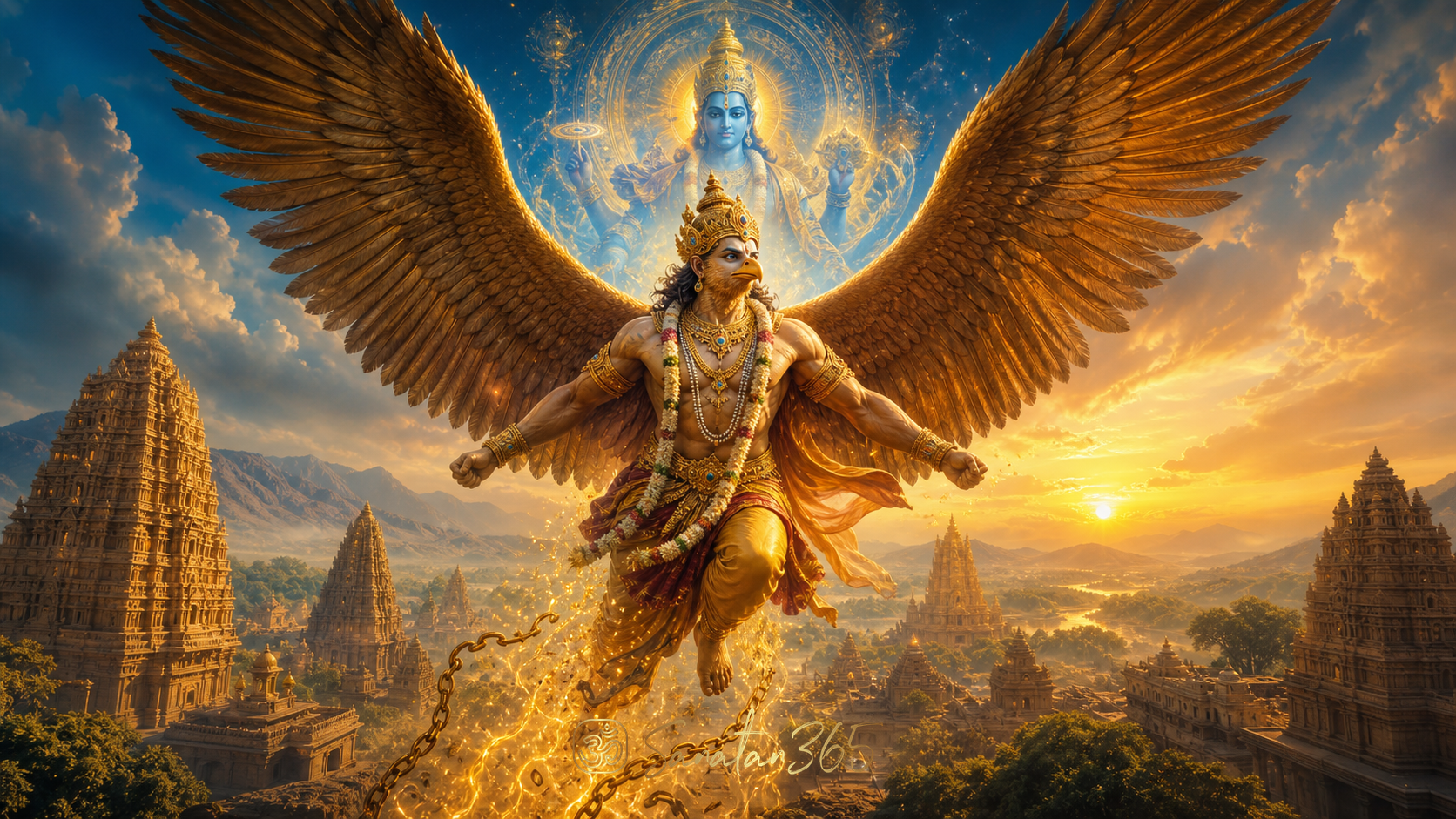
The Garuda meaning in Hindu tradition joins freedom, courage, discernment, and devotion. Garuda (गरुड, Garuḍa, the mighty divine bird) is the king of birds and the vāhana (वाहन, divine vehicle or bearer) of Lord Vishnu. His best-known story tells how he sought amrita, the nectar of immortality, not for selfish gain but to free his mother Vinata from bondage. That strength, later offered in Vishnu's service, makes Garuda far more than a mythic mount.
What Is the Garuda Meaning in Hinduism?
Garuda is a divine being usually represented through a powerful union of human and bird forms. Temple sculpture may show him with wings, a beak-like face, strong limbs, and folded hands. In other images he appears more fully birdlike, carrying Lord Vishnu across the heavens. These forms differ by period, region, and artistic tradition, but they share several ideas:
- speed directed by purpose;
- strength governed by dharma;
- freedom from unjust bondage;
- sharp sight and spiritual discernment;
- readiness to serve the Divine;
- protection of sacred order.
Garuda is often called the king of birds. The Sanskrit name Suparṇa (सुपर्ण, “beautiful-winged” or “having splendid wings”) also appears in sacred literature for a mighty celestial bird. Scholars distinguish early Vedic bird imagery from the fuller Garuda narratives of the epics and Puranas, so the traditions should not be compressed into one simple historical claim.
The Bhagavad Gita gives Garuda a particularly elevated place. In Krishna's account of divine manifestations, he says, “Among birds, I am Garuda” (Bhagavad Gita 10.30). The verse does not mean that every image of Garuda is identical with Krishna. It presents the finest power of flight among birds as a visible sign through which divine excellence can be contemplated. Readers may compare this with the meaning of Vishnu's four symbols, which also shows how sacred forms make qualities such as order, protection, and discernment visible.
Garuda's meaning therefore begins with capacity but does not end there. Flight can express freedom; vision can express knowledge; speed can express readiness; and strength can express protection. Each gift becomes spiritually significant when it serves something greater than pride.
Key takeaway: Garuda represents powerful capacities brought under the guidance of freedom, discernment, devotion, and dharma.
What Is the Garuda Story of Vinata and the Nectar of Immortality?
The Mahabharata's Adi Parva preserves the foundational story of Garuda's birth and his determination to liberate his mother. The account belongs to a complex family narrative involving the sage Kashyapa and his wives Vinata and Kadru.
Vinata and Kadru received different blessings for children. Kadru became the mother of the nagas, while Vinata became the mother of Aruna and Garuda. Through impatience, rivalry, and a wager concerning the colour of the celestial horse Uchchaihshravas, Vinata was deceived and forced into servitude to Kadru and her naga sons. The epic's story contains layers of conflict and should be read as sacred narrative rather than as permission for hostility toward animals, people, or communities.
Garuda could not accept his mother's bondage as permanent. The nagas named a formidable price for her release: he must obtain the gods' amṛta (अमृत, nectar of immortality). Garuda then undertook a dangerous quest, overcoming obstacles through extraordinary force and intelligence.
The motive is crucial. He did not seek immortality for himself. He sought the nectar as the agreed ransom for Vinata's freedom.
That distinction changes the moral centre of the story. Power used only to enlarge the self becomes hunger without limit. Power accepted as responsibility can break a cycle of humiliation. Garuda's love for his mother does not make every action easy or morally uncomplicated, but it gives his strength a direction beyond appetite.
When Garuda finally reached the nectar, his courage impressed Vishnu. Their encounter led to a reciprocal bond. Garuda asked for a place above Vishnu's banner and for immortality without drinking the nectar. Vishnu, in turn, asked Garuda to become his vahana. The mighty bird who had flown for freedom freely chose service.
This sequence matters:
- Garuda recognizes bondage.
- He accepts a demanding responsibility.
- He refuses to make the prize his private possession.
- He earns freedom without consuming what others covet.
- He places his power in divine service.
The episode offers a different picture of heroism from conquest for its own sake. Garuda's victory is measured by what he liberates and what he refuses to exploit.
Key takeaway: The Garuda story presents courage as the disciplined use of strength to free another, not the pursuit of power for personal immortality.
Why Is Garuda Vishnu's Vehicle?
To call Garuda Vishnu's vehicle can sound mechanical in English, as though a vahana were simply transportation. Hindu iconography carries a deeper meaning. A deity's vahana often reveals a relationship between divine purpose and a particular force of nature, mind, or character.
Vishnu is associated with preservation, cosmic order, and timely protection. Garuda brings speed, wide vision, mobility, and fearless energy. Their pairing suggests that protection must be able to reach where it is needed. Order is not passive. It may require swift action guided by clarity.
Garuda is also a devotee. In many Vaishnava temples, his image faces Vishnu's sanctum with hands joined in añjali mudrā (अञ्जलि मुद्रा, the gesture of reverent salutation). The wings remain powerful, yet the posture is humble. This is one of Hindu art's most concise teachings: folded hands do not cancel strength; they direct it.
South Indian temples often give Garuda a prominent place directly before the main Vishnu shrine. Festival processions may feature the deity on Garuda Vahana, a ceremonial mount shaped as Garuda. At Tirumala, Kanchipuram, Srirangam, and many other Vaishnava centres, such processions are major expressions of devotion, though dates and customs follow each temple's calendar.
Garuda's bond with Vishnu also prevents a shallow reading of independence. Freedom in Hindu thought is not always isolation from relationship. Garuda wins release from forced servitude, then chooses sacred service. The difference lies in consent, alignment, and purpose. Bondage denies dignity; devotion offers the self without erasing dignity.
That pattern echoes the larger Hindu understanding of seva (सेवा, selfless service). Seva is not meant to glorify the helper. It turns ability toward the good of another, a community, or the Divine. The meaning of seva in Hindu life offers a practical companion to Garuda's image.
Key takeaway: Garuda becomes Vishnu's vahana because his speed and strength perfectly express protection in motion, while his devotion shows that chosen service is compatible with true freedom.
What Do Garuda's Wings, Serpent Imagery, and Folded Hands Symbolize?
Garuda's iconography gathers several strong visual contrasts. Each should be interpreted with care rather than turned into a rigid formula.
Wings and upward movement
Wings naturally suggest movement beyond limitation. In Garuda's story, flight is not escape from responsibility. It allows responsibility to be fulfilled. Spiritually, the wings can symbolize the ability to rise above narrow vision while remaining committed to action.
Some later interpretations compare Garuda's two wings with knowledge and disciplined action, or with different bodies of sacred teaching. Such readings can be meaningful within their lineages, but they should be presented as devotional interpretation rather than as one universal scriptural definition.
Keen sight
The great bird sees from above. This can symbolize viveka (विवेक, discernment between what is enduring and what is misleading). Height alone does not create wisdom; a detached overview can become cold. Garuda's example joins far-seeing vision with loyalty and action.
Garuda and the nagas
Epic stories often portray conflict between Garuda and the nagas. Art may show Garuda overcoming or holding serpents. The image can represent victory over poison, fear, constriction, or forces that obstruct freedom. Yet Hindu tradition also reveres nagas in their own sacred contexts. Ananta Shesha serves as Vishnu's cosmic couch, and naga worship remains important in many regions.
This is why the symbolism should not be simplified into “birds are good and snakes are evil.” Sacred narratives hold multiple relationships at once. Garuda's conflict arises within a specific family and epic story; it does not erase the dignity of naga traditions.
Folded hands
Perhaps Garuda's most important symbol is also the quietest. When he kneels before Vishnu in anjali mudra, the body capable of crossing worlds becomes still. Reverence does not weaken him. It makes his power trustworthy.
Temple visitors commonly offer respect to Garuda before turning toward Vishnu's sanctum, following local custom. The gesture acknowledges the ideal devotee who remains alert, strong, and entirely oriented toward the Divine.
Key takeaway: Garuda's wings signify purposeful freedom, his sight suggests discernment, his serpent imagery recalls a specific liberation story, and his folded hands reveal power made trustworthy through devotion.
What Can Garuda Teach About Courage and Freedom Today?
Garuda's story can guide modern reflection without reducing a sacred being to a motivational mascot. Five lessons stand out.
1. Name the bondage accurately
Vinata's condition is not overcome through denial. Garuda first understands the obligation placed before him. In daily life, a binding pattern may be debt, dishonesty, resentment, compulsive approval-seeking, or an unjust arrangement. Clear naming is the beginning of responsible freedom.
2. Do not confuse the prize with the purpose
Amrita is immensely desirable, yet Garuda does not drink it. The object of power is not always the goal. A promotion, audience, credential, or financial resource can become a tool rather than an identity.
3. Let strength answer love
Garuda's quest begins in concern for his mother. His force is relational, not merely individual. Courage matures when someone asks, “Who becomes safer, freer, or better served because this ability exists?”
4. Pair speed with discernment
Fast action is useful only when direction is sound. Garuda's sharp sight is as important as his wings. Before acting quickly, a person can check facts, consequences, motives, and whether the action respects another's dignity.
5. Choose service freely
Garuda escapes imposed servitude and then accepts Vishnu's service. This does not romanticize exploitation. It distinguishes coercion from devotion. Healthy service has awareness, consent, purpose, and limits. It does not demand silent acceptance of abuse.
A simple Garuda-inspired reflection can be used without inventing a ritual:
- Sit quietly and bring one current responsibility to mind.
- Ask what genuine freedom would look like for everyone affected.
- Identify the ability available now: courage, speech, money, time, influence, or patience.
- Name one temptation to use that ability for ego alone.
- Choose one action that places the ability in service of dharma.
Those drawn to devotional practice may offer a simple pranam before a traditional Garuda image in a Vishnu temple, recite a familiar Vishnu name or prayer learned from a trusted source, and reflect on humble readiness. Local temple guidance should take precedence over improvised internet rituals.
Key takeaway: Garuda-inspired courage combines honest diagnosis, disciplined strength, freedom from egoic possession, and service chosen with clarity.
Conclusion
Garuda's wings carry one of Hindu tradition's clearest teachings about power. He rises against bondage, seeks the nectar without consuming it, frees his mother, and then places extraordinary ability in Vishnu's service. His freedom does not end in isolation, and his devotion does not erase his strength.
Key takeaway: Garuda teaches that the highest strength is not the power to take everything, but the freedom to serve what is worthy.
FAQ
Who is Garuda in Hinduism?
Garuda is a divine bird-being, the king of birds, and the vahana of Lord Vishnu. The Mahabharata tells of his birth to Vinata, his quest for amrita to free her, and his later bond with Vishnu.
Why is Garuda the vehicle of Vishnu?
Garuda's speed, strength, far-seeing vision, and devotion complement Vishnu's role as preserver and protector. Their pairing symbolizes divine protection that can move swiftly while remaining guided by order and purpose.
What does Garuda symbolize?
Garuda commonly symbolizes freedom, courage, speed, discernment, protection, and strength directed toward service. His folded-hands posture before Vishnu adds humility and devotion to these powerful qualities.
Is Garuda an eagle?
Garuda is often described or depicted through eagle-like or great-bird features, sometimes combined with a human torso and limbs. He is a divine being rather than an ordinary biological eagle, and his artistic form varies across regions.
What is the lesson of Garuda's amrita story?
Garuda obtains the nectar of immortality to secure his mother's freedom but does not drink it for personal gain. The story teaches that courage and capability become noble when they liberate others and resist selfish possession.
About the author
Sanatan365 Editorial
Bringing Sanatan Dharma to modern seekers through authentic, scripture-grounded content.
Related in Deities
 Deities
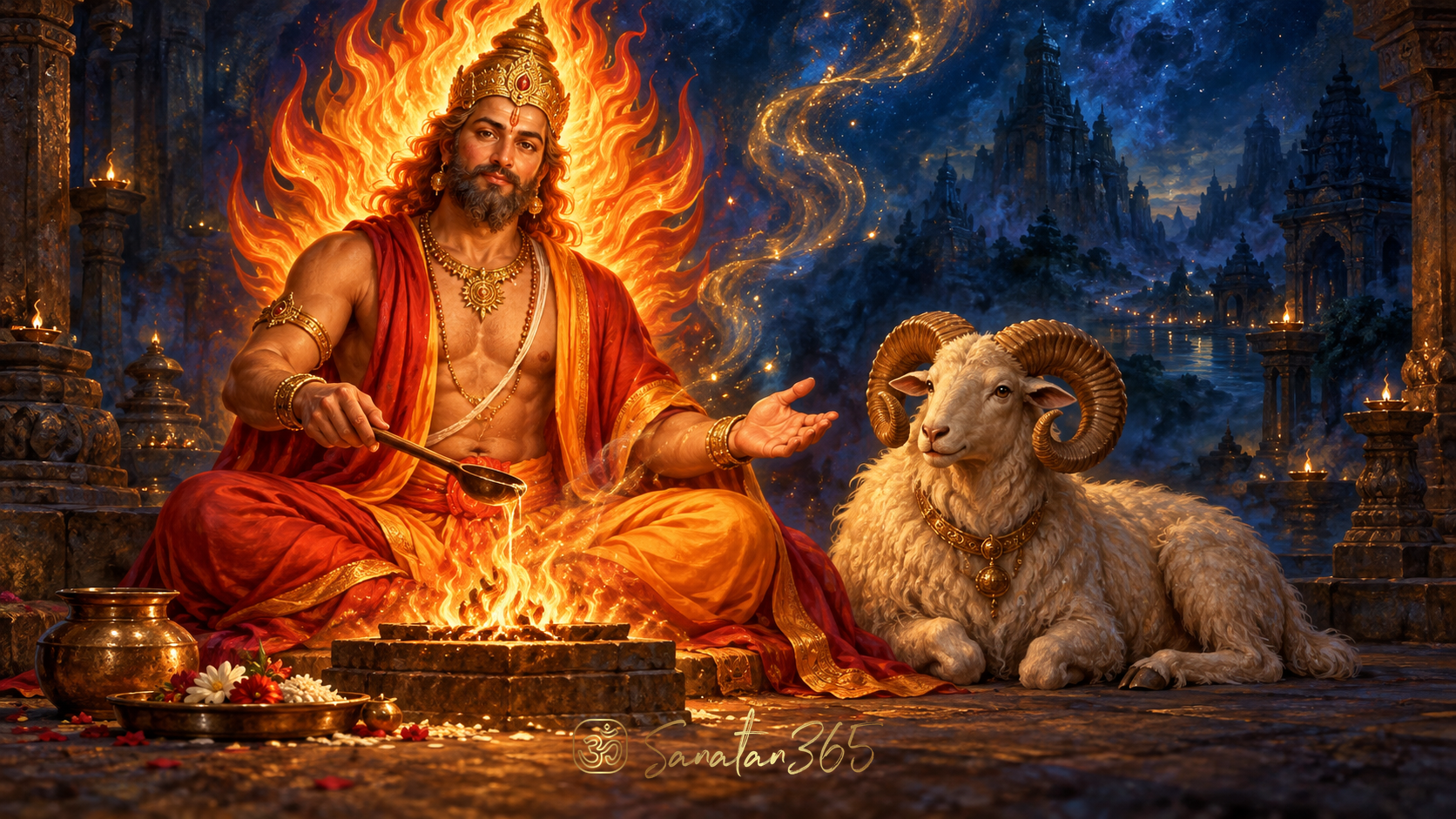
Agni Deva Meaning: Sacred Fire and the Divine Messenger
Meet Agni as the Vedic priest and messenger, read the first Rig Veda hymn, and understand sacred fire without reducing a living deity to a…
 Deities
Brahma Deva Meaning: Four Faces, Creation, and Sacred Knowledge
Understand Brahma, the Hindu creator deity, through his four faces, lotus imagery, sacred knowledge, and a careful distinction from Brahman…
 Deities
Ushas, the Vedic Goddess of Dawn: Light, Renewal, and Time
Ushas, the Vedic goddess of dawn, appears in the Rigveda as radiant light that awakens life, calls beings to activity, and reveals both ren…