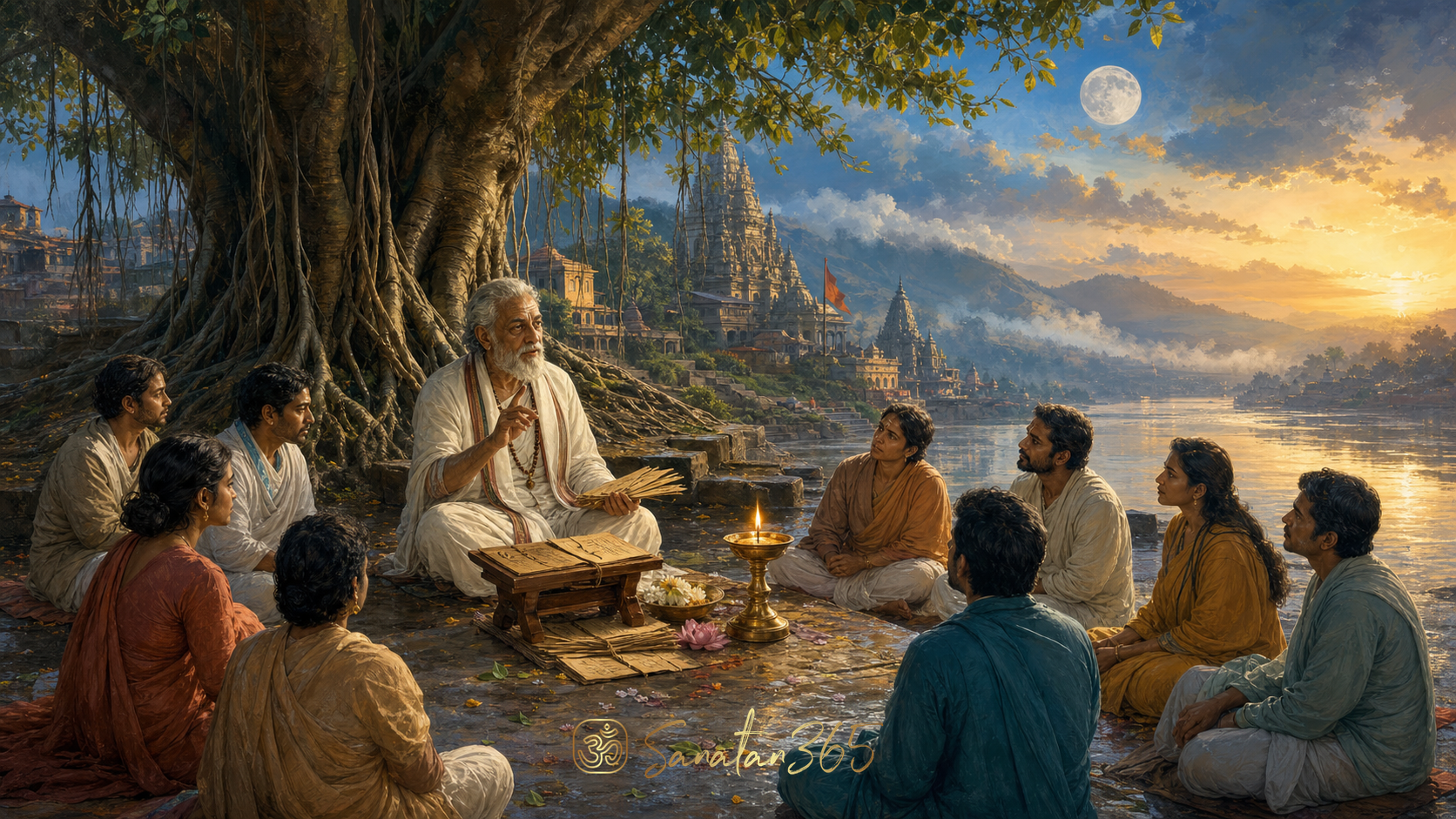
Guru Purnima 2026: Date, Meaning, Vyasa Puja, and Simple Practices
Guru Purnima 2026 falls on Wednesday, July 29. Learn why it is called Vyasa Purnima, how Hindu families honor teachers, and how to observe it with gratitude and discernment.
The brightest full moon of the teacher arrives in the heart of the monsoon, when the land itself seems ready to receive.
Guru Purnima 2026 falls on Wednesday, July 29, 2026. Observed on the full moon, or pūrṇimā (पूर्णिमा, full-moon day), of the Hindu month of Ashadha, it is a day to honor the people and lineages that carry wisdom from one generation to the next. Also called Vyasa Purnima, the festival remembers Veda Vyasa and invites a practical response: gratitude, careful study, service, honest self-examination, and renewed commitment to what a worthy teacher has taught.
When Is Guru Purnima 2026?
Guru Purnima will be observed on Wednesday, July 29, 2026. For New Delhi, the Purnima tithi begins on the evening of July 28 and continues through the evening of July 29, according to the Drik Panchang Guru Purnima calendar. Because a tithi (तिथि, lunar day) is not identical to a midnight-to-midnight civil date, local timings can vary slightly by city.
For a home observance, the simplest reliable approach is to use July 29 and check a trusted local panchang for the exact Purnima window. Families in India and the diaspora may follow their own sampradaya, temple, ashram, or family calendar. Those inherited customs deserve priority over a generic online schedule.
Guru Purnima occurs during the monsoon month of Ashadha. In many traditional settings, this season also marks a turn toward steadier study and reduced travel. The rains create a natural image for learning: the earth softens, seeds receive water, and disciplined attention begins to bear fruit.
Key takeaway: Guru Purnima 2026 is July 29; use a local panchang for city-specific tithi timing and preserve the customs of one's own tradition.
Why Is Guru Purnima Called Vyasa Purnima?
Guru Purnima is widely known as Vyasa Purnima because Hindu tradition associates the day with Krishna Dvaipayana Vyasa, usually called Veda Vyasa. Vyasa is revered as a great compiler, teacher, and transmitter of sacred knowledge. He is traditionally linked with arranging the Vedas, composing the Mahabharata, and shaping the Puranic inheritance. Modern historical scholarship treats the authorship and formation of these large textual traditions with more complexity, so reverence need not become an unsupported chronological claim. The enduring point is that “Vyasa” represents the disciplined work of preserving, organizing, and transmitting wisdom.
The Sanskrit word guru (गुरु) refers to a weighty or venerable teacher, especially one who guides a student in spiritual knowledge. Encyclopaedia Britannica's overview of the guru notes the teacher's central place in the transmission of Hindu spiritual understanding. The relationship is traditionally described as guru-shishya paramparā (गुरु-शिष्य परम्परा, teacher-student lineage): knowledge is not merely downloaded as information; it is received through study, practice, correction, and lived example.
Several scriptural passages illuminate this ideal:
- The Taittiriya Upanishad 1.11 tells the departing student, ācārya devo bhava (आचार्य देवो भव), “regard the teacher as worthy of profound reverence.”
- The Mundaka Upanishad 1.2.12 advises the sincere seeker to approach a teacher who is grounded in scripture and established in Brahman.
- The Bhagavad Gita 4.34 joins three disciplines: respectful approach, sincere questioning, and service.
tad viddhi praṇipātena paripraśnena sevayā “Understand this through humble approach, sincere inquiry, and service.” — Bhagavad Gita 4.34
The verse is sometimes reduced to obedience, but its three-part structure is richer. Praṇipāta brings humility; paripraśna brings intelligent questioning; sevā brings action. A mature teacher-student relationship needs all three.
Key takeaway: Vyasa Purnima honors not only a revered sage but the demanding civilizational work of preserving truth and teaching it responsibly.
What Does Guru Purnima Mean in Daily Life?
The festival asks a direct question: What knowledge has changed the way one lives, and who helped make that change possible? The answer may include a spiritual acharya, a parent, a schoolteacher, a music or Sanskrit teacher, a mentor, or an elder who embodied dharma quietly.
Gratitude on Guru Purnima is not flattery. It has at least four practical dimensions.
Remember the source
Modern life rewards quick summaries and detached quotations. Guru Purnima restores attribution. A teaching has a source, a context, and often a lineage of interpretation. Remembering that lineage protects both humility and accuracy.
Examine what has been practiced
A shelf full of books is not the same as transformed conduct. The day offers a chance to review one teaching honestly. Has it made speech more truthful? Attention steadier? Service less self-centered? The most respectful offering to a teacher is often evidence that the instruction has entered daily life.
Renew disciplined study
The Sanskrit word svādhyāya (स्वाध्याय, self-study or sacred study) appears in Yoga and Vedic traditions as a continuing discipline. One can choose a text, class, mantra, or ethical vow for the coming month and give it a realistic schedule.
Pass learning forward without claiming ownership
Teachers preserve knowledge by sharing it accurately. Students can do the same: cite a source, support a library, help a younger learner, record an elder's oral history, or volunteer in a study community. Transmission becomes an act of seva rather than self-display.
These practices also make Guru Purnima welcoming. A person does not need to have formally accepted a guru to observe the day. Gratitude toward genuine teachers and commitment to truthful learning are meaningful starting points.
Key takeaway: Guru Purnima becomes real when gratitude changes study, conduct, attribution, and service.
How Can You Perform a Simple Guru Purnima Puja?
Home practices differ across regions and lineages. Some devotees perform formal Vyasa Puja in an ashram; others visit a teacher, temple, or family elder. A simple household observance can remain reverent without imitating rituals for which one has not received instruction.
-
Clean and prepare a quiet place. Set a clean cloth near the household shrine or study space. Place a scripture, a photograph of a departed or living teacher if appropriate, or a written list of teachers one wishes to remember. The focal point should be clear and treated respectfully.
-
Light a diya safely. Offer a lamp, flowers, and clean water. These simple offerings represent attention, beauty, and hospitality. If fire is unsafe, a flower and a few minutes of silence are sufficient.
-
Begin with remembrance. Recite a prayer received from one's family or lineage. The familiar Guru Stotram verse beginning “Guru Brahma, Guru Vishnu” may be used with understanding rather than as decoration. Readers seeking its context can explore Guru Brahma Guru Vishnu Mantra Meaning: Honoring the Teacher.
-
Read a short passage. Bhagavad Gita 4.34, Taittiriya Upanishad 1.11, or a passage chosen by one's teacher can anchor the observance. Read slowly and note one instruction that can be practiced.
-
Offer gratitude. Name specific gifts received: patience from a parent, discipline from an acharya, clarity from a professor, courage from a mentor. Specific gratitude is more transformative than grand praise.
-
Make one commitment. Choose a modest sankalpa (संकल्प, sacred intention): twenty minutes of study daily, one weekly act of service, careful citation of sources, or regular contact with an elderly teacher.
-
Give dakshina or seva appropriately. Guru-dakṣiṇā (गुरुदक्षिणा, an offering made in gratitude to a teacher) may take the form customary in one's tradition. It may also be support for a gurukula, educational charity, temple, library, or student who needs books. Never let social pressure determine an unaffordable gift.
-
Share prasad and seek blessings. If food has been offered according to family practice, share it respectfully. Call or visit teachers when welcome, without creating an obligation for them to respond immediately.
Fasting is observed in some communities, but it is not a universal requirement. Children, elders, pregnant people, and anyone with a health condition should not undertake restrictive fasting without appropriate professional guidance. Devotion is not measured by physical strain.
Key takeaway: A meaningful Guru Purnima puja needs sincerity, remembrance, study, and one lived commitment more than elaborate display.
How Do Guru Purnima Traditions Vary Across India and the Diaspora?
There is no single household script for Guru Purnima. In ashrams and Vedanta centers, the day may include Vyasa Puja, paduka puja, scriptural discourse, bhajan, meditation, and community meals. Classical music and dance lineages may honor the guru who transmitted an art. Schools and families may thank academic teachers and elders. In some communities, the day connects with the beginning or renewal of chāturmāsya (चातुर्मास्य, a four-month period of intensified restraint and spiritual practice), though calendrical and lineage details differ.
In Maharashtra, Gujarat, Karnataka, Tamil Nadu, Bengal, Uttar Pradesh, and other regions, the language and sequence of offerings naturally vary. A family might recite an abhang, sing a bhajan, read from the Ramcharitmanas, study the Gita, or sit in silent meditation. None of these expressions needs to be treated as the only authentic form.
Diaspora observances often take place on the nearest community gathering while the personal vrata or prayer remains on the lunar date. Online satsang can connect students across distance, but the medium should support attention rather than turn a sacred occasion into constant recording and posting.
The most reliable rule is simple: follow one's established sampradaya and local temple guidance where available. When no inherited form exists, choose a modest practice rooted in gratitude, study, and service.
Key takeaway: Regional variety is a strength; the shared center is reverence for truthful teaching and responsibility toward what has been received.
How Should a Seeker Choose and Honor a Teacher Wisely?
Guru Purnima celebrates the sacred potential of teaching, but reverence must include viveka (विवेक, discernment). Hindu texts praise a teacher who is both learned and grounded in realization. A title, large following, dramatic promise, or digital presence is not proof of wisdom.
A careful seeker can look for signs such as:
- teachings that are consistent with dharma and open to responsible examination;
- conduct that does not exploit fear, money, intimacy, or dependency;
- respect for the student's family responsibilities, health, and agency;
- willingness to distinguish spiritual counsel from medical, legal, and financial expertise;
- humility about the limits of personal knowledge;
- a community in which questions can be asked without humiliation.
Honoring a teacher does not require surrendering ethical judgment. If a relationship becomes coercive, unsafe, or exploitative, seeking help from trusted people and qualified authorities is appropriate. Sacred language should never be used to conceal harm.
The same discernment matters online. A quotation card, chatbot, podcast, or search result may support study, but it does not automatically carry the context, accountability, or lived relationship of a qualified teacher. Digital tools are best treated as aids to reflection and access, not as infallible spiritual authorities.
This balanced view protects the dignity of genuine gurus. Trust grows when it is joined with truthfulness, ethical conduct, and freedom from manipulation.
Key takeaway: Reverence and discernment are partners; ethical clarity safeguards both the seeker and the sacred teacher-student tradition.
A Seven-Day Guru Purnima Practice for 2026
Those preparing for July 29 can use a simple seven-day sequence:
- Day one — remember: Write the names of seven people who taught something life-giving.
- Day two — read: Study one short passage from a trusted scripture or commentary.
- Day three — practice: Apply one instruction during work, family life, or prayer.
- Day four — thank: Send a private, specific message of gratitude to a teacher or elder.
- Day five — serve: Help a learner, support a study space, or give time to a community need.
- Day six — review: Notice where knowledge has remained intellectual rather than lived.
- Day seven — renew: On Guru Purnima, make one sustainable commitment for the next lunar month.
The sequence is intentionally quiet. Public praise can be beautiful, but private practice often reveals whether gratitude is genuine.
Key takeaway: Preparation turns Guru Purnima from a single ceremonial day into a cycle of remembrance, practice, and renewal.
Conclusion
Guru Purnima 2026 arrives on July 29 as both celebration and audit. It honors Veda Vyasa, living teachers, parents, mentors, and the lineages that keep wisdom available. Yet its deepest offering is not a flower or a post. It is the student's willingness to listen carefully, question sincerely, practice steadily, serve humbly, and transmit truth without distortion.
Key takeaway: The finest Guru Purnima offering is a teaching faithfully lived.
FAQ
What is the date of Guru Purnima in 2026?
Guru Purnima 2026 falls on Wednesday, July 29. The Purnima tithi begins on July 28 and ends on July 29, with exact times varying by location; check a trusted local panchang.
Why is Guru Purnima also called Vyasa Purnima?
The day honors Veda Vyasa, revered in Hindu tradition for preserving, organizing, and transmitting sacred knowledge. It therefore celebrates both Vyasa and the wider teacher-student lineage.
Can someone celebrate Guru Purnima without having a formal guru?
Yes. One may honor parents, schoolteachers, mentors, elders, and the scriptural traditions that have offered genuine guidance. Gratitude, study, service, and ethical commitment are meaningful observances.
Is fasting compulsory on Guru Purnima?
No universal rule makes fasting compulsory for everyone. Practices differ by family and lineage. Anyone for whom fasting may be unsafe should choose prayer, study, charity, or another suitable observance and seek professional guidance where needed.
What is a simple offering for Guru Purnima?
A diya or flower, a short scriptural reading, a specific expression of gratitude, and one realistic commitment to live a teaching can form a complete and sincere home observance.
About the author
Sanatan365 Editorial
Bringing Sanatan Dharma to modern seekers through authentic, scripture-grounded content.
Related in Festivals
 Festivals
Parivartini Ekadashi 2026: Date, Meaning, and Gentle Vrat Guide
Parivartini Ekadashi 2026 falls on September 22. Learn why it is called Parsva or Vamana Ekadashi, how it relates to Chaturmas, and how to…
 Festivals
Hartalika Teej 2026: Date, Meaning, Puja, and Parvati's Resolve
Hartalika Teej 2026 is observed on September 14 in honour of Goddess Parvati and Lord Shiva. Learn the festival's story, vrat meaning, regi…
 Festivals
Radha Ashtami 2026: Date, Meaning, and Devotion at Home
Radha Ashtami falls on 19 September 2026 in India. Explore its meaning, Braj traditions, local timing guidance, and a thoughtful home obser…

